
Written by The PawCalmHub Team. Reviewed for alignment with current veterinary behavioral guidelines and the American Kennel Club (AKC). Last updated 2025.
⚠️ This article provides general wellness information. For dogs with severe separation anxiety involving self-injury, please consult a licensed veterinarian or certified veterinary behaviorist.
You grab your keys. Your dog’s ears go up.
You put on your shoes. They start to pace.
You open the front door — and the whining begins, building into desperate barking that you can hear all the way down the hallway as you leave.
You spend your whole workday feeling guilty, wondering what’s happening at home. You come back to chewed furniture, scratched doors, neighbors who are barely still speaking to you, and a dog who greets you with the frantic energy of someone who genuinely believed you were never coming back.
This is dog separation anxiety — and it affects an estimated 14–17% of pet dogs in the United States, with rates rising sharply in the post-pandemic years as dogs adopted during lockdowns adjusted to owners returning to offices. You are far from alone in this. And there is a genuinely effective path forward.
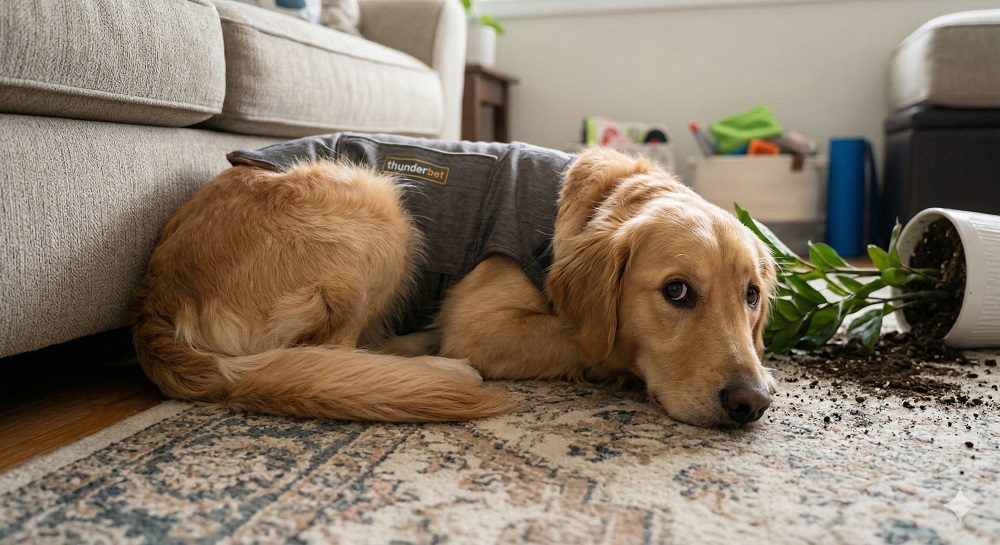
What Is Separation Anxiety — Really?
Separation anxiety is not your dog being dramatic or misbehaving to punish you for leaving. It is a genuine anxiety disorder characterized by extreme distress specifically triggered by separation from their primary attachment figure — which is almost always you.
From a neurological perspective, a dog with separation anxiety experiences the same physiological stress response as a human having a panic attack. Cortisol spikes. Heart rate and breathing accelerate. The prefrontal cortex — responsible for rational behavior — is essentially overridden by the amygdala’s alarm system. Your dog is not choosing to destroy the couch. They are in genuine crisis.
The American Kennel Club defines separation anxiety as a dog that is hyper-attached to their owner and becomes extremely stressed when left alone, noting that it is one of the top reasons pet parents seek professional behavioral help. Their complete guide is available at AKC.org — Dog Separation Anxiety.
Signs Your Dog Has Separation Anxiety
Not all anxious behavior when alone is true separation anxiety. Many pet parents misidentify boredom-driven behavior as anxiety — and the solutions are quite different.
True Separation Anxiety: What It Looks Like
- Distress begins within minutes of your departure — not hours later
- Behaviors are almost exclusively triggered by your absence, not other factors
- Dog shows pre-departure anxiety — watching your routine cues (keys, shoes, bag) with growing distress before you even leave
- Behaviors stop when you return, regardless of how long you were gone
- Destruction and vocalization are focused near exit points (doors, windows) rather than random
- Dog may refuse to eat, drink, or settle at all while you are gone
- In severe cases: excessive drooling, self-injury from escape attempts, loss of bladder or bowel control
Separation Anxiety vs. Boredom: The Key Differences
This distinction matters because the solutions are fundamentally different. A bored dog needs more enrichment. An anxious dog needs behavioral modification.
| Separation Anxiety | Boredom / Under-stimulation | |
|---|---|---|
| When it starts | Within 5–15 minutes of departure | After 1–2+ hours of alone time |
| What is destroyed | Door frames, windows, escape routes | Random household items, toys |
| Vocalization | Starts immediately at departure | May occur but not immediately |
| Stops when you return | Yes — immediately | May continue regardless |
| Pre-departure distress | Yes — watches your cues | No |
| Eats/plays when alone | Rarely or never | Often yes |
| Solution | Behavioral modification + support | Exercise, enrichment, stimulation |
💡 Pro tip: A pet camera is the single most useful diagnostic tool for distinguishing separation anxiety from boredom. Watch the footage from the first 30 minutes after you leave — what you see will tell you everything about which problem you are actually dealing with. Our Pet Camera with Two-Way Audio makes this easy and also allows you to check in calmly once your dog has settled.
11 Proven Strategies to Help Your Dog Stay Calm Home Alone
1. Desensitize Your Departure Cues
Most dogs with separation anxiety begin showing stress long before you leave — the moment you put on shoes or pick up your keys. These “pre-departure cues” become conditioned predictors of distress.
Break that association by performing your departure routine multiple times a day without actually leaving. Put on your shoes, sit down and watch TV. Pick up your keys, make coffee, put them down. Open and close the front door. Repeat until your dog no longer reacts to these cues.
2. Practice Very Short Departures First
The core behavioral treatment for separation anxiety is systematic desensitization — graduated exposure to the feared situation, starting below the threshold that triggers panic.
For most dogs with separation anxiety, the threshold is shockingly low — sometimes seconds. Start by stepping outside for five seconds, coming back calmly before your dog reacts. Build to ten seconds. Then thirty. Then two minutes. Never push beyond your dog’s current comfort level in a single session.
Done consistently, most dogs show meaningful improvement within 4–8 weeks.
3. Give a High-Value Enrichment Toy at Departure
A snuffle mat stuffed with high-value treats, or a rubber toy packed with frozen peanut butter given exclusively at departure time serves two purposes: it creates a positive association with your leaving, and it occupies the critical first 10–15 minutes — the window when most dogs’ anxiety peaks after the door closes.
Give this toy only when you leave. Its power comes from its exclusivity. If your dog has access to it all day, it loses its effectiveness.
The most effective tool for this is a properly fitted compression vest. View Product →
4. Establish a Calm Departure Routine
Long, emotional goodbyes amplify departure anxiety. Leave matter-of-factly. A brief, calm touch, a quiet word, and out the door. No apologies, no lengthy goodbyes, no looking back. Your calm confidence communicates that leaving is a completely normal event — and gradually, your dog begins to believe it.
5. Use Calming Supplements Strategically
For separation anxiety specifically, daily supplementation produces better results than situational dosing, because the anxiety is a daily occurrence. Natural calming supplements containing hemp extract, L-theanine, and melatonin given with the morning meal — 30–60 minutes before a typical departure — can measurably reduce distress levels throughout the workday.
Think of supplements as lowering the baseline level of anxiety your dog starts the day with, so that your departure hits a less activated nervous system.
6. Try a Pet Camera With Two-Way Audio
Used correctly, a pet camera with two-way audio can be a therapeutic tool. Brief check-in calls timed to when your dog begins to settle — not when they are panicking — can maintain the sense of your presence and interrupt escalating distress cycles.
The key: do not call in when your dog is already in full anxiety mode. Your voice at that moment can paradoxically make things worse by confirming that your absence is something to be distressed about. Use the camera to observe patterns, then call in during quiet moments to reinforce calm.
7. Exercise Before You Leave
A physically and mentally tired dog is a calmer dog. A 30–45 minute walk or active play session before your departure meaningfully reduces baseline arousal levels. A five-minute sniff walk — letting your dog dictate the pace — is neurologically more tiring than a brisk 20-minute walk at your pace.
8. Create a Consistent Daily Routine
Dogs thrive on predictability. Inconsistent schedules actively worsen anxiety by keeping the nervous system in a constant state of uncertainty. A consistent daily routine is one of the most underrated anxiety treatments available.
Same wake time. Same feeding time. Same departure time when possible. The more predictable your day is from your dog’s perspective, the less their nervous system has to work to manage uncertainty.
9. Consider Doggy Daycare or a Dog Walker
For dogs with severe separation anxiety, removing the separation itself — at least partially — is sometimes the most pragmatic bridging strategy while you work on long-term behavioral treatment. A midday dog walker visit meaningfully reduces total alone time while simultaneously providing social stimulation.
10. Use a White Noise Machine
External sounds — neighbors, street noise, other dogs — can trigger and amplify anxiety in dogs home alone. A white noise machine near your dog’s resting space creates an acoustic buffer that muffles unpredictable external sounds, reducing reactive barking and keeping the environment calmer between peak anxiety moments.
11. Work With a Veterinary Behaviorist for Severe Cases
True separation anxiety is a medical condition. Veterinary-prescribed medications like fluoxetine, clomipramine, or situational medications like Sileo can be genuinely life-changing for dogs with severe cases, and they work far better when combined with behavioral strategies.
The AKC specifically recommends against punishment as a response to separation anxiety behavior, noting that a dog who has acted out during a panic episode cannot connect a delayed consequence with their earlier behavior — making punishment not just ineffective, but actively harmful to the trust relationship. Full guidance at AKC.org.
Your Daily Separation Anxiety Routine — A Printable Framework
Save or screenshot this routine. Consistency is everything with separation anxiety.
╔══════════════════════════════════════════════════════════════╗
║         PAWCALMHUB — DAILY CALM ROUTINE FOR ANXIOUS DOGS     ║
╠══════════════════════════════════════════════════════════════╣
║                                                              ║
║  ⏰ 60 MINUTES BEFORE LEAVING                                ║
║     → Give calming chew with breakfast                       ║
║     → Practice 1–2 short mock departures (keys, no leaving)  ║
║                                                              ║
║  ⏰ 30 MINUTES BEFORE LEAVING                                ║
║     → 20-minute sniff walk or active play session            ║
║     → Set up safe den space with worn clothing               ║
║                                                              ║
║  ⏰ AT DEPARTURE                                              ║
║     → Hand over exclusive departure toy (snuffle mat / Kong) ║
║     → Calm, brief goodbye — no apologies, no looking back    ║
║     → Leave within 60 seconds of giving toy                  ║
║                                                              ║
║  📱 WHILE AWAY                                               ║
║     → Check pet camera — watch, don't immediately call in    ║
║     → Call in ONLY during a calm moment to reinforce it      ║
║     → Midday dog walker if dog is in distress past 3 hours   ║
║                                                              ║
║  🏠 WHEN YOU RETURN                                          ║
║     → Calm, low-key greeting — wait until dog settles        ║
║     → Brief praise for calm behavior                         ║
║     → Evening enrichment session (snuffle mat, puzzle feeder)║
║     → Consistent bedtime routine                             ║
║                                                              ║
║  📅 WEEKLY GOALS                                             ║
║     → Extend departure duration by 20–30% each week         ║
║     → Track progress in a simple notebook or app            ║
║     → Celebrate small wins — every calm departure counts     ║
╚══════════════════════════════════════════════════════════════╝

       PawCalmHub.com · hello@pawcalmhub.com
A Note on What Doesn’t Work
Research consistently shows that punishment does not treat separation anxiety — it makes it worse. A dog who has already destroyed something in a panic does not connect your anger upon return with the behavior that happened hours earlier. They only learn that your homecoming is unpredictable and frightening — which raises their overall anxiety level and worsens the next episode.
Similarly, getting a second dog as a companion for an anxious dog often fails — because true separation anxiety is about attachment to you specifically, not about being alone.
Frequently Asked Questions
Q: How do I know if my dog has separation anxiety or just boredom? A: The clearest distinction is timing and focus. Separation anxiety begins within minutes of your departure and centers on exit points. Boredom behavior starts later, is more random, and often involves destruction of accessible household items. A pet camera is the most reliable diagnostic tool — watch the first 30 minutes after you leave.
Q: Can separation anxiety in dogs be cured completely? A: Many dogs with mild to moderate separation anxiety show complete resolution with consistent behavioral treatment over 4 to 12 weeks. Severe cases may require ongoing management. Meaningful improvement is achievable for almost every dog with the right combination of behavioral, enrichment, and supplement support.
Q: Does getting a second dog help with separation anxiety? A: Rarely. True separation anxiety is about attachment to you specifically — not about being alone. A second dog may provide mild comfort for some dogs, but it does not address the neurological root of the anxiety.
Q: How do I stop my dog from barking when I leave? A: The most effective approach combines desensitizing departure cues, giving an exclusive high-value enrichment toy at the moment of departure, and daily calming supplements to lower baseline anxiety. A pet camera helps you identify exactly when barking starts and stops — data that shapes your treatment approach precisely.
Q: Can separation anxiety in dogs get worse with age? A: Yes, untreated separation anxiety tends to worsen over time as the anxiety response becomes more deeply conditioned. Dogs who receive consistent behavioral treatment and enrichment support typically improve progressively. Starting treatment early produces better outcomes.
Q: How long does it take to treat separation anxiety in dogs? A: Most dogs with mild-to-moderate separation anxiety show meaningful improvement within 4–8 weeks of consistent systematic desensitization combined with daily calming supplements. Severe cases may take 3–6 months of consistent treatment and may require veterinary behavioral support alongside home strategies. There are no shortcuts — but there is a reliable path.
Q: Should I crate my dog for separation anxiety? A: It depends entirely on your individual dog. Some dogs find crates deeply calming and den-like — a crate reduces the “search area” of their anxiety and provides a sense of enclosure and safety. Other dogs with separation anxiety find crating escalates their distress significantly, and may injure themselves attempting to escape. Introduce a crate very gradually and with positive associations before relying on it for alone time. Never force a dog into a crate as an anxiety management strategy without prior positive crate training.
The Path Forward
Separation anxiety is one of the most frustrating challenges in dog ownership because progress is slow, setbacks happen, and the problem affects your daily life in real, tangible ways. But it is genuinely, meaningfully treatable — with patience, consistency, and the right tools.
At PawCalmHub, everything we offer — from our snuffle mats and calming chews to our pet cameras and enrichment toys — was selected specifically because it addresses a real mechanism of dog anxiety.
Need personalized advice for your dog’s specific situation? Email us at hello@pawcalmhub.com. We love hearing from pet parents navigating this — and we’ll always write back.
About the Author
The PawCalmHub Team
At PawCalmHub, we are a passionate team of pet lovers dedicated to helping anxious pets live calmer, happier lives. Every article we publish is thoroughly researched against current veterinary behavioral guidelines and reviewed for alignment with trusted sources including the American Kennel Club. We believe understanding your pet’s anxiety is the first step to helping them through it.
Questions or topic suggestions? Reach us at hello@pawcalmhub.com.
Explore our full range of vet-aligned calming and wellness products at PawCalmHub.com