
📊 Evidence-Based Content Rating
⭐⭐⭐ Clinical evidence: Peer-reviewed veterinary studies
⭐⭐ Moderate evidence: Some studies + strong professional consensus
⭐ Emerging evidence: Theoretical or early-stage research
This article uses this rating system throughout for full transparency.
Reviewed for alignment with AKC and Fear Free veterinary guidelines.
Written by The PawCalmHub Team. Reviewed for alignment with current veterinary behavioral guidelines and the American Kennel Club (AKC). Last updated 2025.
⚠️ Sudden onset nighttime anxiety in a previously calm dog can indicate an underlying medical condition. Always consult your veterinarian if the behavior appears suddenly without an obvious trigger.
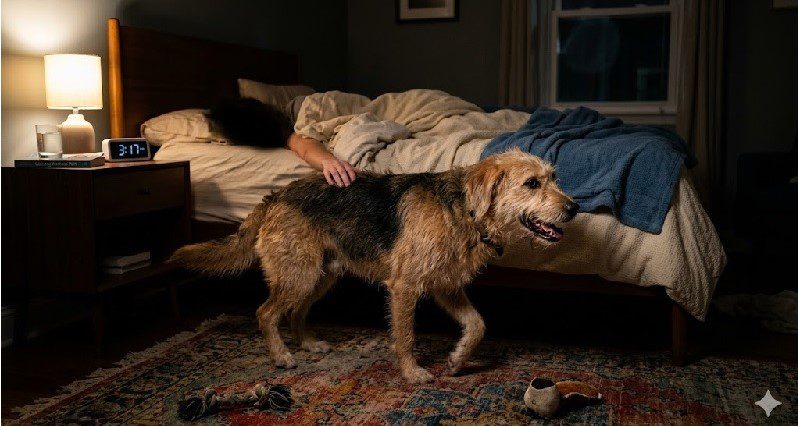
It is 2am. The house is silent. Your dog is pacing.
Not the gentle kind of pacing — the kind with an edge to it. Back and forth across the bedroom floor. Pause. A whine. More pacing. A long exhale followed by the rustle of them circling, lying down, immediately getting back up.
You lie there watching, exhausted, trying to figure out what is wrong. They ate dinner. They had their walk. Nothing happened. But something is clearly happening for them right now, in the dark, that you cannot see.
Nighttime anxiety in dogs is one of the most disruptive and least discussed forms of canine anxiety — in part because it affects owners so directly and in part because the triggers are often harder to identify than daytime anxiety. This article breaks down the nine most common causes and exactly what to do about each one.
Why Nighttime Specifically?
The first question worth answering is: why does the anxiety surface at night when the day seemed fine?
Several factors make the nighttime environment uniquely challenging for anxious dogs:
Reduced sensory stimulation. Dogs regulate a significant portion of their anxiety through physical activity, scent work, and social engagement throughout the day. When these inputs drop away at night, some dogs experience what behaviorists describe as “sensory withdrawal” — a kind of neurological restlessness that manifests as anxiety.
Amplified sounds. The quiet of night makes sounds that were masked by daytime noise suddenly prominent and unidentifiable. A car alarm three streets away. The heating system clicking on. A neighbor’s door. For noise-sensitive dogs, the night soundscape can be actively anxiety-provoking.
Separation from you. Even dogs who are fine during daytime departures can experience proximity anxiety at night — particularly if they normally sleep near you and something disrupts that arrangement.
Cognitive changes in older dogs. This is a significant and frequently missed cause covered in detail below.
The 9 Causes of Nighttime Anxiety in Dogs
1. Canine Cognitive Dysfunction (Sundowner Syndrome)
The most important cause to understand — and the one most commonly missed in older dogs.
Canine Cognitive Dysfunction (CCD) is a neurological condition affecting dogs over 9 years old that closely parallels Alzheimer’s disease in humans. One of its most characteristic symptoms is nighttime restlessness, disorientation, and vocalization — sometimes called “sundowner syndrome” because it worsens in the evening and at night.
Signs that nighttime anxiety may be CCD-related: your dog wanders and appears confused rather than alert, stares at walls, gets “stuck” in corners, or vocalizes without apparent reason. They may sleep during the day and be awake at night (sleep-wake cycle reversal). This is a medical issue requiring veterinary assessment and is not behaviorally fixable alone.
2. Pain or Physical Discomfort
Dogs in pain often mask their discomfort during the day when they are distracted by activity and social engagement. At night, with no distraction available, the discomfort becomes overwhelming. Arthritis, dental pain, digestive discomfort, urinary tract issues, and undiagnosed injuries are all common causes of nighttime restlessness that are frequently misidentified as behavioral anxiety.
Key indicator: your dog seeks unusual sleeping positions, is reluctant to lie down on one side, or gets up and lies down repeatedly. This pattern strongly suggests physical discomfort and warrants a veterinary visit.
3. Noise Sensitivity
Many dogs who appear to handle daytime sounds normally are actually operating at a manageable stress threshold during the day — and nighttime sounds push them over it. Low-frequency sounds like distant traffic, bass from music, HVAC systems, and even low-frequency humming from electronics are more noticeable at night and can trigger sustained anxiety responses in sensitive dogs.
Solution: a white noise machine placed between your dog and the direction of the sound source meaningfully reduces nighttime sound-triggered anxiety. Brown noise (lower frequency than white noise) is often more effective for dogs than standard white noise.
White Noise vs Brown Noise for Dogs — What Is the Difference and Which Works Better
This is one of the most searched but least answered questions in the dog anxiety noise-management space.
White noise contains equal energy across all audible frequencies — it sounds like static, a detuned radio, or a rushing shower. It is effective at masking sudden high-frequency sounds (barking, voices, door slams) because those frequencies are already present in the white noise signal.
Brown noise (also called red noise) emphasizes lower frequencies — it sounds deeper, more like rumbling, rushing water, or distant thunder. The bass-heavy quality is believed to be more soothing neurologically because it more closely resembles natural low-frequency ambient sounds that the canine nervous system evolved alongside.
For dogs specifically: Brown noise appears to be more effective than white noise for two reasons. First, it better masks the low-frequency sounds (distant traffic, HVAC systems, footsteps in hallways) that are more likely to trigger reactive barking in noise-sensitive dogs. Second, the deeper, more consistent tone is less stimulating than the broader-spectrum signal of white noise.
Practical guidance:
- For a dog whose nighttime anxiety is primarily triggered by sudden sounds (barking outside, late-night voices): white noise is effective
- For a dog whose nighttime anxiety is more generalised restlessness without specific triggers: brown noise is worth trialling
- For dogs with noise phobia (storms, fireworks sensitivity): brown noise is the stronger choice
Volume: Set at approximately 50–60 decibels — audible but not overwhelming. Position the speaker or machine between your dog’s sleeping area and the wall facing the street or primary sound source.
Free access: Brown noise tracks are available free on YouTube (search “brown noise 8 hours”), Spotify, and Apple Music. Purpose-built white/brown noise machines (like LectroFan or Marpac Dohm) give more consistent output than phone speakers.
4. Separation or Proximity Anxiety
If your dog sleeps in a different room from you, or if you have recently changed where they sleep, nighttime separation anxiety can emerge even in dogs who handle daytime departures well. Nighttime proximity anxiety is specifically about the dark, the quiet, and the absence of your physical presence — a distinct form from daytime separation anxiety.
Gradual proximity desensitization — systematically moving your dog’s sleeping space closer to yours over several weeks, or allowing them to sleep in your room — is more effective than behavioral intervention for this specific anxiety type.
5. Insufficient Daytime Exercise and Mental Stimulation
A dog who has not had adequate physical exercise or mental enrichment during the day carries unspent arousal energy into the night. This manifests as restlessness, inability to settle, and low-grade anxiety that keeps them alert when they should be sleeping.
The solution is not always more physical exercise — mental enrichment is equally important. A snuffle mat session in the late afternoon, a puzzle feeder at dinner, and a short post-dinner scent walk provide the cognitive depletion that allows genuine rest.
6. Environmental Changes
Dogs track routine at a granular level. A change in your schedule, a new piece of furniture, a different scent in the home, a visitor who stayed, a change in the household’s bedtime routine — all of these can trigger ambient anxiety that surfaces most strongly at night when there is nothing to distract from it.
If the nighttime anxiety began around the same time as any household change, that correlation is almost certainly causal.
7. Thunderstorm or Weather Sensitivity
As covered extensively in our thunderstorm anxiety guide, many dogs are sensitive to barometric pressure changes that occur well before and after a storm is audible to humans. Nighttime anxiety that correlates with stormy weather — even when no thunder is audible in your home — may be weather-driven.
Track whether the nighttime anxiety correlates with weather events. If it does, the management strategies for storm anxiety (compression vest, calming supplements, white noise) apply directly.
8. REM Sleep Behavior
Some dogs exhibit what appears to be nighttime anxiety but is actually REM sleep behavior disorder — intense physical movement, vocalization, and apparent distress during sleep that resolves immediately on waking. If your dog appears anxious during sleep but is immediately calm and oriented when you gently wake them, this is almost certainly sleep behavior rather than true anxiety.
This is generally benign unless the movements are violent enough to risk injury. Mention it to your veterinarian.
9. Underlying Anxiety Disorder Not Adequately Managed
For dogs with diagnosed anxiety disorders — separation anxiety, generalized anxiety, noise phobia — nighttime can be when the cumulative daily anxiety burden surfaces most intensely. A dog managing anxiety during the day through activity and engagement may be genuinely struggling once those props are removed.
This is the situation where daily calming supplements — given consistently with the evening meal rather than just during acute events — make the most significant difference. Melatonin specifically has strong evidence for improving sleep quality and reducing nighttime restlessness in anxious dogs.
Subscribe & save 15% · Free US shipping
Building a Nighttime Calm Routine
The most effective approach combines multiple strategies deployed consistently:
5pm — Evening enrichment: Snuffle mat session or puzzle feeder with dinner. This depletes mental energy and provides the dopamine release that supports subsequent calm.
7pm — Final exercise: A 20-30 minute walk including at least 10 minutes of free sniffing. This should complete at least 2 hours before sleep to allow arousal levels to normalize.
8pm — Calming supplement: Hemp calming chews or a melatonin supplement given with a small evening treat. Allow 60 minutes to reach full effect before sleep.
9-10pm — Wind-down: Low activity, quiet environment, dim lighting. Dogs read your cues — a calm wind-down routine from you signals to them that nighttime is safe and settled.
Bedtime — Sleep environment: White or brown noise machine running. A worn piece of your clothing near their sleeping space. Temperature comfortable — anxious dogs often benefit from a slightly cooler sleeping environment.
Sleep Training for Adult Dogs — Managing Bed-Sharing and Nighttime Independence
For many anxious dogs the nighttime anxiety is inseparable from questions about where they sleep and how much access they have to you. Here is the honest guidance:
The bed-sharing debate — settled: Modern veterinary behavioral science does not support the idea that allowing a dog to sleep in your bed causes behavioral problems or worsens anxiety. For dogs with proximity-based nighttime anxiety, sleeping near you often dramatically reduces distress. The decision is yours to make based on preference — not behavioral science.
When bed-sharing is contraindicated: If your dog shows any resource guarding around the sleeping space (growling when you move, blocking access). If your dog’s movement disrupts your sleep significantly enough to affect your health. If you are introducing a new partner to a dog who has historically shared your bed.
Transitioning a dog off the bed without drama: If you need to move your dog to floor sleeping, do it gradually rather than suddenly. Week 1: dog sleeps on bed as usual. Week 2: dog bed placed beside your bed — dog can still see and smell you. Week 3: dog bed moved slightly further. Week 4: final position. The gradual transition maintains the sense of your presence throughout rather than creating an abrupt spatial separation.
For dogs who wake at night: A consistent “go to your place” command trained during the day (send dog to their bed, reward in place, release) gives you a tool for redirecting nighttime waking without creating a confrontation. A dog who knows a confident “go to bed” cue from a calm owner processes it very differently from a dog dragged back to their bed by an exasperated owner at 3am
When to See a Veterinarian
See your veterinarian promptly if:
- Nighttime anxiety began suddenly in a previously calm dog
- Your dog is over 8 years old and showing confusion or disorientation alongside restlessness
- The anxiety is severe enough to prevent sleep entirely
- You suspect physical discomfort is a factor
The AKC recommends that sudden behavioral changes in adult dogs — particularly nighttime restlessness — always be evaluated for underlying medical causes before assuming a behavioral diagnosis. Their guide to dog sleep health is available at AKC.org.
Frequently Asked Questions
Q: Why does my dog suddenly get anxious at night? A: Sudden onset nighttime anxiety in an adult dog most commonly indicates either a medical issue (pain, cognitive dysfunction, urinary discomfort) or an environmental change. Always rule out medical causes with a vet visit before pursuing behavioral solutions.
Q: Is it normal for dogs to be restless at night? A: Occasional nighttime restlessness during weather events or changes in routine is normal. Consistent, nightly restlessness that disrupts sleep is not and warrants investigation.
Q: Can melatonin help a dog sleep at night? A: Yes — melatonin is one of the most well-supported natural interventions for nighttime restlessness and sleep disruption in dogs. Dose 1–3mg for small dogs, 3–6mg for medium-large dogs, given 60 minutes before bedtime. Always use dog-specific formulations — some human melatonin contains xylitol, which is toxic to dogs.
Q: Why does my old dog pace at night? A: Nighttime pacing in senior dogs is a classic sign of Canine Cognitive Dysfunction (CCD) and warrants a veterinary assessment. It can also indicate pain from arthritis or other age-related conditions. Do not assume it is purely behavioral in a dog over 9 years old.
Q: Should I let my dog sleep in my bedroom if they have nighttime anxiety? A: For proximity-related nighttime anxiety, yes — allowing your dog to sleep in your room meaningfully reduces nighttime distress for most dogs. There is no behavioral evidence that this worsens separation anxiety or creates dependency problems in dogs who are otherwise well-adjusted.
At PawCalmHub, our Hemp Calming Chews are specifically formulated for daily use — including evening dosing for nighttime anxiety management. Our Dog Snuffle Mat is one of the most effective pre-bedtime enrichment tools available. Both are backed by our 30-day satisfaction guarantee and ship free from US warehouses.
About the Author
The PawCalmHub Team
At PawCalmHub, we are a passionate team of pet lovers dedicated to helping anxious pets live calmer, happier lives. Every article we publish is thoroughly researched against current veterinary behavioral guidelines, peer-reviewed studies, and trusted sources including the American Kennel Club and the Fear Free organization. References in this article link directly to the sources cited.
Questions? Email us at hello@pawcalmhub.com — we respond within 24 hours.
Explore our full range of grooming and wellness tools at PawCalmHub.com