
📊 Evidence-Based Content Rating
⭐⭐⭐ Clinical evidence: Peer-reviewed veterinary studies
⭐⭐ Moderate evidence: Some studies + strong professional consensus
⭐ Emerging evidence: Theoretical or early-stage research
This article uses this rating system throughout for full transparency.
Reviewed for alignment with AKC and Fear Free veterinary guidelines.
Written by The PawCalmHub Team. Reviewed for alignment with current veterinary behavioral guidelines and the American Kennel Club (AKC). Last updated 2025.
Bringing home a new puppy is one of the most joyful things a person can do. It is also, for a surprising number of new puppy owners, one of the most stressful — because puppies are anxious little creatures who did not read the book about how delightful this experience is supposed to be.
The crying at 2am. The trembling in the crate. The following you from room to room like a small, worried shadow. The howling when you leave for 90 seconds to check the mail.
Most of this is completely normal. But some of it is not — and knowing the difference is the most important thing you can do for your puppy’s long-term emotional health.
This guide covers everything: what causes puppy anxiety, the critical development windows that shape it, what is normal versus what needs intervention, and exactly how to help your puppy build the emotional resilience that will carry them through a lifetime.
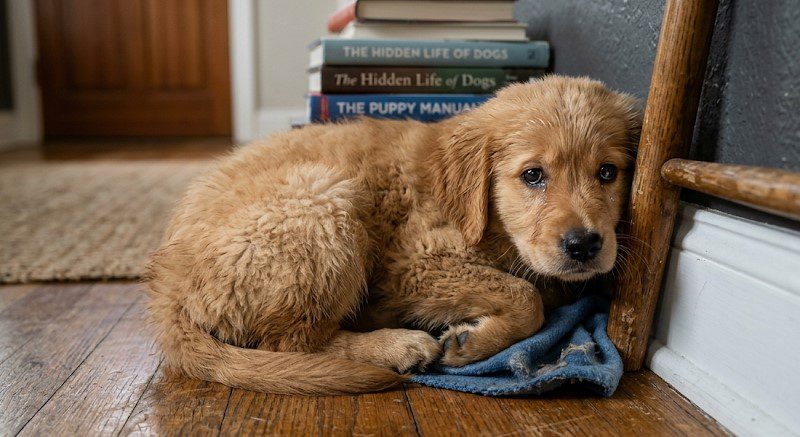
Why Puppies Are Naturally Anxious
Puppies experience the world at a neurological disadvantage that most people do not appreciate.
At 8 weeks old — the typical rehoming age — a puppy’s prefrontal cortex (the brain’s rational, calming center) is almost completely undeveloped. Their amygdala (the brain’s alarm system) is fully functional. This means they experience fear, starttle, and distress with full adult intensity, but they have almost none of the neural infrastructure that would normally regulate and calm that response.
They are, neurologically speaking, all alarm system and no off switch.
This is not a character flaw. It is not poor breeding. It is the normal developmental state of a mammalian juvenile nervous system. The off switch develops gradually between 8 weeks and 18 months — which is precisely why early positive experiences during this window are so critically important.
The Critical Socialization Window (8–16 Weeks)
Veterinary behavioral research consistently identifies 8–16 weeks as the single most important developmental period in a dog’s life. During this window, the puppy’s nervous system is actively building its threat-assessment model — essentially deciding what is “normal” and what is “dangerous” based on experience.
A puppy who experiences diverse, positive exposures during this window — different people, surfaces, sounds, environments, animals, handling — develops a nervous system that classifies novel experiences as interesting rather than threatening.
A puppy who is kept protected and isolated during this window — well-intentioned as this often is — develops a nervous system that classifies unfamiliar things as potential threats by default. This is the neurological foundation of generalized anxiety in adult dogs.
The American Kennel Club specifically emphasizes that appropriate socialization between 8–16 weeks is the single most powerful anxiety-prevention tool available, and that the risk of under-socialization significantly outweighs the risks of careful, controlled exposure to the world. Their full puppy anxiety guide is at AKC.org.
The Puppy Owner’s “Puppy Blues” — You Are Not Alone
Here is something the puppy guides rarely acknowledge: bringing home a new puppy is often genuinely overwhelming, even for experienced dog owners.
The 24-hour neediness. The interrupted sleep. The biting. The accidents. The constant supervision. The guilt when it is hard. The fear that you have made a terrible mistake.
This experience is so common it has a name — puppy blues — and it affects an estimated 30–40% of new puppy owners to some degree. It is real, it is normal, and it is temporary.
What helps: Remember that week two is almost always harder than week one (the novelty has worn off but the routine has not yet established). Connect with other new puppy owners — Reddit’s r/puppy101 community is a large, supportive space for exactly this experience. Know that the socialization window panic (I have not exposed them to enough things!) affects almost every conscientious new owner. Do what you can. Perfect is not the goal.
The puppy who is challenging you right now is building the foundation of the dog they will become. Your patience during this period is the single greatest investment you can make in their long-term emotional health.
Socialization Bingo — The 8–16 Week Challenge
Print this card and work through as many squares as possible during your puppy’s critical socialization window. Every positive exposure builds the emotional resilience that prevents anxiety in adulthood.
╔═══════════════════════════════════════════════════════╗
║        SOCIALIZATION BINGO — 8 TO 16 WEEKS           ║
╠═══════════════╦═══════════════╦═══════════════════════╣
║ Children      ║ Men with      ║ Umbrellas             ║
║ (supervised)  ║ beards/hats   ║ opening               ║
╠═══════════════╬═══════════════╬═══════════════════════╣
║ Vacuum        ║ Car ride      ║ Vet visit             ║
║ cleaner on    ║ (short, fun   ║ (happy visit,         ║
║               ║ destination)  ║ treats only)          ║
╠═══════════════╬═══════════════╬═══════════════════════╣
║ Other dogs    ║ Bicycles      ║ Staircases            ║
║ (vaccinated,  ║ passing       ║ (up AND down)         ║
║ calm)         ║               ║                       ║
╠═══════════════╬═══════════════╬═══════════════════════╣
║ Different     ║ Crowds        ║ Nail touch            ║
║ floor types   ║ (park or      ║ (treat after          ║
║ (tile/grass)  ║ market)       ║ every paw)            ║
╠═══════════════╬═══════════════╬═══════════════════════╣
║ Thunderstorm  ║ Handling      ║ Car sounds            ║
║ recording     ║ ears/mouth    ║ (traffic,             ║
║ (low volume)  ║ (daily)       ║ trucks)               ║
╚═══════════════╩═══════════════╩═══════════════════════╝
Goal: Complete as many as possible before 16 weeks.
Every positive exposure = anxiety prevention for life.
Types of Puppy Anxiety and What They Look Like
New Home Anxiety (First 1–4 Weeks)
The most universal form. Your puppy has just been separated from their mother, their littermates, and every familiar scent and sound they have ever known. The crying, clinging, and restlessness of the first weeks is grief and disorientation — not behavioral problems.
What it looks like: crying at night, whining when left alone, seeking constant physical contact, refusing to settle.
What to do: provide warmth, proximity, and routine. A heartbeat simulation toy near the sleeping area. A worn item of your clothing. A predictable feeding and sleep schedule from day one.
Separation Anxiety in Puppies
Distinct from new home anxiety. True puppy separation anxiety involves distress that is specifically triggered by your absence — not just by novelty or darkness.
What it looks like: escalating distress specifically when you leave, even briefly. Destruction focused near exits. Crying that does not settle within 5–10 minutes of your departure.
What to do: begin short departure desensitization immediately (see our full separation anxiety guide for the protocol). Do not wait until the puppy is “settled” to start — early intervention produces far better outcomes than waiting.
Noise Sensitivity
Puppies who were not exposed to diverse sounds during the socialization window frequently develop noise sensitivity that can escalate into full noise phobia in adulthood. Thunder, fireworks, traffic, vacuum cleaners, and hair dryers are the most common triggers.
What to do: Sound desensitization during the socialization window. Play recordings of thunder, traffic, and household appliances at very low volume during positive moments (mealtimes, play). Gradually increase volume over weeks. This is far more effective at 10 weeks than at 10 months.
Handling and Grooming Anxiety
Puppies who are not regularly and positively handled — ears, paws, mouth, being lifted, being restrained briefly — during the socialization window frequently develop handling anxiety that makes veterinary care and grooming genuinely difficult throughout their lives.
What to do: Daily positive handling practice from day one. Touch every body part gently while treating. This investment at 8–16 weeks prevents years of grooming struggle.
What Is Normal vs. What Needs Intervention
| Behavior | Normal? | When to Act |
|---|---|---|
| Crying first 1–3 nights | Yes | If persists past 2 weeks |
| Clinginess first 1–4 weeks | Yes | If not gradually improving |
| Startling at new sounds | Yes | If startle response is extreme or worsens |
| Refusing to be alone for any duration | No | Start separation training immediately |
| Trembling during normal activities | No | Consult vet — may indicate illness |
| Not eating for more than 24hrs | No | Consult vet |
| Aggressive fear response | No | Consult vet or behaviorist |
Building a Calm, Confident Puppy: The Core Framework
1. Structure and Predictability First
Before enrichment, before training, before socialization — structure. A consistent feeding schedule, consistent sleep location, consistent wake time. The puppy’s nervous system calibrates to predictability. Every consistent routine is a message: “the world makes sense, you are safe.”
2. Crate Training as a Safe Space
A properly introduced crate is not a punishment. It is a den — the enclosed, protected space that activates a dog’s innate sense of safety. A puppy who loves their crate has a portable anxiety management tool that works for their entire life.
Introduction: feed every meal inside the crate with the door open. Once your puppy is entering voluntarily, close the door briefly during meals. Build duration gradually. Never use the crate as punishment. Never force entry.
3. Snuffle Mat for Mental Enrichment and Calm
Ten minutes on a snuffle mat before a nap or before a period of alone time depletes puppy mental energy and provides the dopamine satisfaction that supports subsequent calm. This is especially valuable for high-energy breeds whose anxiety is driven by under-stimulation.
4. Positive Socialization (Quality Over Quantity)
Every new experience should be presented at an intensity your puppy can handle without showing fear. The goal is not exposure — it is positive exposure. A puppy who encounters a novel thing while eating a high-value treat builds a positive association. A puppy who is flooded with a terrifying experience at full intensity builds a negative one.
The rule: if your puppy shows any fear response, you have pushed too far too fast. Step back, reduce the intensity, and build more slowly.
5. Calming Supplements for Anxious Puppies
Natural calming supplements are safe for puppies 12 weeks and older. For puppies showing significant anxiety during the adaptation period, a supplement containing L-theanine and chamomile given daily with meals can meaningfully reduce baseline anxiety and make positive socialization experiences more accessible to a puppy whose alarm system is constantly activated.
Note: always use weight-appropriate dosing and choose puppy-safe formulations without hemp extract for dogs under 6 months unless specifically recommended by your veterinarian.
6. What to Do at Night
The most commonly contested puppy topic. Current veterinary behavioral guidance is clear: allowing a puppy to sleep in your room — or even on your bed — does not create behavioral problems or worsen separation anxiety in dogs who receive appropriate independence training during waking hours.
Practical approach: a crate placed beside your bed for the first 4–8 weeks. You can reassure your puppy with a hand through the crate door without fully removing them. Gradually move the crate further from the bed as the puppy adjusts.
The Mistakes That Create Anxious Adult Dogs
Over-protection during the socialization window: keeping puppies away from the world to “protect” them during 8–16 weeks creates the very anxiety they are being protected from.
Inadvertent reinforcement of anxiety: hovering anxiously over a frightened puppy, allowing avoidance of every scary thing, and excessive consoling without redirection can teach the puppy that the world is as dangerous as their alarm system suggests.
Punishing fear responses: scolding a puppy for growling, snapping, or hiding is one of the most damaging things an owner can do. Fear responses are the puppy communicating — punishing communication teaches them to communicate through biting instead.
Waiting for problems to resolve on their own: anxiety disorders do not self-resolve. They deepen over time without intervention. The puppy who is anxious at 10 weeks and receives no support becomes the dog with a full anxiety disorder at 2 years.
Is it normal for puppies to be anxious?
Yes — a degree of anxiety is neurologically normal in puppies whose prefrontal cortex is still developing. What is not normal is anxiety that is severe, worsening, or preventing the puppy from eating, sleeping, or engaging positively with their environment.
At what age does puppy anxiety peak?
The first fear period typically occurs between 8–11 weeks. A second fear period occurs between 6–14 months. Both are developmentally normal and both pass with patient, positive management.
How do I calm an anxious puppy at night?
Place the crate next to your bed so your puppy can sense your presence. Add a worn item of your clothing. Use a heartbeat simulation toy for the first 1–2 weeks. Avoid responding to crying immediately but do not let a puppy cry indefinitely — a brief, calm reassurance is appropriate.
Can puppies take calming supplements?
Yes, most natural calming supplements containing L-theanine and chamomile are safe for puppies 12 weeks and older at weight-appropriate doses. Always check the product label and consult your vet for puppies under 6 months.
Should I get a second dog to help my anxious puppy?
Not as an anxiety solution. A second dog may provide companionship but does not address the neurological root of anxiety. An anxious puppy needs behavioral support, not a companion who may also become anxious.
About the Author
The PawCalmHub Team
At PawCalmHub, we are a passionate team of pet lovers dedicated to helping anxious pets live calmer, happier lives. Every article we publish is thoroughly researched against current veterinary behavioral guidelines, peer-reviewed studies, and trusted sources including the American Kennel Club and the Fear Free organization. References in this article link directly to the sources cited.
Questions? Email us at hello@pawcalmhub.com — we respond within 24 hours.
Explore our full range of grooming and wellness tools at PawCalmHub.com