
Estimated read time: 20 minutes | Last updated: 2025
A note on this guide: This article draws on peer-reviewed research in veterinary physiology, deep-touch pressure science, and thermoregulation to help dog owners make genuinely informed decisions about calming beds. PawCalmHub sells its own self-warming anxiety bed — we have noted this transparently and structured this guide to be useful regardless of which product you choose. The goal is to help you understand what actually works and why — so that whatever you purchase delivers real benefit for your dog.
The calming dog bed market is one of the most aggressively marketed categories in pet retail.
Walk into any pet store or open any pet product website and you will find beds described as “anxiety-reducing,” “stress-relieving,” and “scientifically proven to calm” — claims that are almost never supported by the scientific citations they imply, and that are designed to move product rather than inform decisions.
This guide does something different. It tells you the actual science — the peer-reviewed physiology of thermoregulation, proprioception, and pressure therapy that determines whether a calming bed works. It gives you specific, measurable criteria for evaluating any bed you are considering purchasing. And it explains, with more honesty than most product-focused content allows, what calming beds can and cannot do — because a well-informed purchase is the one most likely to produce the outcome you need.
The outcome you need is a dog who is calmer, more settled, and more able to recover from anxiety events. A calming bed, chosen and used correctly, contributes meaningfully to that outcome. Used incorrectly, or chosen based on marketing rather than mechanism, it contributes nothing — and costs between $30 and $150 that could have been spent on tools that work.
Let us start with the science.
The Science Behind Calming Dog Beds — Three Mechanisms That Matter
Most calming bed marketing focuses on materials and aesthetics. The science focuses on three specific physiological mechanisms — and understanding these mechanisms is what allows you to evaluate any calming bed claim with genuine critical rigour.
Mechanism 1: Thermoregulation and the Autonomic Nervous System
The relationship between body temperature and the autonomic nervous system is one of the most robustly documented findings in mammalian physiology — and it is the most consistently overlooked mechanism in calming bed science.
The autonomic nervous system has two primary modes: the sympathetic system (fight-flight-freeze, elevated cortisol, elevated heart rate, muscle tension, heightened threat sensitivity) and the parasympathetic system (rest-digest-recover, reduced cortisol, reduced heart rate, muscle relaxation, reduced threat sensitivity).
Research published in the Journal of Thermal Biology documents that skin thermoreceptors — sensory receptors distributed throughout the body surface — provide direct input to the hypothalamus, which regulates both body temperature and autonomic nervous system tone. Specifically: warmth activates the parasympathetic system through thermoreceptor pathways. Cold activates the sympathetic system.
The practical implication is direct: a dog lying on a warm surface is neurologically nudged toward the parasympathetic state. A dog lying on a cold surface — a tile floor, a standard foam mat in a draughty room — is neurologically nudged toward the sympathetic state. The bed your dog sleeps on is not just a comfort choice. It is an ambient input to their autonomic nervous system, running continuously, 24 hours a day.
A self-warming bed — which uses a heat-reflective inner layer to return the dog’s own body heat rather than generating external heat — provides this thermoregulatory input passively, at a temperature that cannot overheat (because it only reflects what the dog produces), and without the electrical or safety risks of a heated pad.
Research from the Cornell University College of Veterinary Medicine on thermal comfort in companion animals confirms that thermal comfort is a significant variable in canine stress response and recovery — and that the ability to self-regulate temperature by choosing a warm resting surface reduces the cortisol load produced by thermal discomfort.
Mechanism 2: Proprioceptive Input and Den Psychology
Proprioception — the body’s sense of its own position in space — is modulated by physical contact with surfaces. Dogs who press into enclosed, contained spaces are activating proprioceptive receptors that provide information about spatial orientation and physical boundaries. This information is processed, in the social mammal nervous system, through the same pathways that process the security signal of physical contact with another body.
Research on denning behaviour in canids published in Applied Animal Behaviour Science documents that den-seeking behaviour in dogs serves a specific neurological function: the enclosed, bounded space provides proprioceptive input that activates the parasympathetic system through the same mechanism as the deep-touch pressure of social contact. The den is, neurologically speaking, a surrogate for physical safety provided by companions.
Bolster-style beds — with raised edges that the dog can press against when lying — activate this proprioceptive mechanism. A dog who curls against the raised edge of a bolster bed is not simply resting. They are receiving ongoing sensory input that communicates spatial containment and safety at a neurological level. The difference between this and a flat mat is the difference between sleeping with a wall behind you and sleeping in the middle of an open room.
The chin-rest function: One of the specific benefits of the raised bolster design is that it allows the dog to rest their chin on the rim — a resting posture that the majority of anxious dogs naturally seek. The downward pressure of the chin on a firm surface activates the same mechanoreceptors as deep-touch pressure therapy. Dogs who choose to rest their chin on furniture edges, human arms, or bolster rims are self-administering a form of pressure therapy that their nervous system recognises as calming.
Mechanism 3: Olfactory Security — The Scent Map of Safety
The third mechanism is the one that almost no calming bed guide discusses — because it requires understanding feline and canine olfactory processing at a level that most pet product content does not reach.
As documented extensively in research on canine olfaction, dogs navigate reality primarily through scent. Every surface a dog regularly contacts becomes imprinted with their individual chemical signature through the passive deposition of skin oils, pheromones, and sebaceous secretions. Over time, an object that carries the dog’s own scent — or the owner’s familiar scent — becomes an olfactory safety signal: something that the nervous system categorises as known, familiar, and therefore safe.
A calming bed that has been regularly used by the dog for weeks carries this olfactory safety signal. When the dog returns to that bed — particularly during an anxiety event — the familiar scent is neurologically processed as a safety cue before any other aspect of the environment is assessed.
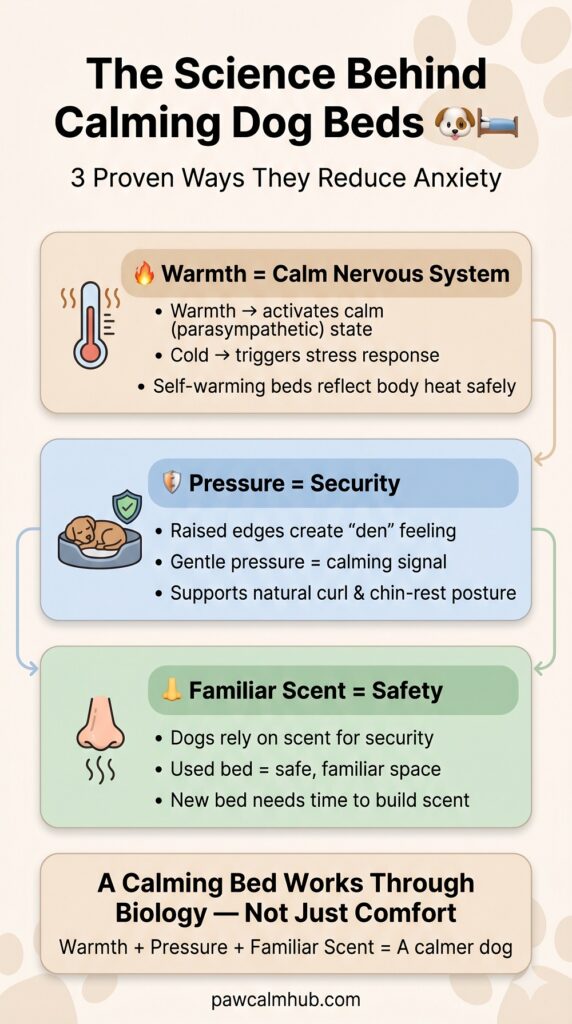
This is why a new bed in a new location during a crisis event does not work. The olfactory safety signal is absent. The dog is arriving at an unfamiliar surface during a moment of maximum threat sensitivity — and the bed’s physical properties cannot compensate for the absence of established scent familiarity.
It is also why the wash and care guidance later in this article is not optional information for anxious dog owners — it is critical clinical knowledge.
The 5 Types of Calming Dog Beds — What the Evidence Actually Supports
Type 1: Self-Warming Beds
How they work: A heat-reflective inner layer — typically Mylar or a similar thermal polymer — reflects the dog’s own infrared body heat back toward them. The bed reaches equilibrium at approximately the dog’s own body temperature rather than the ambient temperature of the room.
The evidence: The thermoregulation mechanism described above is the most directly relevant physiological mechanism to anxiety management. Self-warming beds are the only bed type that addresses the autonomic nervous system tone through ambient temperature continuously — not just during the dog’s active use of the bed, but throughout the night and day.
Best for: Anxiety driven by cold sensitivity, night-time restlessness, post-surgical recovery, senior dogs with arthritic pain (warmth reduces joint inflammation and the pain-driven anxiety it produces), and any dog whose anxiety is worst in winter months or cool environments.
Recommended for: The majority of anxious dogs as a first bed — because the thermoregulation mechanism is universal, the risk is zero (cannot overheat), and the benefit operates 24 hours a day without owner management.
Type 2: Donut and Bolster Beds
How they work: Raised edges — typically 10–20cm — provide proprioceptive containment and the chin-rest function described above. The enclosed shape mimics the den environment that the canine nervous system categorises as safe.
The evidence: The denning behaviour research supports the bolster design for dogs who naturally seek enclosed spaces during anxiety events. The proprioceptive mechanism is well-established in the deep-touch pressure literature, and the specific application to raised-edge beds follows logically from the same mechanoreceptor pathway.
Best for: Dogs who circle before lying down (seeking containment), dogs who press into corners or under furniture during anxiety events, dogs who naturally seek to rest their chin on elevated surfaces.
Important caveat: The bolster benefit requires the dog to be physically contained by the rim — which means sizing is critical. A bolster bed that is too large for the dog provides no rim contact and therefore no proprioceptive input. The dog should be able to curl comfortably with their back touching the rear rim and their nose close to the front rim.
Type 3: Orthopedic Memory Foam Beds
How they work: High-density viscoelastic foam distributes body weight evenly, reducing pressure on joints, and conforms to the dog’s body shape to support natural alignment.
The evidence: The primary evidence base is for pain relief and joint support — which has clear relevance to anxiety in senior dogs whose anxiety is pain-driven. For primary anxiety disorders without a significant pain component, orthopedic foam provides comfort without the specific anxiety-management mechanisms of thermoregulation or proprioceptive containment.
Best for: Senior dogs with arthritis or joint disease where pain is a primary driver of anxiety. Less optimal as a primary anxiety management tool for younger dogs with behavioural anxiety.
Honest assessment: Marketed heavily as calming beds, orthopedic foam beds are better described as comfort and pain-management beds. They are excellent products for their primary function — joint support — but do not address the autonomic nervous system directly in the way that self-warming or bolster designs do.
Type 4: Weighted Pressure Beds
How they work: Weighted inserts — typically 1–3kg distributed across the sleeping surface — apply mild, constant pressure to the dog’s underside while lying. The mechanism is directly analogous to a weighted blanket in humans: distributed pressure activates mechanoreceptors and produces a parasympathetic response.
The evidence: Human weighted blanket research is extensive and well-supported, with multiple randomised controlled trials documenting anxiety reduction through deep-touch pressure. Dog-specific weighted bed research is limited — there are no published randomised trials as of 2025 — but the physiological mechanism is sufficiently well-understood that the application to dogs is considered plausible by veterinary behaviour specialists.
Best for: Dogs who respond strongly to deep-touch pressure — identifiable by their response to the anxiety vest (dogs who benefit from the vest are more likely to benefit from weighted sleep surfaces). Worth trialling for dogs who have not responded adequately to self-warming or bolster designs.
Limitation: Weighted beds are not appropriate for very small breeds (the weight ratio to body mass may be excessive) or for dogs who move frequently during sleep (the weight benefit requires the dog to remain in contact with the surface).
Type 5: Heated Electric Beds
How they work: An electric heating element within the bed pad generates consistent warmth independently of the dog’s body heat.
The evidence: The thermoregulation mechanism is the same as for self-warming beds — warmth activates the parasympathetic system. Electric heating provides a higher temperature ceiling than self-warming, which can be advantageous in very cold environments or for dogs with very low body fat (sight hounds, very lean working breeds).
Honest limitations: Electric heated beds carry specific risks for anxious dogs that self-warming beds do not. An anxious dog who does not move freely during anxiety events may remain on an overheating surface without repositioning — a burn risk that does not exist with self-warming designs. They also require a power source, a cable that some dogs chew, and active temperature monitoring. For the majority of anxious dogs, the self-warming design provides equivalent thermoregulation benefit without these risks.
The 7 Non-Negotiable Criteria for Evaluating Any Calming Bed
Before purchasing any calming bed — including the PawCalmHub self-warming bed — evaluate it against these seven criteria. A bed that fails more than two of them is not a calming bed regardless of what its marketing claims.
Criterion 1: Machine Washable at Low Temperature
A calming bed for an anxious dog must be washable — anxiety events frequently involve drooling, urinary accidents, or stress-related coat shedding that requires regular laundering. But it must be washable at low temperature — high heat damages both the heat-reflective properties of self-warming materials and the olfactory security that accumulated scent provides.
Check the care label specifically: look for machine wash cold, gentle cycle recommended, air dry. A bed that must be dry-cleaned, spot-cleaned only, or washed at high temperature is not appropriate for an anxious dog regardless of its other properties.
Criterion 2: Non-Slip Base
An anxious dog approaching their bed is already in a state of elevated arousal. A bed that slides across the floor when the dog steps onto it produces a sudden loss of footing — which is both a physical threat signal and a potential injury risk. Non-slip bases are not an optional feature. They are a safety requirement.
Test any bed by placing it on your most common floor surface and pushing it laterally with your foot. It should not slide. If it slides under gentle pressure, it will slide when a medium-to-large breed steps onto it at speed.
Criterion 3: Appropriate Size — Allows Both Curl and Stretch
The most common sizing error with calming beds is purchasing too small — because the curled dog appears to fit, but the sleeping dog cannot stretch without leaving the bed. An anxious dog who cannot fully stretch in their bed cannot reach the deep, physiologically restorative sleep that is essential for anxiety recovery.
Measure your dog from nose to tail base when fully stretched out. The bed should be at least this length. For bolster beds, add the diameter of the rim to the total size calculation — the internal sleeping surface should be at least nose-to-tail length.
Criterion 4: Waterproof Inner Lining
Anxiety frequently produces physiological symptoms that include urinary accidents — either directly from anxiety-induced loss of bladder control or from the disrupted toileting patterns that chronic anxiety produces. A calming bed without a waterproof inner lining will retain urine in the stuffing material, producing a hygiene problem that no amount of laundering resolves and that — critically — requires replacement rather than washing.
A waterproof inner lining does not mean a crinkly, noisy waterproof outer cover that many dogs find aversive. It means a silent, integrated inner membrane that protects the stuffing from liquid penetration while remaining undetectable to the dog.
Criterion 5: No Harsh Chemical Smell When New
The olfactory safety mechanism described above requires the bed to become associated with the dog’s and owner’s scent over time. A bed that arrives with strong chemical, synthetic, or fabric-treatment smells is presenting an aversive olfactory stimulus at the exact moment the dog needs to form a positive association.
Before placing a new bed in your dog’s space: air it for 24–48 hours outdoors or in a well-ventilated room. Then place a worn, unwashed owner garment on it for 48 hours before the dog has access. You are pre-seeding the bed with familiar, safe owner scent before the dog encounters it.
Criterion 6: Chew-Resistant Seam Construction
Anxious dogs frequently chew. A calming bed with weak seam construction will be destroyed by a moderately anxious dog within days — creating both a waste of money and a potential ingestion risk from stuffing materials. Look specifically for: reinforced double-stitched seams, thread weight that resists pulling, and no exposed elastic or decorative elements that can be easily removed.
No bed is indestructible. But there is a wide spectrum between beds that last six months and beds that last six years with a moderately anxious dog — and seam construction is the primary variable.
Criterion 7: Rim Height Appropriate to Breed and Resting Posture
For bolster-style beds: the rim height must be proportionate to the dog’s head height when lying down. A rim that is too low provides no chin-rest surface and no proprioceptive containment — it is a flat mat with a decorative edge. A rim that is too high prevents the dog from comfortably resting their head outside the bed when they choose to — which some dogs need during warmer periods.
The optimal rim height is approximately 60–80% of the dog’s head height when lying. For a medium-sized dog with a 15cm head height when lying, a 10–12cm rim is appropriate.
The Wash and Care Guide — Protecting the Bed’s Scent-Safe Quality
This section exists because it addresses something that almost no calming bed guide covers — and that, for anxious dogs, is the difference between a bed that works and a bed that was washed back to uselessness.
The olfactory safety mechanism requires accumulated scent. Every high-temperature wash, every use of strong detergent, and every tumble-dry cycle strips the bed of the chemical markers that the dog’s nervous system uses to categorise it as safe. A bed washed at 60°C with biological detergent and tumble-dried on high heat is, from the dog’s olfactory perspective, a new and unfamiliar bed — and will need weeks of regular use to re-establish the scent security that made it effective.
The Scent-Safe Washing Protocol:
How often to wash: Every 3–4 weeks under normal use, or immediately following a urinary accident. Do not wash more frequently than necessary — each wash is a partial reset of the scent safety signal.
Temperature: Cold wash only — maximum 30°C (86°F). Above 40°C, the heat-reflective properties of self-warming materials begin to degrade and the volatile organic compounds that constitute the dog’s scent signature are driven off by the heat.
Detergent: Use an unscented, non-biological detergent at half the recommended quantity. Biological detergents contain enzymes that break down organic compounds — including the same compounds that constitute the dog’s scent markers. Scented detergents replace the dog’s scent with a synthetic fragrance that may be aversive. Unscented, non-biological formulations clean effectively without destroying the olfactory architecture that makes the bed work.
Fabric softener: Never. Fabric softeners coat fibres with synthetic fragrance compounds that persist for weeks and overwhelm the dog’s own scent markers. They also reduce the breathability of self-warming materials by coating the reflective inner layer.
Spin cycle: Gentle — high spin speeds stress seams and can misshape the rim structure of bolster beds.
Drying: Air dry only — flat or hung, in a ventilated space out of direct sunlight. Tumble drying at any temperature degrades self-warming materials, reduces stuffing loft, and stresses seams. Direct sunlight bleaches and breaks down outer fabric over time.
Drying time: Allow 24 hours of air drying before returning the bed to the dog. A damp bed is not a safe sleeping surface and the moisture will promote mould growth in the stuffing.
Post-Wash Scent Restoration:
After every wash, perform the following before returning the bed to use:
- Place a worn, unwashed owner garment — a T-shirt slept in for two nights — on the dry bed for 24 hours. This pre-seeds the clean bed with familiar owner scent before the dog encounters it.
- If the dog has a secondary scent item — a blanket or toy they use regularly — place this on the bed during the 24-hour re-scenting period. Their own scent from a secondary item seeds the bed faster than owner scent alone.
- Scatter a small amount of the dog’s regular kibble or a few treats into the bedding before returning it to use. The food scent accelerates re-engagement with the clean bed, preventing the avoidance that some anxious dogs show toward freshly washed items.
Extending Wash Intervals Without Compromising Hygiene:
Between washes, spot-clean with a damp cloth and a tiny amount of unscented soap for localised soiling. Use a pet-safe, unscented enzyme spray for urine spots — enzyme-based cleaners break down urine compounds without the fragrance overlay of conventional cleaning sprays. Allow complete air drying before returning to use.
Brush the bed surface weekly with a soft-bristle brush to remove loose coat and surface debris — this reduces the frequency at which a full wash is needed while maintaining basic hygiene.
Bed Replacement Timeline:
With the care protocol above, a high-quality self-warming calming bed should maintain its functional properties for 18–24 months under daily use. The indicators that replacement is needed:
- The heat-reflective inner layer is visibly damaged or crinkled — it is no longer functioning efficiently
- Stuffing has compressed to the point where the dog’s body contacts the floor through the bed
- Seams have failed and stuffing is accessible
- The waterproof inner lining has cracked or begun to leak
Do not replace a bed before these indicators are present — the accumulated scent safety of a long-used bed is itself a therapeutic asset. But do replace promptly when they appear, because a compromised bed provides neither physical comfort nor the olfactory security that the intact bed has built.
Placement Strategy — Where You Put the Bed Is as Important as Which Bed You Buy
The most common placement errors — and their corrections:
Error 1: Placing the bed in a room the dog doesn’t naturally use. The bed needs to be where the dog already chooses to spend time during calm periods. Placing it in a spare bedroom to “give them their own space” means it is in a low-association location that the dog does not associate with rest. The olfactory security signal only builds through regular voluntary use.
Error 2: Placing the bed against an exterior wall. Exterior walls transmit more sound and temperature variation than interior walls. A bed pressed against an exterior wall during a thunderstorm is the worst possible acoustic position. Position beds on interior walls, away from windows and exterior doors.
Error 3: Placing the bed in direct sunlight. Sunlight bleaches the outer fabric, raises the temperature beyond comfortable, and may cause the dog to avoid the bed during the hottest parts of the day — disrupting the consistent use that builds the olfactory security signal. Natural light near the bed is fine. Direct beam sunlight on the bed is not.
Error 4: Moving the bed frequently. Every move resets part of the spatial familiarity the dog has built with the bed’s location. The bed’s position — in addition to the bed itself — becomes a known spatial marker that the dog’s nervous system categorises as safe. Relocate only when absolutely necessary, and when you do, bring the owner garment re-scenting protocol with it.
Error 5: Placing the bed where the dog cannot see the room entrance. Anxious dogs monitor exits. A dog whose bed is positioned such that they cannot see the room’s entrance without moving their head significantly is a dog who cannot rest without maintaining active surveillance. Position beds so the dog has a clear sightline to at least one exit from their natural resting posture.
Pairing the Calming Bed With Your Full Anxiety Toolkit
The calming bed is the foundation of the anxiety management system — the ambient, continuous input that lowers the baseline from which all other anxiety events escalate. It works best as infrastructure on top of which specific interventions are layered.
The complete pairing system:
For everyday anxiety maintenance:
- Self-warming bed (continuous thermoregulation)
- Snuffle mat for anxious dogs at mealtimes (olfactory enrichment, cortisol reduction)
- Hemp calming chews for dogs daily for dogs with generalised anxiety
For situational anxiety events (storms, fireworks, vet visits, separations):
- Dog anxiety vest applied 15–20 minutes pre-trigger
- Lick mat for dog anxiety during the event
- Calming chew administered 45 minutes pre-trigger
- Return to the calming bed immediately post-event for decompression
Read more: How to Build the Perfect Dog Safe Room for Anxiety — the complete guide to creating the environment in which the calming bed sits.
Read more: The Complete Pet Anxiety Guide — all seven anxiety types and the 5-tier treatment framework.
FAQ: Best Calming Beds for Anxious Dogs
How long does it take for a calming bed to start working?
The thermoregulation and proprioceptive mechanisms are immediately active from the first use — the dog receives warmth and containment as soon as they lie on the correctly sized and placed bed. The olfactory security mechanism, however, requires time to build: a minimum of 2–3 weeks of regular daily use before the bed carries sufficient accumulated scent to function as a reliable safety signal. This is why calming beds appear to work better over time — the physical mechanisms are consistent, but the olfactory mechanism builds progressively. If a calming bed appears to be less effective in the first week than in week four, this is the expected pattern of the olfactory mechanism developing.
Should I buy multiple calming beds for different rooms?
For dogs with significant anxiety, yes — and this is not an extravagance. The olfactory security mechanism requires the bed to be in the location where the dog needs it. A dog whose anxiety peaks in the kitchen during thunderstorms is not helped by a calming bed in the bedroom. Two beds — one in the primary living area, one in the designated safe room — provide coverage across the highest-anxiety contexts at a total cost that is typically less than one veterinary consultation for an anxiety-related presentation.
My dog won’t use their new calming bed. What should I do?
A dog avoiding a new bed is responding to its novelty — the absence of familiar scent makes it an unknown and therefore potentially unsafe object. Follow the scent restoration protocol above: place a worn owner garment on the bed for 48 hours, scatter a few treats in the bedding, and let the dog discover and investigate at their own pace without pressure. Never place the dog in the bed — every forced placement reduces the positive association. Feed one meal on the bed for three consecutive days — the food pairing builds positive association faster than any other available technique.
Can a calming bed replace veterinary treatment for severe anxiety?
No — and this guide has been explicit about that throughout. A calming bed is Tier 1–2 management: ambient environmental support that lowers the baseline cortisol level and provides passive parasympathetic activation. For dogs with moderate to severe anxiety disorders — particularly generalised anxiety, severe separation anxiety, or severe noise phobia — it is one component of a multi-modal approach that includes veterinary assessment and potentially pharmaceutical support. It significantly improves the effectiveness of other interventions by lowering the baseline from which they operate. It does not replace them.
My dog sleeps on the calming bed but still shows anxiety during events. Is the bed not working?
The bed is working as designed — providing continuous ambient parasympathetic support that lowers the resting cortisol baseline. What it cannot do is prevent acute anxiety events triggered by specific, powerful stimuli. The appropriate additional intervention for specific anxiety events is a layered protocol: anxiety vest pre-trigger, lick mat during event, and calming chews 45 minutes pre-trigger. The bed is the foundation. The other tools address the acute events that the foundation alone cannot prevent.
What is the difference between a calming bed and a regular dog bed?
A regular dog bed provides comfort — physical cushioning and a designated sleeping surface. A calming bed specifically addresses one or more of the three mechanisms described in this guide: thermoregulation (self-warming materials), proprioceptive containment (bolster edges), or pressure therapy (weighted materials). The distinction is mechanism, not price or marketing language. A regular bed labelled as “calming” without addressing one of these mechanisms is a regular bed with better copywriting.