
Written by The PawCalmHub Team. Reviewed for alignment with current veterinary behavioral guidelines and the American Kennel Club (AKC). Last updated May 2025.
⚠️ This article provides general wellness and behavioral information only. For dogs with severe fireworks phobia involving self-injury or extreme distress, please consult a licensed veterinarian before July 4th.
Every year, in the days following July Fourth, animal shelters across the United States report their highest intake numbers of the entire calendar year.
Not because of illness. Not because of accidents. Because of fireworks.
Tens of thousands of dogs — panicked by the sudden, overwhelming assault of sound, light, and pressure that a fireworks display delivers — bolt from yards, slip out of collars, and run. Many are recovered. Many are not.
And for every dog who runs, there are hundreds more who spend the night shaking, hiding, panting, and suffering through one of the most terrifying experiences of their lives — while their helpless owners watch, wishing they could do more.
You can do more. Significantly more. Here is everything that actually works.
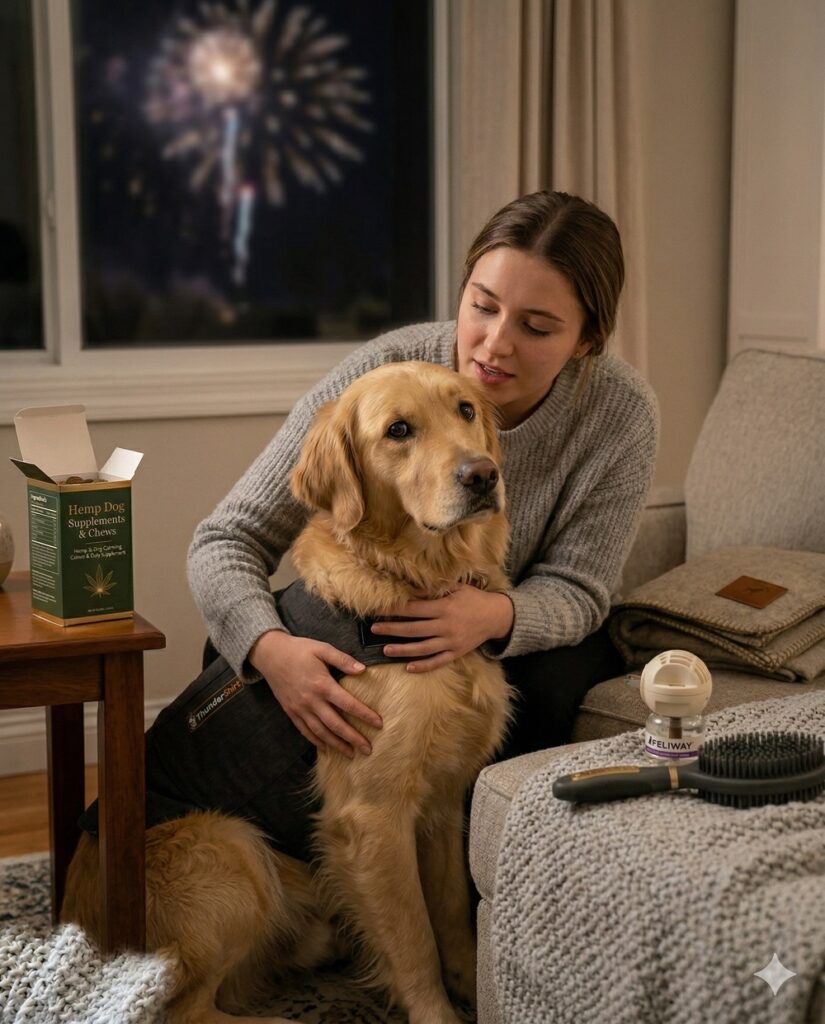
Why Fireworks Hit Dogs So Hard — The Science
To understand why fireworks trigger such extreme responses in dogs, you have to understand what your dog is actually experiencing during a display — because it is far more than just loud noise.
Sound intensity beyond human experience: A fireworks display produces sounds ranging from 150 to 175 decibels at the launch point — louder than a jet engine at close range. According to research published in Hearing Research, dogs’ hearing range extends to approximately 65,000 Hz compared to 20,000 Hz for humans, meaning they detect high-frequency components of each explosion that are completely inaudible to us. What sounds like a boom to you registers as a full-spectrum sonic assault to your dog.
Infrasound vibration: The low-frequency pressure waves produced by large fireworks travel through the ground and through building walls. Your dog does not just hear fireworks — they feel them physically throughout their entire body.
Unpredictability: Thunderstorms, however frightening, have a rhythm — they build, peak, and recede. Fireworks are random, sudden, and from your dog’s perspective, completely without pattern or warning. The unpredictability itself is a major amplifier of the stress response.
Static electricity buildup: Research from veterinary behaviorists including Dr. Nicholas Dodman, BVMS, MRCVS, Professor Emeritus at Tufts University Cummings School of Veterinary Medicine, suggests that static electricity buildup in a dog’s coat during high-anxiety weather events — including fireworks displays — can cause genuine physical discomfort that compounds the auditory overwhelm. Dogs who seek out bathtubs or press against metal objects during fireworks may specifically be trying to ground themselves and relieve static charge.
Understanding this helps explain why so many dogs with fireworks anxiety seem almost impossible to comfort during a display. They are not being dramatic. They are in the equivalent of a sensory emergency.
The American Kennel Club reports that more dogs go missing on July 4th than on any other day of the year in the United States, making fireworks season one of the most dangerous times for noise-sensitive dogs. Their full safety guide is available at AKC.org — How to Keep Dogs Calm on the Fourth of July.
Preparation: What to Do Before the Fireworks Start
The window before fireworks begin is your most powerful opportunity. Everything you do in advance compounds in effectiveness once the display starts.
Step 1: Update Your Dog’s ID and Microchip — Right Now
Before anything else — before any product, any supplement, any behavioral strategy — make sure your dog’s ID tag has a current phone number and that their microchip registration is up to date.
During fireworks panic, dogs perform escape feats that defy belief. A frightened dog can clear a six-foot fence, pull out of a harness, or squeeze through a gap you never noticed. The AKC strongly recommends ensuring your dog’s microchip information is registered and current before every fireworks season — AKC Reunite, their free pet recovery service, has reunited thousands of lost dogs with their families following July 4th panic events.
This step is free. It takes five minutes. Do it today.
Step 2: Exercise Generously on Fireworks Day
Plan for a vigorous 45–60 minute walk or active play session in the early afternoon of any day when fireworks are expected. Physical exhaustion genuinely reduces the intensity of the anxiety response. Do not exercise so close to fireworks time that they are still wound up when the display begins. Early afternoon exercise creates a fatigue buffer for the evening.
Step 3: Give Calming Supplements 60 Minutes Before
Natural calming supplements need time to reach therapeutic levels in your dog’s system. Give your dog their calming chews 60 minutes before fireworks are scheduled to begin — or before dark on July 4th, since informal neighborhood fireworks often start well before the official display.
Hemp extract, L-theanine, and melatonin are the three evidence-backed ingredients with the strongest peer-reviewed support for noise phobia specifically. A supplement containing all three gives you the broadest coverage for fireworks anxiety.
Subscribe & save 15% · Free US shipping
Step 4: Fit and Apply the Compression Vest Early
Do not wait until your dog is already panicking to put on a compression vest — once the anxiety spiral has started, adding a new stimulus can amplify distress temporarily. Put the vest on at least 30 minutes before anticipated fireworks, while your dog is still calm.
Getting the right fit — your compression vest sizing guide:
A compression vest only works when it fits correctly. The pressure must be consistent and snug. Measure your dog’s chest girth — the circumference at the widest point of the ribcage, just behind the front legs — with a soft tape measure.
| Size | Chest Girth | Typical Breeds |
|---|---|---|
| XS | 13–17 inches | Chihuahua, Yorkshire Terrier, Toy Poodle, Maltese |
| S | 17–22 inches | Beagle, Miniature Schnauzer, Cocker Spaniel, Shih Tzu |
| M | 22–27 inches | Border Collie, Springer Spaniel, Bulldog, Whippet |
| L | 27–32 inches | Labrador, Golden Retriever, Standard Poodle, Husky |
| XL | 32–38 inches | German Shepherd, Rottweiler, Great Dane, Mastiff |
The two-finger rule: Slide two fingers under the fastened vest. You should feel gentle resistance — snug but not constricting. If your fingers slide in easily, go one size down. A loose vest does not deliver the therapeutic pressure needed for the calming effect.
When in doubt, size down. The vest should be fitted before the first anticipated fireworks event so your dog can wear it calmly before they associate it with stress.
Step 5: Create and Introduce the Safe Den Space
Your dog needs a designated safe space — a den — that they associate with safety before the fireworks start, not during them. A covered crate in an interior room away from windows, a closet with their bed and a worn piece of your clothing, or a padded space under a heavy piece of furniture all work well.
Introduce this space before the anxiety starts and let your dog choose to use it. A dog in their den during a stressor is a dog who is self-regulating successfully.
During the Fireworks: What to Do in the Moment
Stay Home If at All Possible
Your presence is one of the most powerful calming interventions available. Modern behavioral science has firmly debunked the idea that comforting an anxious dog reinforces their fear — that was never supported by evidence. Your calm communicates safety.
Use White Noise or Calming Music
A white noise machine or a fan on high placed between your dog and the direction of the fireworks creates an acoustic buffer that meaningfully reduces the impact of each explosion. Research consistently supports classical music and reggae as genres that produce calm behavior in anxious dogs.
Close all windows and curtains. Interior rooms with heavy drapes reduce both sound transmission and the visual stimulus of flashing lights.
Offer a High-Value Distraction
A lick mat spread generously with peanut butter, or a snuffle mat loaded with high-value treats, gives your dog’s brain somewhere to go other than into full panic. The foraging and licking behaviors are neurologically incompatible with the peak anxiety response — they cannot do both simultaneously.
Have the distraction ready and available from the very beginning of the evening, before peak panic sets in.
Do Not Force Interaction or Movement
A panicking dog should never be forced out of their safe space, made to sit or stay, or prevented from pacing if pacing is what they need. Let them move. Let them hide. Your job is to create safety around them, not to stop their anxiety response by force.
After the Fireworks: Recovery
Wind Down Together Calmly
Once the fireworks have ended, give your dog time to come down naturally. A gentle grooming session using a silicone grooming glove or a slow massage can help accelerate the physiological recovery from elevated cortisol and adrenaline.
Build a Year-Round Desensitization Plan
The most powerful long-term strategy is systematic desensitization — playing recorded fireworks sounds at very low volume during daily positive experiences (mealtimes, play, treat time) and gradually increasing the volume over months.
Begin this process in August or September — well after July 4th — so your dog has months of positive exposure before the next fireworks season. The Sounds Scary app (developed specifically for this purpose with veterinary behavioral input) provides calibrated exposure tracks at gradually increasing intensities.
Talk to Your Vet for Severe Cases
For dogs with severe fireworks phobia — those who have injured themselves attempting to escape, lost bladder or bowel control, or remained in elevated distress for hours — natural and behavioral strategies may not be sufficient alone. Veterinary-prescribed situational medications, particularly Sileo (dexmedetomidine oromucosal gel, FDA-approved specifically for noise aversion in dogs), can be genuinely transformative. Ask your vet about a consultation before July 4th season.
Your July 4th Survival Routine — Quick Reference
| Timing | Action |
|---|---|
| Weeks before | Update microchip · Practice wearing vest · Start desensitization recordings |
| Day before | Order calming chews if not stocked · Confirm safe den space is ready |
| Morning of July 4th | Confirm ID tag is current · Plan early afternoon exercise |
| 60 min before dark | Give calming chews with a meal |
| 30 min before dark | Fit compression vest · Set up den space · Prepare lick mat |
| As fireworks begin | Turn on white noise · Offer distraction toy · Stay calm and present |
| After fireworks | Calm wind-down · Gentle massage · Remove vest once relaxed |
| August–September | Begin desensitization recordings for next year |
Frequently Asked Questions
Q: How early should I give my dog calming chews before fireworks? A: Give calming chews at least 45 to 60 minutes before fireworks are expected to begin. On July 4th, do not wait for the official display — informal neighborhood fireworks often start at dusk, so dosing by early evening gives the ingredients time to reach active levels before any sounds begin.
Q: Should I keep my dog inside during fireworks? A: Absolutely. Even dogs who appear calm outdoors can bolt without warning when a particularly loud explosion goes off close by. Keep your dog indoors in a secure interior room, close all windows and curtains, and make sure all doors and exterior gates are firmly latched before the evening begins.
Q: Do compression vests really help dogs during fireworks? A: Yes, for the majority of dogs with mild to moderate fireworks anxiety. Compression vests work through Deep Pressure Therapy — activating the parasympathetic nervous system and reducing the cortisol spike triggered by sudden loud noise. They are most effective when put on before anxiety peaks, not after, and when properly sized.
Q: How do I measure my dog for an anxiety vest? A: Measure your dog’s chest girth — the circumference at the widest point of the ribcage, just behind the front legs — with a soft tape measure. Use the sizing chart in this article to select the correct size. If between sizes, always go smaller. The two-finger rule (you should feel gentle resistance sliding two fingers under the fitted vest) is the most reliable fit check.
Q: Why does my dog shake for hours after fireworks have ended? A: This is prolonged cortisol elevation — the stress hormone takes time to clear from your dog’s system even after the trigger has stopped. Gentle massage, a calm environment, and your own settled energy all help accelerate physiological recovery. Dogs who shake for more than two to three hours after fireworks consistently may benefit from a veterinary consultation.
Q: Is it safe to give my dog melatonin for fireworks anxiety? A: Yes, melatonin is considered safe for most healthy adult dogs at appropriate weight-based doses. Always use a formula specifically made for dogs — some human melatonin products contain xylitol, which is toxic to dogs. Consult your vet before giving melatonin to puppies, pregnant dogs, or dogs on existing medication.
About the Author
The PawCalmHub Team
At PawCalmHub, we are a passionate team of pet lovers dedicated to helping anxious pets live calmer, happier lives. Every article we publish is thoroughly researched against current veterinary behavioral guidelines, peer-reviewed studies, and trusted sources including the American Kennel Club. References and citations in this article link directly to the studies and sources cited.
Questions? Email us at hello@pawcalmhub.com — we respond within 24 hours.
Explore our full range of vet-aligned calming products at PawCalmHub.com
This article is reviewed annually each May and updated with current year references, new product availability, and any new veterinary guidance on noise phobia treatment.