
📊 Evidence-Based Content Rating
⭐⭐⭐ Clinical evidence: Peer-reviewed veterinary studies
⭐⭐ Moderate evidence: Some studies + strong professional consensus
⭐ Emerging evidence: Theoretical or early-stage research
This article uses this rating system throughout for full transparency.
Reviewed for alignment with AKC and Fear Free veterinary guidelines.
Written by The PawCalmHub Team. Reviewed for alignment with current veterinary behavioral guidelines and the American Kennel Club (AKC). Last updated 2025.
⚠️ This article covers natural and complementary interventions. For dogs with severe anxiety disorders, natural remedies may be insufficient alone. Always consult your veterinarian for a comprehensive treatment plan.
The market for natural dog anxiety remedies is enormous — and enormously confusing.
CBD. Valerian. Lavender. Adaptil. Rescue Remedy. Thunder shirts. Melatonin. Probiotics. Sound therapy. Acupuncture. The list goes on, and everyone has a different opinion about what works.
This guide cuts through the marketing and the mythology. For every natural remedy category, we give you the evidence, the mechanism of action (how it actually works), the realistic expectations, and the honest limitations — so you can make informed decisions for your specific dog.
We use a three-tier evidence rating system: ⭐⭐⭐ = Strong peer-reviewed evidence in dogs ⭐⭐ = Moderate evidence — some studies, strong anecdotal support ⭐ = Limited evidence — theoretical support or human research only
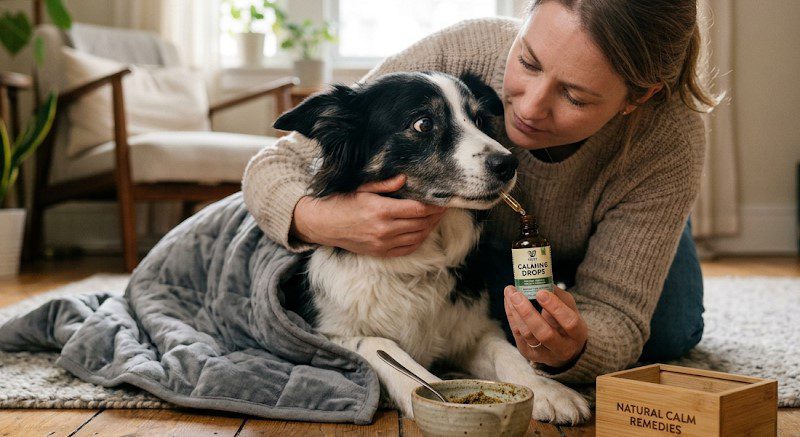
Supplement-Based Remedies
Hemp Extract (CBD) ⭐⭐⭐
Mechanism: Interacts with the endocannabinoid system — specifically CB1 and CB2 receptors involved in mood regulation, stress response, and pain perception. Modulates the release of cortisol and promotes homeostatic nervous system function.
Evidence: A 2019 study published in Frontiers in Veterinary Science found that CBD oil significantly reduced anxiety-related behaviors in dogs during stressful events. Multiple subsequent studies have supported anxiolytic effects at appropriate doses.
Realistic expectations: Effective for mild-to-moderate anxiety. Works best when given daily rather than situationally. Takes 30–60 minutes for onset. Does not sedate — your dog remains alert.
Limitations: Quality varies enormously between products. Always look for products that specify milligrams of hemp extract per serving (not just “hemp seed oil”) and show third-party lab testing. Dose matters — underdosed products will not produce measurable effects.
Our recommendation: Full-spectrum hemp extract at 1–2mg per kg of body weight, given daily.
How to Read a CBD Certificate of Analysis (COA) — What to Look For Before You Buy
A Certificate of Analysis is a third-party lab report that verifies what is actually in a CBD product. Reputable brands provide one for every batch. Here is exactly what to look for:
1. Third-party lab verification The COA must be from an independent laboratory — not the brand’s own testing. Look for lab names like ProVerde, Botanacor, or ACS Laboratory. If you cannot find a COA or it appears to be self-issued, do not buy the product.
2. CBD concentration accuracy The COA should confirm the CBD milligrams per serving match the label claim within a 10–15% margin. Products that show significantly less CBD than labeled are underdosed. Products showing significantly more may be misdosing.
3. THC level Hemp-derived CBD must contain less than 0.3% THC by law. The COA should confirm this. For dogs specifically, even trace THC can cause adverse reactions — always verify this number.
4. Heavy metals panel Look for testing on arsenic, cadmium, lead, and mercury. All should read “ND” (not detected) or below safe threshold limits.
5. Pesticide and solvent screening Should show no residual pesticides or extraction solvents above safe limits.
6. Batch number matches product The batch number on the COA should match the batch number printed on your product’s label. A COA for a different batch tells you nothing about what is in your specific product.
Where to find COAs: Reputable brands publish COAs on their website under “Lab Results,” “Transparency,” or “COA.” If a brand does not publish COAs publicly, that alone is sufficient reason to choose a different product.
L-Theanine ⭐⭐⭐
Mechanism: An amino acid from green tea that increases GABA, serotonin, and dopamine — neurotransmitters associated with calm, positive emotional states. Uniquely promotes relaxation without sedation.
Evidence: Among the best-evidenced natural calming compounds available for dogs. Multiple clinical trials confirm significant reductions in anxiety behaviors. Suntheanine (the patented form) shows the most consistent results.
Realistic expectations: Works within 30–60 minutes. Effective for mild-to-moderate situational anxiety. Daily use produces better baseline results than situational dosing.
Limitations: Loses effectiveness at very high anxiety intensities — better suited as a baseline management tool than an acute intervention.
Melatonin ⭐⭐⭐
Mechanism: Regulates the sleep-wake cycle and modulates the HPA (hypothalamic-pituitary-adrenal) axis — the body’s primary stress response system. Shown to reduce cortisol response to noise events specifically.
Evidence: Among the strongest evidence bases of any natural dog anxiety remedy. Multiple peer-reviewed studies specifically support melatonin for noise phobia, nighttime anxiety, and sleep disruption.
Realistic expectations: Particularly effective for noise-related anxiety (thunderstorms, fireworks) and nighttime restlessness. Give 30–60 minutes before anticipated stressors. Effective at 1–3mg for small dogs, 3–6mg for large dogs.
Limitations: Some dogs become mildly drowsy at higher doses. Always use dog-specific formulations — some human melatonin contains xylitol, which is toxic to dogs.
CBD and Melatonin Dosage Guide by Dog Weight
Use this as a starting reference. Always begin at the lower end of the range and increase gradually based on your dog’s response. Consult your veterinarian before use, particularly for dogs on existing medications.
| Dog Weight | Hemp Extract (CBD) Starting Dose | Melatonin Dose | Notes |
|---|---|---|---|
| 5–10 lbs | 1–2mg per dose | 1mg | Small breeds; start at minimum |
| 10–25 lbs | 2–5mg per dose | 1–3mg | Most small-medium breeds |
| 25–50 lbs | 5–10mg per dose | 3mg | Medium breeds standard range |
| 50–75 lbs | 10–15mg per dose | 3–6mg | Large breeds |
| 75–100 lbs | 15–20mg per dose | 6mg | Large to giant breeds |
| 100 lbs+ | 20–25mg per dose | 6mg max | Giant breeds — always vet consult |
Important: These are general guidelines based on published veterinary research. Individual response varies significantly by breed, metabolism, and anxiety severity. A dog showing no response at the standard dose after 14 days of consistent use may benefit from veterinary assessment rather than dose escalation.
Note on probiotics: Emerging research on the gut-brain axis in dogs specifically identifies Bifidobacterium longum (BL999) as the strain with the most promising preliminary evidence for reducing anxiety-related behaviors. If adding a probiotic to your dog’s anxiety management protocol, look for this specific strain on the label.
Chamomile ⭐⭐
Mechanism: Contains apigenin — a compound that binds to GABA receptors in the brain, producing mild anxiolytic effects similar to low-dose benzodiazepines but without dependency or sedation at typical supplement doses.
Evidence: Strong historical use with moderate clinical research. Most effective when combined with other active ingredients rather than used as a standalone supplement.
Realistic expectations: Mild calming effect, best as a supporting ingredient in a multi-compound formula. Good safety profile for long-term use.
Valerian Root ⭐⭐
Mechanism: Acts as an adaptogen — modulating the nervous system’s response to stress over time rather than producing an acute calming effect. Contains valerenic acid which influences GABA neurotransmission.
Evidence: Moderate evidence base. Works best after 2–4 weeks of consistent use rather than as an acute intervention.
Realistic expectations: Better for chronic anxiety management than acute events. Most effective as part of a multi-ingredient formula.
Ashwagandha ⭐⭐
Mechanism: Reduces cortisol output from the adrenal glands and improves stress resilience through adaptogenic action. Well-established in human research; emerging dog-specific research.
Evidence: Moderate — strong human evidence base, growing veterinary interest. Not yet studied as extensively in dogs as other supplements.
Realistic expectations: Emerging option worth considering for chronic high-cortisol anxiety. Best used as a long-term daily supplement rather than situational intervention.
Rescue Remedy ⭐
Mechanism: Bach Flower Essence formula containing diluted flower extracts. Homeopathic formulation — active ingredients are diluted to undetectable concentrations.
Evidence: No peer-reviewed clinical evidence of efficacy beyond placebo in controlled veterinary studies. The mechanism of action is not pharmacologically supported.
Honest assessment: We include this because it is widely used and widely discussed. The evidence simply does not support it as an anxiety treatment. Many owners report positive effects — this may reflect the placebo effect on owner behavior (calmer owner = calmer dog), the brandy carrier in some formulations, or genuine individual variation.
Our recommendation: Not a product we can recommend as a primary anxiety treatment given the lack of evidence.
Physical and Environmental Remedies
Deep Pressure Therapy (Compression Vest) ⭐⭐⭐
Mechanism: Applies constant, gentle pressure to the dog’s torso, activating the parasympathetic nervous system and suppressing the sympathetic (fight-or-flight) response. The same mechanism used in weighted blankets for humans with anxiety.
Evidence: Strong. A 2014 study in the Journal of Veterinary Behavior found compression garments reduced anxiety behaviors in 89% of participating dogs. Widely recommended by veterinary behaviorists as a first-line non-pharmaceutical intervention.
Realistic expectations: Works within 5–15 minutes when correctly fitted. Most effective when applied before peak anxiety rather than during it.
Pheromone Therapy (Adaptil/DAP) ⭐⭐
Mechanism: Synthetic versions of the calming pheromone secreted by nursing mother dogs. Detected by chemoreceptors in the dog’s nose and vomeronasal organ, signaling safety at a neurological level below conscious awareness.
Evidence: Moderate-to-strong. Multiple studies show effectiveness for kennel stress, travel anxiety, and new environment adjustment. Less consistent evidence for severe phobias.
Realistic expectations: Most effective for mild-to-moderate anxiety related to environmental change or travel. Available as diffusers, sprays, and collars. Diffusers take 24–48 hours to establish effective room concentration.
Limitations: Not effective for all dogs. Collars must be replaced every 4 weeks.
White Noise and Calming Music ⭐⭐
Mechanism: Acoustic masking of anxiety-triggering sounds. Calming music — specifically classical, reggae, and soft rock — has been shown to alter dog heart rate variability and reduce stress markers in shelter dogs.
Evidence: Moderate. The research on music is stronger for shelter environments but transfers to home settings. White noise is more about masking triggers than direct calming.
Realistic expectations: Excellent adjunct therapy — reduces the frequency and intensity of sound-triggered anxiety episodes. Low cost, no side effects, works immediately.
Nose Work and Mental Enrichment ⭐⭐⭐
Mechanism: Olfactory engagement activates dopaminergic reward pathways while simultaneously suppressing cortisol-driven stress response. Neurologically incompatible with the peak anxiety state — the brain cannot fully engage in focused nose work and full panic simultaneously.
Evidence: Strong. Research in Applied Animal Behaviour Science confirms that regular nose work activities measurably reduce anxiety-related behaviors and cortisol markers in dogs.
Realistic expectations: One of the most evidence-backed non-supplement interventions available. A snuffle mat used daily provides sustained, cumulative anxiety reduction over weeks and months.
Massage and Therapeutic Touch ⭐⭐
Mechanism: Rhythmic, gentle touch activates the oxytocin system — the social bonding and calming hormone — while reducing cortisol and heart rate in both the dog and the human providing the touch.
Evidence: Moderate clinical evidence, very strong anecdotal and observational support.
Realistic expectations: Excellent for daily baseline anxiety reduction and strengthening the human-dog bond. Less effective as an acute intervention during peak anxiety when the dog is too activated to accept touch.
Building Your Natural Remedy Stack
The most effective approach combines remedies from multiple categories:
FOUNDATIONAL (daily, ongoing): Hemp extract + L-theanine + melatonin supplement (daily with morning meal) Consistent enrichment routine (snuffle mat, puzzle feeder) Consistent daily exercise
SITUATIONAL (30–60 minutes before known trigger): Additional calming supplement dose Compression vest application Pheromone spray on bedding
IN THE MOMENT: Lick mat White noise Calm owner presence
This three-layer approach addresses anxiety neurochemically (supplements), physically (compression), and cognitively (enrichment) — the most comprehensive natural anxiety management possible without pharmaceutical intervention.
The AKC recommends natural remedies as first-line interventions for mild-to-moderate anxiety and notes that the combination of behavioral strategies with natural supplements consistently produces better outcomes than either alone. Read their full guidance at AKC.org.
What is the most effective natural remedy for dog anxiety?
Based on the current evidence base, the combination of hemp extract, L-theanine, and melatonin in a daily supplement routine — paired with regular mental enrichment and compression therapy for acute events — produces the most consistent results for mild-to-moderate anxiety.
How quickly do natural remedies work for dog anxiety?
Supplements with L-theanine and hemp extract produce effects within 30–60 minutes of ingestion. Full baseline benefits from daily supplementation typically emerge at 7–14 days. Physical tools like compression vests work within 5–15 minutes. Enrichment-based interventions produce cumulative improvement over weeks of consistent use.
Are natural remedies enough for severe dog anxiety?
For severe anxiety — self-injury during panic, inability to eat or function, extreme noise phobia — natural remedies alone are typically insufficient. A veterinary behaviorist consultation and consideration of pharmaceutical support alongside natural strategies is the appropriate next step.
Is CBD safe for dogs daily?
Yes — hemp extract at appropriate doses is considered safe for long-term daily use in dogs based on current research. Always use dog-specific formulations from reputable brands with third-party lab testing
Do probiotics help dog anxiety?
Emerging research on the gut-brain axis suggests that gut microbiome health influences anxiety in dogs. Probiotic supplementation is a promising area with early positive studies. Not yet strong enough evidence for a primary recommendation, but a reasonable addition to a comprehensive anxiety management plan.
What should I look for on a dog CBD product’s Certificate of Analysis?
Third-party lab verification, accurate CBD concentration, THC below 0.3%, heavy metals panel showing clean results, and a batch number that matches your product. See our full COA guide in this article.
Is there a simple way to calculate CBD dose for my dog?
Start with 1–2mg of CBD per 10 lbs of body weight per dose. Give once daily for the first week, then adjust based on response. Use the weight table in this article as your reference. Always consult your vet for dogs on existing medications.
Subscribe & save 15% · Free US shipping
About the Author
The PawCalmHub Team
At PawCalmHub, we are a passionate team of pet lovers dedicated to helping anxious pets live calmer, happier lives. Every article we publish is thoroughly researched against current veterinary behavioral guidelines, peer-reviewed studies, and trusted sources including the American Kennel Club and the Fear Free organization. References in this article link directly to the sources cited.
Questions? Email us at hello@pawcalmhub.com — we respond within 24 hours.
Explore our full range of grooming and wellness tools at PawCalmHub.com