
📊 Evidence-Based Content Rating
⭐⭐⭐ Clinical evidence: Peer-reviewed veterinary studies
⭐⭐ Moderate evidence: Some studies + strong professional consensus
⭐ Emerging evidence: Theoretical or early-stage research
This article uses this rating system throughout for full transparency.
Reviewed for alignment with AKC and Fear Free veterinary guidelines.
Written by The PawCalmHub Team. Reviewed for alignment with current veterinary behavioral guidelines and the American Kennel Club (AKC). Last updated 2025.
⚠️ Sudden or rapidly worsening anxiety in a senior dog always warrants veterinary assessment to rule out pain, cognitive dysfunction, and other medical causes.
You adopted this dog 11 years ago. You know every one of their habits, every sound they make, every look they give you.
And lately, something has shifted.
They startle at sounds that never bothered them before. They pace at night when they used to sleep soundly. They follow you from room to room with a new urgency. They seem confused sometimes — standing in doorways, staring at walls, forgetting the routine they have followed for years.
Your dog is the same dog. But their brain is changing. And understanding how it is changing is the key to helping them.
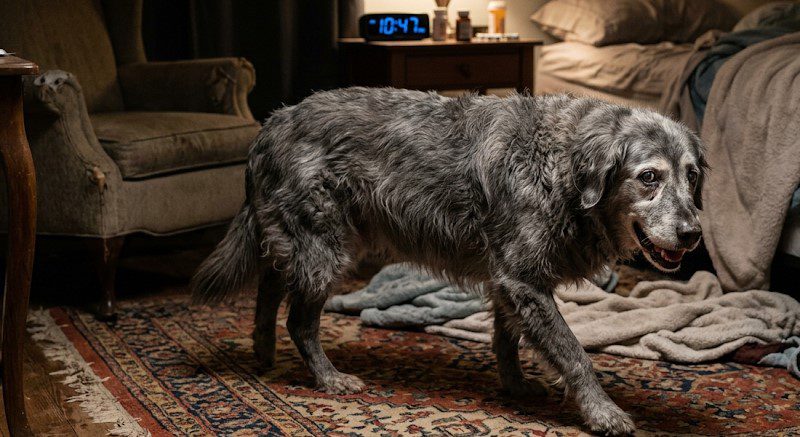
The Aging Dog Brain: What Is Actually Happening
Several interconnected neurological changes occur in the aging canine brain that directly increase anxiety vulnerability:
Prefrontal cortex decline: The prefrontal cortex — the brain’s rational regulator — begins to show reduced volume and efficiency in dogs over 7-8 years. This is the brain region responsible for inhibiting the amygdala’s alarm responses. As it declines, the alarm system fires more easily and is harder to regulate.
Serotonin reduction: Serotonin is a neurotransmitter that broadly promotes calm, positive emotional states. Dogs produce progressively less serotonin as they age. Lower serotonin levels directly correlate with higher baseline anxiety — the same mechanism underlying clinical anxiety disorders in humans.
Melatonin dysregulation: The pineal gland, which produces melatonin, becomes less efficient with age. Disrupted melatonin production causes sleep-wake cycle dysregulation that directly worsens nighttime anxiety.
Sensory decline: Age-related hearing and vision loss changes how a senior dog processes their environment. A dog who cannot hear well is more easily startled. A dog whose vision is declining navigates an increasingly uncertain sensory world — a physiological anxiety trigger in itself.
Pain: Arthritis, dental disease, and other age-related conditions create background pain that maintains a low-level stress response continuously. A dog in chronic pain is a dog with chronically elevated cortisol — the physiological state of anxiety.
Canine Cognitive Dysfunction: The Anxiety That Looks Like Dementia
Canine Cognitive Dysfunction (CCD) affects an estimated 14–35% of dogs over age 8, rising to over 60% of dogs over age 15. It is a neurodegenerative condition directly analogous to Alzheimer’s disease, characterized by abnormal protein deposits in the brain that impair cognitive function.
The DISHAA diagnostic framework identifies the core signs:
- Disorientation: getting lost in familiar spaces, staring at walls, confusion about directions
- Interaction changes: reduced interest in human interaction, altered relationships with family members
- Sleep-wake cycle changes: sleeping during the day, awake and restless at night
- House soiling: forgetting previously reliable house training
- Activity changes: reduced engagement, apparent purposelessness
- Anxiety: new or worsening anxiety, separation distress, general fearfulness
If your senior dog is showing multiple signs from this list, discuss CCD assessment with your veterinarian. There is no cure, but veterinary treatment (including selegiline/Anipryl, a medication specifically approved for CCD) combined with environmental and nutritional support can significantly slow progression and improve quality of life.
Pain Assessment: The Hidden Anxiety Driver
Pain is the most commonly overlooked cause of anxiety in senior dogs — because dogs mask pain exceptionally well, and because pain’s effects on anxiety are indirect and therefore harder to identify as connected.
A senior dog with unmanaged arthritis is in constant discomfort. That constant discomfort maintains a persistent stress response. That persistent stress response lowers the anxiety threshold for every other trigger — sounds that were manageable become overwhelming, separations that were fine become distressing.
Signs of pain-driven anxiety:
- Anxiety that is worse in cold or damp weather (classic arthritis pattern)
- Reluctance to lie down, difficulty finding a comfortable position
- Stiffness after rest, improved movement after 10–15 minutes of gentle activity
- Irritability or uncharacteristic aggression when touched in specific areas
- Licking or chewing specific joints or body areas
If any of these patterns fit your senior dog, a pain assessment by your veterinarian should precede any anxiety treatment. Managing the pain may resolve or significantly reduce the anxiety.
Sensory Loss and Anxiety
Age-related hearing loss and vision decline are significant, underappreciated anxiety drivers in senior dogs.
Hearing loss: A dog who cannot hear well is more easily startled by sounds they cannot anticipate. They may also become distressed when they cannot locate you by sound — a form of sensory separation anxiety. Signs include increased startle responses, difficulty finding you when out of sight, apparent unresponsiveness to verbal cues they previously knew well.
Vision decline: A dog whose vision is failing navigates a progressively more uncertain visual world. Familiar environments become less reliable — shadows, reflections, and poor lighting create visual uncertainty that the anxious brain interprets as potential threats.
What to do: Speak to your senior dog before approaching them to avoid startles. Maintain consistent furniture placement and nighttime lighting. Use scent — a worn piece of your clothing — as a reliable comfort signal that does not depend on hearing or vision.
Managing Senior Dog Anxiety: A Comprehensive Approach
1. Veterinary Assessment First
Before any behavioral or supplement-based intervention, a comprehensive veterinary assessment is essential. Your vet should evaluate: pain levels (especially arthritis), cognitive status (CCD screening), sensory health (hearing and vision), thyroid function (hypothyroidism mimics anxiety), and any other age-related conditions that may be contributing.
2. Pain Management
If pain is identified as a contributing factor, appropriate pain management — NSAIDs, joint supplements (glucosamine/chondroitin), acupuncture, physiotherapy — should be the primary intervention. Many senior dogs who receive adequate pain management show significant spontaneous reduction in anxiety behaviors.
3. Daily Calming Supplements
Senior dogs benefit significantly from daily calming supplement routines targeting the specific neurochemical deficits of aging:
Melatonin — directly addresses the melatonin dysregulation of aging. Particularly valuable for nighttime restlessness and sleep-wake cycle disruption.
L-theanine — supports serotonin and GABA — the neurotransmitters declining with age.
Hemp extract — endocannabinoid system support is particularly relevant in aging dogs whose system becomes less efficient over time.
Omega-3 fatty acids — EPA and DHA support neurological health and have anti-inflammatory properties relevant to both pain and cognitive function. Look for fish oil supplements specifically formulated for dogs.
Cognitive Health Nutrition for Senior Dogs — What the Research Supports
Diet is among the most underappreciated tools for managing cognitive decline and anxiety in senior dogs. While no diet reverses CCD, specific nutritional interventions have meaningful evidence for slowing progression and supporting neurological function.
Omega-3 Fatty Acids (EPA and DHA): The most well-established nutritional intervention for canine cognitive health. EPA and DHA — the active forms found in fish oil — have anti-inflammatory effects on brain tissue and support neuronal membrane integrity. Multiple studies support supplementation in senior dogs. Look for fish oil specifically formulated for dogs (human fish oil capsules can be appropriate at weight-adjusted doses but verify your specific brand does not contain xylitol or added flavors).
Recommended dose: 20–55mg EPA+DHA combined per kg of body weight daily. Always introduce gradually — too much fish oil at once causes digestive upset.
Antioxidants (Vitamin E and C): Oxidative stress is a significant driver of neurological aging in dogs. Antioxidant supplementation has shown neuroprotective effects in canine studies. Commercial senior dog foods often include antioxidant fortification — check the label. If supplementing separately, use veterinary-formulated options rather than human supplements (human Vitamin E often contains propylene glycol which is toxic to cats and potentially problematic for dogs at high doses).
MCT Oil (Medium Chain Triglycerides): An emerging but promising intervention. The brain can use ketones from MCT metabolism as an alternative fuel source when glucose metabolism is impaired (as occurs in CCD). Preliminary studies suggest MCT supplementation may improve cognitive function scores in dogs with CCD. Coconut oil is a natural MCT source but purpose-formulated MCT oils have more consistent and concentrated composition. Start with very small doses (1/4 teaspoon for small dogs, 1/2 teaspoon for large dogs) and increase slowly — too much MCT causes diarrhea. Always consult your vet before adding MCT oil for a dog with any liver or metabolic conditions.
B Vitamins (particularly B12 and folate): Deficiency in B12 and folate is associated with accelerated cognitive decline in aging mammals. Senior dog foods typically include B vitamin fortification. For dogs showing cognitive symptoms, a veterinary B complex supplement is worth discussing with your vet.
Dietary Phosphatidylserine: A phospholipid that supports neuronal membrane function. Found in soy lecithin and some purpose-formulated cognitive support supplements for dogs. Early studies are promising.
What to look for in a senior dog food:
- DHA listed as an ingredient
- Antioxidant blend (Vitamins C and E, selenium)
- Reduced calorie density (senior dogs are often less active)
- Joint support ingredients (glucosamine, chondroitin) — managing joint pain reduces anxiety
- Avoid high sodium content — common in some senior formulations and problematic for dogs with cardiac or kidney conditions common in this age group
4. Adapted Enrichment for Senior Capability
Mental enrichment remains essential for senior dogs — but the form needs to adapt to their reduced physical capability and potentially slower cognitive processing.
A lick mat is ideal for senior enrichment — it requires no physical exertion, provides dopamine release through foraging behavior, and the repetitive licking action is genuinely calming. Shorter snuffle mat sessions (5–10 minutes) with easier-to-find treats are appropriate for cognitively declining dogs who may become frustrated by challenge levels suited to younger dogs.
5. Environmental Modifications
- Night lights in key locations (bathroom, bedroom, hallway) to support declining night vision
- Non-slip mats on smooth floors to reduce falls that increase anxiety
- Ramps or steps for furniture if your dog previously slept elevated
- White noise machine for nighttime sound sensitivity
- Maintain consistent routine with even greater rigidity than in younger years — predictability is more important to the aging nervous system, not less
6. Pheromone Therapy
Adaptil diffusers — which release synthetic calming pheromones — are particularly well-suited to senior dogs because they work without requiring any behavioral compliance from the dog. Plugin a diffuser in the rooms your senior dog uses most. The calming signal works passively throughout the day and night.
7. Physical Warmth and Comfort
Senior dogs regulate temperature less efficiently and find cold genuinely uncomfortable in ways that amplify anxiety. Ensure warm bedding in a draft-free location. An orthopedic memory foam bed supports arthritic joints and reduces the overnight discomfort that drives nighttime restlessness.
Senior Dog Home Modification Guide — Products That Reduce Anxiety
Beyond supplements and behavioral interventions, specific home modifications reduce the physical and sensory uncertainty that drives anxiety in senior dogs:
Orthopedic memory foam bed: Standard beds require effort to get comfortable that arthritic dogs experience as pain. Memory foam conforms to the body and distributes weight evenly. One of the highest-impact senior dog purchases available.
Non-slip mats and rugs on smooth floors: A dog who slips is a dog in a state of physical uncertainty — a direct anxiety driver. Cover all smooth flooring in areas your senior dog uses. Yoga mats cut to size work as budget-friendly options.
Ramps for furniture access: If your dog previously slept on your bed or sofa and can no longer jump safely, a ramp maintains access without the injury risk. Maintaining sleeping location is important for dogs who are already anxious about environmental change.
Night lights: Plug-in night lights in hallways, near water bowls, and near the sleeping area reduce navigation difficulty for dogs with declining vision — which directly reduces nighttime anxiety and wandering.
Raised food and water bowls: Arthritic necks make lowered bowls painful. Raised bowls reduce eating-associated pain and can improve food motivation in dogs showing appetite reduction from discomfort.
The Quality of Life Question
This is perhaps the most important section of this article, and the one that requires the most courage to read.
There comes a point in some senior dogs’ lives where anxiety is so pervasive and so unresponsive to intervention that the question of quality of life must be honestly assessed. A dog who is confused, in pain, sleeping poorly, no longer finding joy in things they loved, and anxious throughout most of their waking hours is a dog who is suffering.
This is not a conversation to have with a blog article. It is a conversation to have with your veterinarian — honestly, without guilt, and with your dog’s experience at the center.
Most senior dog anxiety is manageable and the dog’s quality of life can be meaningfully maintained with the right support. But “most” is not “all,” and knowing when you have done everything possible is part of the profound responsibility of loving a pet through the end of their life.
The AKC’s resources on aging dogs and quality-of-life assessment are available at AKC.org.
Is it normal for older dogs to become more anxious?
Yes — age-related neurological changes, sensory decline, and pain all contribute to increased anxiety in senior dogs. It is common, but it is not untreatable. Most senior dog anxiety responds well to a combination of veterinary pain management, daily supplements, and environmental adaptation.
What causes sudden anxiety in an old dog?
Sudden onset anxiety in a senior dog most commonly indicates pain, cognitive dysfunction (CCD), thyroid dysfunction, or another medical condition. Always prioritize veterinary assessment before assuming behavioral causes.
Can CBD help senior dogs with anxiety?
Yes — hemp extract (CBD) is among the better-evidenced natural interventions for senior dog anxiety. The endocannabinoid system plays a significant role in aging-related neurological changes, and CBD’s modulating effect on this system is particularly relevant in older dogs.
How do I know if my senior dog has cognitive dysfunction?
Use the DISHAA framework: Disorientation, Interaction changes, Sleep-wake changes, House soiling, Activity changes, Anxiety. If your dog shows signs in three or more categories, discuss CCD assessment with your veterinarian.
My senior dog won’t settle at night. What should I do?
See our dedicated guide on dog nighttime anxiety for the complete protocol. For senior dogs specifically, rule out pain and CCD first, then implement daily melatonin supplementation, a white noise machine, nighttime lighting, and warm orthopedic bedding.
About the Author
The PawCalmHub Team
At PawCalmHub, we are a passionate team of pet lovers dedicated to helping anxious pets live calmer, happier lives. Every article we publish is thoroughly researched against current veterinary behavioral guidelines, peer-reviewed studies, and trusted sources including the American Kennel Club and the Fear Free organization. References in this article link directly to the sources cited.
Questions? Email us at hello@pawcalmhub.com — we respond within 24 hours.
Explore our full range of grooming and wellness tools at PawCalmHub.com