
Estimated read time: 16 minutes | Last updated: 2025
A note on this guide: Breed predisposition describes a statistical tendency across a population — it does not determine the outcome for any individual dog. Many dogs from high-anxiety breeds live calm, well-adjusted lives with the right management. Many dogs from low-anxiety breeds develop significant anxiety disorders. Use this guide as a starting point for understanding your dog’s neurological baseline, not as a fixed diagnosis.
You probably already have a suspicion about your dog.
Maybe they shake during thunderstorms while your neighbour’s dog sleeps right through. Maybe they have destroyed three sofas in the two years since you adopted them, despite every training intervention you’ve tried. Maybe they are simply never fully relaxed — always scanning, always monitoring, always the first to react when something shifts in the environment.
And maybe someone has told you: “That’s just the breed.”
They are not entirely wrong. But they are not telling you the full story either.
The relationship between breed and anxiety in dogs is one of the most robustly documented findings in veterinary behavioural science — and one of the most misunderstood by the people it affects most. Yes, certain breeds carry a measurably higher predisposition toward anxiety. Yes, this is written into their genetics in ways that selective breeding over centuries has shaped and amplified. But predisposition is not destiny. Understanding why certain breeds are more anxious — the specific neurological and behavioural mechanisms involved — is what turns this information from a shrug into an action plan.
That is what this guide is for.
The Science That Changed How We Think About Breed Anxiety
In 2020, a team of researchers at the University of Helsinki published a study in Scientific Reports that stands as the most comprehensive investigation into canine anxiety and breed predisposition ever conducted. Led by Dr. Hannes Lohi, the study analysed behavioural data from over 13,700 dogs across 264 breeds — producing findings that both confirmed long-held veterinary suspicions and revealed some genuinely surprising patterns.
The headline finding: 72.5% of dogs show at least one significant anxiety-related behaviour. But the finding that matters most for this guide is what the study revealed about breed clustering.
Anxiety is not randomly distributed across the dog population. Specific anxiety traits cluster in specific breeds with statistical significance. Noise sensitivity was most prevalent in Lagotto Romagnolos, wheaten terriers, and mixed-breed dogs. Fearfulness was highest in Spanish water dogs and Shetland sheepdogs. Inattentive behaviour was most common in cairn terriers. Aggression toward strangers — a social anxiety variant — was notably elevated in miniature schnauzers.
The study also identified something that surprised many in the veterinary community: mixed-breed dogs showed higher rates of noise sensitivity than many purebreds. The researchers hypothesised this may reflect a broader genetic variability that produces less predictable neurological profiles — a finding with significant implications for rescue dog owners.
What drives these breed differences? The researchers pointed to two intersecting mechanisms.
First, selective breeding for specific behavioural traits appears to have simultaneously selected for anxiety-related traits. Herding breeds were developed to be exquisitely sensitive to environmental stimuli — to notice the single sheep that has broken from the flock, to respond instantly to subtle directional cues from the shepherd. That hypersensitivity to environmental input does not switch off when the sheep are gone. In a suburban home, it manifests as vigilance, reactivity, and noise sensitivity.
Second, by selecting for certain traits like sociability and bonding, breeders may have inadvertently selected for the separation anxiety that is the shadow side of extreme owner-attachment. The dog who follows you from room to room, who greets you as though you have returned from war after a 20-minute supermarket run, who cannot settle unless they can feel your physical presence — that dog was, in many ways, bred to be exactly that attached. The anxiety is not a malfunction. It is the cost of the connection.
External reference: Salonen et al. 2020, Scientific Reports — Prevalence, comorbidity, and breed differences in canine anxiety in a referral hospital population
What Breed Predisposition Actually Means — and What It Doesn’t
Before the breed profiles, a framework that prevents the most common misreading of this information.
Predisposition describes a lower threshold, not an inevitable outcome. A breed with high anxiety predisposition has a nervous system that reaches the anxiety response at a lower level of stimulus than a breed with low predisposition. The same thunderstorm that a Basset Hound sleeps through will send a Border Collie under the bed — not because the Border Collie is weaker, but because their nervous system is calibrated to respond to that stimulus at a lower intensity. The threshold is genetic. Whether it is crossed, and how often, is environmental.
Breed predisposition interacts with early experience. A Border Collie who receives excellent socialisation during the critical window of 3–14 weeks, who is raised in a stimulating, positive environment with consistent handling and exposure to the full range of normal life stimuli, will have significantly lower expressed anxiety than a Border Collie from a puppy mill who experienced isolation during that same window. The genetics load the gun. The environment pulls the trigger.
Individual variation within breeds is substantial. The breed averages in this guide are population-level statistics. Your individual dog may sit at the calm end of their breed’s distribution, or the anxious end, or anywhere between. Use breed predisposition as a starting hypothesis, not a conclusion.
With that in mind — the breeds.
The 15 Most Anxiety-Prone Dog Breeds
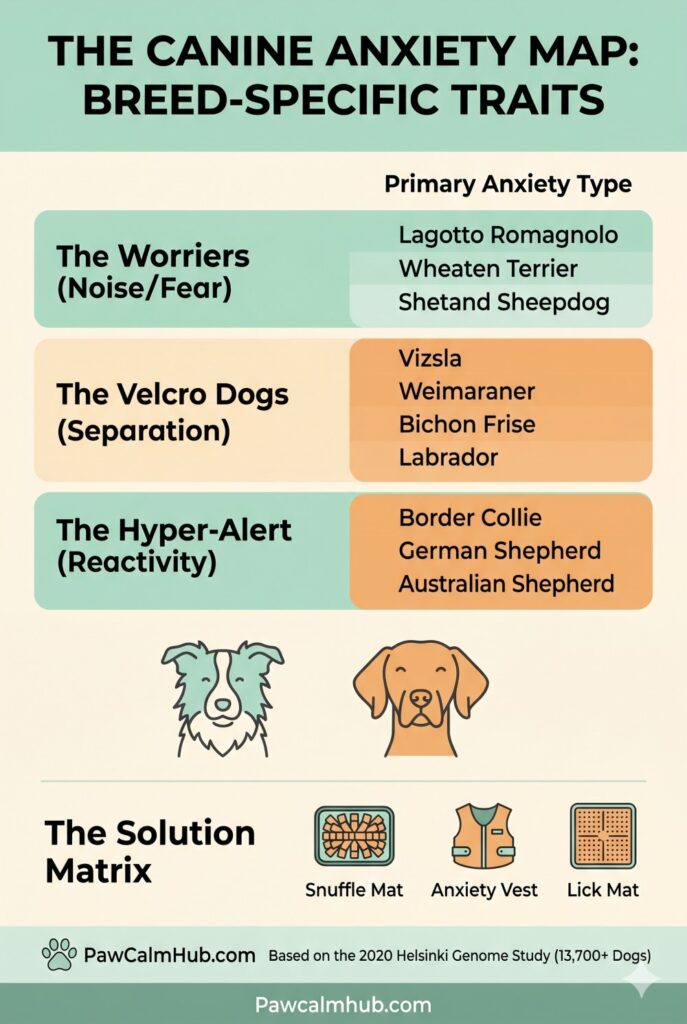
1. Border Collie
Primary anxiety type: Noise phobia, generalised hyperarousal, obsessive-compulsive behaviours
Why they’re prone: Border Collies were bred over centuries to be the most environmentally responsive working dog in existence. Their ability to detect, interpret, and react to subtle directional signals from shepherds — and to monitor an entire flock for the slightest deviation — required a nervous system tuned to near-maximum sensitivity. In a working environment with a job and an outlet, this sensitivity is functional genius. In a suburban home without adequate mental and physical stimulation, it becomes chronic hyperarousal that manifests as anxiety, obsessive behaviours (shadow chasing, light chasing, compulsive ball fixation), and extreme noise reactivity.
The specific mechanism: Border Collies often develop what behaviourists call arousal-based anxiety — their baseline arousal level is simply higher than most breeds, meaning they have less distance to travel before tipping into a full anxiety response. Boredom amplifies this dramatically.
What helps most: Mental stimulation before physical — nose work, puzzle feeders, and snuffle mats produce the cognitive fatigue that two hours of fetch cannot replicate. A snuffle mat for anxious dogs used at every meal is not optional enrichment for a Border Collie — it is baseline management. Structured work (agility, herding, advanced obedience) channels the sensitivity productively.
Read more: Best Interactive Dog Toys for Anxious Dogs
2. German Shepherd
Primary anxiety type: Separation anxiety, territorial anxiety, noise sensitivity
Why they’re prone: German Shepherds were developed as protection and herding dogs with a strong guarding instinct and intense owner-bonding. The same loyalty and protectiveness that makes them exceptional working dogs produces a nervous system that is deeply attuned to the presence and absence of their primary person — and to anything that might constitute a threat to the home or family.
The specific mechanism: German Shepherds frequently develop what is sometimes called sentinel anxiety — a state of chronic vigilance in which they are perpetually monitoring the environment for threats. This is not relaxed awareness. It is sustained, cortisol-elevating hypervigilance that is neurologically exhausting and, over time, produces the same physiological damage as any chronic anxiety disorder. Barking at sounds outside, pacing at night, and inability to settle when the owner is absent are the most common presentations.
What helps most: The anxiety vest during high-trigger periods, consistent daily exercise to burn the vigilance energy, and a smart camera during separations so you can assess what is actually happening versus what you imagine is happening. Many German Shepherd owners are surprised to discover their dog settles within minutes of departure — the anxiety is in the anticipation, not the reality of being alone.
Read more: Dog Separation Anxiety Solutions
3. Australian Shepherd
Primary anxiety type: Boredom anxiety, noise sensitivity, herding-instinct frustration
Why they’re prone: Like the Border Collie, Australian Shepherds were bred for a working life that demanded constant engagement, environmental sensitivity, and rapid response to stimuli. Unlike Border Collies, Australian Shepherds also carry a strong social drive that makes isolation particularly distressing. The combination of high stimulation need and high social need produces an anxious dog very quickly when either goes unmet.
The specific mechanism: Australian Shepherds commonly develop frustration-based anxiety — a form of distress produced not by a specific fear but by the mismatch between their neurological need for engagement and the level of stimulation their environment provides. This is the breed that herds children, chases cars, and develops obsessive behaviours around moving objects — not out of aggression, but out of an unmet biological drive.
What helps most: Rotating puzzle feeders to prevent habituation, structured training sessions twice daily, and an automatic dog ball launcher that provides self-directed physical exercise. For a dog whose anxiety is partly driven by insufficient stimulation, the ball launcher is one of the highest-ROI single investments available.
4. Vizsla
Primary anxiety type: Severe separation anxiety, velcro dog syndrome
Why they’re prone: The Vizsla is one of the most intensely owner-bonded breeds in existence — so much so that they are commonly described as a “velcro dog.” This bonding was functional in their original role as hunting companions who worked in close partnership with a single handler all day. In a modern home where that handler leaves for eight hours of work, the result is some of the most severe separation anxiety documented in any breed.
The specific mechanism: Vizslas frequently develop what behaviourists classify as hyper-attachment disorder — an anxiety response so tightly linked to the owner’s presence that even brief separations produce a full physiological stress response. The dog is not misbehaving during absence. They are experiencing genuine psychological distress with measurable physiological correlates.
What helps most: The desensitisation protocol for separation anxiety must begin early — ideally before the first extended separation ever occurs. This means practising departures from the very first week of ownership: putting on your coat, walking to the door, picking up your keys, and then not leaving. Gradually extending absence from 30 seconds to 5 minutes to 20 minutes over weeks. A dog treat dispenser toy for anxiety that delivers rewards autonomously during absences helps build the positive association that departure does not mean abandonment.
5. Weimaraner
Primary anxiety type: Extreme separation anxiety, destructive anxiety
Why they’re prone: Weimaraners were bred as close-working hunting dogs with exceptional physical stamina and an intense drive to work alongside their handler. They are frequently cited by veterinary behaviourists as among the highest-risk breeds for severe separation anxiety — not because they are emotionally fragile, but because their need for human partnership is neurologically fundamental rather than a learned preference.
The specific mechanism: Weimaraners have a notably low arousal threshold combined with an extremely high activity drive. The combination means that when left alone without adequate pre-departure exercise and mental stimulation, they reach full anxiety arousal within minutes and sustain it for the duration of the absence. The destruction that results — frequently structural, targeting doors and walls rather than soft furnishings — reflects the intensity of the panic, not wilfulness.
What helps most: Vigorous exercise immediately before departure to lower the arousal baseline. A calming chew administered 45 minutes before departure. A lick mat prepared and frozen the night before, given at the moment of departure — the licking provides both a distraction and a parasympathetic nervous system activation that counters the acute stress response.
Read more: Hemp Calming Chews for Dogs and Lick Mat for Dog Anxiety
6. Bichon Frise
Primary anxiety type: Separation anxiety, noise sensitivity, social anxiety
Why they’re prone: The Bichon Frise was bred specifically as a companion animal — a dog with no working function whose entire purpose was human companionship. This has produced a breed with an extremely high social drive and correspondingly low tolerance for solitude. What looks like a cheerful, confident small dog is frequently a dog whose equanimity is entirely dependent on human proximity.
The specific mechanism: Bichons commonly develop what is sometimes called demand anxiety — a pattern where the dog has learned that vocalisation, destructive behaviour, or persistent attention-seeking successfully produces owner return or engagement. This is not manipulation in any morally loaded sense — it is a learned association, and it means that the management approach must carefully avoid accidentally reinforcing the anxiety behaviour while still meeting the dog’s genuine social needs.
What helps most: A self-warming bed in the owner’s habitual daytime location, consistent departure and return routines that are calm and low-drama, and ensuring the dog has adequate mental stimulation during absences rather than being left in an empty, unstimulating environment.
Read more: Self-Warming Dog Anxiety Bed
7. Cavalier King Charles Spaniel
Primary anxiety type: Separation anxiety, noise sensitivity, generalised fearfulness
Why they’re prone: Another purpose-bred companion dog, the Cavalier combines intense owner-bonding with a gentle, sensitive temperament that processes stressors more acutely than more robust breeds. They are also notably prone to a neurological condition called Syringomyelia — a painful spinal condition affecting a significant proportion of the breed — which can produce pain-driven anxiety that is frequently misattributed to behavioural causes.
The specific mechanism: Any assessment of anxiety in a Cavalier should include veterinary evaluation to rule out Syringomyelia and related conditions. Pain-driven anxiety and separation anxiety present very similarly in this breed. Treating the wrong one wastes time and causes unnecessary distress.
What helps most: Veterinary pain assessment first. For confirmed behavioural anxiety, the grooming glove is particularly useful for Cavaliers — their tactile sensitivity means that gentle, systematic touch with a soft grooming tool is among the most effective calming interventions available.
Read more: Grooming Glove for Anxious Dogs
8. Lagotto Romagnolo
Primary anxiety type: Noise sensitivity (highest of any breed in the Finnish study)
Why they’re prone: The Finnish genome study flagged the Lagotto Romagnolo — a truffle-hunting breed — as showing the highest prevalence of noise sensitivity of any breed assessed. The likely mechanism is the same as in other scent-work breeds: a nervous system finely calibrated to detect and respond to subtle environmental signals, with a corresponding hypersensitivity to sudden or unpredictable auditory input.
What helps most: Sound desensitisation begun in puppyhood — gradual exposure to recorded storm and fireworks sounds at low volume with high-value food rewards. An anxiety vest during storm season, deployed proactively rather than reactively.
Read more: How to Help a Dog With Fireworks Anxiety and How to Calm a Dog During Thunderstorms
9. Shetland Sheepdog
Primary anxiety type: Noise sensitivity, fearfulness, herding-drive hyperarousal
Why they’re prone: The Sheltie is, in simplified terms, a Border Collie in a smaller package — with all the environmental sensitivity and herding-drive hyperarousal that implies, compressed into a dog that many owners underestimate because of their size and appearance. The Finnish study placed Shetland sheepdogs among the highest-fearfulness breeds assessed.
What helps most: The same approach as Border Collies — mental stimulation prioritised over physical, structured routine, and proactive noise desensitisation. Shelties are also particularly responsive to owner emotional state, so managing your own anxiety around their triggers produces measurable benefit.
10. Cocker Spaniel
Primary anxiety type: Noise sensitivity, situational anxiety, what veterinary behaviourists call “rage syndrome” in certain lines (a distinct condition from anxiety, but worth awareness)
Why they’re prone: Cocker Spaniels show elevated noise sensitivity and situational anxiety — particularly around grooming. Given that their coat requires frequent professional grooming, grooming anxiety is a particularly relevant management challenge for this breed.
What helps most: Early, systematic desensitisation to grooming implements, beginning with a grooming glove before progressing to scissors and clippers. The quiet dog nail grinder for anxious dogs removes the sharp clip sound that triggers many Cocker Spaniels during nail care.
Read more: How to Groom an Anxious Dog at Home
11. Chihuahua
Primary anxiety type: Social anxiety, noise sensitivity, territorial anxiety
Why they’re prone: Chihuahuas present a specific management challenge because their anxiety is frequently misread as aggression or personality. The reactive barking, the snapping at strangers, the shaking in unfamiliar environments — these are fear responses that owners often attribute to boldness or attitude. In reality, many Chihuahuas are running on a chronic background level of social anxiety that would be immediately recognised as such in a larger breed.
The specific mechanism: Chihuahuas are notably small in a world built for larger animals. From a dog’s-eye perspective, human environments are disproportionately scaled, unpredictable, and full of stimuli that represent genuine physical threat to a 2kg dog. Their anxiety, in many cases, is a proportionate response to their actual vulnerability in a human-scale world.
What helps most: Never forcing social contact — allowing the dog to approach strangers on their own terms, at their own pace. A safe space the dog can retreat to at social gatherings. Avoiding situations where the dog is held against their will by well-meaning strangers who want to pet them. Their anxiety is not solved by exposure — it is solved by control.
12. Spanish Water Dog
Primary anxiety type: Fearfulness (highest of any breed in the Finnish study for this trait)
Why they’re prone: The Finnish study identified the Spanish Water Dog as showing the highest rates of generalised fearfulness of any breed assessed. As a relatively rare breed with a limited breeding population, this may partly reflect founder effects — a small gene pool in which anxiety-related traits have become amplified. The specific mechanisms are less well understood than in the more common breeds above.
What helps most: Early socialisation with particular emphasis on novelty exposure — new environments, new surfaces, new sounds — during the critical window. A foundation of predictable routine that reduces the cognitive load of environmental uncertainty.
13. Miniature Schnauzer
Primary anxiety type: Stranger-directed aggression as a social anxiety variant
Why they’re prone: The Finnish study identified miniature schnauzers as showing notably elevated aggression toward strangers — a finding that most owners and many veterinarians interpret as a dominance or territorial behaviour, when in fact it is most accurately understood as a social anxiety response. The dog is not bold. They are frightened, and aggression is their defensive strategy of choice.
What helps most: Desensitisation to strangers using food, at a distance the dog finds manageable — gradually decreasing the distance as positive association builds over weeks. Never punishing the growl (the growl is the warning; removing it creates a dog who bites without warning). Veterinary behaviourist consultation for cases where the aggression has reached the point of biting.
14. Jack Russell Terrier
Primary anxiety type: Frustration anxiety, noise sensitivity, predatory arousal-based anxiety
Why they’re prone: Jack Russells were bred as working terriers — dogs who pursued prey into burrows with fearless intensity and high, sustained arousal. That predatory drive does not have a natural outlet in most modern homes, and the resulting frustration produces an anxious, reactive, destructive dog that owners frequently describe as “crazy” when they are, in fact, simply severely under-stimulated and under-challenged.
What helps most: Channelling the prey drive productively — scent work, earth dog activities, puzzle feeders that simulate the problem-solving of a working terrier. A dog puzzle feeder for anxious dogs is among the most effective single tools for a frustrated terrier.
15. Rescue and Mixed-Breed Dogs
Primary anxiety type: Trauma-based anxiety, noise sensitivity (elevated above many purebreds per the Finnish study), variable
Why they’re prone: Mixed-breed dogs deserve their own category for several reasons. First, as noted above, the Finnish study found elevated noise sensitivity in mixed-breed dogs compared to many purebreds — a finding that likely reflects the neurological unpredictability of mixed genetics. Second, rescue dogs carry an additional layer of risk from trauma, rehoming, and the neurological effects of extended shelter stays. Third, without known breed history, the owner has no breed predisposition baseline to work from — everything must be learned from observation.
The specific mechanism: Many rescue dogs exhibit what behaviourists describe as complex trauma-based anxiety — a presentation that combines multiple anxiety types simultaneously, is typically more severe than breed-specific anxiety alone, and requires a longer, more patient management timeline. The 3-3-3 rule (3 days to decompress, 3 weeks to learn the routine, 3 months to feel at home) is a useful minimum framework — but many rescue dogs require 6–12 months to reach their genuine behavioural baseline.
Read more: Natural Remedies for Dog Anxiety
The Lowest-Anxiety Breeds — What They Do Differently
Understanding which breeds are most anxiety-prone is more useful when paired with understanding why certain breeds are not. The following breeds consistently appear at the low-anxiety end of the spectrum in behavioural research — and their characteristics point toward what the nervous system looks like when it is not calibrated for high-stimulus work.
Basset Hound: Bred for slow, methodical scent tracking with a calm, patient temperament. Low arousal threshold — they are not easily excited by environmental stimuli and return to baseline quickly after novel exposure.
Greyhound: Despite their racing history, Greyhounds are notably calm in a home environment. Their arousal is highly specific — they sprint in response to visual prey stimuli — but generalised anxiety is uncommon. Many retired racing Greyhounds are easier to manage in terms of separation anxiety than breeds with more intense owner-bonding.
Bernese Mountain Dog: A working breed with a calm, steady temperament. Lower noise sensitivity than herding breeds, moderate social drive, and a generally stable emotional baseline.
Maltese: Small like the Bichon and Chihuahua, but showing lower rates of anxiety-related behaviour in population studies. The distinction may lie in their longer breeding history as companion animals, which has produced a more stable social confidence.
Saint Bernard: Large, calm, and slow to arouse. Their physical size means they are less threatened by the scale of human environments, and their temperament was deliberately selected for gentleness and steadiness.
The pattern across these breeds: they were either bred for calm, patient work (scent tracking, draft pulling) or as stable companion animals over many generations — not for the high-stimulus reactivity that herding, hunting, and protection work demands.
Breed-Specific Calming Tool Pairings
The most effective calming tools are not the same across breeds. Here is a practical matching guide for the highest-anxiety breeds discussed above.
Border Collie / Australian Shepherd / Shetland Sheepdog: Priority tool — snuffle mat for anxious dogs and dog puzzle feeder. Mental stimulation before physical exercise. Anxiety vest for thunderstorm season.
German Shepherd / Weimaraner / Vizsla: Priority tool — hemp calming chews for daily baseline support, dog anxiety vest for departure events, video camera with pet feeder to monitor and intervene during separations.
Bichon Frise / Cavalier King Charles / Maltese: Priority tool — self-warming dog anxiety bed placed in the owner’s habitual space, grooming glove for anxious dogs for tactile calming, and a consistent daily routine above everything else.
Chihuahua / Miniature Schnauzer / Spanish Water Dog: Priority tool — management of social exposure (never force contact), a designated safe retreat space, and lick mat for dog anxiety during high-social-demand situations (guests, vet visits, grooming).
Rescue / Mixed-Breed: Priority tool — patience and the full toolkit deployed gradually. Begin with the self-warming bed and snuffle mat. Add the anxiety vest only after the dog has had 3–4 weeks to decompress. Introduce calming chews once eating is normalised and consistent.
Is Your Breed on This List? Here Is What to Do Next
Step 1: Establish your baseline. Spend one week observing and recording your dog’s specific anxiety triggers, the time of day anxiety is worst, and the first signal that precedes escalation. Use a simple 1–10 daily rating. You cannot measure progress without a baseline.
Step 2: Identify the anxiety type. Using the profiles above and the full type breakdown in The Complete Pet Anxiety Guide, identify which of the seven anxiety types best describes your dog’s pattern. Separation anxiety, noise phobia, and situational anxiety each have different optimal management approaches.
Step 3: Rule out medical causes. Particularly for dogs over 7 years old, or for any dog where anxiety is new in onset or suddenly worsening — veterinary examination before behavioural intervention. Pain and illness produce anxiety symptoms that no amount of environmental management will resolve.
Step 4: Build the breed-appropriate toolkit. Use the pairing guide above as your starting point. Add tools progressively — environment and routine first, then enrichment tools, then physical calming products, then supplements.
Step 5: Give it time. Anxiety management is measured in weeks and months, not days. The nervous system that has been running at high arousal for months or years does not recalibrate in a week of snuffle mat use. Consistent, cumulative management is what produces lasting change.
Related reading:
- The Complete Pet Anxiety Guide — all seven anxiety types, the 5-tier treatment ladder, and the 30-day calm-down plan
- Dog Separation Anxiety Solutions
- Natural Remedies for Dog Anxiety
- Best Interactive Dog Toys for Anxious Dogs
- How to Help a Dog With Fireworks Anxiety
- Senior Dog Anxiety
Are certain dog breeds born with anxiety?
Yes. Research (Salonen et al., 2020) shows that anxiety traits are heritable and cluster in specific breeds like Border Collies and Lagotto Romagnolos due to selective breeding for hyper-vigilance
Which breed has the worst separation anxiety?
Vizslas and Weimaraners are statistically most prone to “Velcro” behavior, often experiencing profound panic when physically separated from their owners.
Can a “nervous” breed ever become calm?
While you cannot change a dog’s DNA, you can significantly lower their reactivity through environmental management, mental enrichment tools like snuffle mats, and consistent training.
Is the Labrador Retriever an anxious breed?
Surprisingly, yes. While they are friendly, their high level of owner-bonding makes them one of the top breeds for separation-related distress
My breed isn’t on this list but my dog is clearly anxious. What does that mean?
It means your dog is anxious — and that is the only thing that matters for management purposes. Breed predisposition describes population-level statistical tendencies. Any individual dog from any breed can develop significant anxiety given the right combination of genetics, early experience, and environment. The absence of your breed from a high-anxiety list does not mean your dog’s anxiety is unusual or unexplained. It means individual variation exists, and your dog sits at the anxious end of their breed’s distribution — or has experienced something in their early life that shifted their neurological baseline.
Do male or female dogs show more anxiety?
The Finnish study found that fearfulness was somewhat more common in female dogs, while aggression-based anxiety variants were slightly more common in males — but the differences were modest and individual variation within sex was far greater than the average difference between sexes. Sex is not a reliable predictor of anxiety risk. Breed, early experience, and socialisation quality are far more predictive.
My dog is a mix of two anxious breeds. Does that double the risk?
Not necessarily — and occasionally the opposite. Mixed genetics can produce what biologists call heterosis, where the combination of two gene pools produces a more neurologically robust individual than either parent breed. However, as the Finnish study noted, mixed-breed dogs do show elevated noise sensitivity at the population level. The honest answer is that without knowing the specific mix and without observing the individual dog’s behaviour, it is not possible to predict. Observe your dog, not their genetics.
At what age does breed-specific anxiety typically emerge?
Most breed-specific anxiety patterns become apparent between 12 and 36 months — the period of social maturity in dogs. Noise phobias in particular tend to emerge or worsen significantly at social maturity, even in dogs who showed no sensitivity as puppies. This is why the absence of noise sensitivity in a young puppy from a noise-sensitive breed is not a reliable predictor of adult behaviour. Many owners are caught off guard when a seemingly confident young dog develops significant thunderstorm phobia at age two or three.
Can training eliminate breed-specific anxiety entirely?
Training can significantly reduce the expression of breed-specific anxiety and improve the dog’s ability to cope with triggers — but it is unlikely to eliminate the underlying predisposition. The goal of management is not to produce a dog who feels no anxiety (that is neurologically unrealistic for a high-predisposition breed), but to produce a dog whose anxiety is manageable, whose coping skills are robust, and whose daily quality of life is not significantly impaired by their breed tendencies. That goal is achievable for the vast majority of dogs on this list.
Is it ethical to breed dogs that are predisposed to anxiety?
This is a question that veterinary professionals and animal welfare researchers are increasingly asking, and it deserves a direct answer: responsible breeders are already selecting against anxiety traits, and breed clubs for several of the breeds on this list have begun incorporating behavioural health screening into their breeding programmes. The Finnish study was partly conducted to give breeders the data they need to make evidence-based selection decisions. Whether progress is happening fast enough is a separate question — but the direction of travel in responsible breeding is toward lower anxiety predisposition, not higher.
External References
- Salonen et al. 2020 — Prevalence, comorbidity, and breed differences in canine anxiety in a referral hospital population, Scientific Reports — the primary source for all breed predisposition data in this guide
- AKC — The Critical Socialization Period for Puppies — background on the 3–14 week window referenced in the genetics section
- Merck Veterinary Manual — Behavioral Problems of Dogs — clinical reference for anxiety type definitions and treatment frameworks
- NCBI — Noise sensitivity in dogs: prevalence at population level — supporting data for the noise sensitivity prevalence figures