
Estimated read time: 20 minutes | Last updated: 2025
A note on this guide: This resource references peer-reviewed veterinary and behavioural science and is written for owners in the early stages of life with a rescue dog. It is not a substitute for professional veterinary or behaviourist advice. If your rescue dog shows signs of severe anxiety, aggression, or self-harm, please contact your veterinarian before implementing any management protocol.
She sat in the back corner of the car the entire drive home.
Not curled up. Not relaxed. Pressed into the corner with her body low, her eyes wide, and her gaze fixed somewhere between the window and nowhere at all. Every time the road curved, she braced. Every time a lorry passed, she flinched. When they pulled into the driveway and the engine cut out, she did not move.
This is how millions of rescue dog stories begin. Not with the wagging tail and the immediate belonging that adoption photos suggest. With a dog who has learned, through experience, that the world is unpredictable — and who has absolutely no reason yet to believe this place will be any different from the last one.
Understanding that moment — what is happening neurologically, what the dog needs, and crucially what the well-meaning new owner must resist doing — is what separates a successful rescue adoption from one that breaks down at the six-week mark.
This guide is built around that understanding. It is the resource that should be handed to every new rescue owner at the moment of adoption — because the decisions made in the first 72 hours, the first three weeks, and the first three months will shape the dog’s neurological baseline for years.
Why Rescue Dogs Are Different — The Neuroscience of Trauma-Based Anxiety
The first thing to understand about rescue dog anxiety is that it is not the same as breed-specific anxiety, separation anxiety, or situational anxiety — though it frequently involves all three. Rescue dog anxiety is most accurately described as complex trauma-based anxiety: a state in which the nervous system has been fundamentally reshaped by adverse experience, producing a threat-sensitivity baseline that is higher than what genetics alone would predict.
To understand why this matters practically, it helps to understand what trauma actually does to a dog’s brain.
When a dog experiences repeated, unpredictable stressors — abandonment, abuse, neglect, extended shelter stays, multiple rehomings — the hypothalamic-pituitary-adrenal (HPA) axis — the biological stress-response system — undergoes structural changes. The amygdala, which processes threat signals, becomes hyperresponsive. The prefrontal cortex, which regulates emotional responses and produces calm, rational assessment of situations, becomes less active relative to the amygdala. The result is a nervous system that is chronically biased toward detecting and responding to threat, even when no objective threat exists.
This is not a character flaw. It is not stubbornness, dominance, or ingratitude. It is a survival adaptation — one that made complete sense in the dog’s previous environment and now, in a safe home, runs as a kind of neurological false alarm that the dog has no control over.
Research published in Applied Animal Behaviour Science consistently shows that dogs with histories of abandonment, neglect, or multiple rehomings show measurably higher cortisol baselines, greater behavioural reactivity to novel stimuli, and slower physiological recovery after stress events compared to dogs raised in stable environments. They are not more anxious because they are weaker. They are more anxious because their nervous system has learned, from experience, to be.
The practical implication is this: rescue dog anxiety cannot be managed on the same timeline as breed-specific anxiety. It requires more patience, a different kind of consistency, and an understanding that progress is not linear. There will be weeks that feel like breakthroughs and weeks that feel like regression. Both are normal. The nervous system recalibrates slowly, and only when it consistently receives evidence that the new environment is safe.
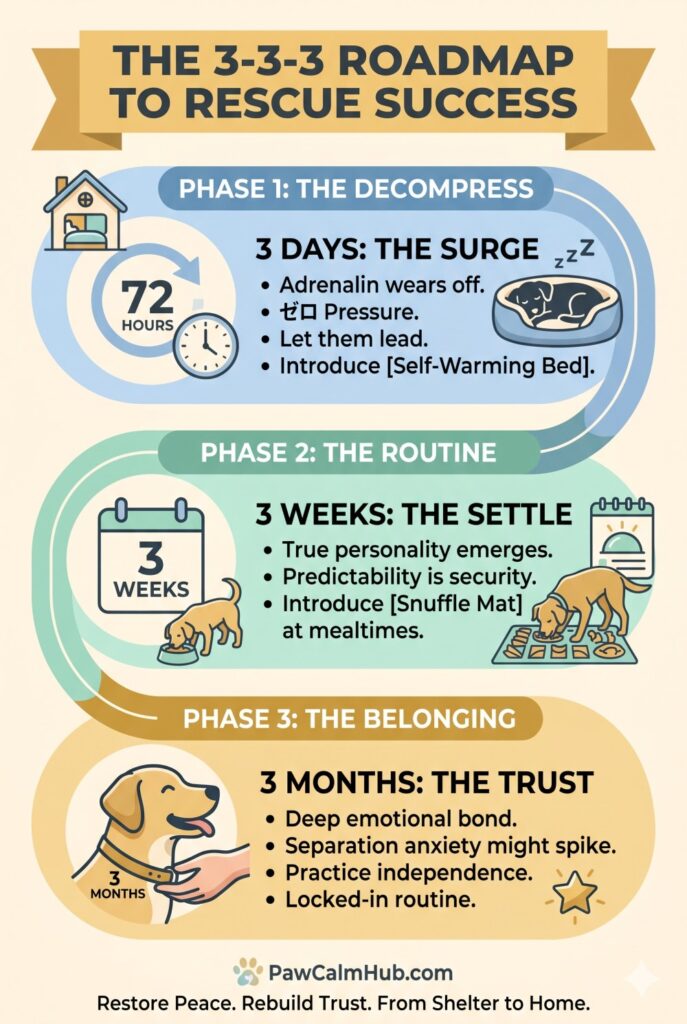
The 3-3-3 Rule — And Why It’s a Minimum, Not a Destination
Most rescue organisations now mention the 3-3-3 rule during the adoption process. If you haven’t encountered it, it works like this:
- 3 days to decompress from the shelter environment
- 3 weeks to learn the routine of the new home
- 3 months to begin feeling genuinely at home
This framework is useful because it sets a realistic timeline that counters the common expectation that a rescue dog will be “settled” within days. But experienced rescue professionals and veterinary behaviourists increasingly note that the 3-3-3 rule is a starting point for dogs with relatively straightforward histories — not a ceiling for dogs with complex trauma.
For a dog who has been rehomed three times, who was surrendered at age six after years with one family, or who spent eight months in a shelter environment, the genuine behavioural baseline — the dog they truly are underneath the anxiety — may not become fully visible for six months to a year. Some behaviours that appear in months two or three are not regression; they are the first signs of the dog beginning to relax enough to show who they actually are.
Understanding this prevents the single most common reason rescue adoptions fail: the owner’s expectation that by week six, the dog should be better — and their conclusion, when the dog is not, that something is fundamentally wrong.
Rescue Puppies vs. Adult Rescues — Understanding the Difference
Not all rescue dogs carry the same anxiety profile, and the management approach differs significantly depending on the age and history of the dog you have adopted.
Rescue Puppies (Under 16 Weeks)
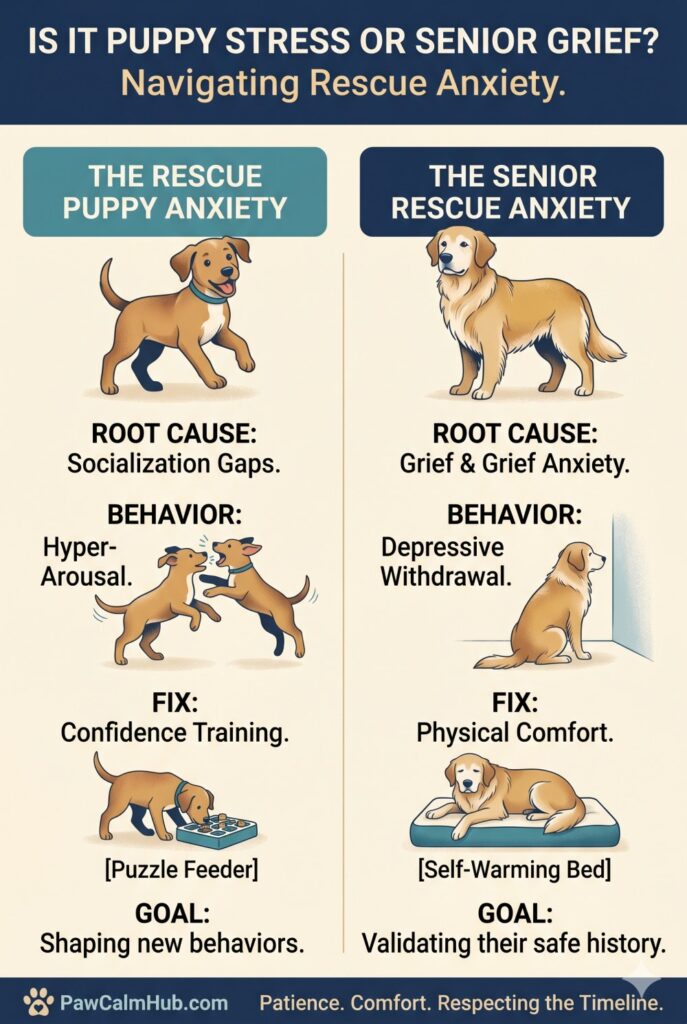
A puppy adopted from a rescue before the close of the critical socialisation window — approximately 3 to 14 weeks of age — arrives with significant neurological plasticity. Their threat-sensitivity baseline has not yet been set in the way an adult’s has. The anxiety they carry from the shelter environment is real, but the nervous system is still in its most formative period — which means that positive experience now produces an outsized and lasting benefit.
The priority with rescue puppies is not managing existing anxiety but preventing its entrenchment. Immediate, systematic, positive socialisation — introducing the puppy to a wide range of people, surfaces, sounds, animals, and environments with high-value food rewards — during this window produces neurological changes that last a lifetime. Every positive novel experience during weeks 3–14 literally builds the neural pathways of resilience.
The risk with rescue puppies is the opposite of the adult rescue risk: owners tend to be too cautious, restricting exposure “until vaccinations are complete” and inadvertently missing the window entirely. Speak to your vet about the evidence around controlled socialisation before the vaccination schedule is finished — most current veterinary guidance supports it.
Adult Rescues (1–7 Years)
The majority of rescue dogs fall into this category. Their socialisation window has closed. Their nervous system baseline is established. The anxiety they carry is real, structural, and will require a management approach measured in months rather than weeks.
The significant advantage of adult rescues is predictability: what you see in weeks three to six — once the initial shutdown phase passes — is close to what you are working with. The dog’s anxiety type, their specific triggers, their coping strategies, and their capacity for connection are all observable and manageable.
The senior rescue presents a category entirely of their own — and is the population most overlooked in rescue guidance.
The Senior Rescue Paradox — When a Dog Loses Their Whole World
This is the section that most rescue guides do not write. Not because it is unimportant — it is arguably the most important — but because it is the most uncomfortable truth in rescue dog welfare.
Every year, thousands of dogs aged eight, ten, twelve, and older are surrendered to shelters. Not because they have behavioural problems. Not because they are difficult or damaged. But because their owner died. Because the family moved to a property that doesn’t allow pets. Because a new baby arrived and the calculus changed. Because someone’s health deteriorated and they could no longer provide care.
These dogs — the senior rescues — arrive at shelters and then at new homes carrying a form of anxiety that is categorically different from a puppy’s fearfulness or an adult rescue’s trauma response. Theirs is the anxiety of total world loss.
A ten-year-old dog who has spent a decade in one home has built their entire psychological architecture around that environment. The smells, the sounds, the routines, the specific weight of their owner’s footstep on the floorboards — these are not preferences. They are the structural components of that dog’s sense of safety and identity. When those things disappear simultaneously and completely, the resulting psychological disruption is profound.
Research on canine attachment shows that dogs form genuine, neurologically significant attachment bonds with their primary caregivers — bonds that share measurable characteristics with human attachment relationships. The loss of an attachment figure in dogs produces a grief response that is physiologically observable: elevated cortisol, disrupted sleep, reduced appetite, and withdrawal behaviours that parallel what grief research documents in humans.
The Senior Rescue Paradox is this: the dog who is least likely to need much time to “learn how to be a pet” — the fully house-trained, socially adjusted, calm senior dog who has lived with humans for a decade — is simultaneously the dog who is most psychologically devastated by the loss of their previous life. Their very stability, their deep attachment to what was, is precisely what makes the loss so acute.
What This Looks Like in Practice
Senior rescues frequently display a grief response in the first weeks that new owners misread as illness, as the dog being “shut down,” or as evidence that the dog doesn’t like them. The signs:
- Complete disinterest in food for 24–72 hours
- Lying in one spot, not engaging with the environment
- Crying or whimpering — particularly at night
- Searching behaviour — moving through the home as though looking for someone or something
- Profound flatness of affect — none of the normal canine curiosity or reactivity
- Sleep disruption — waking repeatedly through the night, unable to settle
These are not signs that the adoption is failing. They are signs that the dog is grieving — and that they need time, gentleness, and the gradual building of new associations, not stimulation, forced interaction, or the assumption that enthusiasm will accelerate their adjustment.
Managing the Senior Rescue Paradox
Do not introduce the full home immediately. A senior dog who has lost their entire world does not need the overwhelm of a new house to explore on day one. Use the anchor room protocol — one room, their bed, their food, a worn garment with your scent. Expand access only as they show genuine comfort in the existing space.
Routine is the scaffolding of recovery. For a dog whose world was built on the reliable routine of a decade, predictability is the fastest path to recalibration. Same feed time, same walk time, same sleep arrangement, every day, from day one. The routine itself becomes the new architecture of safety.
Do not pathologise the grief. If a senior rescue is not eating on day two, that is grief, not illness — unless it persists beyond 48 hours, in which case a veterinary check is appropriate (for both reassurance and to rule out the stress-related physical conditions that senior dogs are more vulnerable to). Do not try to entice eating with an escalating sequence of increasingly exciting foods — this trains the dog that food refusal produces better food, which creates a separate problem.
A self-warming bed placed near the owner’s regular sitting spot provides warmth, scent proximity, and a consistent anchor point that begins to function as the new version of the dog’s “spot.” This single environmental detail — something that smells of the new owner and is reliably warm and comfortable — does more psychological work in the first two weeks than almost any other single intervention.
Shop: Self-Warming Dog Anxiety Bed — for senior rescues, thermoregulation matters more than in younger dogs; ageing reduces the body’s ability to self-regulate temperature, making warmth a genuine welfare need rather than a comfort extra.
Expect the secondary anxiety peak. Many senior rescues show something counterintuitive at the four to eight week mark: their anxiety worsens after an initial period of improvement. This is not regression. This is attachment forming. As the dog begins to bond with the new owner, the prospect of losing them — as they lost the last person — becomes a new source of fear. The separation anxiety that emerges at this stage is a sign of emotional recovery, not deterioration. Manage it with the same patience and structure as the initial grief response.
The timeline for senior rescues is longer than for younger dogs. Where an adult rescue may find their baseline in three to six months, a senior rescue who has lost a lifelong home may need six to twelve. This is not a problem to be solved — it is a reality to be understood and honoured.
Week-by-Week Calm-Down Plan: The First Year With a Rescue Dog
Days 1–3: The Decompress Phase
This is the phase most new owners get wrong — not through negligence but through love. The impulse to show the dog their new home, introduce them to family members, take them to the park, and demonstrate that this is a good place is understandable and well-intentioned. It is also exactly wrong.
A dog arriving from a shelter is neurologically overwhelmed. The shelter environment — noise, unfamiliar animals, unpredictable handling, the smell of stress pheromones from dozens of anxious dogs — has been running their HPA axis at elevated arousal for however long they were there. That arousal does not switch off at the moment of adoption. The car journey, the new smells, the new faces, the new sounds of the new home — all of this lands on a nervous system that is already running at capacity.
The decompress phase requires one thing above all: less. Less stimulation, less interaction, less expectation. Set up a single room before the dog arrives — their food, water, bed, and a worn garment that carries your scent. When you bring the dog home, take them directly to that room. Sit on the floor. Do not reach for them, call them, or attempt eye contact. Be a calm, boring presence in their space and let them make every first move.
Do not introduce the dog to other household members in the first 24 hours if it can be avoided. Do not invite friends or family to meet the new dog. Do not post them on social media and then have strangers comment that you should take them to the park. Every additional social demand in these first three days is a withdrawal from a neurological account that is already overdrawn.
Read more: Why Is My Dog Anxious at Night? — night-time is when rescue dogs most commonly show acute anxiety during the decompress phase; this guide covers what to do and what not to do when it happens.
Days 4–7: The First Signals
By day four, most rescue dogs will begin showing the first signs of curiosity — a brief sniff of the room’s perimeter, a glance at the owner that lasts longer than a threat-assessment scan, a slightly less rigid body when approached. These are significant. Acknowledge them internally. Do not react to them enthusiastically — enthusiasm is arousal, and the dog’s nervous system is still not ready for arousal of any kind, including positive arousal.
Begin a snuffle mat at mealtimes. The snuffle mat does several things simultaneously: it slows eating (which reduces the cortisol spike associated with rapid ingestion), it activates the foraging system of the brain (which is incompatible with the anxiety response), and it creates a predictable, positive, repeated experience that begins building the new home’s association with good things.
The snuffle mat for anxious dogs is one of the first tools to introduce precisely because it requires almost no interaction from the owner — the dog can engage with it entirely on their own terms, which means it produces benefit without requiring the dog to trust you yet.
Weeks 1–2: Establishing the Routine
The most powerful calming force available to a new rescue owner is not a product, a training method, or a supplement. It is routine.
Lock in the daily schedule immediately and do not deviate from it. Same wake time. Same feed time. Same walk time. Same bed time. The dog’s nervous system is making one central calculation in these first weeks: is this place predictable? Every time the routine holds, the answer edges toward yes. Every time it doesn’t, the answer edges back toward uncertainty.
Keep walks short, slow, and sniff-led in the first two weeks. The urge to give the new dog a “good long walk” to tire them out is well-intentioned but counterproductive for a recently arrived rescue. Long walks in unfamiliar territory are not exercise for an anxious dog — they are sustained exposure to threat stimuli. A 15-minute sniff walk around the immediate neighbourhood, where the dog can investigate smells at their own pace, produces more genuine neurological benefit than an hour-long park adventure.
Introduce a lick mat for dog anxiety during the first identified high-anxiety period of the day — for most rescues, this is the early evening when the environment quietens and the dog’s arousal drops enough for anxiety to surface. Load it with something high-value. The licking behaviour activates the parasympathetic nervous system and produces a measurable cortisol reduction. Use it consistently at the same time each day to build a predictable calming ritual.
Weeks 3–6: Building Trust and Confidence
By week three, a dog who is adjusting well will show observable changes. They may initiate contact for the first time — a nose to the hand, a chin rested on the knee. They may investigate the home beyond their anchor room voluntarily. They may begin to play — tentatively, briefly, watching the owner’s reaction carefully.
These weeks are when short, positive training sessions become valuable. Not obedience for its own sake — but structured, rewarding interactions that teach the dog that engagement with the owner predicts good things. Five minutes twice a day of simple, achievable requests (sit, hand target, name recognition) with high-value food rewards builds confidence and positive human-association more effectively than any amount of passive kindness.
Introduce puzzle feeders to replace some snuffle mat sessions. The dog puzzle feeder for anxious dogs increases the cognitive challenge of foraging, producing deeper mental fatigue and greater satisfaction — both of which lower the anxiety baseline over time.
If the dog tolerates handling comfortably by week three, introduce a grooming glove. Systematic, gentle tactile contact with a soft grooming tool builds touch-tolerance that will be essential for veterinary handling and ongoing grooming, while simultaneously releasing oxytocin in both dog and owner — the bonding hormone that is doing quiet, important work in these early weeks.
Read more: How to Groom an Anxious Dog at Home — the full desensitisation protocol for dogs who are resistant to handling.
Months 2–3: The Identity Phase and the Separation Anxiety Peak
This is the phase that most surprises and distresses new rescue owners.
Between weeks six and twelve — as the dog begins genuinely bonding with the new owner — separation anxiety frequently emerges or intensifies. A dog who seemed calm during absences in the first few weeks begins showing distress at departures: pacing before the owner leaves, vocalising during absence, destructive behaviour around exit points, or regression in house training.
This is not a worsening of the dog’s anxiety. It is evidence of attachment forming. The dog is anxious about departure now because they have begun to care — and because every departure carries the shadow of the abandonments that came before. The owner leaving in the morning is, to the dog’s nervous system, a potential repeat of the last time someone left and didn’t come back.
Manage the separation anxiety peak with a structured departure protocol:
Make departures boring. No prolonged goodbyes, no high-pitched reassurances, no extended eye contact. These behaviours, however loving, communicate that departure is a significant emotional event — which it is, but the dog does not benefit from having that confirmed.
Use a departure anchor. At the precise moment of leaving, give the dog a frozen lick mat or a treat-dispenser toy loaded with high-value food. This creates a positive association with the departure moment and gives the dog something absorbing to do during the first minutes of absence — the period when anxiety peaks most sharply.
Introduce the anxiety vest during this phase, not at the moment of peak distress but during low-stakes positive contexts first — building the association that the vest predicts good things before using it as a departure tool.
Shop: Dog Anxiety Vest
Read more: Dog Separation Anxiety Solutions — the full protocol for managing separation anxiety, including the graduated departure desensitisation programme.
Use a camera. Most owners catastrophise what is happening during their absence — and some under-estimate it. A video camera with pet feeder gives you accurate data rather than assumption, allows remote monitoring and two-way reassurance, and prevents the “guilt return” — coming home early because you are worried — that accidentally teaches the dog that acute distress produces the owner’s reappearance.
Months 4–6: Active Engagement and Expanding the World
By month four, the well-managed rescue dog is typically showing significant stabilisation. Appetite is consistent. Sleep is normalised. The routine is established as a genuine source of security rather than just a structure being tolerated.
This is the phase to begin expanding the world — carefully and progressively. New walking routes. New people introduced at the dog’s pace. Possibly a dog socialisation class with a skilled trainer who understands rescue dog dynamics.
It is also the phase to introduce higher-intensity physical engagement. An automatic dog ball launcher allows sustained, self-directed physical exercise that burns the anxiety energy that months of careful, low-stimulation management may have allowed to accumulate. For larger breeds, the automatic ball launcher for large dogs provides the same benefit at a scale appropriate for their physical needs.
Physical exercise at this stage is not just beneficial — it is important. Research consistently shows that regular aerobic exercise produces measurable reductions in anxiety-related behaviour in dogs through the same mechanisms it does in humans: reduced cortisol, increased serotonin and dopamine availability, and improved sleep quality.
Begin introducing calming chews during high-stress periods if not already using them. By month four, you know enough about your dog’s specific triggers to time supplementation strategically. Thirty to forty-five minutes before a known stressor — a vet visit, a car journey, fireworks season — gives the active compounds time to reach therapeutic levels.
Read more: Do Calming Chews Work for Dogs? — an evidence-referenced assessment of what the research actually shows about calming supplements.
Months 7–12: The Long Game
The final phase of the first year is the one most rescue owners were not warned about: the long plateau.
Progress in rescue dog anxiety management is not a straight line. It is an irregular curve with advances, setbacks, and long flat sections where nothing seems to be changing. The flat sections are not stagnation — they are consolidation. The nervous system is integrating the evidence of safety at a neurological level, building the structural changes that produce lasting change rather than temporary relief.
By the end of the first year, most rescue dogs with trauma-based anxiety will show significant improvement from their arrival baseline — not perfection, but a dog who is recognisably more comfortable, more trusting, and more able to recover from triggering events than they were in the early weeks. Celebrate that. It is the result of a full year of consistent, patient, evidence-based management — and it is genuinely remarkable when you understand what the nervous system has had to do to get there.
Some dogs will still have residual anxiety at twelve months. Some may always be noise-sensitive, or always need more decompression after social events than a neurotypical dog. That is not failure. That is who they are — and a well-managed residual anxiety is infinitely preferable, for both dog and owner, to unmanaged acute anxiety disorder.
What Grooming Reveals About a Rescue Dog’s Anxiety
Grooming is a diagnostic tool as much as a welfare necessity. The way a rescue dog responds to being touched, handled, and groomed tells you more about their trauma history in five minutes than most other assessments.
Dogs who flinch from hands approaching their head were likely struck. Dogs who freeze or show whale eye when their paws are touched were likely subjected to aversive nail clipping. Dogs who go rigid during body handling may have experienced painful veterinary procedures without adequate pain management. Dogs who cannot tolerate restraint of any kind frequently have a history of forceful handling that associated restraint with threat.
None of this is a reason to avoid grooming. It is a reason to approach it as a structured, progressive desensitisation process rather than a functional necessity to be got through.
Begin with the grooming glove — the softest, least threatening point of entry into systematic physical contact. Work from the areas of least sensitivity (back, shoulders) toward the areas of greatest sensitivity (paws, ears, muzzle) over several weeks. Each session should end before the dog shows stress signals — not when the grooming is “done.”
For nail care specifically, the loud, sharp sound of a nail clipper is a documented trigger for anxiety in dogs with aversive handling histories. The quiet dog nail grinder for anxious dogs removes the sound component of this trigger, allowing tactile desensitisation to proceed without the auditory spike that sets back progress.
Read more: How to Groom an Anxious Dog at Home — the complete step-by-step desensitisation protocol for grooming-resistant rescue dogs.
The 8 Most Common Rescue Dog Anxiety Behaviours — What They Actually Mean
1. Resource Guarding Growling or snapping over food, toys, or resting spots. This is not aggression — it is insecurity. A dog who has experienced resource scarcity guards resources because, in their experience, resources disappear. The management approach is never to punish the growl (which removes the warning without addressing the fear) but to systematically build positive association with approach near resources.
2. Regression in House Training A previously house-trained dog who begins having accidents in the new home is communicating stress, not defiance. The stress hormones that run elevated in a recently arrived rescue directly affect bladder control. Accidents in the first two to four weeks are not a training problem — they are a physiological response to anxiety that resolves as the nervous system stabilises.
3. Shadow Following The dog who follows the owner from room to room, including to the bathroom, is displaying attachment anxiety — the fear that the owner will disappear as previous people did. This is a sign of bonding that needs careful management rather than either indulgence or punishment. Building confidence through independence games (brief, rewarded separations within the home) addresses the root cause rather than the symptom.
4. Food Refusal Particularly common in the first 72 hours and in senior rescues. Acute stress suppresses appetite through the same cortisol mechanisms in dogs as in humans. Do not escalate food offerings — maintain the normal meal and remove it after 20 minutes if uneaten. If refusal persists beyond 48 hours, contact your veterinarian. A lick mat with a thin layer of something highly palatable often succeeds when a full bowl fails, because the licking behaviour itself activates the parasympathetic system enough to allow appetite to re-emerge.
5. Night-Time Anxiety Howling, crying, or restlessness through the night is one of the most distressing early experiences for new rescue owners — and one of the most common. At night, the environmental stimuli that distract the dog during the day disappear, and the anxiety surfaces into the quiet. A self-warming bed placed near the owner’s sleeping area (not necessarily in the same room — proximity of scent is often sufficient), white noise, and the absence of dramatic owner response (going to the dog repeatedly reinforces the night-time vocalisation) are the three most effective management tools.
Read more: Why Is My Dog Anxious at Night?
6. Escape Attempts A dog who persistently attempts to escape the garden, the house, or their crate is not seeking adventure — they are experiencing a threat response so severe that the containment itself feels dangerous. This is among the more serious rescue anxiety presentations and warrants veterinary assessment. It poses a genuine physical safety risk and should not be managed with more secure containment alone, without addressing the underlying anxiety.
7. Freeze on Walks A rescue dog who stops walking and refuses to move is not being stubborn. They have encountered a stimulus that exceeds their coping threshold and their nervous system has defaulted to the freeze response — the third option in the fight-flight-freeze triad. The correct response is patience: stand still, ignore the trigger if possible, allow the dog to make the next move. Never drag a frozen dog. This escalates the threat response and breaks trust.
8. Mouthing and Nipping Some rescue dogs — particularly those who were not socialised during the critical window — use their mouths to communicate in ways that were never redirected. This is not aggression in the clinical sense; it is a communication deficit combined with high arousal. Structured positive training with a qualified trainer who has rescue dog experience is the appropriate intervention.
When to Seek Professional Help for Your Rescue Dog
Most rescue dog anxiety can be managed effectively with the protocol in this guide, patience, and time. There are situations, however, where professional support is not optional.
Contact your veterinarian if:
- Anxiety is not showing any improvement after eight weeks of consistent management
- The dog is self-harming — licking or chewing to open wounds, hair pulling
- Aggression has produced injury to a person or another animal
- The dog has not eaten for more than 48 hours
- Night-time distress is severe and unrelenting beyond the first two weeks
- You are observing signs of what may be cognitive dysfunction (particularly in senior rescues) — disorientation, staring at walls, apparent confusion about the environment
Ask your vet for a referral to a certified applied animal behaviourist (CAAB) or a veterinary behaviourist (DACVB) if the anxiety is complex, if there is a history of significant trauma, or if the dog’s anxiety is not responding to standard management after three to four months of consistent implementation.
A veterinary behaviourist is a vet who has completed post-doctoral specialist training in animal behaviour and psychopharmacology. They are the highest level of clinical resource available for complex rescue dog anxiety cases — and for some dogs, the combination of appropriate medication and behavioural management is what transforms an unmanageable anxiety disorder into a liveable on
How long does rescue dog anxiety last?
It depends on the dog’s history, age, and the consistency of management in the new home. Dogs with relatively uncomplicated histories — surrendered due to owner circumstances rather than behavioural reasons, minimal shelter time — often reach a stable baseline within three to six months. Dogs with complex trauma histories, multiple rehomings, or extended shelter stays may need six to twelve months. Senior rescues who have lost a lifelong home may need the full first year to show their true baseline. There is no universal timeline. There is only the individual dog, the quality of management they receive, and the patience of the people around them.
Should I use a crate for my anxious rescue dog?
Yes, provided it is introduced as a “Safe Haven” and not a punishment. Covering the crate and adding a self-warming bed can create a den-like environment that reduces sensory overload.
My senior rescue dog just stares at the wall. Is this anxiety?
Yes, this is often a sign of “shutting down” due to grief or cognitive confusion. In senior dogs, anxiety is frequently “quiet.” Ensure they have a comfortable, warm spot and consider a veterinary check-up to rule out vision or hearing loss which can exacerbate their fear.
Is it harder to help an anxious senior dog than a puppy?
It’s different. Puppies require active training and socialization. Seniors require patience, consistency, and physical comfort. Once a senior dog realizes they are safe, their loyalty is often deeper and more immediate than a younger dog’s.
Should I let my rescue dog sleep in my bedroom?
There is no universal right answer — but there is a useful framework. Proximity to the owner’s scent is one of the most effective calming interventions available in the early weeks, and having the dog’s bed in the bedroom (not necessarily on the bed itself) provides this without requiring physical contact. If you are comfortable with it and the dog settles better for it, it is not creating dependency — it is meeting a genuine safety need during a period of acute adjustment. If you ultimately do not want the dog in the bedroom long-term, the transition out is easiest managed gradually, moving the bed progressively toward the door over several weeks rather than making an abrupt change.
My rescue dog is aggressive toward my other dog. Is this normal?
Inter-dog tension in the early weeks of a rescue arrival is common and does not necessarily indicate long-term incompatibility. A newly arrived rescue is running at high arousal and has no established relationship with the resident dog — any interaction in this state carries more conflict potential than it will once both dogs have had time to acclimatise. Manage the introduction using the scent-first, visual-second protocol: keep them separated initially, swap bedding, allow scent familiarity before visual contact. If aggression persists beyond the first month and includes sustained pursuit, cornering, or injury, seek behaviourist assessment before concluding the dogs cannot cohabit.
Is it normal for my rescue dog to ignore me completely in the first week?
Completely normal — and actually a healthy sign. A dog who ignores you in the first days is not rejecting you. They are in shutdown — a protective neurological state in which the overwhelmed nervous system withdraws from engagement to conserve resources. A dog in shutdown is not available for bonding, training, or play. They need time and low-stimulation space before they are neurologically available for relationship-building. The first voluntary engagement — a sniff of your hand, a brief moment of eye contact that isn’t threat-assessment — will come. When it does, honour it quietly.
Should I take my rescue dog to training classes immediately?
Not in the first four to six weeks for most rescue dogs. Group training classes involve multiple unfamiliar dogs, multiple unfamiliar people, high environmental arousal, and the social demands of performing behaviours on cue — all of which exceed the coping capacity of a recently arrived rescue. Individual training sessions with a qualified, positive-reinforcement trainer who understands rescue dog dynamics can begin earlier and are significantly more productive in the early months. Group classes become valuable once the dog has a stable enough baseline to learn in a high-stimulation environment — typically from month three or four onwards.
My rescue dog was fine for two months and now seems worse. What happened?
This is the secondary anxiety peak described in the month two to three section of this guide — and it is one of the most common and most distressing experiences for new rescue owners. As the dog forms genuine attachment to the new owner, the prospect of losing them — as they lost previous people — becomes a new source of fear. The separation anxiety, reactivity, or regression you are seeing is not evidence that the adoption is failing. It is evidence that the dog is beginning to love the new home enough to fear losing it. Manage it with the separation anxiety protocol, maintain your routine, and give it another six to eight weeks of consistent management before assessing where you actually are.
Can rescue dogs with severe anxiety ever become fully calm?
Many do — but “fully calm” requires definition. Most well-managed rescue dogs with significant anxiety histories become dogs who function well, enjoy their lives, form strong bonds with their owners, and manage their triggers effectively. Very few become dogs with no residual anxiety whatsoever. The goal of management is not to produce a neurotypical dog — it is to produce a dog whose anxiety is manageable, whose quality of life is high, and whose relationship with their owner is secure. For the vast majority of rescue dogs, with time and the right management, that goal is achievable
What is the single most important thing I can do for my rescue dog’s anxiety?
Protect the routine. Above every product, every supplement, every training technique — the single intervention that produces the greatest and most sustained reduction in rescue dog anxiety is a consistent, predictable daily schedule that the dog can learn to rely on. Routine communicates safety at a neurological level. It answers the question the anxious rescue dog is asking a thousand times a day: what happens next? When the answer is always the same, the question stops being frightening.