
A note on this guide: This article references peer-reviewed research in veterinary gastroenterology, microbiome science, and canine behaviour. It is intended as an educational resource and is not a substitute for professional veterinary advice. Before making dietary changes or introducing supplements, speak with your veterinarian — particularly if your dog has an existing health condition or is taking medication.
You have tried the anxiety vest. You have used the lick mat, the snuffle mat, the calming chews. You have restructured the routine, built the safe room, and read everything you can find about separation anxiety. And your dog is still anxious.
What if the problem is not in their head?
What if it is, quite literally, in their gut?
This is not a fringe idea. It is one of the most rapidly advancing areas of veterinary and biomedical science — and its implications for how we understand and manage anxiety in dogs are profound. The connection between the gastrointestinal system and the brain is so significant, so bidirectional, and so well-documented that researchers have given it its own name: the gut-brain axis. And in dogs, as in humans, the state of that axis has measurable consequences for mood, behaviour, and anxiety.
Most pet owners have never heard of it. Almost no pet wellness content covers it. That gap is exactly why your dog may still be anxious despite everything you’ve tried — and why this guide exists.
The Gut-Brain Highway — How Your Dog’s Belly Talks to Their Brain
Before the science, a map. Because understanding the gut-brain connection requires understanding that the gut and the brain are not separate systems communicating occasionally. They are a continuous, bidirectional highway with traffic moving in both directions, constantly, every second of every day.
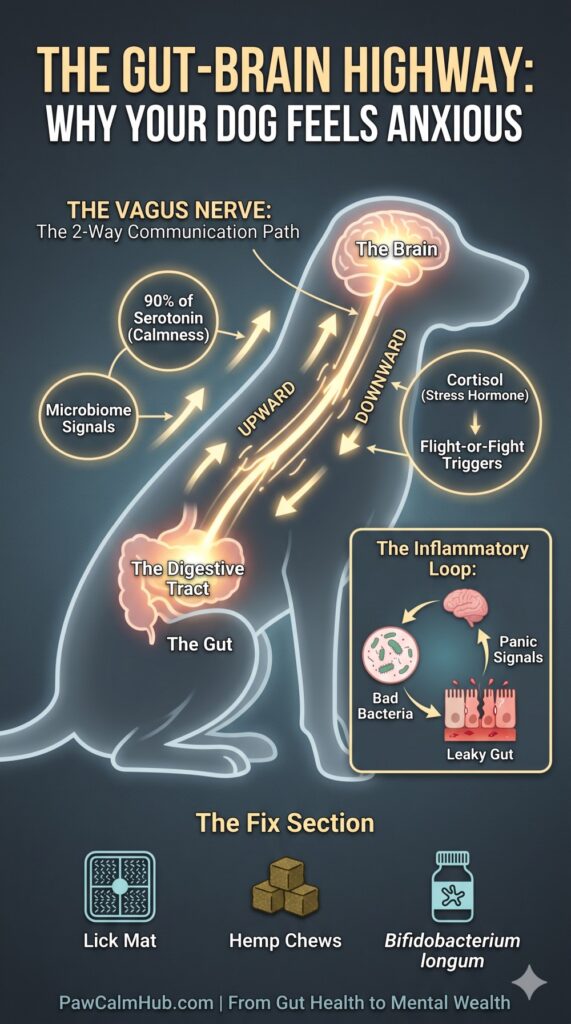
Think of it this way:
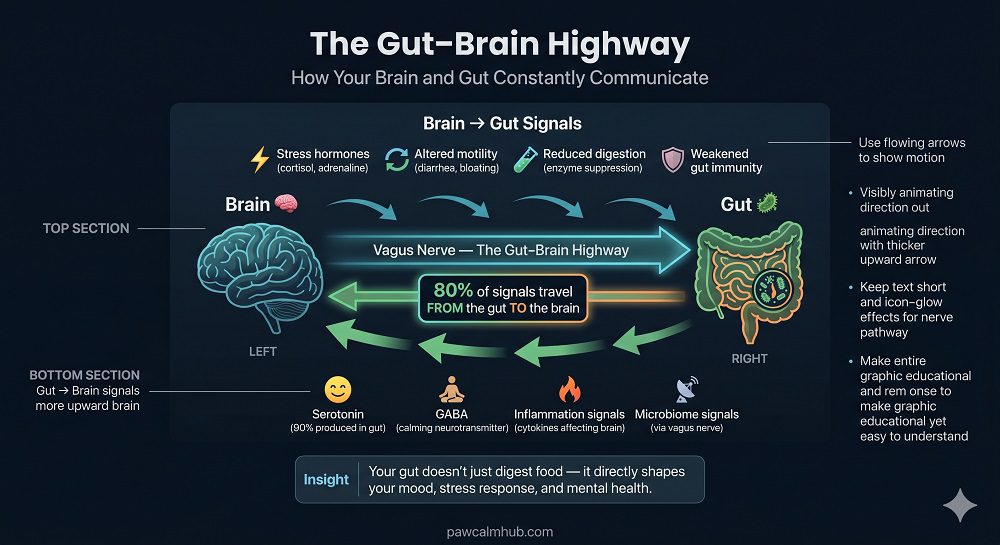
The critical insight in that diagram is the direction of traffic. Most people assume the brain controls the gut — stress causes an upset stomach. That is true. But the reverse is also true, and arguably more important for anxiety management: the gut controls the brain. The majority of vagus nerve signals travel upward, from the gut to the brain’s mood and anxiety centres, not the other way around.
This means that what is happening in your dog’s gut is directly influencing the neurochemical environment in which their anxiety either escalates or resolves. A disrupted gut microbiome is not just a digestive problem. It is a mental health problem.
The Serotonin Revelation — Why Gut Health Is Brain Health
Here is the number that changes everything: approximately 90% of the body’s serotonin is produced not in the brain, but in the gastrointestinal tract.
Serotonin is the neurotransmitter most commonly associated with mood stability, calm, and emotional regulation. It is the primary target of the most commonly prescribed class of antidepressants in humans — SSRIs (selective serotonin reuptake inhibitors) — and it is what fluoxetine and other veterinary anxiety medications are designed to modulate in dogs.
But if 90% of serotonin is produced in the gut, and the gut’s ability to produce serotonin depends on the health and composition of its resident microbial community — the gut microbiome — then the gut microbiome is, functionally, one of the most important determinants of your dog’s baseline anxiety level.
Research published in the journal Microbiome has documented that gut microbiome composition directly influences serotonin production through the activity of specific bacterial strains on enterochromaffin cells — the cells in the gut lining responsible for serotonin synthesis. Alter the microbiome, and you alter serotonin output. Alter serotonin output, and you alter mood, anxiety threshold, and emotional regulation.
In dogs specifically, research from the University of Helsinki — the same group whose landmark anxiety prevalence study is referenced throughout this library — has documented measurable differences in gut microbiome composition between behaviourally anxious and behaviourally calm dogs. The direction of causality is still being investigated, but the association is robust: anxious dogs have different microbiomes. The question is whether the different microbiome is contributing to the anxiety, resulting from it, or both.
The evidence increasingly suggests: both. The relationship is circular. Anxiety disrupts the gut. A disrupted gut amplifies anxiety. And without intervention at the gut level, that circle can run indefinitely — which is one reason why some dogs remain anxious despite everything their owners try at the behavioural and environmental level.
GABA — The Calming Signal Your Dog’s Gut May Not Be Sending
Serotonin is not the only neurotransmitter with gut origins. GABA — gamma-aminobutyric acid — the brain’s primary inhibitory neurotransmitter, responsible for reducing neuronal excitability and producing calm — is also produced in significant quantities by gut bacteria.
Specifically, certain strains of Lactobacillus and Bifidobacterium bacteria produce GABA as a metabolic byproduct. When these bacterial populations are healthy and abundant, they contribute to GABA availability in the system. When they are depleted — by poor diet, stress, antibiotics, or illness — GABA production falls, and the brain’s primary calming system loses one of its inputs.
A landmark study published in the British Journal of Pharmacology found that Lactobacillus rhamnosus — a specific probiotic strain — reduced anxiety-related behaviour in mice through a mechanism involving GABA receptor expression in the brain. Crucially, this effect was mediated entirely through the vagus nerve: when the vagus nerve was severed, the anxiolytic effect disappeared. The gut bacteria were talking directly to the brain’s anxiety system — and the brain was listening.
While the direct dog-specific research on this mechanism is still developing, the physiological parallels between canine and murine gut-brain systems are sufficient that veterinary researchers now consider gut-directed interventions a legitimate and evidence-adjacent management tool for canine anxiety.
In plain language: the right gut bacteria may be producing calming signals that your dog’s brain needs and currently isn’t getting. Restoring those bacteria may restore those signals.
What Disrupts the Dog Gut Microbiome — The 6 Hidden Culprits
Understanding what disrupts gut health is as important as understanding how to restore it. For most anxious dogs, one or more of the following is actively undermining the gut environment that healthy neurotransmitter production requires.
1. Ultra-Processed Kibble
The majority of commercial dry dog foods are produced through an extrusion process that involves extreme heat and pressure. This process destroys many of the naturally occurring enzymes and beneficial bacteria that would be present in whole foods, and frequently requires artificial preservatives — including BHA (butylated hydroxyanisole) and BHT (butylated hydroxytoluene) — to achieve shelf stability.
Research has documented that BHA and BHT have effects on gut microbiome composition in mammalian systems. More broadly, highly processed diets low in diverse plant fibre — the primary food source for beneficial gut bacteria — consistently produce lower microbiome diversity than whole-food or minimally processed diets across mammalian species.
2. Antibiotics
This is the most dramatic and well-documented gut microbiome disruptor. A single course of broad-spectrum antibiotics can reduce gut microbiome diversity by 30–50% — and in some cases, full recovery of the pre-antibiotic microbiome does not occur for months. For a dog who receives antibiotics for a routine infection and subsequently becomes more anxious, the gut-brain axis disruption produced by the antibiotic course is a plausible and underappreciated contributing factor.
3. Chronic Stress Itself
Here is the cruelest aspect of the anxiety-gut loop: anxiety itself disrupts the gut microbiome. Elevated cortisol alters gut motility (producing diarrhoea or constipation), reduces the protective mucus layer of the gut lining, and changes the pH environment in ways that favour harmful bacteria over beneficial ones. The anxious dog’s gut is being continuously disrupted by the anxiety — which further disrupts the gut’s ability to produce the neurotransmitters that would reduce the anxiety.
4. Frequent Dietary Changes
The gut microbiome is a community of trillions of organisms that adapts to and depends on a consistent nutritional environment. Frequent food switching — a common practice among well-intentioned owners trying to find the “best” food for their dog — repeatedly disrupts this community before it can stabilise, preventing the establishment of the diverse, stable microbiome that supports optimal neurotransmitter production.
5. Dietary Fillers and Artificial Additives
Corn syrup, artificial colours, and chemical flavour enhancers — present in many budget commercial pet foods — provide no nutritional value and may actively harm beneficial bacterial populations. Gut bacteria thrive on dietary fibre and complex carbohydrates from whole food sources. They do not thrive on refined sugars and synthetic compounds.
6. Insufficient Dietary Diversity
Research in human microbiome science consistently shows that dietary diversity — the range of different plant foods consumed — is the strongest single predictor of gut microbiome diversity, and microbiome diversity is the strongest single predictor of gut microbiome health. Dogs eating the same food, every meal, every day, for years are not building the diverse microbial community their gut-brain axis needs.
7 Signs Your Dog’s Anxiety May Be Gut-Driven
The following signs suggest that gut disruption may be contributing to your dog’s anxiety — not as the sole cause, but as a maintaining factor that is preventing other interventions from working as well as they should.
1. Anxiety that flares after eating or in the hour following meals If your dog is noticeably more anxious or reactive in the period after eating, the gastrointestinal activity of digestion — and the cortisol response it may be producing in a compromised gut — is worth investigating.
2. Loose stools or constipation during high-anxiety periods The bidirectionality of the gut-brain axis means that stress triggers gut dysfunction and gut dysfunction amplifies stress. If your dog’s digestive patterns correlate with their anxiety patterns, you are likely observing the gut-brain loop in action.
3. Excessive gut gurgling (borborygmi) alongside anxious behaviour Audible gut sounds during anxious periods indicate altered gut motility — a direct consequence of stress hormone effects on the gastrointestinal system.
4. Improved behaviour following periods on a whole-food or raw diet If your dog has been measurably calmer on a different diet, this is not coincidence. Dietary quality has a direct and documented effect on gut microbiome composition and neurotransmitter production.
5. Significant worsening of anxiety following a course of antibiotics As described above, antibiotic-induced microbiome disruption is one of the most direct gut-brain axis events that owners can observe in real time. If your dog’s anxiety worsened noticeably after antibiotics, the connection is likely causal.
6. Anxiety paired with excessive grass eating Dogs self-medicate gastrointestinal discomfort by eating grass — a behaviour that increases gut motility and can induce vomiting. A dog who is both anxious and grass-eating frequently may be experiencing gut discomfort as a component of their anxiety state.
7. Anxious behaviour that does not respond to otherwise effective calming interventions If a dog with moderate anxiety fails to respond to a well-implemented combination of environmental management, enrichment tools, and calming products, an underlying gut-brain disruption is worth investigating as a maintaining factor.
The Specific Probiotic Strains That Support Canine Anxiety
Not all probiotics are equivalent. The probiotic market is saturated with products of highly variable quality, potency, and relevance to the specific mechanism of gut-brain axis support. The following strains have the most robust evidence base for anxiety-related gut-brain function in dogs and closely related mammalian species.
Bifidobacterium longum (specifically strain BL999)
This is the most extensively studied probiotic strain for anxiety in companion animals. A placebo-controlled study published in PLOS ONE found that dogs supplemented with Bifidobacterium longum BL999 showed significantly reduced anxiety behaviours compared to placebo — specifically in noise sensitivity and overall emotional reactivity. The proposed mechanism involves the strain’s ability to modulate cortisol output and influence GABA receptor expression through vagal signalling.
When selecting a canine probiotic for anxiety support, Bifidobacterium longum is the strain to look for first. Products that specify the strain designation (BL999 or equivalent) rather than just genus and species are indicating a higher level of research specificity.
Lactobacillus rhamnosus
As referenced above, this strain has produced the strongest direct evidence of anxiolytic effect through GABA modulation in the animal research literature. The British Journal of Pharmacology study demonstrating vagus-nerve-mediated anxiety reduction remains one of the most-cited pieces of evidence in the gut-brain anxiety field.
Lactobacillus acidophilus
A foundational probiotic strain with broad gut health benefits including mucus layer support, pathogenic bacteria competition, and short-chain fatty acid production. Short-chain fatty acids — particularly butyrate — have documented anti-inflammatory effects in the gut lining that are relevant to the gut-brain axis, as gut inflammation is one of the mechanisms by which a disrupted microbiome increases brain anxiety levels.
Bifidobacterium breve
Particularly relevant for dogs recovering from antibiotic courses. B. breve re-establishes quickly in antibiotic-disrupted microbiomes and produces GABA as a metabolic byproduct — making it especially useful in the post-antibiotic period when gut-brain axis disruption is most acute.
Lactobacillus casei
Associated with serotonin pathway support and documented anti-anxiety effects in mammalian research. A useful strain in multi-strain probiotic formulations targeting mood and anxiety rather than purely digestive function.
What to look for on a probiotic label:
- Strain specificity (genus, species, and strain designation — not just “Lactobacillus”)
- Colony-forming unit (CFU) count guaranteed at expiry, not at manufacture
- Independently tested for potency (third-party certification)
- Prebiotic inclusion (fructooligosaccharides or inulin feed the probiotic bacteria and amplify their effect)
- No artificial additives that would undermine the gut health you are trying to build
Always discuss probiotic supplementation with your veterinarian before beginning — particularly for dogs with IBD, immunocompromise, or any condition affecting gut integrity.
Slow Feeding as a Gut-Health Intervention
This is the connection most owners miss: the way a dog eats has a direct effect on gut health, and gut health has a direct effect on anxiety.
Rapid eating — bolting food in under 60 seconds — produces a cortisol spike through multiple mechanisms. The physical act of rapid ingestion triggers the stress response, increases intra-abdominal pressure, and sends the gut into a state of motility dysregulation that takes hours to resolve. For a dog already predisposed to anxiety, this daily cortisol spike from meal-time eating adds to the baseline load in ways that compound over months.
Slow feeding — spreading the same meal across a foraging experience that takes 10 to 20 minutes — has the opposite effect. The extended eating time reduces cortisol, activates the parasympathetic “rest and digest” system, promotes thorough chewing (which improves digestive enzyme contact with food), and reduces the gas production that rapid ingestion causes.
A snuffle mat for anxious dogs at mealtimes accomplishes all of this simultaneously: it slows eating through the foraging mechanic, activates nose-work (which independently suppresses anxiety), and extends the positive mealtime experience in ways that build a calm, positive association with the food environment.
A dog puzzle feeder for anxious dogs provides the same slow-feeding benefit with an additional cognitive challenge layer — the problem-solving engagement produces mental fatigue that complements the gut-health benefit.
Read more: Best Interactive Dog Toys for Anxious Dogs
Hemp and the Endocannabinoid System — The Gut Connection
The endocannabinoid system (ECS) is a regulatory network present in all mammals — including dogs — that modulates pain, mood, immune function, appetite, and stress response. Critically, the ECS is heavily expressed in the gastrointestinal tract, where it regulates gut motility, gut barrier integrity, and the inflammatory response of the gut lining.
Hemp-derived CBD interacts with the ECS through CB1 and CB2 receptors distributed throughout the gut and the brain. In the gut, this interaction has anti-inflammatory effects on the gut lining, modulates the stress-induced acceleration of gut motility, and may support the tight junction integrity of the intestinal barrier — a structure that, when compromised (the “leaky gut” phenomenon), allows bacterial endotoxins to enter the bloodstream and trigger a systemic inflammatory response that reaches the brain.
Research published in Frontiers in Veterinary Science has documented anti-anxiety effects of hemp CBD in dogs, with measurable reductions in cortisol and anxiety-related behaviours. The gut-mediated mechanism — ECS modulation in the gut producing downstream effects on brain anxiety — adds a layer of explanation to why hemp supplementation helps some anxious dogs when standard approaches have not.
Read more: Do Calming Chews Work for Dogs?
The 4-Week Gut Reset Protocol for Anxious Dogs
This protocol is designed to be implemented alongside, not instead of, the behavioural and environmental management strategies in the rest of this library. Think of it as addressing the biological substrate of your dog’s anxiety while the behavioural work addresses the learned and environmental components.
Week 1: Eliminate the Disruptors
Transition to the cleanest, most whole-food-aligned diet your budget and your dog’s digestive tolerance allow. If your dog is on a highly processed kibble with artificial preservatives, begin transitioning to a higher-quality alternative — do so gradually over 7 days to prevent digestive upset. Remove treats with artificial additives from the rotation. Stop unnecessary antibiotic exposure (always a veterinary decision, but worth discussing with your vet if antibiotics are being used routinely for minor conditions).
Introduce a plain, unsweetened probiotic yoghurt (if your dog is not dairy-sensitive) or a canine-specific probiotic containing Bifidobacterium longum and Lactobacillus rhamnosus. Start at half the recommended dose for the first three days.
Week 2: Add the Gut-Supporting Stack
Move to full probiotic dose. Add a prebiotic fibre source — a small amount of plain cooked sweet potato, pumpkin, or a commercial prebiotic supplement — to feed the probiotic bacteria. Introduce slow feeding at every meal using a snuffle mat or puzzle feeder. This is the week the gut environment begins to shift.
Week 3: Layer in the CBD Support
If you are using hemp calming chews, begin them this week — the gut environment is now more receptive to their ECS-modulating effects. Maintain the probiotic, the prebiotic fibre, and the slow feeding. Add a lick mat for dog anxiety during the highest-anxiety period of the day — the licking behaviour supports parasympathetic activation that complements the gut-directed work.
Week 4: Assess and Calibrate
Rate your dog’s anxiety on the same 1–10 scale you used before beginning the protocol. Compare to week 1. Note any changes in digestive patterns, eating speed, and stool consistency — these are proxies for gut health improvement that precede visible behavioural changes. If digestive patterns have improved but behavioural anxiety has not yet shifted, this is expected — neurotransmitter production changes lag behind microbiome changes by 2–4 weeks. Maintain the protocol for a full 8 weeks before assessing final outcome.
Microbiome composition changes are measurable within two to four weeks of consistent probiotic use. Behavioural changes — which depend on downstream neurotransmitter production changes — typically lag behind by an additional two to four weeks. Expect a realistic window of four to eight weeks of consistent supplementation before assessing whether the intervention is producing observable behavioural benefit. Studies on Bifidobacterium longum BL999 in dogs used a 6-week supplementation period before outcome assessment.
When Gut Issues Need a Vet — Not Just a Diet Change
The gut-brain connection described in this guide operates within the range of normal gut function variation. There are gut conditions that sit outside that range and require veterinary diagnosis and treatment — not probiotic supplementation and slow feeding.
Contact your veterinarian if your dog shows:
- Persistent vomiting (more than once per week for more than two weeks)
- Bloody or black stools
- Dramatic, sudden weight loss
- Chronic, severe diarrhoea or constipation
- Abdominal distension or visible discomfort
- Complete loss of appetite lasting more than 48 hours
These signs may indicate inflammatory bowel disease (IBD), intestinal parasites, food allergy, or more serious gastrointestinal pathology — conditions that can produce significant secondary anxiety but that cannot be addressed through diet and probiotics alone.
If your vet diagnoses a chronic gastrointestinal condition, discuss the gut-brain axis research directly. More veterinary professionals are now familiar with this literature, and a collaborative approach — treating the gut condition medically while supporting the microbiome nutritionally and addressing anxiety behaviourally — produces better outcomes than either approach al
How do I know if a probiotic has Bifidobacterium longum?
You must check the “Active Ingredients” or “Guaranteed Analysis” on the back of the label. High-quality brands will list the specific strain (e.g., BL999). If a brand only says “Probiotic Blend” without naming strains, they may not be using the ones scientifically linked to anxiety relief.
Can I just give my dog human yogurt for their anxiety?
While plain, unsweetened yogurt contains some probiotics, the concentration is usually too low to cross the “blood-brain barrier” or survive the highly acidic canine stomach in enough volume to affect behavior. Dedicated canine psychobiotics are formulated to survive and colonize the dog’s unique gut environment.
How long does it take to see a change in behaviour after starting probiotics?
Significant behavioural results from gut-health interventions typically take 4 to 8 weeks of consistent supplementation and diet adjustment
Can I use human probiotics for my dog?
Some human probiotic strains — particularly Lactobacillus acidophilus, Lactobacillus rhamnosus, and Bifidobacterium longum — are relevant to dogs and are used in canine-specific products. However, human probiotic formulations are dosed for human body weight and gut volume, and often include additives (xylitol, artificial sweeteners) that are toxic to dogs. Always use products specifically formulated and dosed for dogs, or consult your veterinarian before using a human formulation.
My dog has been on the same kibble for three years. Should I change it?
Dietary quality matters, and a more diverse, whole-food-aligned diet does support a healthier gut microbiome. However, a dramatic dietary switch in an anxious dog who has a stable digestive baseline carries its own risks — digestive disruption during the transition period can temporarily worsen anxiety through the same gut-brain mechanisms this article describes. If you decide to transition, do so gradually over 10–14 days, monitor stool quality closely, and support the transition with a probiotic specifically formulated for dietary change periods
Is “leaky gut” a real condition in dogs?
Yes — intestinal hyperpermeability, which is the clinical term for what is colloquially called “leaky gut,” is a documented condition in dogs. It involves degradation of the tight junction proteins in the gut lining, which normally act as a selective barrier between the gut contents and the bloodstream. When these junctions are compromised, bacterial endotoxins (specifically lipopolysaccharides) enter the bloodstream and trigger a systemic inflammatory response. That systemic inflammation includes neuroinflammation — inflammation in the brain — which has documented effects on mood, anxiety, and cognitive function. It is a real mechanism with real behavioural consequences.
Can stress alone damage the gut microbiome without any dietary cause?
Yes. Elevated cortisol directly alters the gut environment — changing pH, reducing mucus layer thickness, altering motility, and suppressing the local immune activity that normally keeps pathogenic bacteria in check. A dog under chronic psychosocial stress (multi-dog household conflict, owner absence anxiety, chronic noise exposure) will develop gut microbiome disruption as a consequence of that stress, even on an otherwise healthy diet. This is why the gut reset protocol must always be implemented alongside, not instead of, behavioural and environmental anxiety management.
My vet hasn’t mentioned the gut-brain connection. Should I bring it up?
Yes, and you can do so productively. Bring specific research — the Bifidobacterium longum BL999 study in PLOS ONE and the University of Helsinki microbiome work are both peer-reviewed and accessible. Frame it as wanting to add a gut-health layer to the existing management plan rather than as replacing anything your vet has recommended. Most veterinarians who are not yet actively incorporating gut-brain axis thinking into anxiety management are nevertheless receptive to the literature when presented with it directly.