
Estimated read time: 16 minutes | Last updated: 2025
A note on this guide: This article is written for owners managing a dog’s recovery from surgery or illness and references peer-reviewed veterinary literature on post-operative behaviour, pain assessment, and anxiety management. It is not a substitute for your veterinarian’s specific post-operative instructions. If your dog shows any of the red-flag signs described in this guide, contact your veterinary clinic immediately.
She came home from the spay and looked at me like a stranger.
Not the anxious glance of a dog in a new place. A full, searching look that contained something that felt, uncomfortably, like accusation. She pressed herself into the corner of her crate — the same crate she had slept in happily for two years — and would not come out for food, water, or any amount of quiet encouragement.
This was not what the discharge notes had prepared me for.
The discharge notes said: keep her calm, limit exercise, check the incision site for swelling, return if she vomits. They did not say that the dog who came home might feel, to herself and to her owner, like a fundamentally different animal. They did not say that post-anaesthetic cognitive disruption can make a previously confident dog suddenly terrified of the staircase she has navigated a thousand times. They did not say that the combined neurological effects of general anaesthesia, surgical stress, post-operative pain, and the complete disruption of routine can produce anxiety symptoms that are indistinguishable, to an untrained eye, from a psychiatric crisis.
This guide says those things. Because owners who know what is happening can manage it. Owners who don’t know stand in the kitchen at midnight wondering what went wrong.
Why Surgery Causes Anxiety — The Four Overlapping Mechanisms
Post-surgical anxiety in dogs is not a single phenomenon with a single cause. It is the convergence of four distinct physiological and psychological disruptions that land simultaneously on an animal who has no framework for understanding what has happened to them or why.
Mechanism 1: Post-Anaesthetic Cognitive and Emotional Disruption
General anaesthesia works by temporarily suppressing central nervous system function — including the brain regions responsible for emotional regulation, memory consolidation, and spatial orientation. As the anaesthesia clears, these functions return — but not uniformly, and not always immediately. Research published in Veterinary Anaesthesia and Analgesia has documented post-anaesthetic behavioural changes in dogs including increased vocalisation, disorientation, altered social interaction, and heightened fear responses — effects that can persist for 24–72 hours in some animals and longer in older dogs with reduced metabolic clearance.
The dog is not malfunctioning. Their brain is, literally, coming back online — and in the hours during which it does so, the normal emotional processing that allows a dog to contextualise their environment and feel safe is temporarily offline.
Mechanism 2: Pain-Driven Anxiety
Pain is one of the most commonly missed drivers of post-surgical anxiety — not because vets fail to provide pain medication, but because pain medication effectiveness varies, wears off at different rates for different animals, and is often judged by owners through the wrong lens. Owners expect a dog in pain to yelp, cry, or refuse to use a limb. Many dogs in significant chronic pain — particularly abdominal pain, incision-site pain, or joint pain following orthopaedic procedures — show no vocalisation at all. They show anxiety.
The dog who cannot settle, who lies down and immediately stands up again, who seeks the owner constantly but then moves away when touched, who stares at the wall — this dog may not be “being weird.” This dog may be in pain that their owner doesn’t recognise as pain because it doesn’t look like what pain is supposed to look like.
Research published in Pain — the leading journal of pain science — has extensively documented that anxiety and pain share neural pathways, interact bidirectionally, and amplify each other. A dog in pain develops anxiety. An anxious dog experiences pain more acutely. Post-surgical recovery is, for many dogs, both simultaneously.
Mechanism 3: The Loss of Routine and Physical Capability
Dogs are creatures of routine and physical agency. They know when walks happen, when meals happen, when the owner goes to bed. They move freely through their environment. They scratch when they want to scratch, run when they want to run, investigate when something interests them.
Surgery removes all of this simultaneously. The dog who comes home from an orthopaedic procedure cannot walk normally, cannot engage in normal social behaviours, cannot follow their routine, and may be wearing an Elizabethan collar that eliminates their ability to engage with their environment at all. The resulting frustration — an animal with high environmental drive who is suddenly physically and spatially constrained — produces anxiety that compounds the anaesthetic and pain effects.
Mechanism 4: Hospital-Associated Fear Conditioning
The veterinary clinic, for a dog with any pre-existing anxiety about vet visits, is already a fear-conditioned environment. The surgical experience — which involves unfamiliar handling, separation from the owner, potentially painful procedures, and recovery in an unfamiliar space surrounded by the stress pheromones of other anxious animals — adds a powerful negative experience to that conditioning.
The dog who returns home has just had the most aversive experience of their veterinary history. Their fear of subsequent vet visits, and their generalised wariness of handling and unfamiliar environments, is likely to be meaningfully elevated as a result — a secondary consequence of surgery that owners rarely anticipate and veterinary discharge notes rarely mention.
The Post-Op Pain vs. Anxiety Scorecard
This is the tool that most discharge notes do not include — and the one that owners need most urgently in the first 72 hours of home recovery.
Pain and anxiety present very similarly in dogs. Both produce restlessness, social withdrawal, altered appetite, vocalisation, and changes in posture and movement. Correctly distinguishing them matters enormously — pain requires veterinary pain management, while anxiety requires environmental management. Getting it wrong in either direction causes harm.
Use this scorecard to assess your dog twice daily in the first week of recovery. Score each item 0 (not present), 1 (mildly present), or 2 (clearly present).
Post-Op Pain vs. Anxiety Scorecard
Score twice daily — morning and evening
- Guarding surgical site (avoiding touch)
- Hunched posture / tucked abdomen
- Reluctance to lie down or move
- Flinching / snapping when touched
- Resting breath rate > 30 per min
- Rigid muscle tone in limbs
- Pupils visibly dilated in normal light
- Repeated food refusal (not just low appetite)
- Pacing without physical cause
- Seeking owner then moving away
- Excessive vocalization (not touch-linked)
- Startling at minor stimuli
- Yawning / lip-licking / stress panting
- Inability to settle in quiet room
- Hiding / pressing into corners
- Eating normally but acting distressed
Interpreting Your Scores:
Important: This scorecard is a communication tool, not a diagnostic instrument. Its purpose is to help you articulate what you are observing to your veterinarian — not to replace their assessment. If you are ever uncertain, the default is always to call your vet. Post-surgical complications are easier to manage when caught early.
The Post-Op Pain Checklist — Reading Your Dog’s Body
Because pain is so consistently underidentified in post-surgical dogs, it deserves its own dedicated assessment tool. The Colorado State University Canine Acute Pain Scale — developed by veterinary pain specialists and used in clinical settings — assesses pain through four domains: vocalisation, response to palpation, body tension, and posture. Here is a practical owner-adapted version.
Vocalisation
- No vocalisation at rest: low pain probability
- Vocalisation only when surgical site is approached or touched: moderate pain signal
- Vocalisation at rest or during normal movement: significant pain — contact vet
Response to Touch Near Surgical Site
- Normal acceptance of gentle touch 3–5cm from site: low pain probability
- Turning to look at hand approaching site: mild pain signal
- Flinching, tensing, or moving away from gentle touch: moderate pain signal
- Growling, snapping, or crying with gentle touch: significant pain — contact vet
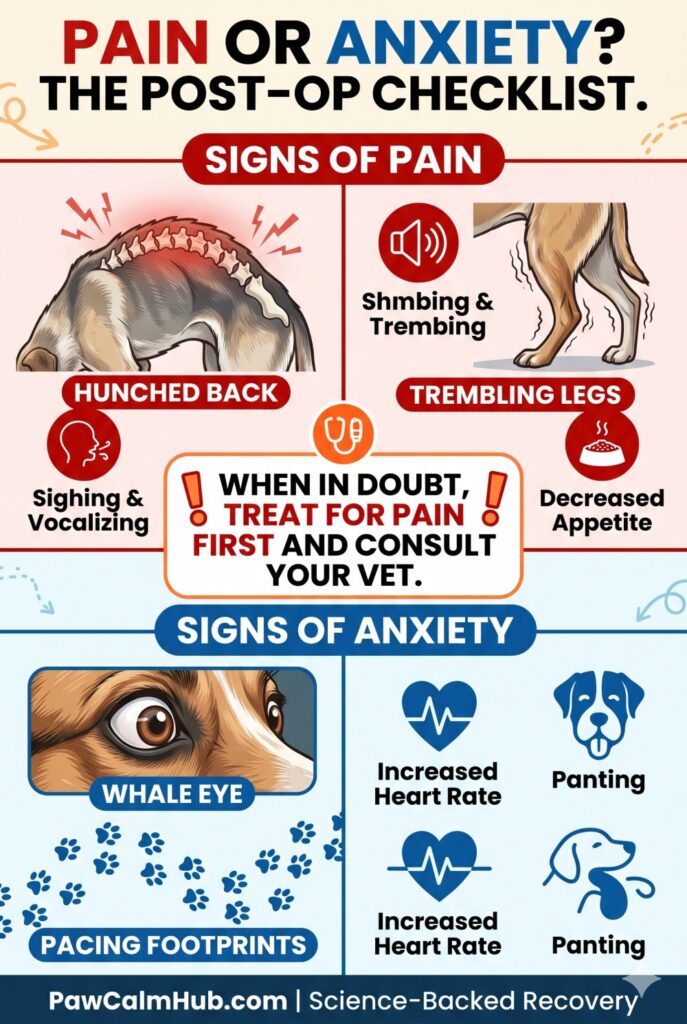
Body Posture and Muscle Tension
- Relaxed posture when lying: low pain probability
- Slightly hunched or guarded when standing: mild pain signal
- Consistently hunched, reluctant to stand straight: moderate pain signal
- Unable to find comfortable position, repeatedly repositioning: significant pain — contact vet
Respiratory Rate at Rest Count your dog’s breaths per minute when they are lying quietly. A normal resting respiratory rate for dogs is 15–30 breaths per minute.
- 15–30: normal
- 30–40: mildly elevated — monitor closely
- 40+: significantly elevated — contact vet; this level of respiratory rate at rest indicates either pain or a respiratory complication
Appetite
- Eating normally: reassuring
- Reduced appetite but accepting food: mild signal — monitor
- Complete refusal of high-value food: moderate to significant signal — if persisting beyond 24 hours post-surgery, contact vet
The Recovery Anxiety Timeline — What to Expect, Day by Day
Hours 1–24: The Fog
The first 24 hours after returning home from surgery are the most neurologically disrupted. Anaesthesia clearance is incomplete. Pain medication may be wearing off between doses. The dog is in an unfamiliar post-surgical body — they can feel the incision, the shaved skin, the sutures, and the collar — without understanding why any of it exists.
What this looks like: Glazed expression, slow movement, apparent confusion about familiar spaces, vocalisation that seems disconnected from any specific cause, excessive sleeping broken by sudden restless periods.
What to do: Minimal intervention. Set up the recovery space before bringing the dog home — a warm, quiet room with low foot traffic, their own bedding plus a self-warming bed for thermoregulation support, and water within easy reach. Keep all family members (including children and other pets) away from the recovery space for the first 12 hours. Dim the lighting. Reduce noise to the lowest possible level.
A self-warming bed is not a comfort extra in this phase — it is a medical support tool. Thermoregulation is compromised after general anaesthesia, and maintaining stable body temperature directly affects the speed and quality of neurological recovery.
What not to do: Do not attempt to comfort the dog with prolonged physical contact. Do not encourage eating if the dog is showing no interest — post-anaesthetic nausea is common and force-feeding creates a negative association. Do not leave the room entirely — your scent and quiet presence are reassuring without being stimulating.
Days 2–5: The Pain Window
Anaesthetic confusion clears but pain typically peaks between days two and five — when the local anaesthetic effects from surgical blocks wear off but the surgical tissue inflammation is at its highest. This is the phase most commonly associated with the anxiety presentations owners find most distressing.
Use the Pain vs. Anxiety Scorecard twice daily during this phase. Pain management adjustment at this stage — a call to your vet — is far more effective than environmental management alone.
A lick mat for dog anxiety serves double duty in this phase: it provides oral motor soothing (parasympathetic activation through licking) and makes medication administration dramatically easier. Most oral post-surgical medications can be pressed into or spread over a lick mat with peanut butter or wet food, transforming medication time from a stressful restraint event into a positive one.
Introduce gentle tactile contact at this stage — not near the surgical site. A grooming glove for anxious dogs used along the dog’s back and shoulders — areas far from any incision site — provides oxytocin-releasing physical contact that supports the bond and calms the nervous system without risking surgical site interference.
Read more: How to Groom an Anxious Dog at Home
Free US shipping · 30-day guarantee
Week 2: Frustration Anxiety
By week two, most dogs are past the acute post-anaesthetic and peak pain phases. What emerges now is a different form of anxiety: frustration anxiety — the psychological and physiological distress produced by restricted physical activity in a dog whose normal arousal requires exercise.
This is the phase owners often find most surprising. The dog seems physically better — eating normally, moving with less obvious discomfort — but is suddenly displaying anxiety behaviours that weren’t present in week one: restlessness, destructive behaviour, excessive vocalisation, attention-seeking that has an almost frantic quality.
The dog is not regressing. They are recovering physically while remaining physically restricted — and the mismatch between their returning energy and their constrained circumstances is producing genuine frustration-based anxiety.
The management tool of choice here is mental stimulation without physical exertion. A snuffle mat for anxious dogs provides foraging-based cognitive engagement that produces genuine mental fatigue without the physical load of exercise. Scatter feeding — hiding small amounts of food around the accessible recovery area for the dog to find — achieves the same effect with even less owner facilitation.
A dog puzzle feeder for anxious dogs provides escalating cognitive challenge that can occupy a frustrated, intellectually active dog for extended periods. For high-drive breeds on surgical rest, this is not enrichment — it is a medical necessity for the management of frustration-based anxiety.
Read more: Best Interactive Dog Toys for Anxious Dogs
Weeks 3–6: The Long Tail and the Secondary Separation Anxiety Risk
Most dogs are physically recovering well by week three. Activity restrictions are easing. Appetite is normal. The incision is healing. From the owner’s perspective, the crisis is over.
The anxiety often is not.
Two secondary anxiety patterns commonly emerge in weeks three to six that owners do not expect.
Secondary Separation Anxiety
The intense bonding of the recovery period — the owner home more than usual, the dog receiving constant attention and close physical proximity — can produce a secondary separation anxiety when normal routines resume. The dog who was calm about owner departures before surgery now shows distress at being left alone, because the recovery period has reset their attachment threshold.
Manage this with the same graduated departure protocol used for standard separation anxiety — very short departures building progressively — and a departure anchor (frozen lick mat at the moment of leaving).
Read more: Dog Separation Anxiety Solutions
Veterinary Fear Escalation
Post-surgical follow-up appointments are among the most anxiety-producing vet visits a dog experiences — they return to the environment where something frightening happened, and they are now physically vulnerable in ways they were not before. Begin the vet desensitisation protocol described in Article 10 of this library as early as possible in the recovery period, even if the next visit is weeks away.
Using a Camera During Recovery
A video camera with pet feeder serves a specific function during post-surgical recovery: it allows you to monitor the dog during periods when you cannot be physically present without needing to enter the recovery room and spike the dog’s arousal. Two-way audio provides the ability to offer verbal reassurance remotely. For dogs receiving regular medication, the feeder function can be programmed to dispense a treat at medication time — building a positive association with that time of day.
How to Build the Perfect Post-Surgical Recovery Space
The recovery space is where most of the anxiety management happens. Setting it up correctly before the dog comes home is one of the highest-value things an owner can do.
Location: A quiet interior room with low foot traffic. Not near the front door (visitor arrivals are arousing and disruptive). Not in a room with exterior-facing windows if the dog is noise or movement sensitive.
Temperature: Warm and stable. General anaesthesia compromises thermoregulation for 12–24 hours. A self-warming bed ensures the dog maintains body temperature without relying on a heating pad, which carries burn risk in a dog who cannot easily reposition.
Sound: White noise at low volume to mask household sounds that would normally go unnoticed but now produce startle responses in the post-surgical nervous system.
Bedding: The dog’s own bedding — carrying their familiar scent — plus a self-warming bed. Do not wash bedding immediately before the recovery period. Familiar scent is a genuine neurological comfort signal.
Access to water: At all times, within easy reach. Post-surgical dogs are often mildly dehydrated from the fasting period before surgery and the IV fluids they received, which paradoxically can produce increased rather than decreased thirst on returning home.
Other pets: Separated from the recovery space for the first 48 hours minimum. Other household pets — particularly dogs — will attempt to investigate the surgical site, will disrupt the quiet the recovering dog needs, and can trigger arousal spikes that elevate pain perception.
Elizabethan collar alternatives: If the standard E-collar is producing extreme anxiety — the dog unable to eat, drink, sleep, or navigate with it — discuss alternatives with your vet: inflatable recovery collars, surgical recovery suits, or soft E-collar alternatives may be viable depending on the site and type of surgery.
When Post-Surgical Anxiety Needs an Immediate Vet Call
Some post-surgical presentations require same-day veterinary contact rather than home management. The following are not “watch and see” situations.
Call your vet immediately if:
- Vomiting persists beyond 12 hours after returning home (mild post-anaesthetic vomiting is normal; sustained vomiting is not)
- The surgical incision site shows increasing redness, warmth, swelling, or discharge — signs of infection that directly worsen pain-driven anxiety
- The dog has not eaten or drunk any water within 36 hours of returning home
- Respiratory rate at rest exceeds 40 breaths per minute for more than 20 minutes
- Resting heart rate is visibly elevated — you can feel the heart pounding through the chest wall
- Behavioural anxiety is dramatically worsening rather than gradually improving across the first 72 hours
- Any sign of self-trauma to the surgical site — licking through the collar, pawing at the incision
Never hesitate to call your veterinary clinic because you feel you might be overreacting. The veterinary nursing team expects calls from concerned owners during post-surgical recovery periods, and the cost of a phone call that turns out to be unnecessary is nothing compared to the cost of a complication missed.
The Role of Calming Chews in Post-Surgical Anxiety
Hemp calming chews are a useful support tool for post-surgical anxiety — but with one important caveat that most content on this topic omits: confirm with your veterinarian that hemp CBD is appropriate given the specific post-surgical medications your dog is taking.
CBD interacts with the cytochrome P450 enzyme system in the liver — the same system responsible for metabolising many pharmaceutical drugs including some analgesics and antibiotics. In most cases, this interaction is not clinically significant at typical supplement doses, but it is a conversation your vet needs to be part of before you add any supplement during the immediate post-surgical period.
Once cleared by your vet, hemp calming chews for dogs administered in the evening during the first two weeks of recovery can meaningfully reduce the night-time anxiety and restlessness that disrupts both the dog’s sleep and the owner’s.
Read more: Do Calming Chews Work for Dogs?
Is it normal for my dog to act like a “stranger” after anaesthesia?
Yes. Post-anaesthetic cognitive dysfunction can cause confusion and fear for 24–72 hours as the neurological system recalibrates
Why is my dog acting aggressive after surgery?
This is almost always “Fear-Aggression” driven by pain or anesthetic disorientation. Your dog feels vulnerable and is using growling as a “keep away” signal to protect their surgical site.
How long does anesthesia stay in a dog’s system?
While most dogs wake up within hours, the cognitive effects and “brain fog” can last for 24 to 72 hours. During this time, they may not recognize cues or may seem frightened of familiar people
Can I give my dog calming chews after surgery?
You must consult your vet first, as some natural ingredients can interact with prescription pain meds or blood thinners. Once cleared, hemp-based chews can be an excellent way to manage “rest-period frustration
How long does post-surgical anxiety typically last?
For most dogs, the acute post-anaesthetic anxiety resolves within 24–72 hours. Pain-driven anxiety follows the pain trajectory — typically improving progressively from days 3–5 onwards as healing advances and inflammation reduces. Frustration anxiety, which peaks in week two, usually resolves as activity restrictions ease in weeks three to four. Secondary separation anxiety — if it develops — may persist for 4–8 weeks after normal routine resumes and requires active management. The full resolution of all post-surgical anxiety effects typically occurs by weeks 6–8 for routine procedures, and may be longer for complex orthopaedic or internal surgeries
My dog is on pain medication but still seems anxious. Does that mean the medication isn’t working?
Not necessarily — but it warrants a call to your vet. As this guide explains, pain and anxiety amplify each other through shared neural pathways, and adequate pain management does not always produce complete anxiety resolution. The reverse is also true: adequate anxiety management can reduce pain perception. If your dog is on veterinary-prescribed pain medication and showing Column B (anxiety) scores consistently higher than Column A (pain) scores on the scorecard, the primary remaining issue may be anxiety rather than inadequate pain control. If Column A remains elevated despite medication, discuss pain management adjustment with your vet directly.
Should I sleep near my dog during recovery?
For the first night, particularly, proximity to the owner provides a genuine neurological comfort signal that environmental management cannot fully replicate. If you can sleep in the same room — on a camp bed, a sofa — the physiological benefit of owner proximity (cortisol reduction, improved sleep quality for the dog) is measurable. If this is not practical, a worn garment placed in the dog’s bed and a white noise machine in the room are the best available proxies.
My dog had surgery three weeks ago and is now showing separation anxiety she never had before. Is this related?
Almost certainly, yes. The recovery period — with the owner home more, the dog receiving sustained close attention and physical care — resets the attachment threshold in many dogs, producing a secondary separation anxiety when normal routines resume. This is a well-recognised post-surgical behavioural pattern. Manage it with graduated departures (beginning with 30 seconds and building slowly), a departure anchor such as a frozen lick mat given at the moment of leaving, and patience. Most dogs return to their pre-surgical separation baseline within 4–6 weeks of consistent graduated departure practice.
My dog had surgery two months ago and is still anxious. Is something wrong?
Two months of sustained post-surgical anxiety warrants veterinary assessment for two reasons. First, it may indicate that pain has not fully resolved — chronic low-grade surgical site pain, particularly following orthopaedic procedures, is more common than post-operative care notes suggest and significantly underdiagnosed. Second, it may indicate that the surgical experience has produced lasting changes to the dog’s fear-conditioning around veterinary handling, physical touch, or confinement — changes that require a structured desensitisation programme and potentially veterinary behaviourist input to address. Neither outcome is inevitable, but both are addressable with the right professional support.
Can neutering or spaying cause lasting anxiety?
Routine neutering and spaying procedures are among the most common surgeries performed in dogs, and for the vast majority, post-surgical anxiety resolves completely within the normal timeline described above. However, research published in Frontiers in Veterinary Science has documented that early neutering (before 12 months) may be associated with increased fearfulness and anxiety in certain breeds — likely through the removal of gonadal hormones during a developmental period when they play a role in neural maturation. This is an active area of veterinary research with significant breed-specific nuance. If your dog’s anxiety began or worsened after neutering and has not resolved within 8 weeks, raise it specifically with your vet as a topic for discussion.
My dog is scheduled for surgery next week. What can I do now to reduce post-surgical anxiety?
Several pre-surgical steps meaningfully reduce post-surgical anxiety. Begin the recovery space setup before the day of surgery — introduce the dog to the space with positive associations now, so it is not novel on their return. Practice short separations (departure and return) to build departure tolerance before the surgery day, which will be the most extreme departure the dog experiences. Discuss a “happy visit” to the vet clinic in the week before surgery to reduce the negative conditioning that the surgical day will otherwise maximise. Ask your vet whether pre-surgical anti-anxiety medication (often trazodone or gabapentin, given the evening before and morning of) is appropriate — many veterinary practices now routinely prescribe this for anxious patients, and it significantly reduces the post-surgical anxiety load.