
Estimated read time: 20 minutes | Last updated: 2025
A note on this guide: This article draws on peer-reviewed research in canine behaviour, attachment science, and veterinary developmental psychology. It is written for expecting parents and new parents who share their home with a dog and want to manage the transition in a way that is safe, humane, and genuinely effective. If your dog has a history of aggression, resource guarding, or unpredictable behaviour, please consult a certified veterinary behaviourist before the baby arrives — not after.
Nobody tells you about the dog.
The prenatal classes cover feeding schedules, sleep deprivation, and the mechanics of labour. The baby books cover developmental milestones, nursery setup, and the first weeks of life. The parenting forums cover everything from nappy brands to postpartum anxiety.
And somewhere in the background of all of it, the dog is pacing.
For millions of households, the arrival of a new baby is the most significant disruption their dog will ever experience. Not because dogs are inherently threatened by infants — they are not. But because every single component of the environment that tells a dog the world is predictable and safe — the routine, the scent landscape, the household soundscape, the owner’s emotional state, the spatial organisation of the home, the allocation of attention — changes simultaneously, dramatically, and without warning.
Most dogs adjust. Some adjust easily. Some adjust slowly and with difficulty. A small number develop anxiety disorders that, if not managed early, become entrenched. The difference between these outcomes is not the dog’s temperament alone — it is the quality of the preparation and management that surrounds the transition.
This guide is the preparation. Twelve weeks. Week by week. Built around what the science of canine behaviour and attachment actually shows — not around the reassuring platitudes that most parenting resources offer when they bother to mention the dog at all.
Why a New Baby Triggers Anxiety in Dogs — The Complete Biological and Social Picture
To manage this transition effectively, you need to understand what is actually happening to your dog — not just what it looks like from the outside.
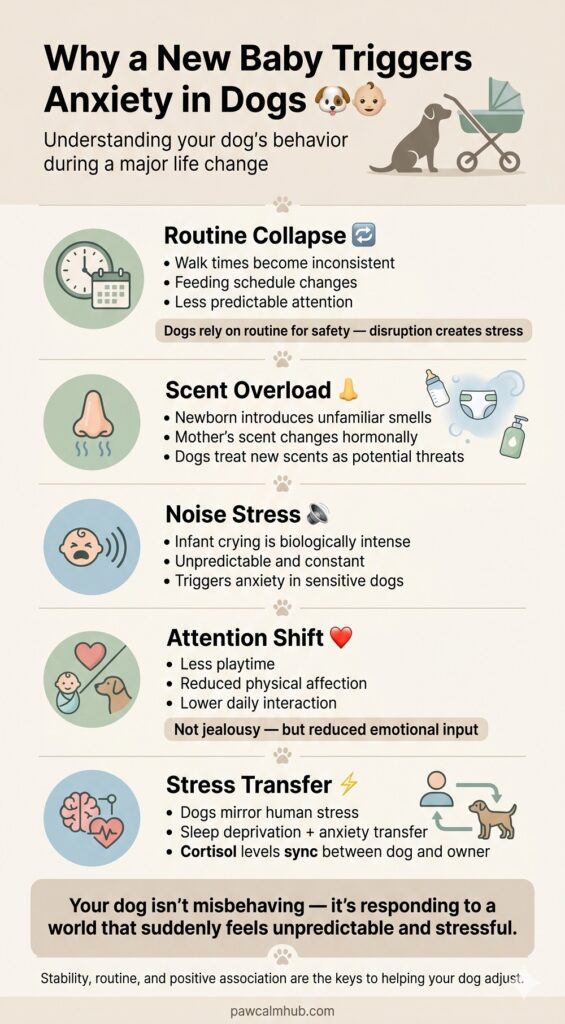
The Routine Disruption
Research on canine stress and environmental predictability consistently identifies routine disruption as one of the primary drivers of anxiety in domestic dogs. Dogs do not experience time the way humans do — they experience it through biological rhythms anchored to environmental cues. The time of the morning walk. The time of the evening meal. The position of the owner on the sofa at 9pm. These are not preferences. They are the structural architecture of the dog’s sense of safety.
A new baby dismantles this architecture completely. Walk times become unpredictable. Meals may be late. The owner who was reliably present is now reliably unavailable. The 9pm sofa session is replaced by feeding, changing, and the particular exhausted desperation of new parenthood. From the dog’s perspective, the predictable world has disappeared.
The Scent Revolution
Dogs navigate reality primarily through olfaction — their sense of smell is estimated at 10,000 to 100,000 times more sensitive than a human’s. The scent landscape of the home is, to the dog, as detailed and information-rich as a visual panorama is to a human. Every object, every person, every surface carries an olfactory signature that the dog has catalogued and assessed.
A new baby introduces an entirely novel olfactory signature — one that evolution has not prepared the dog to categorise as familiar or safe. The smell of newborn human skin, amniotic fluid residue, breast milk or formula, nappy cream, baby-specific laundry products, and the distinctive physiological markers of a very young infant are all genuinely novel to a dog who has never lived with a baby. Novel scents in the home environment are categorised, by default, as potentially threatening until proven otherwise.
On top of this: the primary female owner undergoes significant hormonal changes during pregnancy and the postpartum period that alter her individual scent signature. The dog who has spent years learning the precise olfactory profile of their primary attachment figure finds that profile gradually and then dramatically changed — producing a disorienting mismatch between the familiar person they see and the altered chemical signature they smell.
The Acoustic Challenge
Infant crying is one of the most acoustically distinctive and penetrating sounds in the human and animal world. Evolutionary research documents that the frequency and pattern of infant crying are specifically calibrated to be impossible to ignore — this is a survival mechanism. For dogs with any predisposition toward noise sensitivity or sound reactivity, the arrival of a crying infant in the household creates a persistent, unpredictable acoustic stressor that operates at all hours and cannot be managed through standard noise-reduction techniques.
The Attention Economy
A dog who has been the primary focus of owner attention and affection for years now occupies a fundamentally different position in the household’s attention economy. This is not jealousy in the anthropomorphic sense — but it is a real reduction in the positive social interactions, physical contact, and structured enrichment that formed the dog’s daily welfare baseline. Over weeks, this reduction produces measurable changes in cortisol levels and behavioural indicators of chronic stress.
The Owner’s Anxiety Contagion
The final and most underappreciated factor: the new parents’ own anxiety, exhaustion, and stress are directly communicated to the dog through physiological signals the dog cannot ignore and cannot contextualise. Research on cortisol synchrony between dogs and their owners documents that dogs and their primary human companions synchronise stress hormone levels — meaning a household running on post-natal anxiety and sleep deprivation is, from the dog’s nervous system’s perspective, a household in which something is chronically wrong.
The 12-Week Transition Plan — Week by Week
Weeks 1–4: Pre-Baby Preparation (The Foundation Phase)
The most common mistake new parents make is doing nothing until the baby arrives and then attempting to manage the dog’s response in real time — while simultaneously managing a newborn, recovering from labour, and operating on fractured sleep. The foundation phase exists precisely to prevent this.
Week 1: The Sound Preparation Programme
Begin playing recorded infant sounds — crying, cooing, the sounds of a baby monitor, the mechanical sounds of a bouncy chair and a pram — through a speaker in the home at low volume. This is systematic sound desensitisation, and it works through the same mechanism as all desensitisation: gradual, positive exposure to a stimulus before it is threatening, building a neutral or positive association that carries into the real exposure.
Start at a volume where the dog notices the sound but shows no anxiety response. Pair the sound with high-value food — real chicken, cheese, or whatever motivates your dog most strongly. The sound predicts something good. Over 7 days, very gradually increase the volume while maintaining the food pairing. By the end of week one, your dog should be hearing the sounds at realistic volume and showing no more than mild, brief interest.
Critical note: if your dog shows significant anxiety responses (panting, hiding, pacing) even at low volume, slow the progression dramatically. Some dogs with sound sensitivity need 3–4 weeks for this step alone. Do not rush it.
Week 2: The Spatial Restructuring
Baby-proofing inevitably involves spatial changes that affect the dog’s access and routine: baby gates installed, rooms designated off-limits, nursery furniture reorganising the scent landscape of a room the dog has always had access to.
Install these changes this week — not the day before the baby arrives. Every change needs to be experienced as normal before it is also experienced simultaneously with the arrival of a newborn. A baby gate installed six weeks before the birth is a neutral feature of the environment by the time the baby comes home. A baby gate installed the day the baby comes home is a sudden restriction that coincides with the most disrupting event the dog has experienced.
Allow the dog to investigate the nursery thoroughly during setup — under supervision. The goal is not to exclude the dog from the nursery forever (though some families choose this) but to ensure that whatever access policy you implement is established and normalised before the baby occupies the room.
Week 3: The Schedule Shift
This is the most practically important preparation step and the one most frequently skipped.
Identify what the dog’s routine will realistically look like in the first weeks after the baby arrives. Walks will likely be shorter, later, or both. Feeding times may shift. The evening routine will be different. Implement that realistic post-baby schedule now — 4–6 weeks before the birth.
Dogs do not adapt to routine change well when it coincides with other major disruptions. A dog who has already adjusted to a shifted walk time, a different feeding schedule, and altered owner availability before the baby arrives has one fewer major disruption to process simultaneously when the baby comes home.
Week 4: Nursery Familiarisation and Resource Redistribution
If the dog will have limited or no access to the nursery, this is the week to complete that training — not the week the baby arrives. Close the nursery door for increasing periods, with the dog receiving a high-value activity (snuffle mat, treat dispenser toy, lick mat) at the moment of closure. The closed door predicts good things rather than exclusion.
Simultaneously, introduce new enrichment tools that will be used to manage the dog during baby-focused periods. The snuffle mat for anxious dogs, dog puzzle feeder, and dog treat dispenser toy should all be introduced and positively associated NOW — not deployed for the first time while you are also trying to feed a newborn.
Read more: Best Interactive Dog Toys for Anxious Dogs
Begin During Pregnancy (Weeks 3–4 Prep)
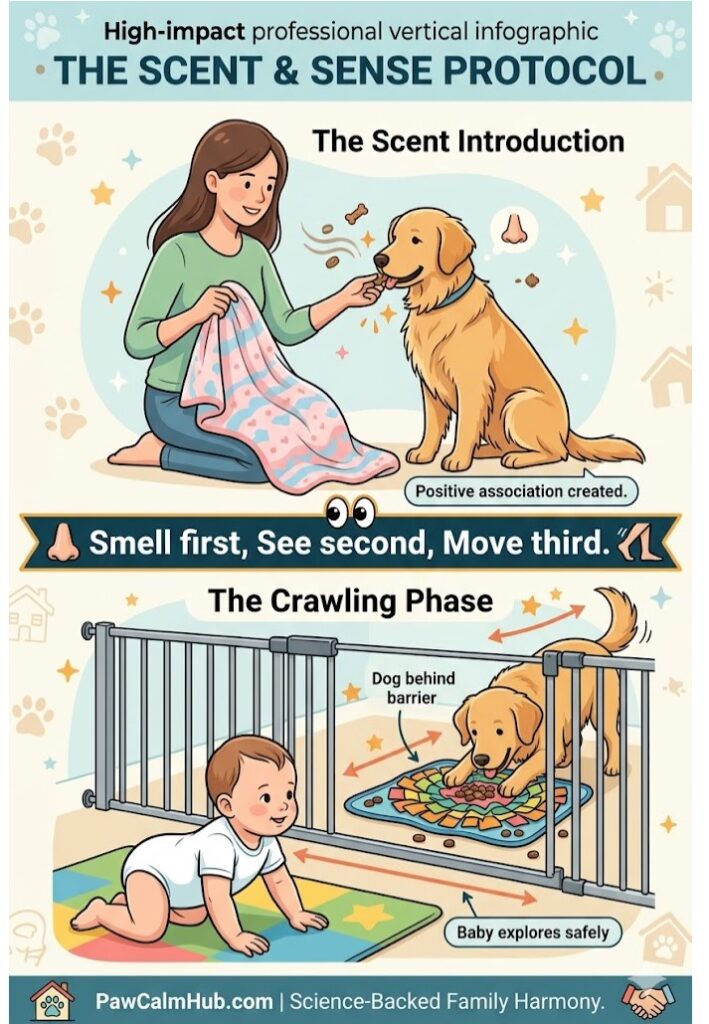
Introduce items like unpackaged blankets or nursery lotions near the dog’s feeding area. Pairing these novel scents with mealtimes for 10–14 days creates an immediate positive neuro-association.
The Hospital Bag Pre-Introduction
Pack a muslin cloth or small blanket specifically to capture the baby’s scent. This “scent vessel” will return home 24 hours before the infant does.
The First Blanket Protocol (Critical Step)
Bring the scented cloth home within 12–24 hours of birth. Place it at nose height in a central room. Do not guide the dog to it. Allow them to discover it on their own terms. If the dog remains calm for 30 minutes, offer a high-value treat near (not on) the item.
Deepening the Feeding Association
Days before homecoming, place the scented cloth near the food bowl during meals. By homecoming, the scent should be:
- Established in the home landscape
- Associated with positive feeding experiences
- Catalogued as neutral or positive by the dog
The Homecoming Reunion
Allow the dog to approach the baby’s feet voluntarily. Honour every retreat without comment. Never force face-to-face proximity.
Weeks 5–8: The First Month Home
The Homecoming Week
The first week at home with a newborn is, for most families, the most chaotic and exhausted of their lives. This is precisely when the dog is most likely to receive the least attention while simultaneously experiencing the greatest disruption — a combination that produces rapid anxiety escalation if not managed proactively.
The single most important management tool in this week is the dog’s routine, maintained by whoever is not currently managing the baby. If the partner is managing the baby while the primary caregiver rests, the partner is responsible for the dog’s walk, meal, and enrichment session. The dog’s routine is not optional welfare — it is the primary anxiety prevention tool available in a week when nothing else is manageable.
The “Yes Space” Principle
Establish one location in the home — near the primary parenting area, not excluded from it — where the dog is always welcome, always has access to enrichment, and is never moved on. A self-warming dog anxiety bed in the corner of the main living area, with a lick mat prepared and available, serves as the dog’s anchor point during feeding and settling sessions.
This “yes space” is the counterbalance to the many spaces and times that are now conditionally available to the dog. Having one space that is unconditionally theirs reduces the territorial anxiety that spatial restriction produces.
Read more: Dog Separation Anxiety Solutions
Never Punish Proximity
This is the rule that most parenting resources get catastrophically wrong when they address dogs at all: never punish a dog for showing interest in or proximity to the baby.
Punishing proximity — scolding the dog for coming near, pushing them away when they approach the feeding chair, confining them whenever they are interested in the baby — creates a negative association between the dog and the baby that is the direct opposite of what you need to build. The dog learns that the baby’s presence predicts bad things (punishment, rejection, confinement). This association, once established, is the foundation of problem behaviour — not its prevention.
Instead: when the dog approaches the baby area calmly, acknowledge it calmly. If they lie nearby while you feed, that is excellent behaviour — tell them so quietly. If they sniff the baby’s feet with a relaxed body, that is the relationship you want to build. Reinforce it.
The only behaviour that warrants immediate, quiet intervention is mouthy or jumping behaviour near the baby — and the correct response is calm redirection to another activity, not punishment.
The Distraction Toolkit — Products That Give Dogs a Job
During feeding sessions, nappy changes, and settling periods when you physically cannot attend to the dog:
The automatic dog ball launcher in a room where the dog has supervised access provides self-directed physical exercise that burns the anxious energy of the excluded dog. For larger breeds, the automatic ball launcher for large dogs provides the same at appropriate scale.
The dog treat dispenser toy rewards autonomous engagement and reduces owner-dependency anxiety — the dog learns that interesting, rewarding things happen independently of the owner’s direct involvement.
Weeks 6–8: Managing the Peak Anxiety Window
For most dogs, the anxiety peaks not in the first week — when the novelty is too overwhelming for full emotional processing — but in weeks four to eight, as the new normal begins to solidify and the dog’s nervous system catches up with what has changed.
Signs of this peak: increased following behaviour, regression in house training, changes in eating, vocalisation during baby-focused periods, and the first appearance of departure anxiety if the parent begins returning to work.
Introduce hemp calming chews for dogs during this phase — daily administration during the highest-disruption weeks provides endocannabinoid system support that lowers the baseline cortisol level from which all other anxiety events escalate.
The Hospital Departure Day — The Single Highest-Risk Moment
Every parent who owns a dog should plan for this specifically — because it is the moment of maximum disruption to the dog’s attachment and routine, and it is the moment least likely to be managed well because everyone’s attention is understandably elsewhere.
The morning of departure for the hospital — particularly if labour begins unexpectedly — the dog’s primary attachment figure leaves. Possibly with unusual behaviour (hurried movement, pain, altered scent from hormonal and physical labour changes). Possibly at an unusual time. Possibly with bags. And then does not return for 24–72 hours.
For a dog with any predisposition toward separation anxiety, this is a full anxiety event before the baby has even arrived.
Pre-plan the following:
Identify, weeks before the due date, who will care for the dog during the hospital stay. Ideally: someone the dog knows well, who will maintain the existing routine as closely as possible, and who has been briefed on the dog’s specific anxiety triggers and management tools.
Leave the dog’s routine written down — not assumed. Feed time, walk duration, enrichment schedule, and any management notes.
Prepare a frozen lick mat in the freezer, ready for the carer to use at departure time. A hemp calming chew administered 45 minutes before the primary owner’s departure reduces the acute cortisol spike that a sudden, unplanned separation from the primary attachment figure produces.
Consider fitting the dog anxiety vest on the dog before departure, if it has been positively introduced. The vest provides sustained parasympathetic support during the absence.
Leave a worn, unwashed garment in the dog’s bed. The olfactory presence of the absent owner is a genuine neurological comfort signal — not a sentimental gesture.
Weeks 9–12: The New Normal
By week nine, the households that have managed the transition well typically show a dog who has found their footing in the new family structure. The baby’s scent is thoroughly familiar. The new routine, however modified, has become the routine. The dog has learned that the baby’s presence in the home does not predict the end of good things — it predicts a different pattern of them.
Signs of successful adjustment:
- The dog investigates the baby’s area voluntarily and without anxiety
- The dog settles calmly during feeding and changing sessions
- Appetite and sleep patterns have normalised
- The dog shows relaxed body language in the baby’s presence — loose gait, soft eyes, normal tail carriage
Signs that management needs to be escalated:
- Sustained food refusal or weight loss
- Persistent house soiling in a previously house-trained dog
- Growling, stiffening, or sustained avoidance of the baby’s presence
- Self-grooming to the point of coat damage
- Worsening separation anxiety beyond week eight
Any of the escalation signs warrants veterinary assessment — and a referral to a certified applied animal behaviourist if the signs involve any behaviour directed toward the baby. Veterinary behaviourist intervention at this stage, before any incident occurs, is the most responsible and most effective management decision a family in this position can make.
Using Remote Monitoring During the Adjustment Period
A video camera with pet feeder positioned in the main living area provides two capabilities essential during this phase: it allows you to monitor the dog’s behaviour in shared spaces when your attention is occupied by the baby, and it allows you to offer remote verbal reassurance during the dog’s anxious periods without physically leaving the feeding or settling session.
Can I leave my dog and baby alone if the dog is “good”?
Never. No matter how calm the dog is, they are animals with instincts. Always use active supervision or a physical barrier (gate) when you are not 100% focused on their interaction.
My dog has started peeing in the nursery. Why?
This is often “Territorial Anxiety.” The dog is trying to reclaim their scent in a room that now smells overwhelmingly like a “new pack member.” Use an enzymatic cleaner and re-introduce positive associations with the room via a snuffle mat.
Is my dog “jealous” of the new baby?
Usually, it is disruption to routine rather than jealousy. Dogs rely on predictability; when a baby alters their walk and feed times, it triggers a biological stress response
At what point during pregnancy should I start preparing my dog?
Ideally, begin the preparation described in this guide at week 28–30 of pregnancy — approximately 10–12 weeks before the due date. This timeline allows sufficient time for each phase of the protocol to be completed without rushing, and ensures that the most important preparation steps (routine shift, spatial restructuring, sound desensitisation, scent introduction) are fully implemented before the birth. If you are reading this closer to your due date, prioritise the routine shift and scent introduction protocol — these two elements produce the greatest anxiety reduction per unit of time invested.
My dog has never shown aggression. Do I really need to worry?
A dog who has never shown aggression in their pre-baby life has no documented history of the specific social and environmental pressures that a newborn produces. Behaviour that a dog has never needed to produce before may emerge under conditions they have never experienced. This is not a reason for alarm — the vast majority of dogs navigate the baby transition safely. It is a reason to implement the preparation protocol seriously and to maintain vigilant, calm supervision during all early dog-baby interactions, regardless of the dog’s history.
My dog keeps trying to lick the baby. Should I allow this?
Light investigative sniffing of the baby’s extremities (feet, hands) from a dog showing relaxed body language is generally safe and can be allowed under close supervision — it builds positive association and satisfies the dog’s primary mode of information-gathering. Licking the baby’s face should be discouraged for basic hygiene reasons, redirecting calmly to an alternative behaviour rather than punishing. If the dog shows any tension, fixation, or arousal during proximity to the baby — stiff body, hard stare, high tail, rapid tongue flicking — increase the physical distance and consult a veterinary behaviourist before allowing close contact again.
Is it normal for my dog to be jealous of the baby?
The concept of jealousy in dogs is neurologically contested — research published in PLOS ONE found that dogs show behaviours consistent with jealousy (specifically, attention-seeking and intervention behaviours when owners interact with a rival) but the cognitive and emotional substrate of these behaviours is debated. What is not debated is that dogs show measurable stress responses to reduced owner attention and changed routine — and that these stress responses produce the attention-seeking, regression, and behaviour change that owners commonly interpret as jealousy. Whether you call it jealousy or stress-driven attention-seeking, the management approach is the same: maintain structured, predictable positive interactions with the dog, provide adequate enrichment during baby-focused periods, and avoid the cycle of punishment for attention-seeking that deepens the negative association.
What if my dog has growled near the baby? Is rehoming the only option?
A single growl is a communication, not a verdict. Growling is the dog’s warning system — and a dog who growls is a dog who is still communicating rather than escalating to a bite without warning. The correct response to a growl near the baby is not punishment (which suppresses the warning without addressing the cause) and not immediate rehoming. It is calm separation, honest assessment of what preceded the growl, and immediate contact with a certified veterinary behaviourist. In the majority of cases, a growl in this context reflects anxiety or resource stress that is addressable with management. What it requires is professional assessment — not immediate surrender
My partner thinks we should rehome the dog before the baby comes. How do I make the case for keeping them?
This is a genuinely difficult conversation, and this guide is not the right place to resolve a relationship decision. What the evidence supports is this: the vast majority of dogs who are prepared appropriately — through the protocol described in this guide — adjust successfully to a new baby without producing safety concerns. Rehoming a dog before any actual problem has occurred, based on anticipated risk alone, means separating the dog from their attachment figures at a point of no behavioural necessity. If your partner’s concern is based on specific observed behaviour (aggression, resource guarding, unpredictability), that concern warrants a professional assessment — not an assumption that rehoming is the only safe option.
How do I manage the dog during night feeds?
Decide your policy before the baby comes and implement it consistently. Options: the dog sleeps outside the bedroom during night feeds (implement this practice now, before the baby, so it is not a sudden change); the dog sleeps in the bedroom but on their own bed with a self-warming mat and a frozen lick mat available for restless periods; or the dog is confined to another room during night hours. Whatever you choose, begin it at least 4 weeks before the due date so that the night arrangement is established as normal before the baby occupies the room