
Estimated read time: 19 minutes | Last updated: 2025
A note on this guide: This article references peer-reviewed veterinary behaviour research, the Fear Free certification programme, and low-stress handling science. It is written for dog owners who dread vet visits as much as their dogs do — and for whom the standard advice of “just stay calm” has never been sufficient. If your dog’s vet anxiety has produced aggression toward veterinary staff, please discuss this specifically with your veterinarian before the next appointment. This guide includes a section on house-call veterinary services for dogs whose vet anxiety is severe enough to warrant this alternative.
Veterinary anxiety is the most commonly reported situational anxiety in dogs.
Not thunderstorms. Not fireworks. Not separation. The place their owners take them specifically to keep them healthy is, for the majority of dogs, the most reliably terrifying place they visit.
This creates a problem that compounds on itself. A dog who is anxious at the vet is harder to examine accurately — pain assessment, heart rate, respiratory rate, and physical palpation findings are all confounded by the physiological arousal of fear. Anxious dogs require more restraint, which increases their aversion, which makes the next visit worse. Owners who dread the visit communicate their own anxiety to their dog in the car on the way — further elevating the dog’s arousal before a door has been opened. And the physical health problems that go undetected because the dog cannot be adequately examined in this state are the final, invisible consequence.
The Fear Free movement in veterinary medicine — founded by Dr. Marty Becker and now encompassing over 90,000 certified veterinary professionals in 160 countries — exists because this problem is significant enough to have produced a professional certification programme dedicated to solving it. Fear Free certification trains veterinary teams in low-stress handling, patient-centred examination protocols, and the specific environmental modifications that reduce in-clinic anxiety.
But the certification only works if the dog arrives in a state that allows its benefits to be delivered. And that is the gap this guide fills: what happens in the 6 weeks before the appointment, the 24 hours before, the morning of, and the 2 hours after — is as important as anything that happens inside the clinic itself.
Why Vet Visits Are So Anxiety-Triggering — The Full Sensory Analysis
The veterinary clinic, viewed through the lens of canine sensory neuroscience, is almost perfectly designed to trigger a threat response. Understanding why helps owners understand what they are managing — and why managing it requires more than telling themselves to stay calm.
The Olfactory Environment
A veterinary waiting room carries the olfactory signatures of dozens of anxious animals who have recently passed through it. Fear pheromones — specifically the alarm pheromone produced by dogs in acute stress states — persist in an environment for hours. A dog who enters a waiting room saturated with other animals’ stress pheromones is neurologically processing a warning signal from every previous patient before any clinical interaction has begun.
Additionally: antiseptic cleaning agents, pharmaceutical residues, the metallic smell of surgical instruments, and the distinctive physiological markers of illness in other patients all constitute novel, aversive olfactory stimuli. For a dog whose sense of smell processes this information at 10,000 to 100,000 times human sensitivity, the olfactory experience of a veterinary clinic is immeasurably more intense and threatening than it is for the humans who work there.
The Acoustic Environment
Other dogs vocalising in stress. The high-pitched sounds of distressed cats. The stainless steel sound of equipment. The PA system. Air conditioning units operating at frequencies within the canine hearing range but outside human awareness. The veterinary clinic is an acoustic environment of extraordinary complexity and unpredictability — and unpredictable sounds are the primary auditory anxiety trigger for dogs.
The Physical Environment
Stainless steel examination tables are cold, hard, elevated, and unstable under the dog’s paws. Elevation itself is a threat signal for animals whose instinct tells them that falling from height is dangerous. The confined space of the consultation room removes the escape routes that anxious animals constantly monitor. Restraint — whether by veterinary staff or by physical positioning — removes the dog’s agency completely and activates the most primitive threat response available.
The Social Environment
Unfamiliar people approaching with confident, direct energy — as clinical staff necessarily do during examinations — represents the social approach pattern of a threat in canine body language terms. Direct eye contact, forward-leaning posture, and reaching hands are all behaviours that a subordinate or anxious dog reads as confrontational. The veterinary examination is, from the dog’s social cognition perspective, a sustained series of threat behaviours performed by strangers.
The Owner’s Own Anxiety
Research published in Scientific Reports documented that long-term stress in owners — measured through hair cortisol levels — correlates with long-term stress in their dogs. This cortisol synchrony means that an owner who is anxious about the vet visit communicates that anxiety to their dog through physiological signals the dog detects but cannot contextualise. The dog who smells their owner’s elevated cortisol in the car on the way to the clinic does not know why their owner is stressed. They simply know that their owner is stressed — and in the dog’s experience, this is relevant threat information.
The 6-Week Vet Preparation Protocol
Weeks 1–2: Touch Desensitisation at Home
The examination is the most aversive component of the veterinary visit for most anxious dogs — and every element of the examination can be practised at home under positive conditions before it is performed under clinical conditions.
Begin systematic handling sessions at home: 5 minutes daily, always ending before the dog shows stress signals, always paired with high-value food.
What to practise, in order from least to most sensitive for most dogs:
Back and shoulders: run both hands firmly along the back from neck to tail. This is the area of least sensitivity for most dogs and the starting point for building handling tolerance.
Chest and abdomen: gentle pressure on the chest, then the abdomen. Veterinarians palpate the abdomen for organ assessment — a dog who has never been touched here under positive conditions finds this deeply aversive.
Ears: gently lift and fold each ear flap. Look inside briefly. The ear examination is one of the most anxiety-triggering components of a routine check for many dogs.
Mouth and teeth: lift the lip gently, touch the teeth, briefly open the mouth. Dental examinations are the most common source of examination-related anxiety.
Paws and nails: handle each paw, apply light pressure between the toes, briefly extend each nail. This is the most sensitive area for most dogs — and the one most likely to produce avoidance or resistance.
Temperature assessment position: ask the dog to stand still while you apply light pressure to the base of the tail region. This is what a temperature check requires, and it is profoundly unfamiliar to most dogs who have not experienced it.
Use a grooming glove for anxious dogs to begin the back and shoulder work before progressing to bare-hand contact for more sensitive areas. The glove provides a softer, broader pressure that many anxiety-prone dogs find more acceptable as an introduction to systematic handling.
Read more: How to Groom an Anxious Dog at Home — the full desensitisation protocol for touch-averse dogs, directly applicable to vet examination preparation.
Weeks 3–4: Happy Visits — The Single Most Effective Preparation Strategy
Call your veterinary clinic and ask for three to five “happy visits” — appointments with no clinical purpose, designed solely to allow the dog to visit the clinic, receive high-value food from the veterinary team, and leave before anything aversive happens.
Most veterinary practices, particularly Fear Free certified practices, will agree to this without hesitation. Those who are unfamiliar with the concept can be directed to the Fear Free Happy Visits protocol — a formal programme that many clinics now offer specifically for this purpose.
The neurological mechanism is classical conditioning: the veterinary clinic environment (currently a conditioned stimulus for fear) is repeatedly paired with the highest-value positive stimulus available (real food from real veterinary staff) under conditions where no aversive event occurs. Over three to five repetitions, the conditioned response begins to shift from fear to anticipation of food.
This does not require dramatic behavioural change to be working. A dog who is slightly less aroused at the clinic entrance on visit three than on visit one is showing neurological progress — even if they are still anxious by external measures. The shift takes time. Happy visits are the investment that makes every subsequent clinical visit more manageable.
Weeks 5–6: Arrival Practice and Car Association
For many dogs, the anxiety begins before the clinic is visible. The car journey, the car park, or the specific route to the clinic are all conditioned stimuli that predict the aversive event and begin producing physiological arousal minutes before arrival.
Car association practice: Drive to the vet clinic car park. Sit for 5 minutes with the engine off. Feed high-value treats throughout. Drive home. No clinic visit. Repeat three times across week five. By week six, the car park is no longer a sufficient proximity trigger — arrival there alone does not complete the arousal cascade.
Route practice: Walk the route to the clinic on foot. Stop outside. Feed treats. Turn around. The route itself is being reconditioned from threat predictor to food predictor.
The House-Call Vet — The Alternative Most Owners Don’t Know Exists
For a significant population of dogs, the anxiety produced by the veterinary clinic environment is not a management problem with a protocol solution. It is a welfare problem that the clinic environment itself is generating — and for which the clinic is not the right setting.
These are the dogs who:
- Cannot be safely examined in a clinic environment without heavy sedation
- Have produced injury to veterinary staff despite Fear Free protocols and pharmaceutical pre-medication
- Become so physiologically dysregulated by the clinic visit that accurate examination findings are clinically meaningless
- Are elderly, seriously ill, or recovering from surgery, and for whom the cortisol load of a clinic visit produces measurable welfare harm
For these dogs — and there are more of them than the veterinary mainstream acknowledges — house-call veterinary services are not a convenience option. They are the appropriate clinical choice.
What a house-call vet provides:
A house-call or mobile veterinarian performs the same examination and many of the same clinical procedures as a clinic-based vet, in the dog’s home environment — where the dog’s cortisol baseline is at its lowest, their sense of territorial security is at its highest, and the owner’s familiar presence provides the cortisol synchrony benefit that the clinic environment eliminates.
Research on veterinary examination quality and patient stress documents that physical examination findings — including heart rate, respiratory rate, pain response, and palpation findings — are significantly more accurate in calm patients than in anxious ones. A dog examined at home by a house-call vet may provide more clinically useful information than the same dog examined in a clinic under chemical sedation.
What house-call vets can do:
- Routine wellness examinations and vaccinations
- Blood and urine sample collection
- Wound assessment and minor treatment
- Palliative and end-of-life care (this is the most established house-call veterinary service in most regions)
- Behavioural assessment in the home environment
- Prescription refills and medication monitoring
What house-call vets typically cannot do:
- Emergency surgery or hospitalisation
- Advanced imaging (X-ray, MRI, ultrasound — though some mobile practices have portable ultrasound capability)
- Complex dental procedures requiring general anaesthesia
- Procedures requiring the full equipment of a clinic setting
How to find a house-call vet:
Search the American Association of Housecall Veterinarians (AAHV) directory for practitioners in your area. In the UK, search “veterinary home visit” through the Royal College of Veterinary Surgeons (RCVS) Find a Vet tool. Many standard veterinary practices also offer home visit services for existing patients — it is worth asking your current vet directly before assuming it is unavailable.
Having an honest conversation with your vet:
If your dog’s clinic anxiety is severe, the most useful thing you can do is have an explicit conversation with your veterinarian about it — not as a complaint but as a clinical problem that warrants a clinical solution. Specifically: ask whether the practice has Fear Free certified staff, ask about pre-visit pharmaceutical protocols (medication prescribed for use at home before the appointment), and ask whether home visits are available or can be arranged. A veterinarian who understands that a terrified, physiologically dysregulated patient is a less useful clinical patient than a calm one will welcome this conversation.
The Vet Visit Day Protocol — Hour by Hour
The Night Before
No changes to routine. A dog whose routine is disrupted the night before a vet visit arrives at the clinic with an elevated baseline cortisol — before the first anxiety trigger is even encountered. Maintain the normal evening walk, normal feeding time, and normal sleep arrangement.
If pre-visit pharmaceutical medication has been prescribed (trazodone or gabapentin are common choices for anxious patients), administer with the evening meal as directed. These medications work best when given the evening before and the morning of — not as a last-minute measure.
Prepare the following items the night before so that the morning involves no searching, rushing, or elevated owner arousal:
- Frozen lick mat loaded with high-value food (store in freezer overnight)
- High-value treats in a dedicated vet-visit pouch (separate from the everyday treat bag — novelty increases salience)
- Anxiety vest laid out where it will be fitted in the morning
- Hemp calming chew in a visible location
60 Minutes Before Departure
Administer the hemp calming chew with a small amount of food. The 45–60 minute onset window means administration now ensures the endocannabinoid system support is active before the first anxiety trigger — the departure ritual — begins.
Maintain your own calm. This sounds obvious and is genuinely difficult. Your dog will detect elevated cortisol in your sweat before you have done anything to indicate stress. If you find vet visits as stressful as your dog does — and many owners do — this is the moment to consciously slow your own heart rate. Slow breathing, deliberate movement, a calm voice: these are not just good advice. They are clinical tools.
30 Minutes Before Departure
Fit the dog anxiety vest in the home environment, using the positive introduction protocol that has been practised over the preceding weeks. The vest is now a familiar, positively conditioned item — fitting it at home, before any anxiety trigger has been encountered, allows the parasympathetic benefit to establish before the car journey begins.
Take a short, gentle, sniff-led walk. Not vigorous exercise — this elevates arousal — but the slow, nose-led walk that allows the dog to discharge some of the anticipatory arousal through olfactory engagement.
The Car Journey
Play white or brown noise, or the Through a Dog’s Ear audio series, at low volume during the car journey. Feed treats periodically during the drive — not continuously, which habituates, but at intervals that maintain the positive association with being in the car.
If the dog is crated in the car: cover three sides of the crate with a blanket to reduce visual stimulation from traffic. If the dog is restrained on the seat: position them so they cannot see the front windscreen — forward visual movement during car travel is a documented anxiety trigger for dogs with motion sensitivity.
Do not engage in extended verbal reassurance during the journey. A calm, occasional word is appropriate. Extended, high-pitched reassurance communicates that the situation warrants worry — the opposite of what you intend.
At the Clinic
Wait in the car. Call ahead when you arrive and ask the receptionist to notify you when the consulting room is ready. A 15-minute wait in a room saturated with stress pheromones, surrounded by anxious animals, is 15 minutes of sustained cortisol elevation that the dog arrives at the examination table carrying. Waiting in the car eliminates this.
In the waiting room (if unavoidable): Stand near the exit rather than in the centre. Avoid other dogs. Feed treats continuously. Do not make eye contact with other dogs or their owners in a way that draws your dog’s attention to them.
On the examination table: Deploy the frozen lick mat immediately. The oral motor activity of licking — sustained, rhythmic, palate-stimulating — activates the parasympathetic system through vagal nerve pathways and provides the veterinary team with a window in which to complete much of the examination while the dog is neurologically occupied.
Research from the Fear Free certification body documents that lick mat use during veterinary examinations significantly reduces restraint requirements, reduces examination time, and improves examination quality across multiple measured parameters. This single tool — a frozen lick mat — is the highest-impact practical intervention available for in-clinic anxiety management.
Shop: Lick Mat for Dog Anxiety
Ask the veterinary team to work from least to most aversive. In a Fear Free consultation, this sequencing is standard. In a non-certified practice, you can request it: begin with the areas your dog is least sensitive about (back, chest) and work toward the more aversive areas (ears, mouth, paws) while the dog is still benefiting from the lick mat engagement.
Do not restrain your dog yourself unless specifically asked. Owner restraint — however well-intentioned — is more aversive to most dogs than trained veterinary staff restraint, because it involves unexpected physical force from their primary attachment figure. Ask the veterinary nurse to provide restraint, and focus on delivering treats and maintaining your own calm presence.
The 2 Hours After — Post-Visit Recovery
The veterinary visit ends at the clinic door. The cortisol spike it has produced does not.
Research published in Applied Animal Behaviour Science documents that cortisol levels remain elevated for 60–90 minutes after the stressor ends in dogs with significant anxiety responses. A dog who returns home from a stressful vet visit is not in their normal state for at least an hour — and expecting normal behaviour from them during this period produces unnecessary conflict.
The post-visit decompression protocol:
Return home. Take a slow, sniff-led decompression walk — 10–15 minutes, dog-paced, no agenda. The olfactory engagement of the walk activates the seeking system and supports cortisol clearance.
At home: offer the snuffle mat with scattered high-value treats in the dog’s safe space. This resets the day’s positive association baseline.
No training, no demands, no guests, no other dogs during this window. The recovering nervous system needs low stimulation, not new challenges.
If the visit was particularly aversive: consider a second hemp calming chew administered 30 minutes after returning home, to support the cortisol clearance period. Discuss this timing with your veterinarian if you are using a prescription pre-visit protocol alongside over-the-counter supplements.
Finding the Right Vet — What to Look for and What to Ask
Not all veterinary practices are created equal in their approach to patient anxiety. In a competitive urban market, a Fear Free certified practice may be available to you. In a rural or underserved area, you may be working with the only practice within a reasonable distance.
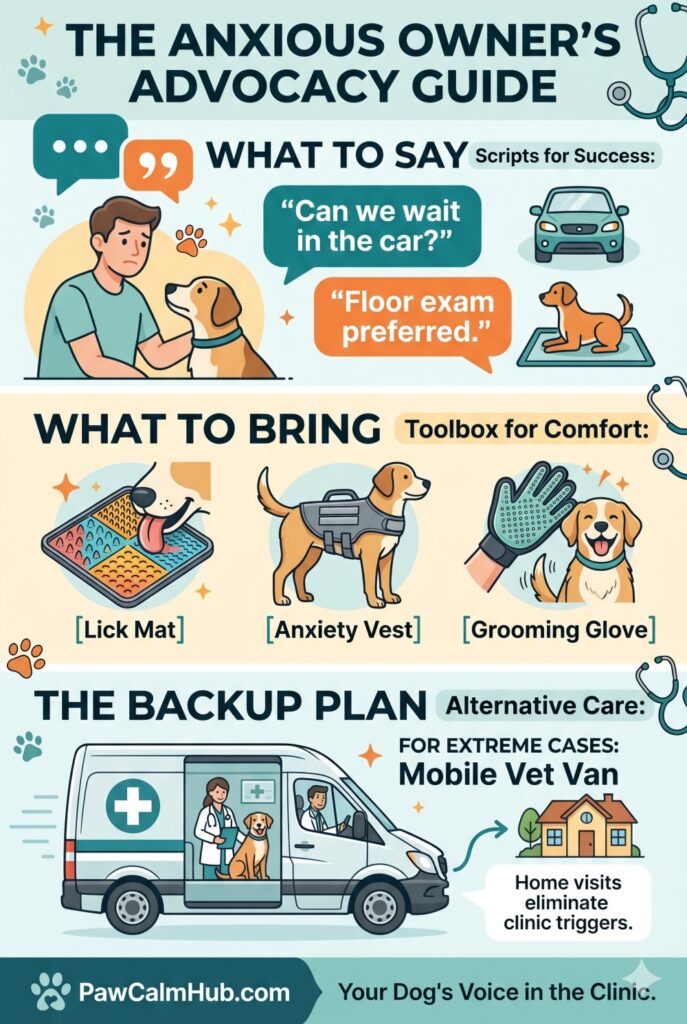
Regardless of location, these are the questions worth asking your veterinary practice before committing to them for your anxious dog:
“Do you have Fear Free certified staff?” Fear Free certification is the most widely recognised indicator of systematic training in low-stress handling. Practices with certified staff have made a specific investment in patient anxiety management.
“Can I have a pre-visit consultation to discuss my dog’s anxiety?” A practice that welcomes this conversation is likely to be more accommodating of the specific requests (lick mat use, examination sequencing, waiting in car) described in this guide.
“Do you offer pre-visit pharmaceutical protocols?” The use of trazodone, gabapentin, or alprazolam administered at home before the appointment is now standard practice in progressive veterinary medicine for anxious patients. A practice that does not offer this as a routine option for documented anxiety patients is behind current best practice.
“Do you offer home visits, or can you refer me to a mobile vet?” As described above: for severely anxious dogs, this is not a premium service question. It is a welfare and clinical quality question that deserves a considered answer.
“Can we use a blanket on the examination table?” Covering the stainless steel surface with a non-slip blanket — or bringing your dog’s own blanket from home — removes two aversive stimuli simultaneously: the cold of the metal and the instability of the slippery surface. Most practices will agree to this without hesitation.
Should I muzzle my dog at the vet if they are anxious?
If your dog has a history of snapping when scared, a muzzle is a tool of love—it keeps everyone safe and allows the vet to work confidently. However, “muzzle-train” at home first with treats so the muzzle itself isn’t a new stressor.
Can I give my dog human anti-anxiety meds before a vet visit?
Never administer human medication to a dog. Some human meds are toxic, and dosages are vastly different. If the 6-week protocol and hemp chews aren’t enough, ask your vet for a prescription “Pre-Visit Pharmaceutical” (PVP) specifically for dogs.
Why does my dog get more anxious when I try to comfort them?
Sometimes, our “comforting” (frantic petting and high-pitched “it’s okay”) actually confirms to the dog that there is something to worry about. Use a calm, low voice and firm, slow pets—or better yet, give them a task like a lick mat.
What is a “Happy Visit”?
This is a trip to the vet where your dog gets weighed, receives high-value treats from the staff, and leaves without any procedure. This breaks the “fear-conditioning loop” of the clinic
My dog is fine at home but completely shuts down at the vet. Is this normal?
Yes — this is one of the most common presentations of situational anxiety in dogs, and it reflects the power of environmental conditioning. Your dog has learned, through repeated experience, that the veterinary clinic predicts aversive events. Their behaviour at home — where no such learning history exists — tells you nothing about how they will behave in a conditioned anxiety environment. The good news is that conditioned responses can be reconditioned through the happy visit protocol described in this guide — it simply requires repetition and patience.
My vet says my dog “seems fine” during examinations. How do I explain that they are actually anxious?
Many dogs in veterinary clinical settings display what behaviourists call tonic immobility — a freeze response in which the dog appears cooperative and calm because they have shut down their active resistance. This is not calm. It is a dissociative stress response. Indicators of tonic immobility that veterinary staff may miss: dilated pupils, rapid shallow breathing, rigid muscle tone, complete stillness rather than normal positional adjustment, and a flat, unresponsive affect. If your dog shows these signs, describe them specifically to your vet — and ask whether the practice has Fear Free certified staff who are trained to recognise the difference between calm and shutdown.
Should I sedate my dog for vet visits?
“Sedate” as a blanket term covers a wide range from pharmaceutical pre-visit protocols (trazodone, gabapentin — which reduce anxiety without eliminating consciousness or cooperation) to general anaesthesia for examination. For moderate anxiety, pharmaceutical pre-visit protocols are appropriate and increasingly recommended as standard care. For severe anxiety that makes safe examination impossible without risk to the dog or staff, brief sedation for specific procedures may be the most welfare-appropriate option. Discuss both options explicitly with your veterinarian — framing the question as “what is the most welfare-conscious approach for my dog’s level of anxiety” rather than as a binary sedation choice.
My dog has bitten a vet tech. What should I do?
Contact a certified veterinary behaviourist (DACVB) before booking the next appointment — not after. A bite history at the veterinary clinic indicates anxiety that has exceeded its threshold and produced an active defensive response — and it will recur without intervention. A veterinary behaviourist can design a comprehensive desensitisation and counter-conditioning protocol specific to your dog’s history, recommend appropriate pharmaceutical support, and potentially arrange house-call assessment to begin work in the dog’s home environment. This is not a situation to manage alone or to assume will resolve with “getting the dog used to it.”
Is it okay to skip vet visits if they cause my dog so much distress?
No — and this is the conversation that no one wants to have honestly. Avoiding veterinary care because of anxiety is understandable and well-intentioned, but it produces measurable harm through missed disease detection, delayed treatment, and the progression of preventable health problems. The appropriate response to severe veterinary anxiety is not avoidance — it is finding the right clinical approach, whether that means Fear Free certified care, pre-visit pharmaceutical protocols, house-call veterinary services, or veterinary behaviourist support to reduce the anxiety to a manageable level. All of these options exist. None of them requires the dog to suffer through repeated traumatising clinic visits.
How do I find a Fear Free certified vet near me?
Use the Fear Free professional finder at fearfreepets.com — a searchable directory of certified veterinary professionals by location. If no certified practice is within a reasonable distance, ask your current vet whether any staff members are enrolled in Fear Free certification (many clinics have staff at various stages of the programme even without full practice certification), or ask for a referral to the nearest certified practice for anxiety-specific appointments.
My dog’s vet anxiety has gotten worse every year despite doing everything I can. What else is there?
Three options to explore explicitly with your veterinarian: first, pre-visit pharmaceutical protocols that you may not yet have tried (if you have used trazodone alone, ask about gabapentin; if you have used gabapentin alone, ask about their combination); second, a referral to a veterinary behaviourist for a systematic desensitisation programme that is more structured than the happy visit protocol described in this guide; and third, house-call veterinary services as a parallel option for routine care while the desensitisation programme works on reducing the clinic anxiety over time. Veterinary anxiety that worsens year on year despite management attempts is a signal that the current approach is insufficient — not that no better approach exists