
Estimated read time: 19 minutes | Last updated: 2025
A note on this guide: This article references peer-reviewed veterinary and behavioural science research on pressure therapy, anxiety management, and canine physiology. It includes a brand comparison table based on publicly available product specifications and independent owner-reported data. PawCalmHub sells its own anxiety vest — we have noted this transparently and structured the comparison to be genuinely useful regardless of which product you choose. If your dog has severe anxiety, please consult your veterinarian before relying solely on any physical calming tool.
Here is the sentence that appears in every one-star review of every dog anxiety vest ever sold:
“I put it on my dog during the thunderstorm and it didn’t do anything.”
And here is the sentence that appears in almost every five-star review:
“I started putting it on twenty minutes before storms and it completely changed how he copes.”
Same product. Opposite outcomes. One variable.
Timing.
The dog anxiety vest is one of the most misused tools in pet anxiety management — not because it doesn’t work, but because the majority of owners who buy one have never been told the single most important fact about how it works: it prevents physiological escalation, it does not reverse it. Applied to a dog already in full panic, it does almost nothing. Applied to a dog whose arousal is beginning to rise — 15 to 20 minutes before the trigger event — it does a great deal.
That is where most reviews go wrong. And it is where most guides about anxiety vests fail their readers — because they describe the product without explaining the neuroscience that determines whether it works.
This guide does both.
The Science: How Dog Anxiety Vests Work
Deep-Touch Pressure Therapy — The Mechanism
Dog anxiety vests work through a mechanism called deep-touch pressure stimulation (DTPS) — the application of gentle, constant, distributed pressure to the body’s surface, which activates the parasympathetic nervous system and produces a measurable reduction in physiological arousal.
The mechanism is not unique to dogs or to anxiety vests. It is the same principle behind:
- Weighted blankets for humans with anxiety and autism spectrum conditions
- Swaddling of newborn infants to reduce crying and regulate sleep
- Temple Grandin’s famous “squeeze machine” — a device she designed and used herself to manage her own sensory overwhelm, and which became the basis for the livestock handling systems she pioneered
Research by Temple Grandin, published in the Journal of Child and Adolescent Psychopharmacology, documented that deep-touch pressure produces a shift from sympathetic nervous system dominance — the fight-flight-freeze state — to parasympathetic dominance — the rest-digest-recover state. This shift is measurable through heart rate variability, cortisol levels, and galvanic skin response in humans, and through analogous physiological markers in animals.
In dogs specifically, the pressure of an anxiety vest activates mechanoreceptors in the skin — sensory receptors that respond to sustained pressure by sending signals to the brain’s calming centres through the same neural pathways that process social touch. The dog’s nervous system interprets distributed body pressure as a contact signal — physiologically similar to the experience of being held, which in social mammals is one of the most potent anxiety-reducing inputs available.
The Cortisol Evidence in Dogs
A study published in the Journal of Veterinary Behavior — the peer-reviewed journal of applied animal behaviour science — documented that dogs wearing an anxiety wrap during a standardised thunderstorm simulation showed lower salivary cortisol levels compared to controls. The physiological effect was not dramatic in all dogs, but it was consistent in direction: the vest reduced the cortisol response to the stressor in the majority of subjects.
The landmark open-label trial by Cottam and Dodman — published in the Journal of Veterinary Behavior in 2013 — assessed the Anxiety Wrap specifically in dogs with documented thunderstorm phobia. After five uses, 89% of owners reported that the wrap was at least partially effective in reducing their dog’s storm anxiety. This is not a marketing statistic. It is a peer-reviewed clinical finding from a study specifically designed to assess effectiveness — and it is one of the strongest pieces of evidence available for any non-pharmacological anxiety intervention in dogs.
What the Research Also Shows — Honest Limitations
The same scientific honesty that makes this guide useful requires acknowledging what the research also shows.
Effect sizes are moderate, not dramatic. The anxiety vest is not a pharmaceutical-grade intervention. For dogs with mild to moderate situational anxiety, it produces meaningful benefit in the majority of cases. For dogs with severe generalised anxiety disorder or severe thunderstorm phobia, it is most effective as part of a multi-modal approach — not as a standalone solution.
Individual response varies significantly. Approximately 11% of dogs in the Cottam and Dodman study showed no owner-reported benefit. The reasons for non-response include incorrect sizing (insufficient pressure), incorrect timing (applied after peak arousal), use for an anxiety type that does not respond to pressure therapy (generalised anxiety disorder, for example, requires different interventions), and individual neurological variation in pressure sensitivity.
The vest is a management tool, not a treatment. It reduces the physiological anxiety response during the event. It does not produce lasting reduction in anxiety sensitivity through repeated use — unlike desensitisation protocols, which retrain the underlying fear response. For lasting change, the vest should be combined with a systematic desensitisation programme where appropriate.
What Dog Anxiety Vests Are Actually Effective For
The anxiety vest has a differentiated evidence base across different anxiety types — and understanding this prevents both over-reliance and unnecessary dismissal.
Highest evidence — use with confidence:
- Thunderstorm phobia — the most extensively studied application; the 89% partial effectiveness finding applies specifically to this use case
- Fireworks anxiety — similar mechanism to thunderstorm phobia; anecdotal and clinical evidence supports
- Travel and car anxiety — pressure therapy during the sustained stressor of travel; most effective when combined with familiarisation to the car as a positive space
Moderate evidence — worth trying:
- Veterinary visit anxiety — particularly effective when combined with the lick mat protocol during the examination itself
- Grooming anxiety — reduces the generalised arousal that makes handling difficult; most effective for dogs anxious about the environment rather than specific grooming implements
- Firework season — when used proactively across the entire fireworks period rather than reactively for individual events
Lower evidence — use as part of a broader plan:
- Situational separation anxiety — brief departures; the vest may reduce the departure-moment arousal spike but is insufficient for established separation anxiety disorder without additional management
- Generalised anxiety disorder — the pressure mechanism targets situational arousal; GAD requires nervous-system-level intervention (veterinary medication, systematic desensitisation) that the vest cannot provide alone
Not recommended:
- Applied mid-panic as a reversal tool — the physiological escalation has already occurred; pressure therapy cannot reverse a full cortisol spike
- As the sole intervention for any anxiety disorder rated above 6/10 in severity — these cases require multi-modal management
Top 3 Dog Anxiety Vests Compared — An Honest Assessment
The anxiety vest market is dominated by three products that account for the majority of sales and the majority of published research. Here is an honest, specification-based comparison to help you choose.
| FEATURE | PAWCALMHUB VEST | THUNDERSHIRT | ANXIETYWRAP |
|---|---|---|---|
| Pressure Coverage | Full torso wrap with dual fastening points | Full torso wrap; single Velcro closure | Full torso + front leg loops for acupressure |
| Material | Soft jersey blend; breathable; washable | Heathered grey fabric; machine washable | Breathable elastic blend; washable |
| Key Pressure Points | Chest, back, and lateral thorax | Chest and back torso; no leg contact | Chest, back, legs (GV14, Bai Hui) |
| Clinical Evidence | Deep-touch pressure mechanism | Owner surveys and vet endorsement | Cottam & Dodman 2013 trial (89% effective) |
| Best For | Situational anxiety; everyday use | First-time buyers; ease of fitting | Severe phobias; acupressure response |
| Price Range | $35–45 | $40–50 | $35–45 |
What the Comparison Tells You
On pressure coverage: The AnxietyWrap’s front leg loops target specific acupressure points — GV14 (governing vessel 14, at the base of the neck) and Bai Hui (at the sacrum) — that traditional Chinese veterinary medicine associates with calming. Whether this acupressure mechanism adds measurable benefit beyond deep-touch pressure alone is not clearly established in the literature, but it is what distinguishes the AnxietyWrap mechanistically from the ThunderShirt design. Dogs who are comfortable with front-leg contact and who have not responded fully to chest-and-torso-only vests are worth trialling on the AnxietyWrap design.
On the ThunderShirt: Its dominance of the market is partly a function of marketing reach and partly a function of genuine quality. The single Velcro closure system is its most significant practical advantage — it is faster to fit, easier for new users to apply correctly, and less likely to be applied incorrectly under time pressure (before a storm, for example). Its main limitation is that single-point closure designs may provide less lateral thoracic pressure than wrap designs — which is a meaningful distinction for dogs whose anxiety response involves significant chest tension.
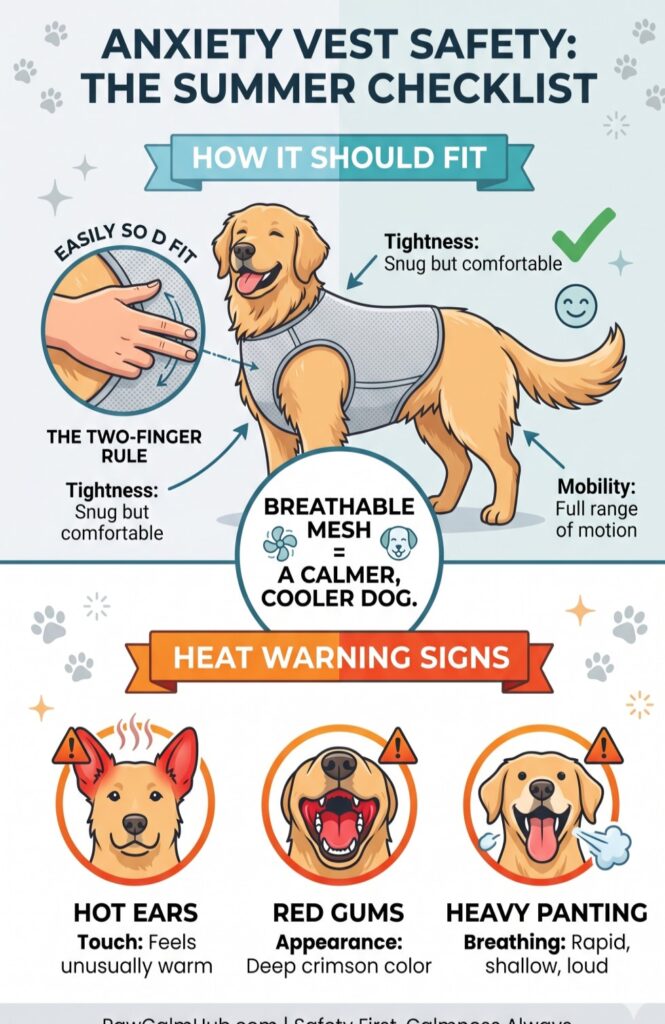
On sizing — the most important purchase variable: All three products are sized by chest girth, which is the correct measurement for pressure therapy. Before purchasing any anxiety vest, measure your dog’s chest girth at the widest point of their ribcage — typically just behind the front legs — with a flexible tape measure. If your dog falls between sizes, size down rather than up: a vest that is too loose provides insufficient pressure and will show limited effectiveness. The two-finger rule applies: you should be able to fit two fingers under the vest at any point, but the vest should not gap or shift during movement.
How to Fit a Dog Anxiety Vest Correctly — The Step-by-Step Guide
This is the section that separates this guide from every product description and basic review article — because incorrect fitting is the primary reason anxiety vests fail to deliver their documented benefit.
Step 1: Measure First
Chest girth measurement: with a flexible tape measure, wrap around the dog’s chest at the widest point, typically 2–3cm behind the front legs. Record in both centimetres and inches and consult the specific sizing chart for your chosen product — sizing varies between brands.
Back length measurement (for wrap-style vests): measure from the base of the neck (just behind the collar) to the base of the tail. This determines whether a vest designed for your dog’s chest girth will also fit their back correctly — important for deep-chested breeds like Greyhounds and Whippets.
Step 2: The Initial Fit — What You’re Checking
Put the vest on and check the following immediately:
The two-finger rule: slide two fingers under the vest at the chest, the back, and each side. You should be able to insert them but feel moderate resistance. If your fingers slide in with no resistance, the vest is too loose. If you cannot insert two fingers, the vest is too tight.
Freedom of movement: ask the dog to sit, stand, and walk a few steps. The vest should not restrict any of these movements, should not bunch at the shoulders, and should not shift sideways during movement.
No chafing points: check the areas under the front legs and at the chest closure — the two most common chafing locations. There should be no skin pinching, fur pulling, or pressure concentration at any single point.
Rear clearance: the vest should not extend past the last rib. Coverage beyond this point can restrict breathing and impede normal abdominal movement.
Step 3: Check the Seams
Run your fingers along every seam that contacts the dog’s skin. Any rough seam, exposed stitching, or hard fastening edge is a source of aversion that will make the dog resist the vest — creating a negative association that undermines the entire protocol. Quality vests have flat seams and covered fastenings on all contact surfaces.
Step 4: The Pressure Assessment
With the vest correctly fitted, place both hands flat on the dog’s sides and apply moderate pressure — approximately the same as a firm stroke. The dog’s response tells you a great deal: a dog who leans into the pressure is pressure-sensitive in a way that predicts good vest response. A dog who moves away is pressure-aversive and may need a more gradual introduction protocol.
The 15-Minute Introduction Protocol — Why This Step Is Non-Negotiable
The single most common reason anxiety vests fail is not the product. It is the introduction.
A dog who has never worn a vest and who is fitted with one for the first time during a panic event will associate the vest with the panic — not with calm. The vest then becomes a conditioned stimulus for anxiety rather than a conditioned stimulus for calm. This is not reversible quickly. Re-conditioning a negatively associated anxiety vest takes weeks of patient work.
The correct introduction sequence — before any trigger event:
Day 1: Show, Don’t Apply Place the vest on the floor near the dog’s feeding area. Let them investigate it voluntarily. Feed their meal in the same location. The vest is present, carries no threat, and is paired with food. Repeat for 24 hours.
Day 2: Brief Draping During a calm, positive context — after a walk, during a relaxed owner-dog session — drape the vest loosely over the dog’s back for 30 seconds. Do not fasten it. Offer a high-value treat immediately. Remove the vest. End on a positive note. Repeat twice.
Day 3: Partial Fit Fasten the vest at one point only — loose enough that it could easily be removed. High-value treat at the moment of fastening. 2-minute duration. Treat again at removal. The dog is learning: vest going on predicts a treat. Vest coming off also predicts a treat. The vest is neurologically neutral and becoming slightly positive.
Days 4–6: Full Fit, Increasing Duration Full correct fitting. 5 minutes on day 4, 10 minutes on day 5, 15 minutes on day 6. Each session in a calm, positive context — after a meal, during quiet owner proximity time. High-value treat at fitting. Calm praise during wear. Calm removal with a treat.
Day 7+: Ready for Pre-Trigger Use The vest is now positively conditioned. Apply 15–20 minutes before a known trigger event. The dog has a learned positive association with wearing it, which means the calming mechanism can operate without the competing arousal of a novel, potentially threatening piece of equipment.
The rule that must not be broken: Never fit the vest for the first time during a crisis. If a storm is happening right now and the vest has never been introduced, it will not help — and may make things worse. Begin the introduction protocol on a calm day this week.
Timing Is Everything — The Pre-Trigger Deployment Protocol
Once introduced, the effectiveness of the anxiety vest is almost entirely determined by the timing of its application.
The physiological reason timing matters:
When a dog perceives a threat — the first distant rumble of thunder, the first firework, the departure ritual of their owner — the amygdala initiates a cascade of stress hormones: adrenaline first, then cortisol. Research published in Hormones and Behavior documents that peak cortisol levels in dogs are reached 15–30 minutes after the initial stressor onset, and that cortisol clearance takes 60–90 minutes after the stressor ends.
Deep-touch pressure therapy works by activating the parasympathetic system — which competes with the sympathetic stress response. When pressure is applied before cortisol peaks, the parasympathetic activation can counterbalance the sympathetic response and prevent the full escalation. When applied after cortisol has already peaked, the parasympathetic system is working against a fully activated stress cascade — and the competition is unequal. The vest loses.
Practical timing guidelines:
For thunderstorm anxiety: Install a weather app with storm alerts. Most apps provide 20–45 minutes of advance warning for nearby storms. Apply the vest at the first storm alert — not when the thunder becomes audible. By the time it is audible, the dog’s barometric pressure sensors have already initiated the anxiety response.
For fireworks anxiety: Apply the vest 30 minutes before the scheduled start time — or at dusk on fireworks-expected evenings, before any fireworks are audible.
For veterinary visit anxiety: Apply the vest at home, 30 minutes before departure, rather than in the car park. The car park is already an anxiety-conditioned environment. The vest should be on and providing benefit before the dog arrives there.
For departure anxiety: Apply the vest 20 minutes before the departure routine begins — before you pick up your keys, before you put on your coat. These are the conditioned stimuli that spike pre-departure anxiety; the vest needs to be providing its effect before they register.
The Multi-Tool Protocol — Why the Vest Works Better in Combination
Research in veterinary behaviour consistently shows that multi-modal anxiety management approaches outperform single-intervention approaches in the majority of cases. The anxiety vest is most powerful when combined with complementary tools that address different aspects of the anxiety response simultaneously.
The Storm Protocol Stack — Example
45 minutes before storm: Administer hemp calming chews for dogs — the endocannabinoid system support begins working while the vest provides surface-level pressure stimulation.
30 minutes before storm: Move to safe room. Start white noise or brown noise machine. Close blackout curtains.
20 minutes before storm: Fit anxiety vest correctly, using the introduction protocol. Offer high-value treat at fitting.
15 minutes before storm: Provide snuffle mat for anxious dogs or lick mat for dog anxiety — olfactory engagement and oral motor soothing activate the parasympathetic system from a second direction simultaneously.
During storm: Remain in safe room if possible. Your calm presence provides cortisol synchrony benefit. Do not react to thunder sounds yourself. Engage the dog with the snuffle mat if they disengage.
After storm: Leave the vest on for 20 minutes after the last audible thunder — the dog’s cortisol will still be elevated for 60–90 minutes after the stressor ends, and premature removal of the vest removes one parasympathetic input during the clearance period.
Shop: Dog Anxiety Vest Shop: Hemp Calming Chews for Dogs Shop: Snuffle Mat for Anxious Dogs Shop: Lick Mat for Dog Anxiety
Read more: How to Calm a Dog During Thunderstorms and How to Help a Dog With Fireworks Anxiety
Troubleshooting — Why Isn’t the Vest Working?
Problem 1: Applied mid-panic The most common failure mode. See the timing section above. If you have been applying the vest after the dog is already in full anxiety, you have been using it as a reversal tool rather than a prevention tool. Restart the introduction protocol and apply pre-trigger from this point forward.
Problem 2: Incorrect sizing — too loose A vest that fits loosely provides insufficient mechanoreceptor activation — the pressure stimulus that drives the parasympathetic response is absent or sub-threshold. Re-measure and size down if the vest allows more than two-finger insertion without resistance.
Problem 3: Not used consistently enough The positive association that makes the vest effective — and the physiological familiarity that makes the dog accept it without arousal — builds through repeated positive use. A vest used twice is not yet a conditioned calming stimulus. A vest used twenty times in positive contexts is. Consistent use during calm periods, not just trigger events, is essential to building effectiveness.
Problem 4: Wrong anxiety type For generalised anxiety disorder — chronic, baseline-elevated anxiety with no specific trigger — the vest provides minimal benefit because there is no acute trigger event to pre-empt. GAD requires nervous-system-level intervention: veterinary assessment for appropriate medication, systematic desensitisation, and comprehensive environmental management. The vest is a situational tool for an anxiety disorder that is not situational.
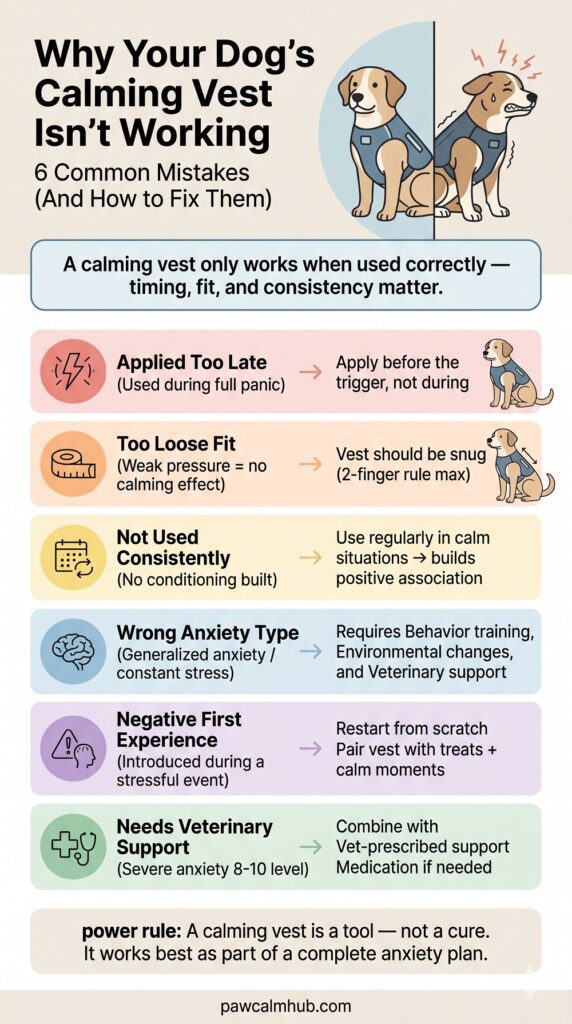
Problem 5: Negative association from rushed introduction If the vest was first applied during a crisis event, the dog may have formed a fear association with it. Rehabilitation requires starting the introduction protocol from day 1 — with the vest presented as a completely novel object, all previous negative associations slowly replaced through systematic pairing with high-value food.
Problem 6: Needs veterinary support For dogs rated 8–10 on an anxiety severity scale, environmental and physical management tools alone are not sufficient. A veterinary assessment — potentially including situational medication (trazodone, gabapentin, alprazolam) prescribed for the specific trigger event — combined with the vest produces significantly better outcomes than either alone. The vest is not a reason to avoid veterinary consultation. It is an adjunct to it.
Read more: Natural Remedies for Dog Anxiety and Do Calming Chews Work for Dogs?
Long-Term Vest Use — Maintenance and Care
Washing: Machine wash cold, gentle cycle. Air dry — heat from a tumble dryer degrades the elasticity of most vest materials, reducing the pressure delivery over time. Wash only when necessary — frequent washing accelerates material fatigue and removes the familiar scent markers the dog has associated with calm.
Inspection: Before each use, check all fastening points, seams, and elastic sections for wear. A vest with degraded elasticity is not providing the pressure stimulus it was designed for. Replace when the material no longer provides firm resistance to the two-finger test.
Storage: Store in a consistent location — ideally the safe room — so that the retrieval of the vest begins cueing the calming association before it is even fitted. Scent is a powerful conditioned stimulus for dogs; a vest stored in a calm-associated space will carry olfactory markers of that association.
Replacement timeline: With twice-weekly use, most high-quality anxiety vests maintain their pressure integrity for 12–18 months. With daily use, expect a replacement at 9–12 months. Noticeable reduction in material firmness is the primary indicator that replacement is needed.
Can I leave an anxiety vest on my dog all day?
No — and for two important reasons. First, continuous wear reduces the effectiveness of the deep-touch pressure mechanism over time through a process called habituation: the mechanoreceptors adapt to the sustained pressure and reduce their signalling rate, diminishing the parasympathetic response the vest is designed to produce. Wear should be limited to the period of anticipated anxiety — typically 2–4 hours maximum per session. Second, continuous wear without a break creates skin irritation risk at contact points, particularly under the front legs and at chest closures.
Will an anxiety vest help with barking at the window?
It can help lower the dog’s overall “arousal level,” making them less likely to react. However, for barking, it should be paired with environmental management like blackout curtains or white noise.
Is a tighter vest better for anxiety?
Only up to a point. It should feel like a “firm hug.” If the dog’s breathing becomes shallow or they seem restricted in their movement, it is too tight and can actually increase their stress.
Can my dog wear an anxiety vest all day?
Vests are most effective for situational triggers. They should be applied 15–20 minutes before a trigger (like a storm) and removed once the event is over to prevent the dog from becoming desensitised to the pressure stimulus
How quickly should I see results from an anxiety vest?
With correct fitting, correct timing, and a properly introduced vest, most owners see measurable benefit from the first pre-trigger use — though “measurable” at this stage means observable reduction in anxiety escalation speed or peak intensity, not complete resolution. The dog who previously went from calm to full panic in 5 minutes of storm exposure may now take 15 minutes to reach the same level, or may not reach full panic at all. Improvement deepens over the first 4–6 uses as the positive conditioning builds. If no benefit is observable after 6 correctly timed, correctly fitted uses, review the troubleshooting section — incorrect application is almost always the explanation.
My dog hates having anything put on. How do I introduce the vest?
Follow the 15-minute introduction protocol described in detail above, but extend it over a longer timeline — 2–3 weeks rather than 7 days. Begin with the vest simply present in the room without any attempt to touch the dog with it. Progress to touching the dog’s back with the folded vest before any draping. Use the highest-value food you have — real chicken, real cheese — at every step. Never proceed to the next step until the dog is visibly comfortable with the current one. A dog who has been conditioned to love their vest through this process will accept fitting without resistance within 2–3 weeks, regardless of how clothing-averse they were at the start.
Should I use the vest every time there is a storm, or will the dog become dependent on it?
Use it every time. The concern about dependency is misplaced — the anxiety vest does not create or deepen anxiety the way some behavioural supports might. It is a management tool that reduces physiological distress during a triggering event. Consistent use in the correct context is how the positive conditioning deepens. A dog who wears their vest every storm and remains calmer than they would be without it is well-managed, not dependent. Dependency in the problematic sense would require the vest to produce worse anxiety in its absence than existed before its introduction — which the mechanism does not support.
My dog is a small breed and most vests don’t seem to fit well. What should I do?
Small breed fitting is a genuine challenge with several vest designs — particularly those designed primarily around medium and large breed body proportions. For small breeds, the most important fitting variable is the chest-to-back length ratio: many small breeds (particularly long-backed breeds like Dachshunds) have a chest girth that fits a given size but a back length that makes the same size too short. Look specifically for vests that offer XS and XXS sizes with corresponding back length specifications, and measure both chest girth AND back length before purchasing. If standard vest sizes don’t fit well, a veterinary behaviourist or certified canine massage therapist can recommend compression garment alternatives.
Can puppies wear anxiety vests?
Yes, with important size and introduction considerations. Puppies grow rapidly — a correctly fitting vest in month two may be two sizes too small by month four. Rather than investing in multiple vests during growth phases, consider whether the anxiety being managed could be better addressed during this developmental period through systematic socialisation and desensitisation — which produces lasting neurological change, unlike the vest which is a management tool only. For specific high-anxiety events that a young puppy must face before their anxiety can be desensitised (mandatory veterinary visits, necessary travel), a correctly fitted vest is appropriate and beneficial.
Read more: Puppy Anxiety Guide
Does the colour of the vest matter? I’ve seen calming blue recommended.
There is limited peer-reviewed evidence specifically examining vest colour and canine anxiety response. Dogs see colour differently from humans — their colour spectrum is roughly analogous to a red-green colour-blind human, distinguishing blues, yellows, and greys but not reds and greens. Blue is within the canine visible spectrum and has been suggested to have calming associations, but no published controlled trial has demonstrated a statistically significant anxiety reduction attributable to vest colour independent of the pressure mechanism. Choose your vest based on fit, material quality, and sizing accuracy — not colour.
What’s the difference between an anxiety vest and a regular dog coat or sweater?
The critical difference is pressure delivery. A standard dog coat or sweater covers the body for warmth but does not apply the firm, distributed pressure that activates mechanoreceptors and produces the parasympathetic response. An anxiety vest is specifically engineered to apply moderate compression at the thorax — the clinical target for deep-touch pressure therapy. Putting a regular coat on an anxious dog provides no meaningful anxiety management benefit beyond warmth. The mechanism requires targeted pressure, not fabric coverage.