
Estimated read time: 18 minutes | Last updated: 2026 | Reviewed against current veterinary and behavioural science research
A note on this guide: This article references peer-reviewed veterinary research on noise phobia in dogs and is written to help US pet owners prepare for one of the most anxiety-intensive events of the calendar year. It does not replace professional veterinary advice. If your dog’s fear response to fireworks is severe — self-harm, escape attempts, complete inability to function — please speak with your veterinarian before July 4. Pre-event prescription medication is available and appropriate for many dogs.
Every year on July 5, animal shelters across the United States log their highest intake numbers of the calendar year.
Not the weeks after Christmas, when holiday adoptions sometimes don’t work out. Not the peak of puppy mill surrender season. July 5 — the morning after Fourth of July fireworks — consistently produces the largest single-day volume of lost, escaped, and surrendered dogs that most US shelters handle all year.
The reason is not complicated. An estimated 49% of dogs show a significant fear response to fireworks noise, according to research published in Today’s Veterinary Practice — nearly one in two dogs. And fireworks are not like other noise triggers. They are not like thunderstorms, which have a pattern the dog learns to read. They are not like construction, which has defined hours and a predictable decline. They are completely unpredictable in timing, direction, and intensity, and they arrive — for most dogs — with zero advance preparation on the owner’s part.
That last part is the one we can change.
This guide gives you a specific, evidence-based timeline from June 28 through July 5 — one that transforms the Fourth of July from the most anxiety-intensive event of your dog’s year into a manageable, prepared-for occasion. It will not eliminate your dog’s fear. But it will give their nervous system the best possible support through it.
Why Fireworks Hit Dogs Harder Than Any Other Sound
Before the protocol, the science — because understanding why fireworks are uniquely terrifying to dogs explains every management decision that follows.
They are multi-sensory. Fireworks are not just sound. They involve a visual flash component (lightning-like, unpredictable), the smell of gunpowder (a chemical stimulus that carries through a dog’s 100,000× more sensitive olfactory system as an acrid alarm signal), vibration felt through the body and paws, and — in dogs who are also noise-sensitive to low-frequency sound — the percussive boom that is felt as physical pressure rather than simply heard.
Research from Cornell University College of Veterinary Medicine documents that dogs can hear a wider range of sound frequencies than humans — approximately 40Hz to 65,000Hz compared to the human range of 20Hz to 20,000Hz. The low-frequency boom of a large firework shell falls within a range that dogs not only hear more intensely but feel as physical vibration through their skeletal structure.
They are completely unpredictable. A thunderstorm has recognisable lead-in signals that an experienced storm-anxious dog learns to read — darkening skies, dropping barometric pressure, the smell of rain. A dog who is afraid of thunderstorms at least knows the storm is coming. Fireworks on July 4 begin without warning, continue in irregular bursts from multiple directions, last for hours, and then produce the worst outcome possible for a dog trying to understand a threat pattern: they stop randomly, with no logical end signal.
They repeat across an extended period. Most of the United States does not observe fireworks only on July 4. Legal and illegal fireworks begin in many communities days before the holiday and continue days after. A dog who experiences a severe July 4 fear response may be managing a sustained anxiety window of five to seven days.
The statistic that should reframe how seriously you take this. Research referenced in Today’s Veterinary Practice on noise and storm phobias found that an estimated 49% of dogs show a significant fear response to fireworks — making noise phobia one of the most prevalent anxiety disorders in the companion dog population. If you have ever told yourself “my dog doesn’t really have a problem with fireworks,” it is worth sitting with that statistic before the next July 4.
⚕️ The 3-Tier Anxiety Management Matrix — What to Use, and When
TIER 1 — Acute Panic or Destructive Behavior
Prescription medication: Sileo, trazodone, or gabapentin. Requires veterinary consultation and prescription. Never combine with over-the-counter supplements without your vet’s explicit approval — some supplements interact with sedative and anti-anxiety drug metabolism pathways.
TIER 2 — Sustained Baseline Stress (Start July 1)
Hemp calming chews + anxiety vest. Daily administration builds cumulative endocannabinoid system support. If your dog is on any prescription medication, confirm with your vet before adding hemp supplements — CBD can affect liver enzyme pathways that also process certain drugs.
TIER 3 — Active Event Distraction (Deploy 8 PM July 4)
Frozen lick mat + brown noise + safe room. No drug interaction risk. Safe to combine with Tier 1 and Tier 2 interventions.
This information is educational and does not replace individualized veterinary guidance. Always disclose all supplements and medications to your veterinarian before combining them.
The June 28 to July 5 Timeline — Day by Day
June 28: Six Days Before (The Medication Window)
The most important thing you can do on June 28 has nothing to do with your dog directly. It requires a phone.
Call your veterinarian.
Pre-event prescription medication for fireworks anxiety — specifically trazodone, gabapentin, or the FDA-approved canine noise aversion medication Sileo (dexmedetomidine oromucosal gel) — must be obtained, prescribed, and trialled before the event. Not the day before. Not the morning of. The medication needs to be in your possession, the correct dose confirmed for your dog’s weight and health status, and ideally trialled once beforehand so you know how your dog responds to it.
University of Pennsylvania’s veterinary behaviour medicine guidance is explicit on this point: to be effective, pre-event medication must be administered and active in the body before any noise or panic begins. Administering it after the first firework has gone off and the dog’s cortisol has already spiked is too late. The medication cannot reverse acute panic once it has begun. It can only prevent escalation to that point when deployed proactively.
If your dog’s fireworks fear is moderate to severe — or if you have never managed it before with a protocol — this phone call is the most important action in this entire guide.
Also begin today: Sound desensitisation with recorded fireworks audio.
🔊 5-Minute Fireworks Counter-Conditioning Track
Play this at low volume during your dog’s meal or a calm, positive activity. Pair with high-value treats throughout. Do not increase volume if your dog shows any anxiety signals — hold steady and increase treat value instead.
Tip: Bookmark this page so you can return to this track daily through your 6-day countdown.
This is classical counter-conditioning — the same principle documented in fireworks phobia research as one of the most effective long-term anxiety reduction strategies available for noise-sensitive dogs. Research from Vetster’s noise phobia guidance notes that this programme should ideally begin weeks before the event — which is why starting June 28 gives you the maximum available window.
June 29–30: Four to Five Days Before (Volume Increase)
Continue the sound desensitisation sessions twice daily. Very gradually increase the volume — but only if your dog is showing no anxiety signals at the current level. If they are still showing whale eye, lip licking, or increased panting at low volume, hold the volume steady and increase the food value of the treats instead.
Begin sourcing your product stack:
If you do not already have these, order them now to ensure they arrive before July 4:
- Anxiety vest — to be introduced positively this week, not for the first time on July 4
- Hemp calming chews — to begin daily administration on July 1 for baseline support
- Lick mats — frozen versions to be deployed during the event
- Self-warming bed — for the safe room setup
Shop: Dog Anxiety Vest | Hemp Calming Chews for Dogs | Lick Mat for Dog Anxiety | Self-Warming Dog Anxiety Bed
Conduct a security audit of your property:
Walk the perimeter of your yard or outdoor space with specific attention to:
- Fence heights and condition — can your dog clear it or push through it in a panic?
- Gate latches — a dog in full flight-mode can work a standard lever latch
- Any gaps at fence bases that a determined dog could excavate
- Exterior doors — does your dog know how to push them open?
A frightened dog who normally has no interest in escaping will attempt to escape during a fireworks event. This is not defiance. It is the most primitive survival instinct available — flight from a threat. Secure every potential exit point before the event, not during it.
Update ID and microchip information. If your dog’s microchip registration or collar tag information is out of date, correct it today. July 5 is the single highest day for shelter intake of lost dogs in the US — and many of those dogs are never reunited with their owners because the contact information on file is wrong.
July 1: Three Days Before (Vest Introduction)
Begin the anxiety vest introduction protocol today.
If your dog has never worn an anxiety vest, the seven-day introduction protocol described in our complete anxiety vest guide cannot be completed in full before July 4. But three days of positive introduction is dramatically better than first-time fitting during a panic event.
Day 1 protocol (today): Place the vest on the floor near the dog’s feeding area. Let them sniff it voluntarily. Feed their meal with the vest present. No fitting yet. You are building neutral-to-positive association with the object before it touches the dog.
Begin daily hemp calming chew administration:
Give your dog one calming chew with their evening meal starting today. The endocannabinoid system support from hemp CBD is cumulative — daily administration builds a more stable baseline than single-dose use. Three days of daily supplementation before the event means July 4 is not the first day the compound is in their system.
Read more: Do Calming Chews Work for Dogs?
Brief all household members — especially children:
Everyone in the household needs to understand the protocol. Children specifically need to know:
- Do not pursue the dog to comfort them during fireworks — let the dog come to them
- Do not restrain the dog during a fear response — this escalates to bite risk
- Do not open exterior doors if the dog is frightened and near the exit
- Do not react to firework sounds themselves — your reaction is directly read by the dog
July 2: Two Days Before (Safe Room Setup)
Set up the safe room today — not the day of the event.
A safe room introduced for the first time during a fireworks event is an unfamiliar space during a crisis, which is neurologically unhelpful. A safe room introduced two days before the event has 48 hours to build positive association before it is needed under stress.
Choose the room based on these criteria:
- Interior room — away from exterior walls that transmit firework sound
- No exterior-facing windows, or windows that can be covered with blackout curtains
- Farthest from the direction most local fireworks typically originate
Complete safe room setup checklist:
Bedding and warmth:
Place your dog’s familiar bedding — unwashed, carrying their scent — and a self-warming bed. The familiar scent is an olfactory safety signal; the warmth provides passive parasympathetic nervous system support through thermoreceptor activation. Do not wash the bedding immediately before the event.
Sound masking:
Set up a white noise machine or a device playing brown noise (lower frequency than white noise, more effective at masking the low-frequency boom of fireworks) at the volume you intend to use on July 4. Let the dog hear it now in a calm context so it does not startle them on the night.
Scent anchoring:
Place a worn owner garment — unwashed, slept in for two nights — in the dog’s bed. The olfactory presence of the primary attachment figure is a documented calming signal for dogs separated from their owner or in a high-stress environment.
The treat dispenser:
Place a treat dispenser toy in the safe room and let the dog discover it with treats loaded inside. You want the first interaction with the dispenser in that room to be positive and independent — reward for choosing to engage with the space.
Begin using the safe room positively today:
Spend 20 minutes in the room with your dog — sitting quietly, reading, being calm and boring. Feed one meal in the safe room. This begins building the room’s association as a positive space rather than a confinement space.
Read more: How to Build the Perfect Dog Safe Room for Anxiety
July 3: The Preparation Day (Lick Mat Prep and Vest Fitting)
Prepare frozen lick mats today — freeze overnight for maximum duration:
Load three to four lick mats with combinations of the following:
- Plain Greek yoghurt (unsweetened)
- Xylitol-free peanut butter (always check — xylitol is toxic to dogs)
- Canned pumpkin puree (plain, not pie filling)
- Wet dog food pressed into the mat surface
- Small pieces of cooked chicken embedded in the above
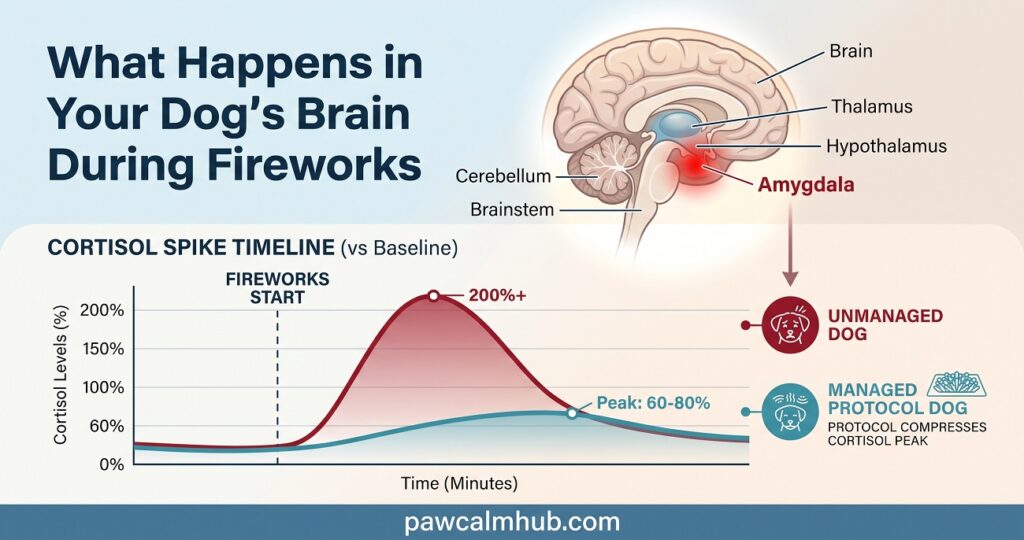
A lick mat frozen for 12 hours keeps the dog engaged for significantly longer than a room-temperature one. The licking behaviour itself — repetitive oral motor activity — activates the parasympathetic nervous system through vagal nerve pathways and produces measurable cortisol reduction. This is not a distraction technique. It is a neurological intervention.
Introduce the anxiety vest for first fitting today:
With the vest positively introduced on July 1 and 2, today you fit it for the first time — in a calm, positive context. The afternoon is ideal. Not during the evening when community fireworks may be beginning.
Fit correctly using the two-finger rule: slide two fingers under the vest at the chest and back — moderate resistance indicates correct pressure. No resistance means too loose and the pressure mechanism will not activate. Unable to insert two fingers means too tight and uncomfortable.
Reward heavily at fitting. Keep it on for 15 minutes during a calm activity — a gentle walk, an owner-proximity session, a meal. Remove calmly. Reward again. The vest is now a known, positively associated object.
Administer calming chew with evening meal.
Final security check:
Walk the property perimeter one final time after dark. Many dogs who are calm in daylight become frantic at night. The conditions of the July 4 event are best simulated by assessing your security under evening conditions.
July 4: The Event Itself — Hour by Hour
6:00 PM — Medication (If Prescribed)
If your veterinarian has prescribed pre-event medication (trazodone, gabapentin, or Sileo), administer it now according to the prescribed timing. Most pre-event medications require 60–90 minutes to reach therapeutic levels. The medication must be on board and active before the first firework is heard.
Do not administer prescription medication for the first time on July 4 without veterinary guidance. Drug interactions, dosing accuracy for your dog’s specific weight and health status, and individual response variation all require professional assessment first.
7:00 PM — The Last Walk
Conduct the evening walk now — before twilight, before any community fireworks begin. Keep it calm and sniff-led rather than vigorous. Vigorous exercise immediately before a high-anxiety event elevates arousal rather than reducing it. A slow, scent-focused walk allows the dog to discharge mild tension through olfactory engagement while keeping physiological arousal at a manageable baseline.
This may be the last outdoor time until after the fireworks season for the evening.
7:30 PM — Move to Safe Room and Begin Masking Sound
Bring the dog to the safe room. Turn on brown or white noise at full masking volume — louder than feels comfortable to you. The dog’s hearing sensitivity is far greater than yours, and the noise needs to compete with firework sounds that you may not yet be able to hear but your dog already can.
Close blackout curtains or blinds in all windows visible from the room. Visual flash stimulation from fireworks maintains the threat-vigilance loop even when sound is adequately masked.
7:45 PM — Apply Anxiety Vest
Fit the vest calmly and positively, using the high-value treat reward the dog now associates with fitting. The vest needs to be on and providing its pressure stimulus before the physiological escalation begins — not after the first audible firework has already spiked cortisol.
8:00 PM — Deploy Lick Mat and Calming Chew
Bring out the first frozen lick mat. Give the hemp calming chew now if your veterinarian has cleared it alongside any prescription medication.
Stay in the safe room with the dog if possible. Your calm presence provides cortisol synchrony benefit — your own relaxed physiological state communicates safety through the olfactory and social signals your dog reads constantly. If you are visibly anxious about the fireworks, your dog reads that as confirmation that the threat is real.
What to do during the fireworks:
Do not dramatically comfort the dog — this communicates that the event is catastrophic and warrants the emotional response you are showing. Do not ignore the dog entirely — your calm presence and occasional quiet reassurance is appropriate and does not reinforce fear. Engage the dog gently with the lick mat if they are willing. If they are not, let them settle in the position they choose.
Do not open exterior doors for any reason during active fireworks. Not to check on something. Not to let them out to toilet. The flight risk is at maximum during the active event.
During the event:
Rotate lick mats as each is finished. Maintain the white noise. Keep the room dark. Remain calm. If you want to watch fireworks yourself, do it from a different location in the house — do not bring the dog to a window to watch.
After the fireworks stop:
Keep the vest on for 30 minutes after the last audible firework. Cortisol clearance in dogs takes 60–90 minutes after the stressor ends — the vest’s parasympathetic support is still useful during this clearance window. Removing it immediately removes one calming input during a period when the nervous system is still elevated.
A final calming chew before bed is appropriate for dogs who have had a significant anxiety response.
July 5: The Recovery Protocol
Do not assume July 4 night’s fireworks are the end of the anxiety window. In most US communities, illegal and neighbourhood fireworks continue through July 5 evening and sometimes beyond. Maintain the safe room setup and lick mat protocol for at least one more evening.
Morning of July 5:
Check the yard perimeter before allowing any off-leash outdoor access. Fences that survived inspection on June 28 may have damage you haven’t noticed. Adrenaline-fuelled escape attempts during the night’s event — even unsuccessful ones — can compromise fence integrity.
Conduct a slow, sniff-led decompression walk. No vigorous exercise. The dog’s cortisol baseline may still be elevated from the previous night — high-intensity exercise on an already-elevated cortisol baseline can produce unusual reactivity.
Feed the normal meal at the normal time. Routine restoration is the fastest path back to baseline for a dog whose routine was disrupted by a major anxiety event.
If your dog is still distressed 48 hours after the event:
This warrants a veterinary call. Sustained post-event anxiety — lasting more than 48 hours — may indicate that the anxiety response produced an effect beyond normal recovery capacity. Some dogs develop secondary anxiety conditions after particularly severe fear events. Early veterinary contact at this point is far more effective than waiting.
What to Do If Your Dog Escapes During Fireworks
This section exists because prevention sometimes fails, and a clear protocol matters more than a moment of panic.
Immediate steps if your dog goes missing on July 4:
Call local shelters before you begin driving. July 5 is their highest intake day — they will be expecting calls and will have systems in place for lost pet reports. Provide your dog’s description, your contact information, and confirmation of microchip status.
Post to Nextdoor immediately — within your immediate neighbourhood first, then expanding rings. Lost pet posts on Nextdoor have the highest recovery rate of any social platform for local lost pets because they reach the specific people who are most likely to have seen the dog.
Search at dawn if the dog has not been found by nightfall. Dogs in flight mode often move far and fast and then go to ground somewhere quiet once the threat sound stops. Dawn is when frightened dogs often begin moving again and are most findable.
Contact the nearest 24-hour emergency veterinary clinic — frightened dogs sometimes run into traffic.
The Sound Desensitisation Programme: Building Resilience for 2027
The week-before protocol in this guide is management — it reduces the impact of the fireworks event without changing the dog’s underlying response to the stimulus. If you want to produce lasting improvement, the tool is sound desensitisation combined with counter-conditioning — and it requires 6–8 weeks minimum, started well before the next fireworks season.
Research referenced by the ASPCA documents that this approach works by pairing the sound of fireworks (the fear trigger) with the highest-value positive stimulus available to that dog — creating a new learned association: fireworks sound predicts something excellent is about to happen. This does not happen in a week. It happens over months of consistent, graduated exposure sessions.
Start the 2027 programme in April — not June. The exposure recordings are widely available on YouTube. The treats just need to be real food, not kibble.
The Complete July 4 Product Stack
Here is every product referenced in this guide in one consolidated list, with the timing of use:
Begin June 28:
Anxiety vest (introduction) → Shop
Begin July 1:
Hemp calming chews (daily) → Shop
July 2:
Self-warming bed (safe room setup) → Shop
Treat dispenser toy (safe room engagement) → Shop
July 3:
Lick mats (prepare and freeze overnight) → Shop
July 4:
All of the above deployed on the timeline above
Smart camera for monitoring → Shop
The Most Important Thing This Guide Can Tell You
You cannot eliminate your dog’s fear of fireworks in the days before July 4. The neurological conditioning that produces a noise phobia is built over time and can only be changed over time.
What you can do — right now, with the timeline in this guide — is build a protocol that surrounds your dog’s nervous system with every available layer of support: pharmacological, environmental, sensory, olfactory, and thermal. A dog whose cortisol is being managed from six angles simultaneously has a dramatically different July 4 experience than a dog whose owner locked them in the bedroom with a bowl of water and hoped for the best.
That difference, compounded over the years of a dog’s life, is the difference between a dog who becomes more noise-phobic every year and a dog who reaches old age having navigated the July 4 event consistently, safely, and with their nervous system intact.
Start the countdown. Your dog is counting on it.
FAQ: Fourth of July Dog Anxiety
How early should I give my dog calming medication before fireworks?
Pre-event prescription medications — trazodone, gabapentin, Sileo — need to be administered 60–90 minutes before fireworks begin to reach therapeutic levels. The exact timing varies by medication and your dog’s individual metabolism, which is why trialling the medication at least once before the event (on a calm day) is recommended by most veterinary behaviour specialists. Never administer human anti-anxiety medication to a dog — dosing, metabolism, and toxicity profiles differ significantly and some human medications are dangerous to dogs.
Should I comfort my dog during fireworks or ignore them?
Comfort them — calmly. The long-held belief that comforting an anxious dog “reinforces” the fear has been largely discredited by current veterinary behaviour science. Calm, quiet reassurance does not create fear. Dramatic, high-arousal reassurance may elevate arousal, but this is different from reinforcing the underlying phobia. Sit with your dog, speak quietly, allow them to press against you if that is what they seek. Your calm presence provides genuine cortisol-regulatory benefit through the documented mechanism of cortisol synchrony between bonded dogs and owners.
My dog was fine with fireworks last year. Can they suddenly develop a phobia?
Yes — and this is one of the most commonly reported and least understood aspects of noise phobia in dogs. Fear responses to fireworks can emerge suddenly in adulthood, even in dogs who showed no sensitivity as puppies. The most common onset is between 12 and 36 months — the period of social maturity — and the phobia tends to worsen progressively with each year of unmanaged exposure through the same mechanism as other conditioned fears: repeated experience without counter-conditioning deepens the fear response. A dog who “was fine last year” deserves the same preparation protocol as a dog with a documented history, because this year may be the year the phobia begins.
Are fireworks worse than thunderstorms for dogs?
For some dogs, yes — and the reason is the unpredictability and the extended duration. Thunderstorms have an anticipatory window (barometric pressure changes, darkening skies) that some dogs detect well in advance, giving the anxiety a kind of logic. Fireworks arrive without warning, from multiple directions, in completely irregular patterns, for hours. Additionally, community fireworks often begin days before July 4 and continue days after, extending the anxiety window in a way that thunderstorms almost never do. The multi-sensory nature of fireworks — sound, flash, smell — also makes them harder to mask than purely auditory triggers.
My dog destroyed the house last July 4. What specifically prevents that this year?
The destructive behaviour during fireworks events is the physical expression of the flight-or-fight response being thwarted by the home environment — the dog is trying to escape a threat and the walls are in the way. The two most effective single interventions for preventing destruction are: (1) the safe room setup that gives the dog a contained, dark, sound-masked space where the threat stimuli are reduced enough that the flight impulse diminishes, and (2) pre-event prescription medication that prevents the full escalation to acute panic in the first place. The anxiety vest and lick mat add further layers, but for a dog whose previous year’s response involved physical destruction of the home, the veterinary conversation about prescription medication is the most important step.
Is it safe to leave my dog home alone on July 4?
If you can avoid it, don’t. The cortisol synchrony benefit of your calm presence during a fireworks event is real and measurable. If you must be away, deploy the full safe room setup, use the smart camera for monitoring, programme the treat dispenser for autonomous reward during your absence, and have someone the dog knows and trusts check on them during the peak fireworks window. Never leave a dog with severe fireworks phobia alone and unmonitored on July 4.
Related reading:
- How to Help a Dog With Fireworks Anxiety
- How to Calm a Dog During Thunderstorms
- How to Build the Perfect Dog Safe Room for Anxiety
- Do Calming Chews Work for Dogs?
- Dog Anxiety Vest — Complete How-To Guide
- The Complete Pet Anxiety Guide