
Estimated read time: 20 minutes | Last updated: 2025
A note on this guide: This article references peer-reviewed veterinary research, Fear Free certification science, and published data on examination quality in anxious patients. It is written for dog owners whose veterinary anxiety management has reached its limits within a traditional clinic setting — and who deserve to know that a genuinely different clinical option exists. It is not a recommendation to avoid veterinary care. It is a recommendation to find the form of veterinary care that allows your dog to actually receive it.
There is a dog named Biscuit in a story told by a veterinary behaviourist that has stayed with me since I first read it.
Biscuit was a seven-year-old Golden Retriever — gentle, food-motivated, beloved. He had never bitten anyone in his life. But he had bitten three veterinary nurses across four years of clinic visits, each bite more severe than the last. His owners had tried everything: pre-visit trazodone, the anxiety vest, a frozen lick mat in the waiting room, a Fear Free certified clinic forty minutes from their home. Nothing was enough. Biscuit arrived at every clinic on a hair trigger, and by the time anyone touched him, the hair trigger had already been pulled.
His owners were told, kindly but plainly, that without heavy sedation he could not be safely examined in a clinical setting.
Then a colleague of the behaviourist — a house-call veterinarian — visited Biscuit at home. Biscuit greeted her at the front door with his tail wagging. He sat on his own sofa during the examination. He ate treats from her hand while she listened to his heart. She completed a thorough physical examination, collected a blood sample, updated his vaccinations, and administered his annual parasite treatment — all in forty-five minutes, in the living room, without sedation, without restraint, and without the behaviour that had made every clinic visit a crisis.
Biscuit had not changed. The environment had.
This is the story that most guides about anxious dogs at the vet never tell — because most guides are written as if the veterinary clinic is the only setting in which veterinary care can occur. It is not. For a significant and underserved population of dogs, the clinic is not the right setting at all. And knowing that an alternative exists — and knowing when, why, and how to access it — is information that every anxious dog owner deserves.
What Is a House-Call Vet? The Definition Most Pet Owners Have Never Encountered
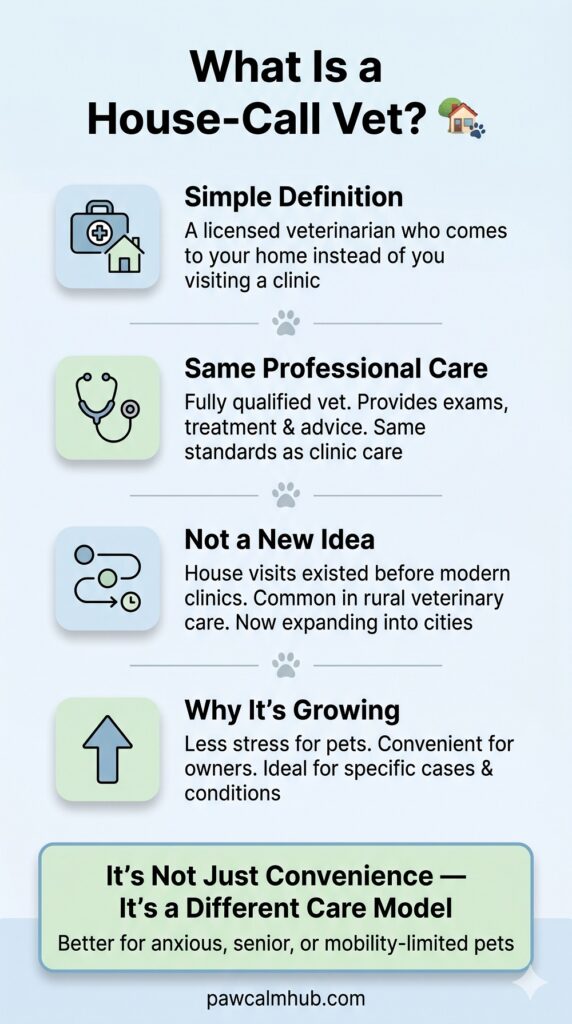
A house-call veterinarian — also called a mobile vet, home visit vet, or domiciliary vet — is a licensed, fully qualified veterinarian who travels to patients’ homes to deliver veterinary care rather than requiring patients to travel to a clinic.
This is not a new concept. House-call medicine predates the modern clinic model in both human and veterinary healthcare — the image of the rural veterinarian making farm visits is as old as the profession itself. What is new is its application in small animal companion animal practice, its availability in urban and suburban markets, and its growing recognition within the veterinary profession as an appropriate clinical choice for specific patient populations — rather than simply a convenience service for owners who find clinic visits inconvenient.
The American Association of Housecall Veterinarians (AAHV) — the professional body representing house-call practitioners in the United States — documents a significant growth in the profession over the past decade, driven by three converging factors: increased owner awareness of veterinary anxiety as a welfare issue, the growing body of evidence on examination quality in anxious patients, and the influence of the Fear Free movement in raising professional standards for low-stress veterinary care across all delivery settings.
Understanding what a house-call vet is — and is not — is the prerequisite for deciding whether one is right for your dog.
The Clinical Case for House-Call Veterinary Care — Why the Setting Matters More Than You Think
This is not a guide about convenience. It is a guide about clinical quality — because the evidence increasingly shows that for a specific population of anxious dogs, the setting of the veterinary examination directly affects the quality and accuracy of the clinical findings.
Examination Findings Are Confounded by Anxiety
Research published in the Journal of Veterinary Internal Medicine documents that physiological parameters commonly used in veterinary examination — heart rate, respiratory rate, blood pressure, and pain response — are all significantly elevated in anxious dogs compared to calm dogs undergoing identical examination procedures. An anxious dog’s resting heart rate in a clinic may be 40–60% higher than their genuine resting heart rate at home. Their respiratory rate may be nearly double. Their blood pressure may reach readings that would indicate hypertension if recorded in a calm patient.
The clinical consequences of this are serious and underappreciated: a dog examined in a state of acute anxiety is providing inaccurate physiological data. A heart murmur that is borderline at home may be masked by the tachycardia of anxiety at the clinic. A blood pressure reading that indicates hypertension in the clinic may reflect normal physiology measured under abnormal conditions. Pain assessment — which requires the patient to respond authentically to palpation — is dramatically confounded by the hyperalgesia (heightened pain sensitivity) that anxiety produces through cortisol’s effects on pain processing pathways.
Research from the Fear Free certification body documents that dogs examined in low-stress conditions show measurably different examination findings from the same dogs examined in high-stress conditions — and that the low-stress findings are more accurate representations of the patient’s true physiological state. This is not a welfare argument. It is a clinical accuracy argument. A dog examined at home, in their own environment, at their baseline cortisol level, is providing better clinical data than the same dog examined in a clinic in a state of acute stress.
The Cortisol Load of Clinic Visits Has Cumulative Health Consequences
Research on hypothalamic-pituitary-adrenal axis function in dogs documents that cortisol levels in dogs experiencing acute anxiety events can spike 200% or more above baseline — and that cortisol clearance after the event takes 60–90 minutes. For a dog who has a significant anxiety response to the veterinary clinic, each visit produces a substantial cortisol load that takes hours to physiologically resolve.
For dogs who require frequent veterinary visits — those with chronic conditions, senior dogs needing regular monitoring, dogs on ongoing medications requiring check-ups — this cortisol load accumulates. Research on chronic cortisol elevation consistently documents its effects on immune function, gut health, sleep quality, and the anxiety threshold itself. A dog who is anxious at the vet, who visits frequently, who experiences repeated acute cortisol spikes, is experiencing a form of cumulative physiological harm that is directly caused by the veterinary care intended to protect their health.
House-call veterinary care eliminates this cortisol load for dogs who would otherwise experience it. The home visit does not just reduce stress — it removes a source of physiological harm from the healthcare process.
The Fear-Conditioning Cycle and Its Escalation
Research on fear conditioning in dogs published in Applied Animal Behaviour Science documents that fear responses to specific environments are strengthened, not weakened, by repeated exposure to those environments without counter-conditioning. A dog who is anxious at the vet clinic and who visits the clinic annually without intervention will — in the majority of cases — be more anxious at the next visit than the last.
This is the opposite of the common assumption that “dogs get used to it.” Some dogs do habituate. Many do not. And for anxious dogs who do not habituate — who show the same or worsening fear response year after year — the clinic environment is functioning as a consistent, reliable fear conditioner that is actively deepening the anxiety disorder with every visit.
House-call veterinary care removes the conditioned environment from the equation. The dog is not being counter-conditioned or desensitised to the clinic — they are simply not going there. For dogs whose clinic anxiety is severe enough that it cannot be adequately managed through the protocols described in our full guide to dog anxiety at the vet, this removal is the welfare-appropriate clinical choice.
Is Your Dog a Candidate for House-Call Veterinary Care? — The Assessment Framework
Not every anxious dog needs or benefits from a house-call vet. The decision involves a careful assessment of the dog’s specific anxiety profile, the availability of house-call services in your area, the nature of the care your dog requires, and the practical and financial considerations of the arrangement.
Use the following framework to assess whether a house-call vet is the right option for your dog.
Strong Candidates — House-Call Is the Appropriate Clinical Choice
Dogs with a documented history of aggression at the veterinary clinic. A dog who has bitten or attempted to bite veterinary staff — regardless of how gentle or compliant they are in every other context — is a dog for whom the clinic examination environment has exceeded their coping threshold to the point of producing a defensive aggression response. Continuing to bring this dog to a clinic setting without fundamental change produces three outcomes: an escalating risk of staff injury, increasingly heavy pharmacological sedation for routine examinations, and worsening anxiety through repeated traumatic conditioning. House-call veterinary care is the appropriate clinical alternative to all three.
Dogs who require heavy sedation to complete routine examinations. Chemical sedation is appropriate for specific procedures requiring immobility or anaesthesia. It is not appropriate as a routine solution for a wellness examination, vaccination, or blood draw in a dog who would be calm and cooperative in a different setting. If your dog is currently sedated for routine annual check-ups, the sedation is managing the setting problem rather than resolving it. A house-call examination may eliminate the need for sedation entirely — providing better clinical data, eliminating the anaesthetic risk, and delivering the routine care more safely and effectively.
Dogs with severe generalised anxiety disorders whose baseline cortisol cannot be adequately reduced through pre-visit protocols. For dogs who begin showing anxiety signals hours before a clinic visit — whose departure routines trigger a full anxiety response regardless of what the destination is — the cortisol load of the entire clinic experience (anticipation, travel, waiting, examination) is consistently beyond what pharmacological and environmental pre-visit management can adequately address. House-call care removes the anticipatory and travel components of this load, delivering veterinary care to a patient who has not spent two hours in an escalating cortisol spiral before the examination begins.
Senior, seriously ill, or post-surgical dogs for whom the cortisol load of a clinic visit produces measurable welfare harm. A fifteen-year-old dog with cognitive dysfunction, significant arthritis, and cardiac disease who requires monthly check-ups is a dog for whom the stress of a clinic visit — travel, waiting room, unfamiliar handling — represents a genuine physiological burden on an already compromised system. The clinical data obtained from this examination may be less accurate than data obtained at home, and the welfare cost of obtaining it may exceed its clinical value. Research on geriatric veterinary care quality increasingly recognises the home as the appropriate examination setting for frail or significantly unwell senior animals.
Dogs being managed through a systematic desensitisation programme for clinic anxiety who need routine care during the desensitisation period. A dog undergoing an active behavioural desensitisation programme for veterinary anxiety — happy visits, graduated exposure, counter-conditioning — should not be required to attend for necessary routine care in a clinic setting while the programme is in progress. Every full clinic visit during an active desensitisation programme risks resetting the conditioning work done to that point. House-call care for routine needs during the programme period protects the investment of the desensitisation work.
Moderate Candidates — House-Call Worth Considering
Dogs whose anxiety worsens progressively with each annual visit despite pre-visit protocols. If you have implemented pre-visit calming chews, the anxiety vest, a Fear Free certified clinic, and waiting in the car — and your dog is still significantly worse at the vet this year than last year — the trajectory is telling you something. The setting is the problem, not the protocol. House-call care is worth discussing with your veterinarian before the next annual visit rather than after it.
Dogs in multi-pet households where one dog’s clinic anxiety produces contagious anxiety in the other dogs. As documented in our multi-dog household anxiety guide, emotional contagion between bonded dogs is a well-documented phenomenon. A dog who returns from the vet smelling of clinic chemicals and stress pheromones can trigger redirected aggression, fear responses, and sustained anxiety in their housemates for 24–48 hours after the visit. For households where this pattern is established, house-call care for the anxious dog eliminates the household disruption that clinic visits produce.
Dogs with specific handling sensitivities that can be managed at home but not in a clinical setting. Some dogs — particularly rescue dogs with trauma histories around physical restraint — can be successfully handled at home by their owner, using the systematic desensitisation techniques described in our grooming and handling guide, but cannot be handled by unfamiliar people in an unfamiliar environment without producing the same restraint-trauma response. A house-call vet who can work with the owner’s handling skills and the dog’s home-based familiarity may achieve examination quality that a clinic cannot.
Less Suitable Candidates — Clinic Care Remains Appropriate
Dogs with mild situational anxiety who respond adequately to the pre-visit protocol described in our dog anxiety at the vet guide — particularly dogs who manage well with pre-visit trazodone or gabapentin, a lick mat during examination, and Fear Free handling — do not need the additional complexity and cost of house-call arrangements. The clinic, managed correctly, remains the appropriate setting.
Dogs who require emergency care, complex diagnostic imaging, surgical intervention, or hospitalisation cannot be served by house-call veterinarians in these specific needs — and should be in a clinic setting without delay when these needs arise.
What House-Call Vets Can and Cannot Do — The Honest Capability Assessment
One of the most important things to understand before arranging house-call veterinary care is the realistic scope of what a mobile practitioner can deliver versus what requires clinic infrastructure. Most house-call vets are transparent about this — but owners need to enter the arrangement with accurate expectations.
What House-Call Vets Can Do Competently
Routine wellness examinations. A thorough physical examination — cardiovascular, respiratory, gastrointestinal, musculoskeletal, neurological, dermatological, and ophthalmological assessment — requires no equipment that a house-call vet cannot bring in a well-equipped medical bag. The examination itself is the clinical skill of the veterinarian, not the infrastructure of the clinic. Many experienced house-call vets argue that the home examination produces better clinical data than the clinic examination for anxious patients precisely because the patient is in their optimal physiological state.
Vaccinations and preventive care. Annual vaccination, parasite prevention, microchipping, and health certificates are all routine procedures that require no clinic infrastructure. They are among the most commonly requested house-call services and are straightforwardly deliverable in a home setting.
Blood and urine collection for laboratory analysis. Sample collection requires competent venipuncture technique and appropriate sample handling — both of which a house-call vet provides. Samples are sent to the same reference laboratories used by clinics. Results are typically available within 24–48 hours. For dogs requiring regular blood monitoring (those on phenobarbital for epilepsy, long-term NSAIDs, or thyroid medication), house-call blood collection eliminates the clinic visit for what is otherwise a routine monitoring procedure.
Wound assessment and minor treatment. Lacerations, skin infections, ear infections, eye conditions, and minor injuries can be assessed and initially treated in a home setting. Research on wound assessment accuracy in varying clinical settings documents that the quality of wound assessment is determined by examiner skill and lighting conditions — both of which a competent house-call vet can provide — not by clinic infrastructure.
Prescription management and medication monitoring. For dogs on ongoing medications, house-call check-ups for medication monitoring — including physical examination, weight assessment, and clinical monitoring parameters — can be delivered at home. This is particularly valuable for senior dogs on multiple medications who require monthly or bimonthly assessments.
Palliative and end-of-life care. This is the most established and most emotionally significant domain of house-call veterinary practice. Research on the experience of pet euthanasia in home versus clinic settings documents significant differences in owner-reported grief experience and sense of peace between home and clinic settings — with home-based euthanasia consistently associated with greater owner comfort, greater sense of dignity for the animal, and lower acute grief scores in the immediate aftermath. For dogs approaching the end of their lives — particularly those with advanced anxiety disorders for whom a clinic visit would constitute significant welfare harm — home-based end-of-life care is not just a clinical option. It is the compassionate standard.
Behavioural assessment in context. A veterinary behaviourist or behaviourally-trained house-call vet can assess the dog’s behaviour in their home environment — the context where the majority of anxiety behaviours actually occur. This produces more ecologically valid behavioural data than a clinic consultation where the dog’s environment-specific anxiety patterns may not be observable, and allows the clinician to directly assess the environmental factors contributing to the anxiety in a way that no clinic consultation can replicate.
What House-Call Vets Cannot Do — The Honest Limitations
Advanced diagnostic imaging. X-ray, MRI, CT scanning, and full echocardiography require equipment that is too large and technically complex for mobile deployment in most current house-call practices. Some mobile practices carry portable ultrasound units with genuine diagnostic capability — useful for abdominal assessment, bladder evaluation, and cardiac screening — but full diagnostic imaging capability requires clinic infrastructure. If your dog requires complex imaging, this needs to happen in a clinic or referral hospital.
Surgical intervention. Any procedure requiring general anaesthesia, a sterile surgical field, monitoring equipment, and post-anaesthetic recovery capacity requires clinic infrastructure. House-call vets cannot perform surgery at home — and a dog who needs surgery should be in a clinic environment regardless of their anxiety status.
Emergency care and hospitalisation. A dog in acute medical crisis — respiratory distress, suspected toxin ingestion, acute abdominal emergency, suspected fracture — needs emergency clinic care immediately. House-call veterinary care is not an emergency service in most cases, and should never be considered as an alternative to emergency clinic care for a dog in medical crisis.
Complex dental procedures. Dental scaling, extractions, and oral surgery require general anaesthesia and specific dental equipment. Routine dental health assessment can be done at home; dental treatment requires clinic infrastructure.
The practical implication of this capability profile is that house-call veterinary care works best as the primary care setting for routine and monitoring needs, with a defined relationship with a nearby clinic for procedures requiring infrastructure. This is not a limitation unique to house-call medicine — it is a realistic care model that mirrors how integrated healthcare works in human medicine, where primary care physicians deliver most routine care and refer to specialists or hospital settings for procedures requiring their specific infrastructure.
Finding a House-Call Vet — The Complete Practical Guide
Directories and Search Resources
In the United States: The American Association of Housecall Veterinarians (AAHV) maintains a searchable directory of member practitioners by location. This is the most reliable starting point for finding a qualified house-call vet in the US market.
For Fear Free certified house-call practitioners: The Fear Free professional finder allows searching specifically for Fear Free certified veterinarians — filter by location and look for practitioners who identify as mobile or house-call in their practice description. A Fear Free certified house-call vet combines the clinical competence of mobile practice with specific training in low-stress patient management — the optimal combination for an anxious dog.
In the United Kingdom: The Royal College of Veterinary Surgeons (RCVS) Find a Vet tool allows searching by location. Search for “home visit” practices or contact local clinics directly — many UK practices offer domiciliary visit services for existing patients without advertising them prominently.
Through your existing veterinary practice: Before seeking an external house-call practitioner, ask your current vet directly: “Do you offer home visits, or can you recommend a colleague who does?” Many veterinary practices offer home visits for existing patients — particularly for end-of-life care, senior animal monitoring, and post-surgical check-ups — without publishing this service prominently. Your vet may also know mobile practitioners in the area who they can refer to with confidence.
Online search: Search “[your city] mobile vet,” “[your city] house call vet,” or “[your city] home visit vet.” In larger metropolitan areas, multiple dedicated house-call practices may operate — read their websites carefully for service scope, fee structures, and any specific mentions of anxiety management or Fear Free principles.
Questions to Ask Before Booking
Once you have identified potential house-call practitioners, these questions will help you assess whether they are the right fit for your anxious dog:
“What is your experience with anxiety and fear in dogs?” A house-call vet specifically serving anxious dogs should be able to speak fluently about low-stress handling, the Fear Free approach, and their experience modifying examination techniques for fear-reactive patients. Vague or dismissive answers suggest a practitioner whose house-call service is primarily about owner convenience rather than patient welfare.
“Are you Fear Free certified or familiar with Fear Free principles?” Certification is not essential — but it is a meaningful quality signal. Familiarity with Fear Free principles indicates engagement with the current evidence on low-stress veterinary care.
“What is your protocol for a dog who becomes aggressive during examination?” The answer to this question tells you a great deal about the practitioner’s experience and philosophy. A good answer involves early identification of stress signals, immediate examination pause, repositioning and re-approach, and clear criteria for when sedation or rescheduling is the appropriate response. An answer that involves forced restraint is not appropriate for the patient population this guide is addressing.
“What procedures can you perform at home versus what would require clinic referral?” A house-call vet who overstates their capability is more dangerous than one who is clear about limitations. You need accurate information to make appropriate decisions for your dog’s care.
“Do you have a relationship with a nearby clinic for procedures requiring their infrastructure?” An integrated care model — house-call vet for routine needs, defined clinic relationship for procedures requiring infrastructure — is the optimal arrangement. A house-call vet who has no referral relationship with a clinic is not providing complete care.
“What is your fee structure, and do you charge a travel fee?” House-call fees vary significantly by region, practitioner experience, and service scope. Understanding the full cost before booking prevents surprises.
The Cost Comparison — House-Call vs. Clinic, Honestly Assessed
This is the section most guides avoid because the answer is not simple. House-call veterinary care costs more per visit than an equivalent clinic visit — typically by 30–70% depending on region and practitioner. The travel fee — which many house-call vets charge in addition to their service fees — adds a further fixed cost per visit regardless of the services delivered.
However, the cost comparison that matters for anxious dog owners is not visit-cost versus visit-cost. It is total-cost versus total-cost, accounting for:
Pharmaceutical costs currently used for clinic visits. Pre-visit trazodone, gabapentin, or alprazolam — prescribed for every clinic visit — add per-prescription costs that recur with every appointment. A dog who does not need pre-visit medication at a house-call visit eliminates this cost.
Sedation costs. For dogs currently requiring sedation for routine examinations, the sedation itself — anaesthetic agents, monitoring, recovery time — may cost $150–300 per appointment in addition to the examination fee. A house-call examination that eliminates the need for sedation may cost less in total than a clinic examination that requires it.
The cost of the anxiety management protocol. Calming chews administered before every visit, the frozen lick mat prepared and transported, the time taken to drive to a Fear Free certified clinic forty minutes away rather than five minutes away — all of these have costs that accumulate across multiple visits per year.
The cost of inaccurate examination findings. A blood pressure reading taken from an acutely anxious dog that indicates hypertension where none exists produces follow-up visits, additional investigations, and potentially unnecessary medication. A cortisol-confounded pain assessment that misses a real pain condition produces delayed treatment and progression of a manageable condition. The clinical cost of anxious-patient examination inaccuracy is difficult to quantify but real.
For some dogs and some owners, the honest total-cost assessment will confirm that clinic care — even with its associated anxiety management costs — remains more affordable than house-call care. For others, particularly dogs with significant anxiety who are currently sedated for routine visits or who require frequent monitoring, the total-cost calculation may be closer than the per-visit comparison suggests.
This is a financial decision that requires honest individual assessment. What this guide can offer is the assurance that the higher per-visit cost of house-call care is not simply a premium for convenience — it is, for the right patient, a premium for clinical quality and welfare that has measurable value beyond its price.
Preparing Your Home for a House-Call Vet Visit — The Practical Guide
Unlike a clinic visit — where preparation primarily involves managing the dog’s anxiety about the environment — a house-call visit requires preparing the home environment to support the examination.
Choose the examination room carefully. The best room for a house-call veterinary examination is the room where your dog is most relaxed — typically their primary living space, not a spare room they rarely use. The familiarity of their primary space and the olfactory safety signals it carries (their own scent, owner scent, familiar furniture) all contribute to the calm that makes the house-call examination work. A comfortable, low table or the floor are both appropriate examination surfaces — ask your house-call vet in advance what they prefer.
Secure other pets. Other dogs in the household should be separated — either in another room or with another family member in the garden — during the examination. Their presence can elevate the anxious dog’s arousal through social contagion, and their investigation of the vet’s equipment bag may be disruptive. Cats can typically remain in the home but should not be present in the examination room.
Prepare your calming toolkit. Have a lick mat for dog anxiety loaded with high-value food and ready to deploy at the start of the examination. Have high-value treats — real food, not kibble — available in a location you can access without leaving the room. If your dog wears an anxiety vest, have it fitted 20 minutes before the vet’s arrival, not at the moment they arrive.
Administer any pre-visit medication at the correct time. If your veterinarian has prescribed pre-visit medication for your dog’s anxiety, administer it at the time directed — typically 60–90 minutes before the appointment — rather than at the moment the doorbell rings. The medication needs to be active before the examination begins, not during it.
Brief the vet before they arrive. A quick phone call or message in the 24 hours before the visit — covering your dog’s specific anxiety triggers, the handling areas they are most sensitive about, the foods they respond to most strongly, and any behavioural signals that indicate they are approaching their threshold — allows the vet to prepare their approach before they arrive. A well-briefed house-call vet can plan an examination sequence that minimises the anxiety-producing elements from the first contact.
Have your medical history documentation ready. Previous veterinary records, current medication lists, and any behavioural history relevant to the examination should be accessible at the start of the visit. Most house-call vets can access records digitally if your previous clinic uses a shared platform — but having physical or PDF copies available ensures continuity of care regardless.
Do not feed a large meal immediately before the visit. A full stomach reduces treat motivation — and treat motivation is the primary positive counter-conditioning tool in a house-call examination. A light meal two hours before the appointment maintains hunger for high-value food rewards without causing discomfort during the examination.
The Integrated Care Model — House-Call as Primary Care, Clinic as Specialist Resource
The most effective arrangement for anxious dogs who benefit from house-call care is not an either/or choice between house-call and clinic veterinary care. It is an integrated model that uses each setting for what it does best.
House-call veterinary care handles: routine wellness examinations, vaccinations, blood and urine monitoring, medication management, wound assessment, minor treatment, and palliative care. These represent the majority of veterinary care interactions for most healthy and moderately unwell dogs across their lives.
Clinic or referral hospital care handles: complex imaging, surgical procedures, emergency care, hospitalisation, specialist consultation, and dental treatment requiring general anaesthesia. These are the minority of interactions for most dogs — but they are clinically essential when they arise.
Establishing this integrated model requires a clear communication relationship between your house-call vet and a defined clinic. Ask your house-call vet at the first visit: “Which clinic do you refer to for procedures requiring their infrastructure, and can you make that introduction proactively?” A house-call vet who has established referral relationships with local clinics is providing complete care. One who does not is leaving a gap in the care model.
For the clinic interactions that remain necessary, the full pre-clinic preparation protocol remains relevant and should be implemented regardless of the integrated care arrangement. The goal is not to eliminate clinic contact entirely for dogs who need it — it is to reduce it to the cases where clinic infrastructure genuinely adds clinical value that a house-call examination cannot provide.
The Welfare Argument — What We Owe Our Anxious Dogs
This guide has presented the case for house-call veterinary care primarily through a clinical lens — examination accuracy, cortisol load, fear conditioning, integrated care models. But there is a welfare argument that deserves to be stated plainly, because it is the argument that reaches the part of every dog owner that the clinical evidence does not.
Your dog cannot choose to avoid the veterinary clinic. They cannot request a different setting. They cannot explain that the smell of antiseptic triggers a fear response that makes them bite, or that the stainless steel table makes them feel as though the floor is falling away, or that the sound of other dogs crying in the back of the clinic is the most frightening sound they know.
They go because you take them. And if every visit produces an acute anxiety event that you observe, that you manage imperfectly, and that leaves your dog dysregulated for hours afterwards — the decision to continue that pattern, when an alternative exists, is a welfare decision. Not a convenience decision. A welfare decision.
The house-call veterinary option is not perfect. It costs more per visit. It cannot deliver the full scope of clinic care. It requires finding a practitioner in your area and establishing a new professional relationship. These are real barriers that deserve honest acknowledgement.
But for the dog who bites at the clinic — who spent the drive home shaking, who hid under the bed until midnight, who startled at sounds for three days afterwards — the question is not whether house-call care is perfect. The question is whether it is better. And for that dog, in most cases, it is.
Read more: Dog Anxiety at the Vet — The Complete Before, During and After Protocol — for dogs whose anxiety can be managed within a clinic setting with the right preparation.
Read more: The Complete Pet Anxiety Guide — the full framework for understanding and managing all forms of dog and cat anxiety.
Read more: Rescue Dog Anxiety — The Definitive First-Year Guide — many rescue dogs with trauma histories are among the strongest candidates for house-call veterinary care.
Read more: Dog Anxiety After Surgery — post-surgical monitoring check-ups are one of the highest-value uses of house-call care.
FAQ: House-Call Vets for Anxious Dogs
Will my dog still be anxious if a stranger comes to the house?
This is the most common concern — and the most commonly resolved by experience. The majority of dogs who are severely anxious in clinic settings show dramatically reduced anxiety when a veterinarian visits at home, even though the veterinarian is a stranger. The reason is that the home environment’s olfactory safety signals, spatial familiarity, and the presence of the primary attachment figure (the owner) collectively provide a neurological safety context that the clinic environment cannot replicate. The unfamiliar person is assessed as a lower threat in a familiar, safe environment than the same unfamiliar person in an environment saturated with stress pheromones from dozens of other animals. Most house-call vets report that dogs who were described by their owners as severely aggressive at the clinic are calm, food-motivated, and handleable at home — often to the owner’s genuine astonishment.
What if my dog has an emergency — can the house-call vet help?
No — and this is a critical point. House-call veterinary care is not an emergency service. A dog in medical crisis requires immediate access to clinic infrastructure — intravenous fluids, oxygen, emergency surgery, hospitalisation — that no house-call practitioner can provide at home. Know the location and phone number of your nearest 24-hour emergency veterinary clinic regardless of your primary care arrangement, and do not hesitate to go directly there if your dog shows any sign of medical emergency. The house-call arrangement does not change your emergency response plan.
Do I need a referral from my existing vet to use a house-call vet?
No — in most cases. House-call veterinarians are independently licensed practitioners who can accept new patients without referral. However, sharing your dog’s medical history with your house-call vet — either by requesting records from your existing practice or providing written medication and health history yourself — ensures continuity of care and prevents important clinical context from being lost in the transition.
Will my house-call vet’s fees be covered by pet insurance?
This varies significantly by insurance provider and policy. Many pet insurance policies cover veterinary services regardless of where they are delivered, provided the practitioner is a licensed veterinarian — which house-call vets are. Some policies specifically exclude home visit fees or travel charges. Review your policy documents directly and, if uncertain, contact your insurance provider before your first house-call appointment to confirm what is covered. Ask your house-call vet whether they have experience working with specific insurance providers and what documentation they provide for claim submission.
My dog was fine at the vet as a puppy and has gotten worse every year. Is it too late to benefit from house-call care?
No — and this pattern of progressive worsening is one of the clearest indicators that house-call care is appropriate. As documented in the fear conditioning research referenced in this guide, clinic anxiety that is not counter-conditioned typically worsens with repeated exposure. A dog who has spent years having their clinic fear repeatedly confirmed through aversive experiences has established deep, well-conditioned fear responses to the clinic environment. Removing that environment through house-call care does not reverse the conditioning — but it stops the cycle of repeated aversive conditioning that is deepening it, and it allows routine care to be delivered without adding yet another layer of negative experience.
Can I use house-call care as a temporary arrangement while my dog goes through a desensitisation programme for the clinic?
Yes — and this is one of the most clinically appropriate uses of house-call care. A dog undergoing a systematic desensitisation programme for veterinary anxiety (happy visits, graduated exposure, counter-conditioning — as described in our full vet anxiety guide) should not be required to attend the clinic for necessary routine care during the programme. Each forced full clinic visit during an active programme risks resetting the conditioning work. House-call care for routine needs during the programme period protects the desensitisation investment and allows the programme to proceed at the pace the dog’s nervous system requires rather than the pace that routine care demands.
My dog is fine at the vet but gets extremely anxious during the car journey. Would house-call care help?
For dogs whose primary anxiety is travel-related rather than clinic-related, house-call care eliminates the car journey component of the veterinary anxiety experience — which may resolve the majority of the distress. Dogs with travel-specific anxiety who are calm once they arrive at the clinic are candidates for house-call care specifically to address the travel component. However, if you have not yet tried the car desensitisation protocol described in our dog car anxiety guide alongside pre-visit calming support, trialling this first is reasonable — house-call care remains the appropriate fallback if the travel anxiety cannot be adequately managed.
How do I explain to my current vet that I want to switch to house-call care?
Most veterinarians who genuinely care about their patients’ welfare — and the vast majority do — will understand and support the decision to move to house-call care for an anxious dog who is not being well served by clinic visits. Frame the conversation around the clinical data: the examination quality concerns, the cortisol load evidence, and the progressive worsening of the anxiety response. Request records for transfer, ask for recommendations if they know house-call practitioners in the area, and maintain the relationship for clinic-infrastructure procedures that house-call care cannot deliver. This is not a rejection of your existing vet — it is a responsible clinical decision that a good vet will respect.