
Estimated read time: 15 minutes | Last updated: 2026 | Reviewed against current veterinary and behavioural science research
A note on this guide: Every statistic in this article is sourced from a published study, industry survey, or veterinary institution, with a direct citation. This is intended as a reference resource for pet owners, journalists, veterinary professionals, and researchers. It is updated as new data becomes available.
Dog Anxiety Statistics 2026: For years, the pet industry talked about anxiety in dogs the way it talked about a difficult personality trait — something some dogs had, most didn’t, and nobody had really measured.
That changed in May 2026.
The US Pet 2026 Survey — a nationally representative study of 1,000 US pet owners — asked, for the first time, which health conditions were affecting their pets. Anxiety did not place second. It did not place third. It was the single most commonly reported condition affecting pets in America, named by 19.6% of respondents — ahead of obesity, osteoarthritis, atopic dermatitis, kidney disease, and cancer combined categories.
This is the moment the data caught up with what millions of dog owners already knew from lived experience: their dog’s anxiety was real, common, and worth taking seriously as a primary health concern — not a footnote to it.
This article compiles the complete current data picture. Every figure is cited. Every source is linked. Use it, share it, cite it.
The Headline Numbers
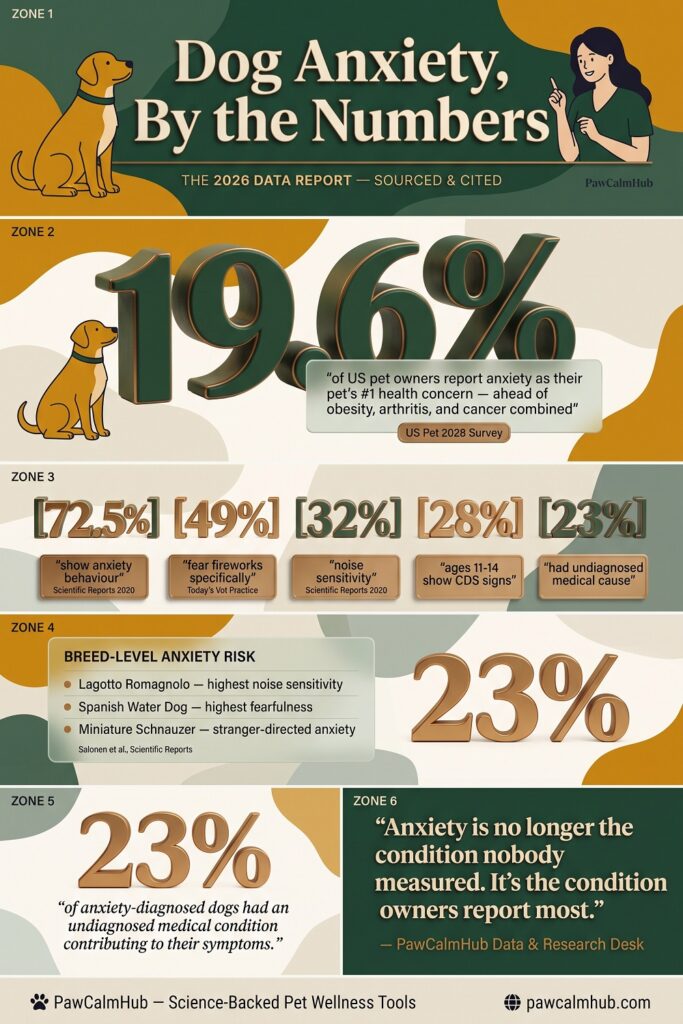
19.6% — of US pet owners report anxiety as a condition affecting their pet, making it the most commonly reported pet health condition in the US Pet 2026 Survey, ahead of obesity (11.9%), osteoarthritis pain (7.7%), atopic dermatitis (5%), kidney disease (3.8%), and cancer and heart disease (3.1% each).
72.5% — of dogs show at least one clinically significant anxiety-related behaviour, according to Salonen et al., published in Scientific Reports — the largest behavioural study of its kind, analysing 13,700 Finnish pet dogs across 264 breeds.
49% — of dogs show a significant fear response to firework noise specifically, according to research referenced in Today’s Veterinary Practice.
Nearly two-thirds — of cats show signs of fear or anxiety, according to Pet Anxiety Awareness Month 2026 programming, founded by pet care expert Kristen Levine and now entering its tenth year.
32% — of dogs show noise sensitivity as their primary anxiety presentation, with fireworks identified as the leading trigger (Salonen et al., Scientific Reports).
17–29% — of dogs are estimated to experience separation anxiety, one of the most common and most frequently under-recognised anxiety subtypes.
📊 Free to Embed — Use These Charts on Your Own Site
These charts are free to use with attribution. Click below to copy the embed code for your blog, newsletter, or article.
Chart 1: Top 7 Reported Pet Health Conditions (2026)
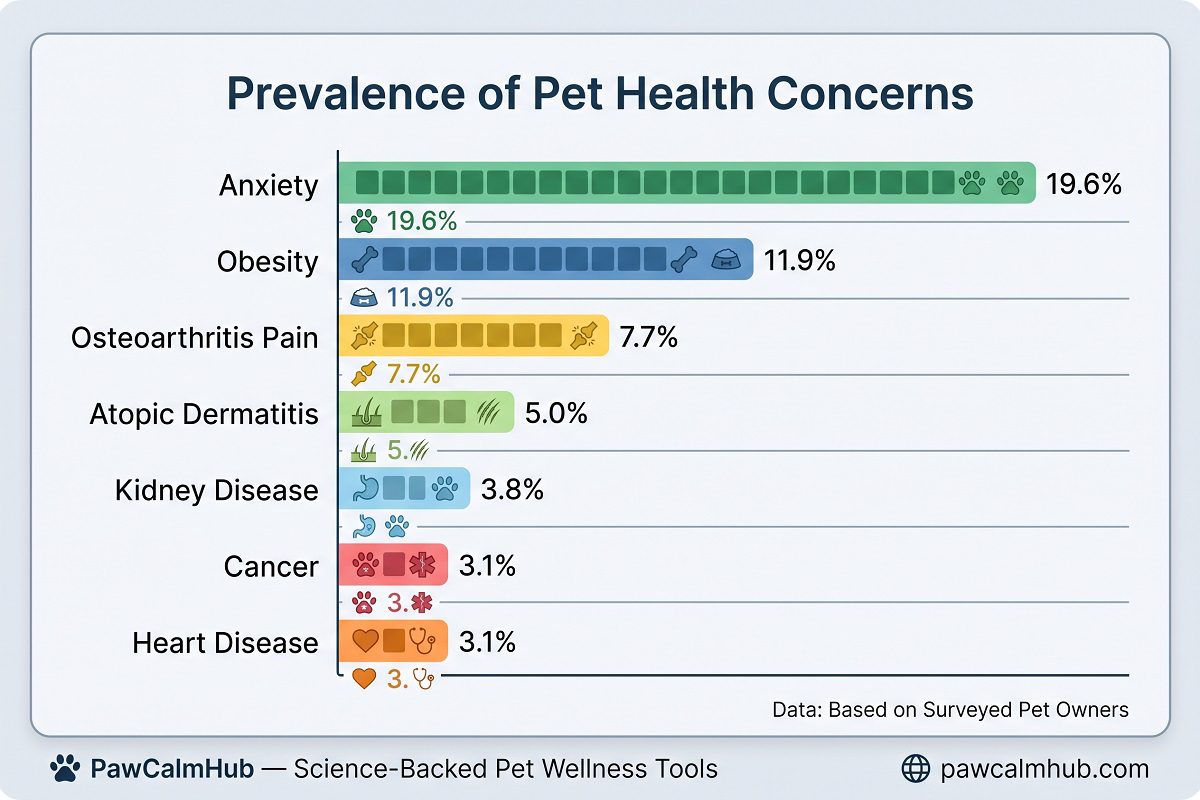
Chart 2: The 23% Rule — Medical vs. Behavioral Anxiety
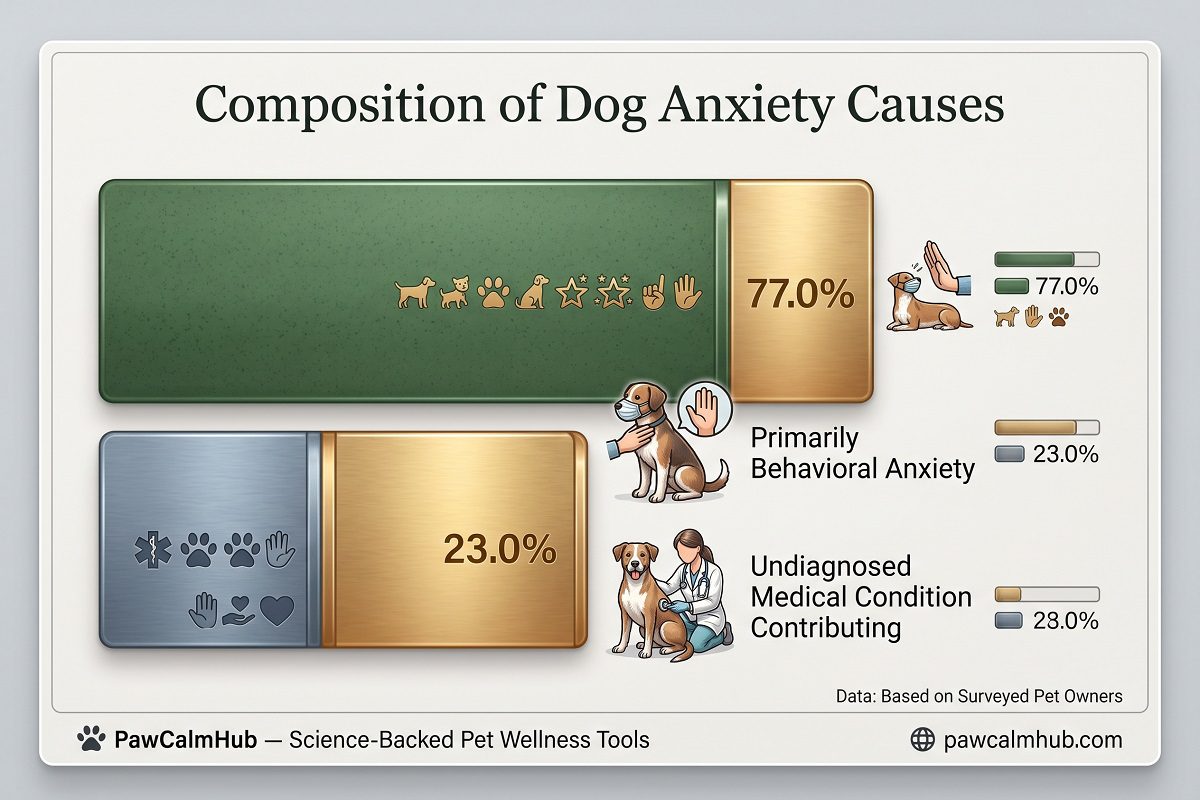
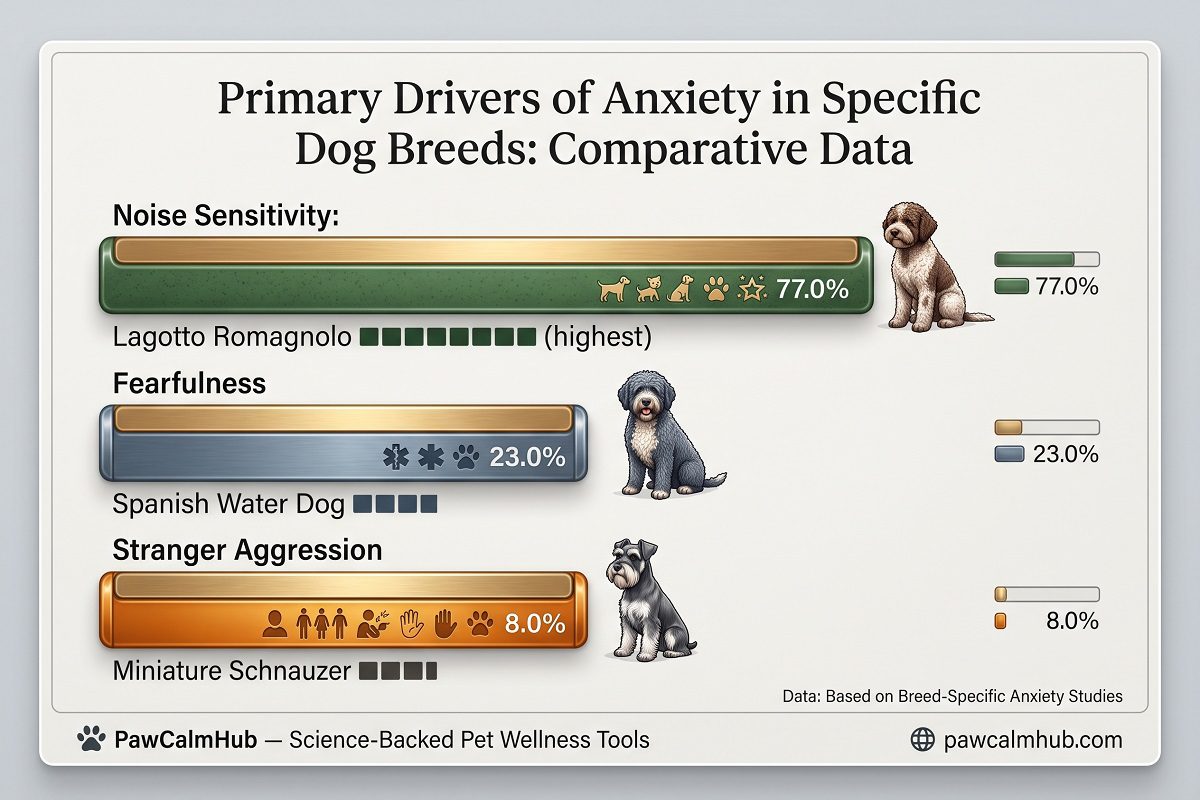
Chart 3: Breed Anxiety Risk Hierarchy
WHAT THE DATA MEANS FOR YOUR HOME
72.5% of dogs show anxiety-related behavior. If yours is one of them, the evidence-based management tools referenced throughout this library are built around the same mechanisms this data points to — parasympathetic activation, cortisol regulation, and consistent daily support.
What the New 2026 Survey Data Actually Shows
The US Pet 2026 Survey, conducted in May 2026 among 1,000 US respondents, was the first major industry survey to include anxiety as a named condition category alongside physical health conditions — a methodological shift that reflects how veterinary and consumer understanding of pet mental health has evolved.
The full ranked list of conditions reported by pet owners:
| Condition | % of Owners Reporting |
|---|---|
| Anxiety | 19.6% |
| Obesity | 11.9% |
| Osteoarthritis pain | 7.7% |
| Atopic dermatitis | 5.0% |
| Kidney disease | 3.8% |
| Cancer | 3.1% |
| Heart disease | 3.1% |
What makes this data significant is not simply that anxiety ranked first — it is that anxiety now outranks conditions that have historically received far more veterinary attention, diagnostic investment, and consumer product development. Obesity has decades of dedicated veterinary nutrition science behind it. Osteoarthritis has an established pain-management pharmaceutical category. Anxiety, despite affecting more reported pets than either, has historically been the most under-resourced category in companion animal healthcare.
The same survey period found that 17% of dogs and 29% of cats are missing their annual wellness visits, with inflation-related cost concerns cited as a primary driver. This creates a specific and important pattern: a growing proportion of the anxiety identified by owners is being managed without professional veterinary guidance — placing greater weight on accurate, evidence-based owner-facing information.
Breed-Level Data — Where Anxiety Concentrates
The Salonen et al. 2020 study in Scientific Reports remains the most methodologically rigorous breed-level anxiety dataset available, and its findings continue to inform current veterinary behavioural guidance in 2026.
Noise sensitivity was most prevalent in:
- Lagotto Romagnolo
- Wheaten Terrier
- Mixed-breed dogs
Fearfulness was highest in:
- Spanish Water Dog
- Shetland Sheepdog
Aggression toward strangers (a social anxiety presentation) was notably elevated in:
- Miniature Schnauzer
A related study — Storengen et al., published in Applied Animal Behaviour Science — examined noise sensitivity prevalence and breed risk across 17 dog breeds, confirming that noise-related anxiety shows measurable heritable patterns rather than being purely environmentally determined.
Read the full breed breakdown: Which Dog Breeds Are Most Prone to Anxiety?
Feline Anxiety Data — The Under-Researched Half of the Picture
Cat anxiety statistics remain significantly less developed than canine data, and that gap is itself a finding worth stating plainly: cats are not less anxious than dogs — they are less studied.
Nearly two-thirds of cats show signs of fear or anxiety, according to Pet Anxiety Awareness Month 2026 programming — a figure that, if confirmed by future large-scale studies at the rigor of the Salonen et al. canine research, would place feline anxiety prevalence in a similar range to dogs.
90%+ of cats over 12 years old show radiographic evidence of arthritis — a documented driver of pain-based anxiety in senior cats — yet fewer than a third receive a formal pain diagnosis at routine veterinary consultation.
29% of cats are missing their annual wellness visit, higher than the 17% figure for dogs — meaning feline anxiety, already less studied, is also less likely to receive professional assessment at all.
Litter tray avoidance and inappropriate elimination remain among the most commonly reported cat behavioral concerns in veterinary practice, and current behavioral literature increasingly identifies chronic environmental stress — not defiance — as the primary driver in the majority of cases.
The practical implication: cat owners searching for anxiety guidance are working with a thinner evidence base than dog owners, which makes accurate, clearly sourced information even more valuable — and makes overclaiming certainty about feline-specific statistics something to actively avoid.
Read more: Signs of Cat Anxiety | Senior Cat Anxiety: The Age-by-Age Calm-Down Guide
The Diagnostic Gap — What Owners Are Missing
One statistic deserves particular attention because of its clinical implications: research referenced in current pet anxiety literature has found that 23% of dogs diagnosed with anxiety were later found to have an undiagnosed medical condition contributing to their symptoms — including thyroid disorders, chronic pain, neurological conditions, and gastrointestinal disease.
This figure reframes how anxiety statistics should be read. A meaningful proportion of the 72.5% prevalence figure includes dogs whose “anxiety” is, at least in part, an undiagnosed medical condition presenting as behavioural distress. This is precisely why every major veterinary behavioural resource — including this content library — recommends veterinary examination before behavioural-only intervention, particularly for dogs whose anxiety is new in onset or occurring later in life.
Read more: Senior Dog Anxiety — Why It’s Often a Medical Signal, Not Just Aging
Age-Related Anxiety Data
28% of dogs aged 11–14 show clinical signs of Canine Cognitive Dysfunction Syndrome — the canine equivalent of Alzheimer’s disease — and this figure rises substantially in dogs aged 15 and older.
90%+ of cats over 12 years old show radiographic evidence of arthritis, according to veterinary orthopaedic literature — yet fewer than a third receive a formal pain diagnosis at routine consultation, meaning pain-driven anxiety in senior pets remains one of the most significant and most correctable gaps in current pet healthcare.
The Financial Picture
Veterinary behavioural consultation costs in the current US market range from $75–200 for an initial consultation, with diagnostic testing (where indicated) adding $200–500, and ongoing behaviourist consultation running $200–500 per session. These costs sit alongside a documented decline in overall veterinary visit frequency — 17% of dogs and 29% of cats missing annual wellness visits — driven substantially by inflation concerns.
This financial pressure is one of the primary forces driving pet owners toward self-directed, online anxiety management resources — which is precisely why the accuracy and depth of the information available to them matters as much as it does.
What This Data Means for Your Dog
Statistics are only useful if they change what you do next. Here is what the current data supports:
If your dog shows any anxiety-related behaviour, you are not managing an unusual problem. You are managing one of the most statistically common conditions in companion dogs today — more common than obesity, more common than arthritis, more common than any single physical health condition tracked in the 2026 survey.
If your dog’s anxiety is new, sudden, or occurring in a dog over seven years old, veterinary assessment should come first. The 23% diagnostic gap statistic is not a reason for alarm — it is a reason for a blood panel before a behavioural protocol.
If you have not had a veterinary wellness visit in the past year, you are part of a very large group — not an outlier. But it does mean the anxiety-related decisions you make at home carry more weight, which is exactly why evidence-based resources matter more now than they did five years ago.
FAQ: Dog Anxiety Statistics
Is dog anxiety actually becoming more common, or are we just measuring it better now?
Both are likely true, and current research cannot fully separate the two factors. Increased owner awareness, expanded veterinary behavioural training, and — as of 2026 — the first major industry survey to formally track anxiety as a named condition have all improved measurement. At the same time, documented drivers including reduced early-life socialisation opportunities during pandemic-era pet acquisitions, increasing urbanisation, and rising rates of rescue and rehoming all have plausible mechanisms for genuinely increasing anxiety prevalence. The honest answer is that both improved measurement and genuine increase are likely contributing.
Why do cat anxiety statistics seem less precise than dog statistics?
Feline anxiety is significantly under-researched relative to canine anxiety, and the data reflects this. Cats are also physiologically and behaviourally adapted to conceal distress far more effectively than dogs — a survival trait that makes population-level anxiety measurement in cats considerably harder to conduct accurately. The “nearly two-thirds” figure from Pet Anxiety Awareness Month programming is currently one of the most-cited available estimates, but the confidence interval around feline-specific prevalence data remains wider than for dogs.
Which single statistic should concern pet owners most?
The 23% diagnostic gap — the proportion of anxiety-diagnosed dogs later found to have an undiagnosed medical condition contributing to their symptoms. It is the statistic most directly actionable by an individual owner: it is the reason to see a veterinarian before beginning a purely behavioural anxiety protocol, particularly for any dog whose anxiety is new, sudden, or occurring later in life.
Are these statistics specific to the US, or global?
The US Pet 2026 Survey and the missed-wellness-visit data are US-specific. The Salonen et al. breed and prevalence data is drawn from a Finnish population of 13,700 dogs — the methodology and findings are widely considered generalisable to the broader companion dog population across similar Western veterinary care contexts, but breed distribution and environmental factors do vary by country.
Related reading:
- The Complete Pet Anxiety Guide
- Which Dog Breeds Are Most Prone to Anxiety?
- Senior Dog Anxiety
- Dog Anxiety at the Vet