
📊 Evidence-Based Content Rating
⭐⭐⭐ Clinical evidence: Peer-reviewed veterinary studies
⭐⭐ Moderate evidence: Some studies + strong professional consensus
⭐ Emerging evidence: Theoretical or early-stage research
This article uses this rating system throughout for full transparency.
Reviewed for alignment with AKC and Fear Free veterinary guidelines.
Written by The PawCalmHub Team. Reviewed for alignment with current veterinary behavioral guidelines and ASPCA resources. Last updated 2025.
The popular image of the cat is a self-sufficient, independent creature who barely notices when you leave and is faintly annoyed when you return.
For some cats, this is accurate. For many others — particularly those who are closely bonded to their owners, who were orphaned or weaned early, or who were raised as single indoor cats — departure is genuinely distressing.
Cat separation anxiety is real. It is increasingly recognized by veterinary behaviorists. And it is far more common than the independent-cat stereotype suggests.
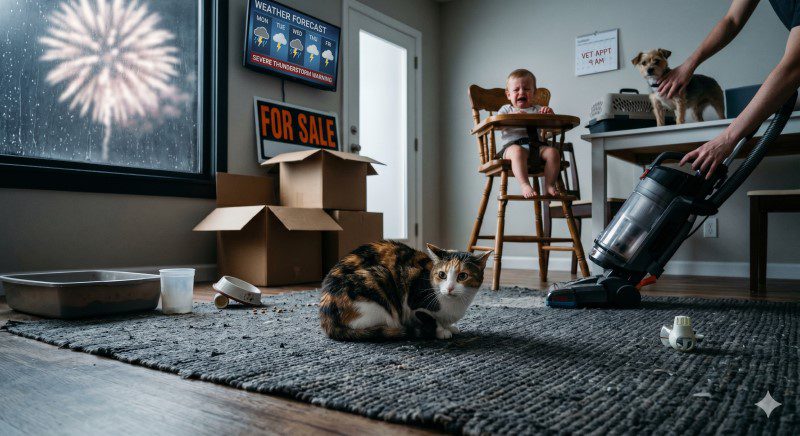
Why Cats Develop Separation Anxiety
Several factors increase a cat’s vulnerability to separation anxiety:
Early weaning or orphaning: Kittens separated from their mother before 8 weeks old frequently develop heightened attachment to human caregivers as a substitute attachment figure. These cats are significantly more likely to show separation-related distress in adulthood.
Single-cat indoor households: A cat who has no feline companion, no outdoor stimulation, and whose entire social world consists of one person experiences your departure as the complete removal of their social and enrichment environment.
Significant life changes: A previous owner’s death, a move, a major household change, or a period of illness that created intensive human contact can all trigger or intensify separation-related dependency.
Breed predisposition: Certain breeds — particularly Siamese, Burmese, and Ragdoll cats — show significantly higher rates of human-directed attachment and correspondingly higher rates of separation anxiety.
Signs of Cat Separation Anxiety
The challenge with cat separation anxiety is that most of the behavior happens while you are gone — which means you observe the before and after, but not the during.
Signs before you leave:
- Watching your departure preparations with visible distress
- Following you intensely around the home
- Increased vocalization or clingy behavior
- Refusing to eat before you leave
Signs that occur while you’re gone (detected via pet camera or neighbor reports):
- Excessive vocalization (crying, yowling)
- Destructive behavior — scratching, knocking things over
- Inappropriate elimination (outside the litter box)
- Refusal to eat or drink during your absence
Signs when you return:
- Frantic, unusually intense greeting
- Extended clingy behavior that does not resolve quickly
- Vomiting or diarrhea (stress response)
- Evidence of the behaviors above — spilled water, displaced objects, litter box miss
Signs persisting throughout:
- Over-grooming — particularly on the belly and inner thighs
- Weight loss from reduced appetite during your absences
- Excessive grooming of your belongings
Separation Anxiety vs. Boredom
Not every cat who misbehaves when alone has separation anxiety. The key distinction:
| Separation Anxiety | Boredom | |
|---|---|---|
| Trigger | Your departure specifically | Being alone without stimulation |
| Timing | Begins immediately at your departure | Develops after extended alone time |
| Behavior focus | Follows you before departure; intense greeting on return | Random destructive behavior; general restlessness |
| Eats when alone | Rarely or not at all | Usually yes |
| Improves with | Attachment security strategies | Environmental enrichment |
A pet camera is invaluable for making this distinction — watching the footage from the first 15–20 minutes after your departure tells you definitively which pattern you are dealing with.
How to Help a Cat With Separation Anxiety
1. Desensitize Departure Cues
Like dogs, cats with separation anxiety learn to dread the specific cues that predict your departure — picking up your keys, putting on shoes, getting your bag. These cues trigger the anxiety response before you have even left.
Desensitize by performing these actions repeatedly throughout the day without actually leaving. Pick up your keys, feed your cat, put them down. Put on your shoes, sit down, take them off. Over 2–3 weeks, the cues lose their predictive power.
2. Create a Calm, Enriching Alone-Time Environment
The goal is making your absence as positive and stimulating as possible:
Before you leave:
- Give a lick mat spread with wet food or tuna exclusively at departure — the licking response releases endorphins and creates a positive departure association. Give it only when you leave, never at other times. Its power is in its exclusivity.
- Puzzle feeders with their daily food allowance give cats something to do during the critical first hour.
Environment:
- Leave a window open to an interesting outdoor view — bird feeders placed outside windows provide hours of cat-safe “television.”
- Calming music or nature sounds (bird sounds are particularly engaging for cats) left on low volume.
- Pheromone diffuser (Feliway) running in the rooms your cat uses most.
3. Strategic Enrichment Timing
Physical play — 15–20 minutes of active wand toy play ending with a successful “catch” — is most effective when scheduled 30–60 minutes before your typical departure time. This depletes physical and predatory energy, and a cat in the satisfied, sleepy state that follows active play handles aloneness far better than an under-stimulated cat.
4. Gradual Independence Building
For cats with strong attachment dependency, systematic practice of brief separations during your time at home is valuable.
Close yourself in a room for 5 minutes. Gradually extend to 10, then 20, then an hour. Return calmly without excessive reunion greeting. This teaches the cat that separation is temporary and non-threatening — and that reunion happens regardless.
5. Consider a Feline Companion
For single-cat households where the owner’s lifestyle creates significant alone time, a second cat can provide social buffering. This is more appropriate for cat separation anxiety than dog separation anxiety because, unlike dogs, cat-to-cat social bonds can genuinely substitute for human companionship.
Important: the introduction must be done slowly and correctly. A poorly introduced second cat creates inter-cat conflict that worsens anxiety rather than relieving it.
When Getting a Second Cat Helps — And When It Makes Things Worse
The feline companion suggestion requires significantly more nuance than most guides provide.
When a second cat may help: Your cat shows general boredom-driven anxiety rather than specific owner-attachment anxiety. They have previously lived successfully with other cats. They are young (under 5 years). The introduction is done slowly and correctly over 4 to 8 weeks.
When a second cat will make things worse: Your cat’s anxiety is specifically attachment-based — they follow you, not the other cat. Your cat has a history of territorial aggression. The introduction is rushed (putting cats together immediately).
The failed introduction risk: A poorly introduced cat pair creates chronic inter-cat conflict — hissing, blocking, resource competition, and stress that is worse than the original single-cat anxiety. Always use a complete multi-phase introduction: separate rooms with scent swapping for one to two weeks before any visual contact, then supervised visual contact through a cracked door, then supervised shared space. Never allow unsupervised contact until both cats are showing relaxed body language in each other’s presence consistently.
Using Technology to Monitor and Support Your Anxious Cat
A pet camera is not just a guilt-reduction tool. Used correctly, it is a diagnostic and therapeutic instrument for cat separation anxiety management.
What to look for in a pet camera for anxious cats:
| Feature | Why It Matters for Anxiety | Recommended Spec |
|---|---|---|
| Two-way audio | Allows calm voice check-ins during settled moments (not during panic) | Essential |
| Night vision | Cats with anxiety often show distress in low light — monitor overnight | Essential |
| Motion alerts | Notifies you of activity so you watch footage strategically rather than continuously | Highly useful |
| Treat toss | Allows remote positive reinforcement during calm moments | Useful but not essential |
| Wide angle lens | Captures your cat’s full movement patterns rather than one spot | Recommended |
| Cloud storage | Allows you to review footage from departure time forward | Recommended |
The evidence-based monitoring protocol: Do not watch the live feed continuously — this increases your own anxiety without helping your cat. Instead: set the camera to motion alerts, review footage at 15-minute, 30-minute, and 60-minute marks after departure. Document when your cat first settles, whether they eat during your absence, and whether any specific events trigger distress. This data is invaluable for your veterinarian or behaviorist.
The check-in rule: Call in through the camera’s two-way audio only during a calm, settled moment — never during active distress. Calling in during panic confirms the distress and often prolongs the episode.
6. Daily Calming Supplement Routine
For cats with moderate separation anxiety, daily calming supplements given with the morning meal can meaningfully reduce baseline anxiety levels — making the alone time less distressing. Cat-appropriate formulations containing L-theanine and Zylkene (hydrolyzed milk protein) have the strongest feline evidence base.
The ASPCA notes that separation anxiety in cats may require a combination of behavioral modification and appropriate calming support, and recommends veterinary guidance for cats showing significant distress. Their full resource is at ASPCA.org.
7. Veterinary and Pharmaceutical Support for Severe Cases
For cats with severe separation anxiety — self-injury through over-grooming, complete refusal to eat during owner absences, or extreme vocalization — behavioral interventions alone may not be sufficient. Veterinary-prescribed medications including fluoxetine and buspirone have strong evidence for feline anxiety and are worth discussing with your vet.
Do cats actually get separation anxiety?
Yes — definitively. Veterinary behaviorists now recognize feline separation anxiety as a genuine disorder, and research confirms that a significant proportion of indoor cats show measurable distress behaviors during owner absence.
How do I know if my cat misses me when I’m gone?
Set up a pet camera and watch the footage from 10–15 minutes after you leave. A cat who misses you in an anxious way will vocalize, pace, or stop eating. A cat who is fine will typically settle to sleep within 15–20 minutes of your departure.
My cat cries when I leave. Is that separation anxiety?
Vocalization specifically at departure is a strong indicator of separation anxiety rather than general vocalization. If it begins at the moment you leave and stops when you return, this is almost certainly separation-related.
Can I cure cat separation anxiety?
Many cats show significant improvement with consistent behavioral management. Complete resolution depends on the severity of the anxiety and the consistency of the intervention. Mild-to-moderate cases often respond well within 4–8 weeks.
Should I get another cat to help my cat with separation anxiety?
Potentially — but only if the introduction is done slowly and correctly, and only after establishing that your current cat is sociable with other cats. A poorly introduced second cat can dramatically worsen anxiety.
Non-slip base · Machine washable · Free US shipping
About the Author
The PawCalmHub Team
At PawCalmHub, we are a passionate team of pet lovers dedicated to helping anxious pets live calmer, happier lives. Every article we publish is thoroughly researched against current veterinary behavioral guidelines, peer-reviewed studies, and trusted sources including the American Kennel Club and the Fear Free organization. References in this article link directly to the sources cited.
Questions? Email us at hello@pawcalmhub.com — we respond within 24 hours.
Explore our full range of grooming and wellness tools at PawCalmHub.com