
Written by The PawCalmHub Team. Reviewed for alignment with current veterinary behavioral guidelines and ASPCA resources. Last updated 2025.
Here is the truth about cat anxiety that most cat owners never hear:
By the time a cat’s anxiety is visible enough for the average owner to notice it, the cat has usually been communicating distress for weeks — sometimes months — through signals that were present all along but went unrecognized.
Cats are evolutionary masters at concealing vulnerability. In the wild, a visibly distressed animal is a vulnerable one — an invitation to predation. So domestic cats communicate anxiety in ways that are subtle, gradual, and easily misread as personality rather than distress.
This guide identifies the 12 most important anxiety signals in cats, explains what each one actually means physiologically, and tells you what to do when you recognize it.
Why Cat Anxiety Signals Are So Easy to Miss
Three factors make cat anxiety signals particularly difficult to read:
They are often the absence of behavior rather than the presence of it. A cat who is no longer asking for morning attention, no longer sitting in a favorite spot, or no longer greeting you at the door is communicating something important through subtraction rather than addition.
They develop gradually. Cat anxiety typically escalates slowly over time rather than appearing suddenly. This gradual onset makes each incremental change easy to normalize — until the cumulative change is obvious.
They overlap with personality variation. A “shy” cat, a “lazy” cat, a “picky” cat — many anxiety presentations are categorized as personality traits by well-meaning owners who have never seen the cat’s baseline behavior before the anxiety developed.
The 12 Signs of Cat Anxiety
1. Over-Grooming (Psychogenic Alopecia)
One of the most important and most missed signs. Anxious cats frequently groom compulsively as a self-soothing behavior — the rhythmic physical motion provides mild neurological relief from the stress response. The problem is that it often exceeds normal grooming into compulsive territory.
What to look for: bald patches or thinning fur — typically on the belly, inner thighs, base of the tail, or flanks. The skin may look irritated or sore. If you find these patches on your cat, the grooming that created them is almost certainly happening primarily when you are not watching — cats tend to groom compulsively in private.
What it means: the anxiety has been present and escalating for a significant time. This is not a mild or early sign.
What it is mistaken for: skin allergies, parasites, dietary sensitivity. Always rule out these medical causes first.
2. Litter Box Changes
Eliminating outside the litter box, using the litter box far more frequently than usual, or straining in the litter box are among the most common manifestations of feline anxiety — and among the most commonly misunderstood ones.
What it means: feline anxiety activates the same physiological stress response as in other mammals — including gastrointestinal effects. Anxiety can cause constipation, diarrhea, increased urgency, or the development of feline idiopathic cystitis (FIC) — a stress-induced inflammation of the bladder that is extraordinarily common in cats and strongly associated with anxiety.
What it is mistaken for: Behavioral “revenge” for perceived slights. This misconception causes enormous harm — cats do not eliminate inappropriately as punishment. They do it because their body is responding to stress.
What to do: Rule out urinary or digestive medical issues with a vet visit. If medical causes are excluded, address the underlying anxiety.
3. Hiding More Than Usual
All cats hide. But a cat who is hiding in a new location, hiding more frequently, or hiding for longer periods than previously is showing a clear behavior change that warrants attention.
What it means: hiding is a primary coping mechanism for an overwhelmed feline nervous system. Increased hiding indicates increased overwhelm.
What it is mistaken for: “She just likes small spaces.” This may be true for a cat who has always preferred enclosed spaces. It is not a satisfactory explanation for a cat who has recently started seeking them more intensely.
4. Reduced Appetite or Eating Habits Changes
Anxiety directly affects the gastrointestinal system through the gut-brain axis. An anxious cat may eat less, eat faster, eat only in specific locations, or stop eating in locations where they previously ate comfortably.
What to look for: gradual reduction in food interest, food left uneaten that was previously finished, preference for eating only in one “safe” location, eating faster than usual (which can indicate anxiety around food security).
5. Increased Vocalization
A cat who is vocalizing more — particularly at night, or in ways that seem disconnected from obvious triggers — is communicating distress.
What it means: nighttime vocalization in younger cats often signals separation anxiety or environmental distress. In senior cats, it is a key sign of feline cognitive dysfunction and warrants veterinary assessment.
What it is mistaken for: wanting attention, hunger, or “just being vocal.” Context and change from baseline are key — a cat who has always been vocal is different from a cat who has recently become vocal.
6. Aggression That Is Out of Character
A cat who has never previously scratched or bitten who begins doing so — particularly during handling, grooming, or social interaction — is almost always communicating that something is exceeding their tolerance threshold.
What it means: aggression is a last-resort communication for cats who feel their earlier signals were not respected. A cat who hisses, swats, or bites is a cat whose earlier avoidance signals went unheeded.
What it is mistaken for: “He’s just grumpy.” Aggression that represents a change from baseline behavior is always worth investigating.
7. Excessive Clinginess or Following
This signal is the opposite of hiding but equally significant. A cat who follows you from room to room with unusual intensity, who demands constant physical contact, or who becomes visibly distressed when you leave a room may be showing attachment-related anxiety.
What it means: dependency behaviors often increase in cats experiencing environmental uncertainty. Your presence is the one reliable constant in a world that feels unpredictable.
8. Startling Easily or Hypervigilance
A cat who startle-jumps at normal household sounds, who holds their body tense even during calm moments, or who constantly scans the environment is showing hypervigilance — a sustained state of threat assessment that prevents genuine relaxation.
What it means: the cat’s threat-detection system is set too sensitively — triggering responses to stimuli that would not register as threatening to a calm cat.
9. Changes in Posture and Body Language
Anxious cats hold their bodies differently from relaxed cats in ways that are distinctive once you know what to look for:
- Tail: tucked under the body, curled tightly, or lashing rapidly when the cat is not playing
- Ears: rotated sideways or flattened against the skull
- Body: compressed — smaller than normal, weight shifted backward
- Eyes: widely dilated even in normal lighting
- Whiskers: pulled back flat against the face
A cat holding their body in these positions during ordinary household activities is a cat experiencing significant stress.
10. Inappropriate Scratching
Scratching is a normal cat behavior. Scratching that suddenly increases, moves to new locations (particularly near doors and windows), or appears frantic rather than routine can indicate anxiety.
What it means: scratching deposits scent marks. An anxious cat may increase scent marking as a way of reasserting territorial ownership in response to perceived threats — a neighbor’s cat visible through the window, new smells in the home, or introduction of a new person or animal.
11. Spraying or Urine Marking
Different from normal litter box use — spraying is a standing posture, vertical surface, small volume of urine. It is a territorial scent marking behavior that increases dramatically under anxiety conditions.
What it means: territorial insecurity. Common triggers include the presence of an outdoor cat, multi-cat household tension, or any perceived threat to territorial ownership.
12. Changes in Sleep Patterns
Cats sleep a lot — but anxious cats sleep in different ways than calm cats. An anxious cat may sleep more (avoidance), sleep less (hypervigilance), change their sleep locations to less exposed positions, or sleep in a tense, un-relaxed posture.
What to look for: a cat who previously slept on the sofa but now only sleeps in enclosed spaces, or a cat who appears to sleep but startles at every sound.
The Anxiety Assessment Checklist
Use this to assess your cat’s current status:
☐ Over-grooming or bald patches ☐ Litter box changes ☐ More hiding than usual ☐ Reduced or changed appetite ☐ Increased vocalization ☐ New aggression ☐ Excessive clinginess ☐ Easy startling or hypervigilance ☐ Compressed, tense body posture ☐ Increased scratching in new locations ☐ Spraying or urine marking ☐ Changed sleep location or quality
1–2 signs: Monitor closely. May be temporary adjustment to a specific change. 3–4 signs: Likely anxiety response. Begin environmental and behavioral support. 5+ signs: Significant anxiety. Veterinary assessment recommended alongside behavioral intervention.
What to Do Next — Action Guide by Sign Type
Not all anxiety signs require the same response. Here is what each category of sign indicates and what action is most appropriate:
If your primary signs are LITTER BOX CHANGES: First action: veterinary visit to rule out urinary tract infection, FIC (Feline Idiopathic Cystitis), or other medical cause. Litter box changes are medical until proven otherwise. If medical causes are excluded: environmental anxiety intervention — identify and address the specific trigger (new pet, schedule change, territorial intrusion). Product support: Feliway Classic diffuser in the room with the litter box. Ensure n+1 litter boxes (one more than the number of cats).
If your primary signs are OVER-GROOMING: First action: veterinary dermatology assessment to rule out allergies, parasites, or skin conditions. If medical causes are excluded: daily calming supplement routine + pheromone therapy + enrichment schedule. Product support: Lick mat to redirect oral behavior constructively. Daily L-theanine supplement to reduce baseline anxiety driving the compulsion.
If your primary signs are HIDING AND WITHDRAWAL: First action: identify any recent household changes — new person, new pet, rearranged furniture, new scent, schedule change. Intervention: respect the retreat, do not retrieve them, create guaranteed safe space. Introduce Feliway Classic. Product support: Feliway Classic diffuser. Do not approach — let your cat initiate contact on their own terms.
If your primary signs are INCREASED AGGRESSION: First action: veterinary assessment to rule out pain as the underlying cause (pain is a primary aggression driver in cats). If medical causes excluded: behavioral consultation with a veterinary behaviorist. Do not attempt to manage aggression through punishment — this worsens it. Product support: Feliway Multicat if inter-cat aggression. Zylkene supplement for general anxiety-driven aggression.
If your primary signs are VOCALIZATION: In younger cats: separation anxiety or environmental anxiety — address with the cat separation anxiety protocol. In senior cats: immediate veterinary assessment for feline cognitive dysfunction, hyperthyroidism, or pain. Nighttime vocalization in a senior cat is a medical sign until proven otherwise.
If you recognize multiple signs in your cat, read our complete guide to how to calm an anxious cat — which covers the full intervention protocol. If anxiety is significant, start with a veterinary visit to rule out medical causes — particularly urinary issues (FIC is extremely common in anxious cats) and pain.
For immediate support, the ASPCA’s resources on cat anxiety are at ASPCA.org.
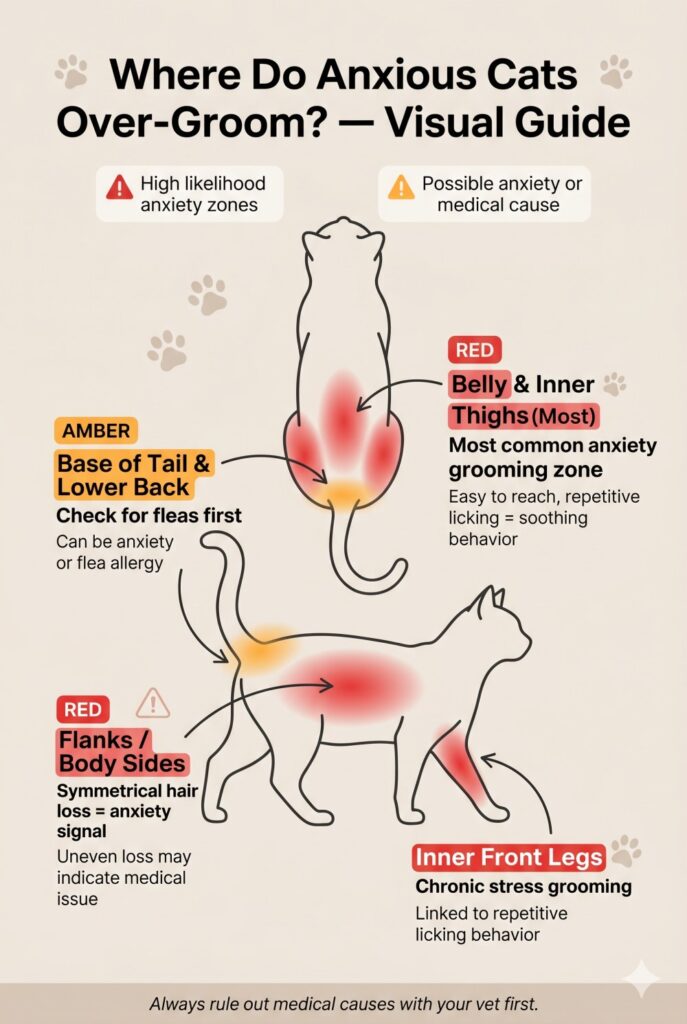
Where Over-Grooming Appears — A Visual Guide
Over-grooming driven by anxiety most commonly appears in specific body locations. Understanding the pattern helps distinguish anxiety-driven grooming from medical skin conditions:
Belly and inner thighs: The most common location for psychogenic alopecia. Your cat can reach these areas easily and the repetitive licking provides maximum sensory soothing. Bald patches here in the absence of skin disease strongly suggest anxiety.
Base of tail and lower back: Secondary common location. Often associated with flea allergy (medical) — rule this out first with your vet.
Flanks (sides of the body): Symmetrical hair loss on both flanks simultaneously is a classic pattern of anxiety-driven grooming. Asymmetrical loss suggests medical cause.
Inner front legs: Associated with chronic stress and highly repetitive licking behavior.
How do I know if my cat is stressed or just tired?
A tired cat looks relaxed — loose muscles, soft eyes, easy breathing. A stressed cat who is “resting” often holds tension in their body — tightly tucked limbs, slightly flattened ears, slightly dilated pupils. Over time, pattern recognition makes this distinction clear.
Can cats hide their anxiety so well that even vets miss it?
Yes — this is well-documented. Cats in clinic environments often suppress visible stress signals due to the high-threat assessment of the veterinary environment. This is why detailed owner reporting of behavior changes at home is so critical — the cat you see in the exam room is frequently not showing their baseline home behavior.
Is over-grooming always anxiety?
No — over-grooming (psychogenic alopecia) can also result from allergies, parasites, skin conditions, or pain. A veterinary assessment to rule out physical causes should always precede an anxiety diagnosis.
What is the single most important thing I can do for an anxious cat today?
Create a guaranteed safe space — elevated, enclosed, undisturbed by anyone else — and commit to never violating it. This single change provides an immediate foundation of territorial security.
The most effective tool for this is a Cat Lick Mat. View Product →
About the Author
The PawCalmHub Team
At PawCalmHub, we are a passionate team of pet lovers dedicated to helping anxious pets live calmer, happier lives. Every article we publish is thoroughly researched against current veterinary behavioral guidelines, peer-reviewed studies, and trusted sources including the American Kennel Club and the Fear Free organization. References in this article link directly to the sources cited.
Questions? Email us at hello@pawcalmhub.com — we respond within 24 hours.
Explore our full range of grooming and wellness tools at PawCalmHub.com