
Estimated read time: 17 minutes | Last updated: 2025
A note on this guide: This article draws on current veterinary behavioural science, applied animal behaviour research, and evidence-based canine social dynamics literature. It explicitly rejects dominance theory as a framework for understanding multi-dog household anxiety — for reasons this guide explains in detail. If your dog’s anxiety has produced injury to a person or another animal, please seek veterinary behaviourist assessment before implementing any protocol.
Search “multi-dog household anxiety” and you will find, again and again, some version of the same advice:
“Make sure you establish yourself as the pack leader.”
“The dominant dog needs to know their place.”
“Feed the alpha dog first.”
This advice is not just unhelpful. It is actively harmful — because it is based on a theory of canine social behaviour that the scientific community has thoroughly and repeatedly disproved, and applying it to a household where one or more dogs is anxious will make the anxiety measurably worse.
This guide does something different. It applies what the science of canine social behaviour actually shows about how dogs relate to each other, what produces stress in multi-dog households, and what evidence-based management looks like when the goal is reducing anxiety rather than asserting hierarchy.
Let us start by dismantling the theory that has caused so much unnecessary suffering.
Dominance Theory Is Wrong — Here Is the Science
Where the theory came from
Dominance theory — the idea that dogs are pack animals who organise themselves into strict linear hierarchies, with an “alpha” at the top asserting control through force and submission displays — originated in wolf research conducted in the 1940s and 1950s, most notably by Rudolf Schenkel. Schenkel’s observations of captive wolves in enclosures produced data on aggressive competition for resources among unrelated wolves forced to live together — and that data was extrapolated, first to wolf social behaviour in general and then to domestic dog behaviour specifically.
The problem — and it is a significant one — is that captive, unrelated wolves forced together in an enclosure do not represent how wolves actually behave in the wild. Groundbreaking research by Dr. L. David Mech — who himself was among the early proponents of dominance theory and later became its most prominent scientific critic — showed through decades of field observation of wild wolf packs that wild wolves do not operate through dominance hierarchies enforced by aggression. Wild wolf packs are family units. They are organised around cooperative parenting, not competitive dominance. The “alpha” wolf is simply the breeding parent. There is no forcible assertion of status. There is no submission ritual. There is a family.
Why this matters for dogs
Research published in Applied Animal Behaviour Science — the leading peer-reviewed journal in this field — has consistently failed to find evidence that domestic dogs organise themselves into stable linear dominance hierarchies within household groups. Dogs do show context-specific deference and priority access to resources — but this is fluid, situation-dependent, and not organised around a fixed hierarchical structure that can be “established” by owner behaviour.
The American Veterinary Society of Animal Behavior (AVSAB) — the professional body representing veterinary behaviour specialists in the United States — issued a formal position statement explicitly rejecting dominance theory as a framework for understanding and managing dog behaviour. The statement notes that dominance-based training techniques elevate stress hormones, increase the risk of fear-based aggression, damage the human-animal bond, and fail to address the underlying causes of behavioural problems.
The specific harm in multi-dog households
In the context of multi-dog household anxiety, dominance theory causes owners to misread stress signals as status challenges and respond to them with techniques that increase rather than decrease cortisol levels. A dog who resource-guards food is not asserting dominance — they are exhibiting anxiety-driven insecurity about resource availability. Responding with punitive “correction” elevates their cortisol, increases their resource insecurity, and makes the guarding behaviour more intense and more likely to escalate to aggression.
A dog who occupies doorways and controls spatial access is not being an “alpha” — they are engaging in what behaviourists call passive resource control, driven by social anxiety about territorial security. Responding by physically relocating the dog or using aversive techniques to “put them in their place” triggers a defensive response from an already anxious animal and worsens the household tension.
The correct framework: Modern veterinary behavioural science understands multi-dog household dynamics through the lens of resource availability, social compatibility, learning history, and individual anxiety thresholds — not dominance hierarchy. Every management recommendation in this guide is built on that framework.
How Dogs Actually Relate to Each Other — The Science of Canine Social Behaviour
With dominance theory set aside, what does the science say about how dogs actually organise their social relationships?
Research by Dr. Nicola Rooney and Dr. John Bradshaw at the University of Bristol’s Anthrozoology Institute found that interactions between dogs in household groups are characterised by dyadic relationships — each pair of dogs has their own specific relational dynamic that is not necessarily consistent with their relationships with other dogs in the household. Dog A may defer to Dog B in the kitchen but not in the garden. Dog B may have priority access to the sofa but not to the owner’s attention. These context-specific patterns are not hierarchy — they are negotiated, situational, and fluid.
The critical implication: there is no single “dominant dog” to manage in a multi-dog household. There are individual dogs with individual anxiety thresholds, specific triggers, and specific resource sensitivities — each of which requires individual management rather than a blanket hierarchical approach.
Emotional contagion research published in Animal Cognition documents that dogs synchronise physiological stress responses with other dogs they are bonded to — cortisol levels in bonded dog pairs rise and fall in parallel. This creates the anxiety feedback loop that is the defining challenge of multi-dog household management: Dog A gets anxious, releases stress pheromones, elevates their arousal, and Dog B reads all of this and escalates in response. Without understanding this mechanism, owners find themselves managing two crises without understanding that they are causally connected.
The 6 Types of Inter-Dog Anxiety Dynamics
1. Mirror Anxiety — The Feedback Loop
Dog A responds to an external trigger — a storm, a visitor, a noise — with a full anxiety response. Dog B, with no independent reaction to the trigger, reads Dog A’s stress signals (pheromones, vocalisation, body language, cortisol in the shared environment) and produces an anxiety response of their own. Their combined arousal then amplifies Dog A’s response further, creating a feedback loop that is worse than either dog’s individual anxiety would be.
Mirror anxiety is the most common form of multi-dog household anxiety and the most mismanaged — because owners focus on managing the trigger rather than managing the feedback loop. Strategic separation during trigger events — keeping the dogs in different rooms before the trigger arrives — breaks the loop at the source.
2. Resource Competition Anxiety — The Silent Stressor
Dogs experience low-grade tension around any resource they perceive as limited: food, water, sleeping spots, owner attention, and spatial territory including access to exits. This tension does not require overt conflict. The mere presence of another dog within a distance the dog associates with resource competition is sufficient to activate a stress response in the more resource-anxious individual.
Resource competition anxiety is the most common form of chronic, low-grade multi-dog household stress — and the most likely to be missed by owners because it produces no dramatic behaviour to observe. Its signs are subtle: one dog eating faster than normal, one dog sleeping in a less preferred location, one dog consistently leaving a room when another dog enters.
3. Hierarchy Instability Anxiety — The Transition Crisis
Multi-dog social dynamics are most stable when the dogs’ relational patterns are established and consistent. Instability occurs at three predictable moments: when a new dog is introduced, when one dog reaches social maturity (typically 18–36 months), and when one dog’s physical or cognitive capacity changes due to age or illness. During these transitions, previously stable relational patterns are renegotiated — a process that produces elevated stress in both dogs for weeks to months.
Understanding that instability is a predictable phase — not a permanent failure — allows owners to manage it with patience rather than attempting to “fix” it through interventions that may extend rather than shorten the transition period.
4. Protective Anxiety — The Guardian’s Burden
In bonded dog pairs, one dog frequently monitors for threats on behalf of the other — maintaining a vigilance that is neurologically exhausting and cortisol-elevating even when no actual threat materialises. The protective dog is not the dominant dog. They are the more anxious dog whose anxiety has found an outlet in hyper-vigilant caregiving of their companion.
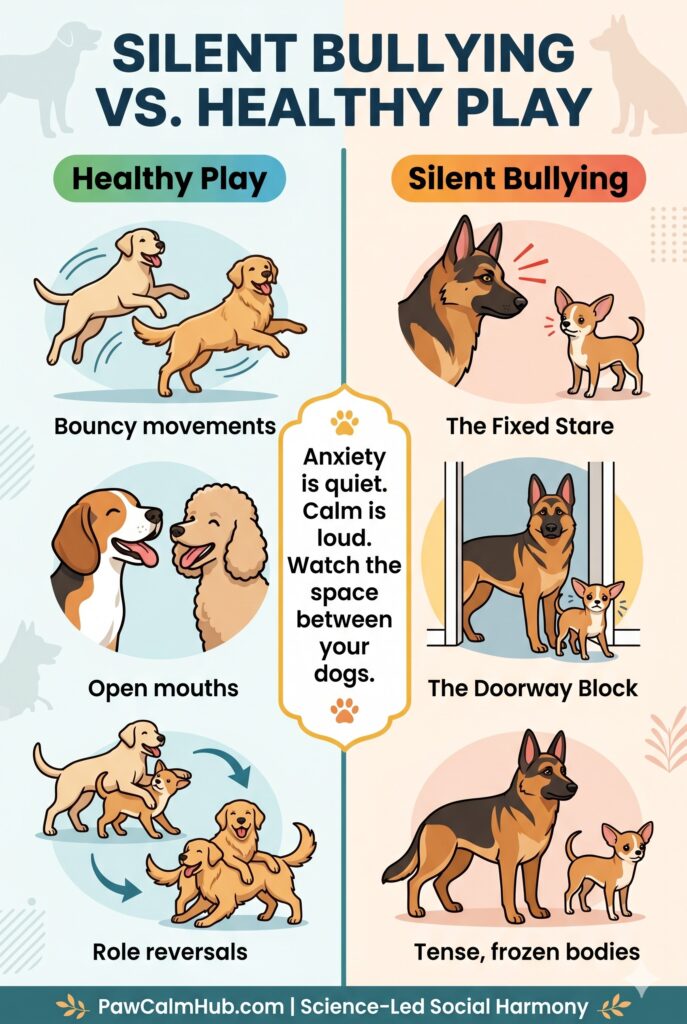
5. One-Directional Passive Control — The Invisible Bully
A socially confident dog controls resource access through body language and spatial positioning — sitting in doorways, occupying prime resting spots, approaching the other dog’s food bowl. There is no overt aggression. The subordinate dog simply cannot move freely through the home and cannot access resources without navigating around the controlling dog’s physical presence. The controlling dog is exercising what behaviourists call passive bullying — and the subordinate dog is experiencing chronic defeat stress that accumulates over months into a clinically significant anxiety disorder.
6. Absence-Triggered Anxiety — The Returning Stranger
When one dog in a bonded pair leaves for a vet visit, a grooming appointment, or an overnight stay, their return produces a crisis that surprises most owners. The returning dog smells of clinic chemicals, anaesthetic agents, stress pheromones from other animals, and unfamiliar handling — and is no longer olfactorily recognisable as the companion they left with. The resident dog’s initial response is frequently aggression toward an animal that smells like a stranger.
The management protocol: separate dogs for 24 hours after one returns from any outside environment. Allow scent familiarity to be re-established through bedding swaps before visual contact resumes. Most cases of post-visit inter-dog aggression resolve within 24–48 hours with this approach.
The Social Mapping Exercise — Understanding Your Household’s Dynamics
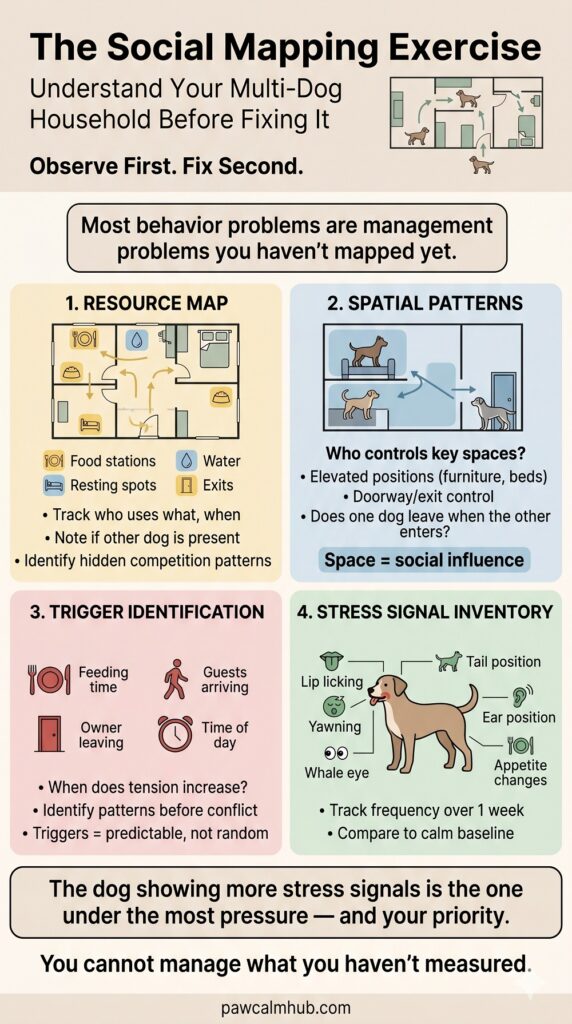
Before implementing any management strategy, spend one week observing and documenting the following. This exercise produces the accurate picture that effective management requires.
Resource Map: Draw a rough floor plan. Mark the location of all food stations, water stations, resting spots, and exits. For each resource, note which dog uses it, at what time, and whether the other dog is present. This exercise frequently reveals resource competition patterns that owners had not consciously noticed.
Spatial Patterns: Which dog occupies which areas at which times? Is one dog consistently in higher positions (furniture, elevated spots)? Is one dog consistently near exits? Does one dog’s presence in a room consistently cause the other to leave?
Trigger Identification: What are the conditions under which inter-dog tension escalates? Feed time, arrival of guests, owner departure, specific locations, specific times of day? Identifying the trigger conditions is the prerequisite for strategic management.
Stress Signal Inventory: For each dog: frequency of lip-licking, yawning, whale eye, tail position, ear position, and appetite over the observation week. Compare to their baseline in lower-tension contexts. The dog showing more stress signals is carrying the greater anxiety burden — and is the primary management priority.
Debunking the 5 Most Harmful Multi-Dog Household Myths
Myth 1: “You need to feed the dominant dog first.”
This advice comes directly from dominance theory and is contradicted by the evidence. Feeding dogs in sequence based on a supposed hierarchy increases resource competition anxiety in both dogs — the “dominant” dog because feeding first reinforces their resource vigilance, and the “subordinate” dog because waiting to be fed in the presence of a dog who has been fed produces sustained cortisol elevation. Feed dogs simultaneously in separate locations. This is what the resource competition evidence supports.
Myth 2: “You shouldn’t comfort a submissive dog — it undermines the hierarchy.”
There is no hierarchy to undermine. There is an anxious dog who needs appropriate management. Withholding comfort from an anxious animal on the basis of dominance theory causes unnecessary suffering and does nothing to address the social dynamics that are producing the anxiety. Comfort the anxious dog. Simultaneously, address the resource and environmental conditions that are producing the anxiety.
Myth 3: “The dogs will sort it out themselves.”
In mild cases of social adjustment between compatible dogs, some self-regulation does occur. In cases involving resource competition anxiety, passive bullying, or one-directional control, waiting for self-resolution typically produces months of unnecessary chronic stress in the subordinate dog — with the associated health consequences of sustained cortisol elevation. Management is not interference in a natural process. It is welfare obligation.
Myth 4: “Separating them will make things worse.”
Strategic separation during trigger events — keeping dogs apart before a known stressor arrives — reduces the contagious anxiety feedback loop, gives each dog a space to regulate their own nervous system, and prevents the escalation that shared arousal produces. Separation does not make inter-dog relationships worse. Chronic shared over-arousal does.
Myth 5: “If they were really bonded, they wouldn’t fight.”
Bonded dogs fight. Bonded dogs produce anxiety in each other. Bonded dogs resource-guard from each other. Bonding describes attachment, not the absence of conflict or anxiety. Some of the most anxious multi-dog household dynamics occur between dogs who are genuinely bonded — because the intensity of the attachment amplifies the stakes of every resource competition.
Evidence-Based Management: What Actually Works
Parallel Decompression Sessions
The single most effective immediate intervention for multi-dog household tension is parallel decompression — giving each dog their own calming session simultaneously, in separate spaces, at the same time each day.
Each dog gets their own snuffle mat for anxious dogs with food distributed through it, in their own anchor zone, for 15–20 minutes. This achieves three things simultaneously: it reduces individual arousal through nose work, it eliminates the resource competition that sharing a space produces, and it builds each dog’s independent positive association with their own space — reducing the territorial anxiety that underlies much inter-dog conflict.
Parallel decompression should happen at the same time every day — the timing itself becomes a predictability signal that begins lowering arousal in advance.
Separate Feeding — Always
Feed every dog simultaneously in separate locations — separate rooms if possible, separate corners of the same room at minimum. Use the dog puzzle feeder for anxious dogs to extend mealtimes, which prevents the dog who finishes first from approaching the dog who is still eating — the most common trigger for food-related inter-dog conflict.
For households where one dog actively guards the other’s food bowl, the microchip feeder solution described in the multi-cat article applies equally: a microchip-activated feeder that opens only for the correct dog eliminates food guarding at the hardware level, removing the learned reinforcement that makes the behaviour worse over time.
Strategic Separation During Trigger Events
Identify the triggers that produce the highest inter-dog tension — typically: owner departure, owner arrival, feeding, the arrival of visitors, thunderstorms, and the period immediately after high-arousal exercise. During these events, separate the dogs proactively — before tension escalates — into their respective anchor zones.
Separation during trigger events is not punishment. It is welfare management. Each dog is given their own lick mat for dog anxiety to self-soothe during the separation, and reunited only when both have returned to a calm baseline.
Read more: How to Calm a Dog During Thunderstorms and How to Help a Dog With Fireworks Anxiety
Individual Calming Support for the Primary Anxious Dog
Identify which dog is carrying the greater anxiety burden — using the stress signal inventory from the social mapping exercise. That dog receives the primary calming intervention: hemp calming chews on high-tension days, an anxiety vest before known trigger events, and a dedicated safe room setup.
Shop: Hemp Calming Chews for Dogs and Dog Anxiety Vest
Do not supplement the less anxious dog unless they are also showing significant anxiety symptoms. Unnecessary supplementation is not helpful and obscures accurate assessment of which interventions are producing behavioural change.
Increasing Vertical and Spatial Territory
Add vertical space to the shared areas of the home — cat trees accessible to dogs, wall-mounted elevated platforms, cleared windowsills with comfortable bedding. Vertical displacement allows dogs to negotiate social tension without ground-level conflict: the more confident dog can move to a higher position, the less confident dog maintains ground-level access, and the tension resolves through spatial adjustment rather than conflict.
Remote Monitoring
Most multi-dog household conflict peaks during owner absence — when the social moderating effect of the owner’s presence is removed. A video camera with pet feeder positioned to monitor shared areas gives you accurate data on what is actually happening during your absence — data that is almost always different from what owners assume. The two-way audio allows de-escalation intervention during early-stage tension without physical return.
The New Dog Introduction Protocol — Getting It Right From Day One
Most multi-dog household dysfunction can be traced to a rushed or unmanaged introduction. The following protocol — recommended by the American Veterinary Society of Animal Behavior — prevents the formation of negative associations that can take months to repair.
Before the new dog arrives: Remove all high-value resources from shared areas. Pick up food bowls, valuable toys, and favourite resting spots that could become triggers. This is temporary — resources are reintroduced gradually once compatibility is established.
First meeting — neutral territory: Introduce the dogs on a walk in a neutral location — a park or quiet street neither dog associates with as their territory. Research on dog-dog introductions consistently shows that neutral-territory first meetings produce lower initial aggression and faster positive association than home-territory introductions.
Parallel walking: Walk the dogs side by side at a distance where both are aware of each other but neither is reacting. Gradually decrease the distance over 15–20 minutes as both remain calm. Feed treats throughout. The goal is to pair the new dog’s presence with continuous positive reinforcement before any direct interaction occurs.
Home introduction: Bring the resident dog into the home first, settle them. Bring the new dog in through a different entrance if possible. Allow investigation through a baby gate before removing the barrier.
First weeks: Separate for all meals, all high-value chew sessions, and all owner departure events. Supervise all shared time. Allow voluntary positive interaction — do not force proximity or play.
Integration timeline: Full, unsupervised integration is typically safe after 4–8 weeks for compatible dogs — and should be delayed indefinitely if either dog is showing sustained stress signals in the other’s presence.
Can a second dog help my first dog’s separation anxiety?
Usually, no. If the anxiety is “owner-focused,” a second dog doesn’t replace you. In many cases, the second dog actually develops “Mirror Anxiety” and you end up with two panicked dogs.
Why do my dogs fight only when I come home?
This is “High-Arousal Conflict.” The excitement of your arrival spikes their cortisol, and because they are in a tight space (the entryway), that energy turns into reactive anxiety.
Should I feed my dogs in the same room if one is anxious?
No. “Resource Anxiety” is very common. Feeding in separate rooms or behind a baby gate allows the anxious dog to lower their guard and digest food properly, which supports the Gut-Brain Axis.
Can one dog “catch” anxiety from another?
Yes. Science calls this “emotional contagion.” Dogs synchronise stress hormone levels; when one dog panics, the other’s cortisol levels often spike in response
My vet suggested I establish myself as the pack leader to fix my dogs’ fighting. Is this right?
This advice, while well-intentioned, is not consistent with current veterinary behavioural science. The American Veterinary Society of Animal Behavior and the majority of certified veterinary behaviourists have moved away from dominance theory as a framework for understanding canine behaviour — because the research does not support it and because dominance-based techniques increase stress hormones and aggression risk. If your dogs are fighting to the point of injury, ask your vet for a referral to a certified veterinary behaviourist (DACVB) who practises using evidence-based, force-free methods. The behavioural management described in this guide is consistent with current AVSAB guidance.
One of my dogs is clearly more confident than the other. Isn’t that dominance?
Social confidence is not dominance in the clinical sense. Dogs vary in confidence, assertiveness, and resource motivation the same way humans vary in personality — and those differences produce different relational dynamics in shared households. What matters for anxiety management is not which dog is more confident, but whether the less confident dog can access all necessary resources without sustained stress, and whether the more confident dog’s behaviour is producing chronic cortisol elevation in the other. Confident dogs are not a problem. Confident dogs whose behaviour creates chronic stress in a housemate are a welfare issue that requires management — not hierarchy enforcement.
My two dogs play and sleep together but still have occasional fights. Is this normal?
Yes — with one caveat. Occasional conflict between dogs who are generally compatible is a normal feature of canine social life, just as occasional disagreements are normal between compatible humans. The questions to ask are: Are the fights increasing in frequency? Are they increasing in intensity? Is one dog showing chronic stress signals between fights? If the answer to any of these is yes, the conflicts are not normal social negotiation — they are escalating anxiety that requires active management.
Should I rehome one of my dogs if they don’t get along?
This question deserves the honest answer it rarely receives. If, after 6–12 months of consistent, evidence-based management — resource abundance, zone separation, professional behaviourist input, and veterinary assessment for pain and medical causes — one dog is still experiencing severe chronic stress (self-harm, complete appetite suppression, redirected aggression causing injury), rehoming to a single-dog household may be the kindest available outcome for that dog. The welfare of both dogs matters. Living in chronic psychological distress is not acceptable simply because the alternative is difficult.
Is it ever OK to have dogs of very different sizes in the same household?
Size difference itself is not a predictor of incompatibility. Some of the most harmonious multi-dog households involve dramatic size differences; some of the most conflict-ridden involve dogs of similar size and breed. Compatibility is determined by individual temperament, arousal level, play style, and resource sensitivity — not size. Size difference does, however, require specific management attention around play (the larger dog may not be aware of the physical impact of rough play on a significantly smaller dog) and around resource access (a small dog who cannot physically access elevated resources is at a spatial disadvantage that should be addressed through management).
My dogs were fine together for two years and have suddenly started fighting. Why?
Sudden onset of conflict between previously compatible dogs is almost always medically driven. The most common cause is pain or illness in one dog — an animal in pain becomes threat-sensitive, responds aggressively to previously tolerated contact, and may redirect their discomfort onto the nearest available target. Arthritis, dental disease, ear infections, and internal conditions can all produce this pattern. A full veterinary examination of both dogs — with specific attention to pain assessment — should be the immediate first step, before any behavioural management is attempted.