
Estimated read time: 18 minutes | Last updated: 2025
A note on this guide: This article draws on principles of canine sensory science, applied animal behaviour, and veterinary environmental medicine to help owners create a genuinely effective anxiety management space for their dog. The recommendations here complement — not replace — veterinary assessment for dogs with moderate to severe anxiety disorders.
There is a sentence that appears in almost every piece of advice ever written about anxious dogs.
“Give your dog a safe space.”
It is good advice. It is also almost completely useless as written — because it tells you what to do without telling you anything about how to do it well. The result is that millions of well-intentioned dog owners have pushed a dog bed into the corner of the laundry room, pointed at it, and wondered why their Border Collie is still shaking through every thunderstorm.
A safe space is not a bed in a corner. A properly constructed dog safe room is a sensory-engineered environment — one designed around the specific neurological needs of an anxious canine nervous system, drawing on what we know about olfactory processing, thermoregulation, sound physics, and the evolutionary psychology of denning behaviour.
The difference between a dog bed in a corner and a properly built safe room is the difference between telling an anxious human to “just relax” and giving them a quiet room, a weighted blanket, familiar music, dim lighting, and a warm drink. The instruction is the same. The outcome is not.
This guide builds the room properly.
The Science Behind the Dog Safe Room — Den Theory and Sensory Neuroscience
To understand why a safe room works — and why most improvised versions don’t — you need to understand two things: what dens meant to the ancestral dog, and how the canine sensory system processes environmental stimuli.
The Evolutionary Case for the Den
Research in canine evolutionary biology documents that the domestic dog’s ancestor — Canis lupus, the grey wolf — is an obligate denning animal. Dens serve a specific function in the wild: they are spaces of reduced sensory input, controlled access, predictable temperature, and absolute safety. The evolutionary pressure that produced the denning instinct was not comfort-seeking — it was survival. A wolf in a den cannot be ambushed. They can monitor the single entrance. They can regulate their body temperature in a stable microclimate. They can rest without maintaining threat surveillance.
That neurological architecture persists in domestic dogs. When a dog presses into a corner, crawls under a bed, or seeks out a small, enclosed space during a storm, they are not being dramatic. They are running an ancestral programme that tells them: small, enclosed, low-stimulus = safe. The safe room is a designed response to that programme.
The Sensory Processing Argument
Dogs experience the world through a sensory hierarchy that is almost the inverse of humans. Where humans are primarily visual animals, dogs are primarily olfactory — their sense of smell is estimated to be 10,000 to 100,000 times more sensitive than a human’s, and the olfactory bulb constitutes a proportionally far larger area of the canine brain than the human brain.
This means that smell is not just one sense among many for a dog. It is the dominant mode through which they assess safety and threat. A room that smells of the owner — carries familiar olfactory markers — is neurologically categorised as safer than a room that doesn’t, regardless of any other variable. A room with unfamiliar chemical smells (cleaning products, fresh paint) raises the threat assessment even in an otherwise quiet, comfortable space.
Sound is the second critical sensory dimension. Dogs hear at a frequency range of approximately 40Hz to 65,000Hz — compared to a human range of 20Hz to 20,000Hz. This means dogs hear sounds that humans cannot detect at all, and experience the sounds that humans do hear at significantly higher perceived intensity. The low-frequency rumble of thunder — around 50–100Hz — is perceived by dogs not just as sound but as physical pressure, felt through the body as well as heard through the ears. Sound management in the safe room is not about creating silence — it is about replacing unpredictable, high-arousal sounds with predictable, low-arousal ones.
Choosing the Right Room — 5 Non-Negotiable Criteria
Before any product is purchased or any element is set up, the room itself must be right. Most homes have one room that is significantly better suited than others — and identifying it correctly saves both money and effort.
Criterion 1: Low Human Traffic
The safe room should not be a thoroughfare. Hallways, living rooms, and kitchens — spaces where the household’s activity levels are highest and least predictable — are poor choices regardless of their size or comfort. Interior bedrooms, studies, or dedicated utility rooms with a door that can remain closed during high-anxiety events are ideal.
Criterion 2: No Exterior-Facing Windows — or Manageable Ones
Exterior windows create two anxiety problems simultaneously: they admit the visual stimuli of the outside world (movement, strangers, other animals) that maintain the threat-monitoring response, and they provide the least acoustic insulation in the room against external noise. A room without exterior windows is the ideal. Where this isn’t possible, blackout curtains — dense enough to block both light and some sound — are the necessary modification.
Criterion 3: Sound Dampening
Hard floors and bare walls reflect sound, amplifying it within the room. Soft furnishings — carpet, rugs, upholstered furniture, acoustic panels — absorb and diffuse sound, reducing the peak decibel level of intrusive noise. A room with carpet and soft furnishings provides measurably better acoustic protection than a tiled or hardwood-floored space. If the room has hard floors, a thick rug — sized to cover the majority of the floor area — provides meaningful acoustic improvement.
Criterion 4: Temperature Stability
Rooms with exterior walls, large windows, or proximity to heating vents experience greater temperature fluctuation than interior rooms. Temperature fluctuation matters because thermoregulation directly affects the autonomic nervous system — cold activates the sympathetic (stress) system, warmth activates the parasympathetic (calm) system. Research in veterinary physiology confirms that thermal comfort is a significant variable in canine stress response. A room that stays within 65–72°F (18–22°C) without owner management is a better safe room candidate than one that requires active temperature control.
Criterion 5: Accessible but Never Mandatory
This is the criterion most owners miss — and it is the most psychologically important. The safe room must be a space the dog can choose to enter, and choose to leave, at all times except during specific high-danger events (fireworks, for example, where safety concerns override choice). A room that is only available to the dog during anxiety events — and is otherwise closed off — fails to build the positive associations that make it neurologically effective. The dog needs daily, voluntary, positive experience in this space so that it carries established safety associations before it is needed under stress.
The 9-Element Perfect Dog Safe Room — Built Right
Element 1: The Anxiety Bed — Thermal Comfort as Neurological Medicine
The bed is the literal and figurative centrepiece of the safe room, and the most important single purchase decision. Three properties determine whether a bed calms an anxious dog or fails to:
Warmth: A self-warming bed — using a heat-reflective inner layer to return the dog’s own body heat — provides passive thermoregulation without electricity, overheating risk, or ongoing cost. The physiological mechanism is well-established: warmth activates the parasympathetic nervous system through thermoreceptor pathways in the skin, producing a measurable reduction in heart rate and cortisol. This is not comfort for its own sake. It is neurological medicine delivered passively, 24 hours a day.
Containment: Raised, bolster-style edges — rather than a flat mat — provide gentle proprioceptive input that mimics the enclosed feeling of a den. The dog can rest their chin on the edge, can feel the rim against their back, and is physically contained in a way that the open flat surface of a standard dog mat does not achieve.
Scent retention: The bed must be washable without losing its scent profile — which means washing on a low temperature cycle and air drying, never tumble drying at high heat, which destroys the olfactory markers the dog relies on for safety association.
Element 2: The Anxiety Vest — For Event-Specific Calming
The anxiety vest lives in the safe room permanently. On normal days, it is simply part of the room’s furniture — familiar, non-threatening, associated with the positive experiences the dog has in this space. On high-anxiety event days, it is fitted 15–20 minutes before the trigger event begins.
The mechanism — deep-touch pressure stimulation of the parasympathetic nervous system — works precisely because it is applied before physiological escalation, not during it. A dog in full panic cannot be calmed by a vest. A dog whose arousal is rising can be. The safe room is where the vest is kept and where it is put on — making the room itself the cue for “something calming is happening,” rather than the vest being associated only with the stressful event.
Shop: Dog Anxiety Vest
Element 3: The Snuffle Mat — Olfactory Engagement as Anxiety Antidote
The snuffle mat is the most neurologically appropriate enrichment tool for an anxious dog in a safe room — because it activates the olfactory system, which is both the dog’s dominant sensory mode and the one most directly connected to the brain’s calming and reward pathways.
Research on nose work and canine behaviour has documented that olfactory foraging activates the seeking system of the brain — a neurological state characterised by dopamine release and forward-directed engagement that is fundamentally incompatible with the anxiety response. A dog using a snuffle mat is not an anxious dog in that moment — the two states cannot coexist in the same neurological space.
Use the snuffle mat in the safe room at meal times and during the periods of the day that typically precede anxiety events. The goal is to build a deep positive association between the safe room and the most rewarding olfactory experience the dog has each day.
Element 4: Sound Management — The Physics of Calm
Sound management in the safe room operates on two levels: blocking intrusive sounds and replacing them with calming ones.
Blocking: Thick curtains, carpet or rugs, and closed doors provide the physical sound dampening that reduces the peak decibel level of external noise. For dogs with severe noise phobia, acoustic foam panels — available inexpensively and mountable on walls — add a further layer of absorption. The goal is not silence but reduction of the sudden, unpredictable sound spikes that trigger the startle response.
Replacing: A white noise machine produces a consistent, low-frequency sound environment that masks the unpredictable sounds outside. Research from the Cornell University College of Veterinary Medicine and others has documented that continuous low-frequency sound reduces anxiety-related behaviours in kennelled dogs. Brown noise — a lower-frequency variant of white noise — is specifically more effective than white noise for masking the low-frequency components of thunder (50–100Hz), making it the better choice for storm-anxious dogs.
Music therapy is a complementary option. The Through a Dog’s Ear series — developed by pianist Lisa Spector and psychoacoustics researcher Joshua Leeds, and published with supporting research — uses simplified classical arrangements specifically designed to slow canine heart rate and reduce anxiety behaviours. It is not equivalent to ordinary classical music and is worth the small investment for dogs with significant sound sensitivity.
Element 5: Scent Anchoring — Making the Room Smell Like Safety
Scent anchoring is the most underutilised element of safe room design, and for the dominant-olfactory canine nervous system, it may be the most important.
Two approaches work in combination:
Owner scent: A worn garment — a T-shirt slept in for two nights, unwashed — placed in or near the dog’s bed provides continuous olfactory reassurance in the owner’s absence. The mechanism is straightforward: the dog’s olfactory system registers the owner’s scent as a safety signal, and that signal persists in the room even when the owner is not physically present.
Pheromone diffusion: DAP (Dog Appeasing Pheromone) — a synthetic analogue of the pheromone produced by lactating dogs that communicates safety to puppies — has a documented evidence base for reducing anxiety-related behaviours in dogs. A placebo-controlled trial published in the Journal of Veterinary Behavior found that DAP diffusers significantly reduced anxiety scores in dogs exposed to stressful stimuli. Position the diffuser at nose height — approximately 30–50cm from the floor — in the corner of the safe room where the bed is located. Replace the refill every 30 days.
Element 6: Blackout Curtains or Covered Crate — Removing Visual Stimulation
Lightning flashes, headlights, people passing outside, other animals in the garden — visual stimuli maintain the threat-monitoring response even when auditory stimuli are managed. Blackout curtains serve double duty: they block light (including lightning flashes and early morning light that disrupts sleep in light-sensitive dogs) and add a layer of acoustic absorption to the window — the weakest acoustic point in any room.
For dogs whose safe space is a crate rather than a full room, covering three sides of the crate with a thick blanket achieves the same effect at a smaller scale — creating the enclosed, low-stimulus den environment that the ancestral denning instinct responds to. Leave the front open for air circulation and to preserve the dog’s sense of choice and exit visibility.
Element 7: The Treat Dispenser — Training the Safe Room Association
The treat dispenser toy serves a specific psychological function in the safe room: it trains the dog that choosing to be in this space produces reward, without requiring the owner to be present to deliver it.
This is classical conditioning at work. Every time the dog voluntarily enters the safe room and engages with the treat dispenser, the room’s safety association deepens. Over days and weeks, the room itself becomes a conditioned stimulus — a space that the dog’s nervous system has learned predicts calm and reward. When the storm arrives, the dog who has been trained to their safe room has a conditioned destination to move toward rather than a direction to flee in.
Element 8: Remote Monitoring — Eyes Without Intrusion
The most common mistake owners make during their dog’s safe room time is checking on them — physically entering the space to assess whether the dog is okay. Every entry spikes the dog’s arousal and resets the calming process. It also prevents the owner from accurately assessing what the dog is actually doing, because the dog’s behaviour in the owner’s presence is different from their behaviour alone.
A smart camera positioned to capture the full room allows continuous monitoring without physical intrusion. Two-way audio provides the ability to offer verbal reassurance from another room if the dog is showing escalating distress — without the physical presence that disrupts the decompression process.
Element 9: Calming Chews — The Pre-Loaded Chemical Support
A resealable bag of hemp calming chews kept in the safe room allows for consistent, timely supplementation without requiring the owner to remember to retrieve them from another location during a stressful event. Administer 30–45 minutes before a known trigger — which means administering them in the safe room before the trigger arrives, not after it begins.
For thunderstorm-anxious dogs, weather apps with storm alerts give the window needed to administer the chew, fit the vest, and settle the dog in the safe room before the storm is perceptible. For fireworks-anxious dogs, local authority information about permitted fireworks dates gives advance planning capability that most owners don’t use but should.
Read more: Do Calming Chews Work for Dogs?
Budget vs. Premium — The Complete Safe Room Shopping List
This is the section that most safe room guides omit because it requires honest engagement with cost. Not every owner has an unlimited budget for anxiety management — and a well-prioritised budget build is significantly better than an expensive one implemented in the wrong order.
The priorities below reflect the neurological impact hierarchy: the elements that produce the greatest anxiety reduction per dollar are listed first. If budget forces choices, work down the list in order.
🟢 Budget Build (Under $75 Total)
These are the highest-impact elements at the lowest cost. If this is all you can do, do this — it will produce meaningful benefit.
The “Calm Den” Budget Setup
Scientific peace doesn’t have to break the bank.
| Focus Area | The Budget Strategy | Approx. Cost |
|---|---|---|
| Sound Masking | Free Brown Noise playlist on old tablet/phone loop | $0 |
| Scent Anchoring | Worn T-shirt (unwashed) in dog’s existing bed | $0 |
| Safe Room | Designate space using 5-criteria framework | $0 |
| Olfactory Work | PawCalmHub Snuffle Mat TOP VALUE | $18–$25 |
| Visual Calm | Heavy blanket/dark sheet pinned over window | $5–$10 |
| Independence | Kong stuffed and frozen (durable/refillable) | $12–$15 |
| Neuro-Support | Entry-level hemp chew (30-day supply) | $15–$20 |
| TOTAL INVESTMENT FOR 30 DAYS OF CALM | ~$50–$70 | |
What you are missing at this level: A dedicated self-warming bed (use the dog’s existing bed with a worn garment for scent), a white noise machine (the phone/tablet solution is an effective substitute), and a camera (not essential if you can position yourself to observe without the dog seeing you).
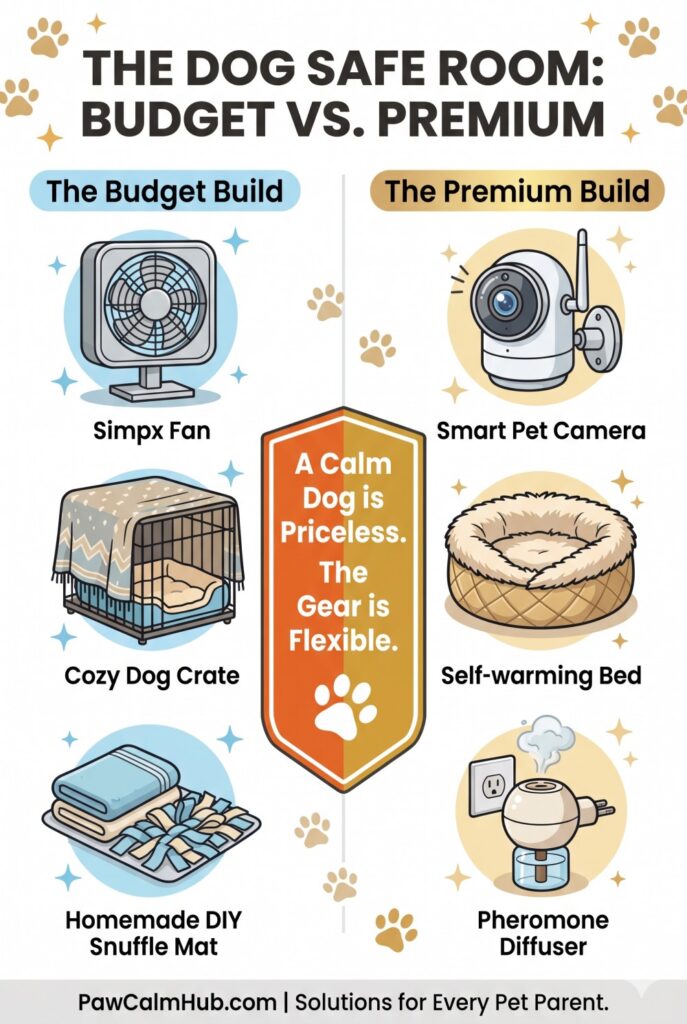
🔵 Mid-Range Build ($75–$200 Total)
This is the level at which all neurologically significant elements are covered. Most owners will find the best value here.
What you are missing at this level: Remote monitoring camera and anxiety vest — both of which add significant capability but are not essential to the core environmental management function of the safe room.
The “Pro-Calm” Home Suite
Comprehensive environmental control for the modern pet.
| Element | Recommended Selection | Cost |
|---|---|---|
| Anxiety Bed | PawCalmHub Self-Warming Bed BESTSELLER | $35–$50 |
| Sound Control | Dedicated White/Brown Noise Machine | $25–$35 |
| Olfactory Work | PawCalmHub Snuffle Mat | $18–$25 |
| Scent Anchoring | Worn garment + DAP Pheromone Diffuser | $25–$35 |
| Visual Barrier | Thermal Blackout Curtains (Single Window) | $20–$30 |
| Mental Engagement | PawCalmHub Treat Dispenser Toy | $20–$28 |
| Bio-Support | PawCalmHub Hemp Calming Chews | $20–$28 |
| TOTAL INVESTMENT FOR THE “PRO-DEN” SETUP | ~$163–$231 | |
🟡 Premium Build ($200–$400 Total)
The complete setup — every element at full effectiveness. For dogs with severe anxiety disorders, the incremental investment is justified by the incremental outcome.
What this gets you over the mid-range build: Real-time monitoring without physical intrusion, a fully fitted vest for pre-trigger deployment, full acoustic management of the room, and the music therapy layer that adds a fourth calming sensory input alongside scent, touch, and sound management.
The “Elite Calm” Bio-Sanctuary
The gold standard in canine sensory engineering and behavioral support.
| System | Premium Selection | Investment |
|---|---|---|
| Thermal Comfort | PawCalmHub Self-Warming Bed AESTHETIC | $35–$50 |
| Somatic Therapy | PawCalmHub Dog Anxiety Vest CORE GEAR | $35–$45 |
| Acoustic Shield | High-Quality White/Brown Noise Machine | $40–$60 |
| Olfactory Work | PawCalmHub Snuffle Mat | $18–$25 |
| Pheromone Defense | DAP Diffuser + Acoustic Pheromone Collar | $40–$55 |
| Visual Isolation | Premium Full-Length Thermal Blackout (Room Set) | $40–$60 |
| Mental Engagement | PawCalmHub Treat Dispenser Toy | $20–$28 |
| Remote Connection | PawCalmHub Video Camera & Smart Feeder | $45–$65 |
| 90-Day Bio-Support | PawCalmHub Hemp Calming Chews MAX QTY | $45–$60 |
| Sensory Music | Through a Dog’s Ear (High-Fidelity Download) | $15–$20 |
| TOTAL INVESTMENT FOR THE ULTIMATE BIO-SANCTUARY | ~$333–$468 | |
The One Purchase to Prioritise Above Everything Else
If budget allows only one new purchase, make it the self-warming anxiety bed.
Here is why: every other element in this list provides its benefit intermittently — during anxiety events, during mealtimes, during specific enrichment sessions. The self-warming bed provides its benefit continuously, 24 hours a day, every day. The thermoregulation effect on the parasympathetic nervous system — passive warmth keeping the autonomic nervous system in its calmer state — runs constantly in the background, lowering the baseline from which all other anxiety events escalate. It is calming infrastructure rather than a calming intervention, and nothing else on this list delivers that kind of uninterrupted background benefit.
Safe Room Mistakes That Backfire
Forcing the dog into the room. The entire psychological value of the safe room depends on the dog choosing to be there. A dog who is carried into the room against their will during a panic event associates the room with the panic, not with safety. The association runs in the wrong direction permanently.
Using it only during anxiety events. A room that the dog visits only during storms becomes a storm-associated room. The safe room must be a daily positive space — mealtimes, enrichment, owner-in-proximity relaxation — so that its safety association is deeply established before it is needed under stress.
Putting it next to the front door. The front door is one of the highest-arousal locations in most homes — the place where departures happen, deliveries arrive, and strangers appear. Proximity to the front door undermines everything the safe room is trying to achieve.
Playing television for company. Television is not white noise. It contains unpredictable voices, sudden sound level changes, music stings, and sound effects — all of which provide the unpredictable auditory stimuli that trigger the startle response. If it helps you to feel that the dog has company, use the Through a Dog’s Ear audio instead.
Closing the dog in the room against their will during non-emergency situations. Containment against the dog’s will is restraint, and restraint elevates cortisol. The safe room works through voluntary association. Closing the door should occur only during the specific high-risk events where escape risk or safety concern justifies it — and even then, after the dog has been given every opportunity to enter voluntarily.
Training Your Dog to Love Their Safe Room — The 7-Step Protocol
Step 1: Begin without the dog present. Set up the room completely. Leave it open and accessible. Let the dog investigate at their own pace over the first 24 hours — do not guide or encourage them in.
Step 2: Scatter high-value treats (not kibble — use real food) just inside the doorway, retreating before the dog approaches. Let them take the treats and leave. Repeat 3x daily for 3 days.
Step 3: Move the treat scatter progressively deeper into the room over days 4–7 — just inside the door, then halfway across the room, then near the bed.
Step 4: Begin feeding one meal per day in the safe room. Place the snuffle mat in the room with the food distributed through it. Leave the room while the dog eats. Re-enter calmly when the meal is finished.
Step 5: Spend time in the room yourself — reading, working on a laptop, sitting quietly. The dog will join you. When they do, do not make it an event. Simply be present, calm, and boring. This is one of the most powerful training steps because it pairs the room with your calm presence rather than your anxious presence.
Step 6: Introduce the treat dispenser in the room. Leave the room once the dog is engaged with it. Return calmly before they finish. You are building the association that being in the room alone with the dispenser is rewarding — and that your return does not require distress.
Step 7: On a calm, non-anxiety day, close the door for 5 minutes while the dog is engaged with the snuffle mat or dispenser. Open it before they show any concern. Gradually extend the duration. This is how you prepare for the day you need the door closed during a storm — without the closed door carrying any negative association.
Should I put my dog in their safe room when they misbehave?
No. Never use the safe room for punishment. It must remain a “guaranteed retreat point” that the dog chooses to enter voluntarily to maintain its psychological safety
Can a laundry room be a good safe room for a dog?
Usually, no. The loud buzz of the dryer and the vibration of the washing machine are unpredictable stimuli that can increase a dog’s anxiety rather than lowering it. Choose a quiet interior room or closet instead.
Should I leave the light on or off in the dog’s safe room?
Low, dim lighting or total darkness is preferred. This mimics a natural den environment and reduces the visual “scanning” behavior that keeps an anxious dog awake.
How do I get my dog to go into the safe room during a storm?
Don’t wait for the storm. You must train the “Safe Room” association during sunny days. If the dog is already panicking, never force them; instead, use a trail of treats to lure them in voluntarily.
Does my dog need a whole room or will a corner work?
A dedicated corner can work for dogs with mild anxiety — particularly if it is physically enclosed (under a staircase, in a large crate, in an alcove) and meets the sensory criteria described in this guide. A full room is superior because it provides greater acoustic insulation, more spatial freedom, and the ability to fully control the sensory environment. For dogs with moderate to severe anxiety, a full room is strongly recommended. For dogs with mild situational anxiety, a well-designed corner or covered crate in the best available location may be sufficient.
My dog won’t stay in their safe room during a storm — they want to be with me. What do I do?
Two options, neither of which involves forcing the dog to stay alone. Option 1: be in the safe room with them. Your calm presence in the properly set-up room provides the combined benefit of the environmental management plus attachment security — the most effective storm management combination available. Option 2: if the safe room concept is important to you for practical reasons, begin the 7-step training protocol at least 4 weeks before storm season with consistent daily implementation. A dog who has not been trained to the safe room cannot be expected to choose it during a crisis.
Should the safe room be where the dog sleeps at night?
This is an excellent outcome if achievable — because it means the dog spends 8+ hours every night building positive association with the space, through rest and the owner’s nearby scent if the room is near the bedroom. If the dog’s normal sleeping arrangement is elsewhere, you can still build effective safe room association through the daytime training protocol described above — it simply takes longer.
How do I manage the safe room if I have multiple dogs?
Each dog needs access to their own safe space — either separate rooms or separate corners within the same room that are spatially distinct enough that one dog cannot block the other’s access. The most anxious dog should have their own dedicated space during trigger events, separated from other dogs — because emotional contagion (one dog’s anxiety amplifying another’s) is a documented phenomenon that undermines everything the safe room is trying to achieve.
Read more: Anxiety in Multi-Dog Households
Can I use a crate as a safe room?
Yes — with specific modifications. The crate should be covered on three sides with a thick blanket (leave the front open for air and exit visibility), positioned in the optimal room location using the criteria above, and contain the dog’s own bedding plus a worn garment. The key difference between a crate-safe-space and a room-safe-space is that the crate door must remain open at all times except for genuine safety requirements. A locked crate during a storm is not a safe room — it is a trap. The safety association depends entirely on the dog’s ability to choose to be there.