
Last updated: 2025 | Reviewed against current veterinary ethology research. Research in feline behaviour science has shown that cats housed with non-preferred companions show measurably elevated stress hormones even without overt conflict.
There is a sentence that should appear at the top of every multi-cat adoption guide, but almost never does:
Cats are not pack animals.
Dogs evolved to live in cooperative social groups. Humans evolved in tribes. Cats — specifically Felis catus, the domestic cat — evolved as semi-solitary, territorial predators who share space with others only when resources are so abundant that competition becomes unnecessary. In the wild, a single cat may hold a home range of anywhere from 2 to 370 acres. Your three-bedroom house offers a fraction of that. And in most homes, the resources cats are hardwired to compete over — food, resting spots, access to exits, owner attention — are always in short supply by feline standards.
This is not a reason to feel guilty for having multiple cats. Millions of cats live together in relative harmony. But it is the lens through which everything in this guide must be read, because the single biggest mistake multi-cat households make is applying dog-social logic to cat-social dynamics. Dogs want to belong to the group. Cats want to own the territory. Once you understand that, the conflicts — and the solutions — make complete sense.
Why Chronic Low-Level Stress Is the Real Problem
When we think of cat conflict, we picture hissing, swatting, and the occasional dramatic chase through the house. And yes, that’s a problem. But the greater welfare concern in most multi-cat homes is something far quieter and far more damaging: chronic, low-grade stress that never fully resolves.
This kind of stress doesn’t look like a fight. It looks like one cat always eating faster than the other. It looks like the younger cat sitting in doorways — blocking exit routes — while the older cat watches from the bed. It looks like litter tray use dropping off slightly, or one cat’s grooming becoming compulsive around the shoulders and flanks. It looks, to most owners, like nothing at all.
But underneath the surface, cortisol levels are elevated. The hypothalamic-pituitary-adrenal axis is running hotter than it should. And over months and years, this produces the kinds of health consequences — feline idiopathic cystitis (stress-triggered bladder inflammation), recurrent upper respiratory infections, behavioural deterioration — that are expensive, distressing, and entirely preventable with the right social management.
The Science of Inter-Cat Stress: What’s Actually Happening
Cats in multi-cat households exist on a social spectrum that animal behaviourists call cohabitation tolerance, not friendship. Some cats develop genuine affiliative bonds — grooming each other, sleeping in physical contact, showing synchronised behaviour. Researchers call these cats bonded pairs or a social group. Many cats, however, simply tolerate each other: they share space, avoid major conflict, but experience ongoing low-level stress from the proximity of a cat they did not choose to live with.
The distinction matters enormously because the management strategies for bonded cats and tolerating cats are completely different. Bonded cats benefit from shared resources. Tolerating cats need separate everything.
A 2020 study published in Applied Animal Behaviour Science found that cats who showed no overt aggression but were placed with a non-preferred companion showed measurably elevated urinary cortisol-to-creatinine ratios compared to cats housed individually. In plain English: your cats don’t have to be fighting to be stressed. Proximity alone, with the wrong companion, raises the stress hormone.
The 6 Types of Inter-Cat Anxiety Dynamics
Not all multi-cat stress is the same. Before you can fix the dynamics in your home, you need to identify which pattern you’re dealing with.
1. Mirror Anxiety One cat develops an anxiety response to a trigger — a storm, a stranger visiting, a noise — and the second cat reads the first cat’s stress signals (pheromones, vocalisation, body language) and escalates in response. There was no original trigger for Cat B. They are simply running the emotional subroutine of Cat A. This creates a feedback loop that is worse than either cat’s individual anxiety would be.
2. Resource Competition Anxiety The most common form. Cats experience low-grade tension around food stations, favourite sleeping spots, the owner’s lap, and litter trays. No overt aggression is required — the mere presence of another cat within 3 feet of a valued resource is enough to trigger a stress response in the subordinate animal.
3. Hierarchy Instability Anxiety Cats establish loose social hierarchies, but these are not fixed. When a new cat is introduced, a resident cat becomes ill, or a kitten reaches social maturity (around 18–24 months), the hierarchy can shift — triggering an extended period of instability during which both cats experience elevated stress.
4. Protective Anxiety One cat becomes hyper-vigilant on behalf of another — often seen in bonded pairs where one cat is more confident. The protective cat monitors for threats constantly, maintaining a chronic state of arousal that is exhausting and anxiety-producing.
5. One-Directional Conflict Anxiety A dominant cat — usually not overtly aggressive — controls resource access through subtle body language: sitting in doorways, staring, occupying key resting spots that force the other cat into suboptimal positions. The subordinate cat never “wins” and lives in a state of chronic defeat stress. This is the form of multi-cat stress most commonly misread by owners as normal behaviour.
6. Absence-Triggered Anxiety Cat A becomes distressed when Cat B leaves the home — for a vet visit, for example. Upon return, Cat B smells of the veterinary clinic (other animals, antiseptic, anaesthetic) and is no longer recognisable as a companion. This triggers redirected aggression and can temporarily destroy a previously stable relationship. The solution — keeping both cats separated for 24 hours after one returns from the vet and reintroducing through scent first — is rarely taught to cat owners.
Diagnosing Your Multi-Cat Household: The Social Mapping Exercise
Before implementing any changes, spend one week observing and recording the following:
Resource Map: Draw a rough floor plan. Mark where each cat eats, where each cat sleeps, where each cat uses the litter tray, and the location of exits (doors, cat flaps, staircases). Note where each cat spends the majority of the day.
Proximity Patterns: Who avoids whom? Which cat occupies doorways or corridors? Is one cat always higher (on furniture) and one always lower?
Stress Signal Inventory: For each cat, note: frequency of hiding, appetite changes, grooming patterns (over-grooming or under-grooming), vocalisation, litter tray usage. Track for seven days.
What you’re looking for is whether one cat consistently controls space and whether one cat consistently retreats. The controller is not necessarily the aggressor — they may simply have more social confidence. The retreater carries the majority of the stress burden.
Signs Your Multi-Cat Home Has a Chronic Stress Problem
Many of these signs are present in homes where owners genuinely believe their cats “get along fine.” Know what to look for beneath the surface.
Obvious Conflict Indicators:
- Hissing, growling, swatting, chasing
- Yowling, especially at night
- One cat blocking another’s exit from a room or litter tray
Subtle Chronic Stress Indicators:
- One cat has stopped using a particular room
- Litter tray accidents outside the box (often the subordinate cat, who cannot safely access the tray)
- Over-grooming to the point of bald patches — particularly on the flanks, belly, or inner thighs
- Reduced appetite in one cat
- One cat that is “always in the same spot” — this can indicate a cat who has stopped moving freely through the home to avoid conflict
- Weight changes in either cat
- Recurrent urinary issues (feline idiopathic cystitis is directly linked to chronic psychosocial stress)
If you recognise three or more of these signs, your cats are under more stress than their behaviour suggests. The good news: the interventions below have a high success rate when implemented consistently.
Explore further: Signs of Cat Anxiety — a full symptom guide for identifying anxiety in cats across all living situations.
The Resource Competition Framework: What to Fix First
The single most effective intervention in a multi-cat household is resource abundance. Cats cannot compete over resources that are not scarce. Your goal is to eliminate scarcity.
The N+1 Rule — Apply It Everywhere
For every resource in a multi-cat home, you need N+1, where N is the number of cats. Two cats need three food stations, three water stations, three litter trays. Three cats need four of each. Additionally — and this is the part most guides omit — these resources need to be spatially separated, not clustered. Three litter trays in the same bathroom provide less relief than one tray per floor of the house.
Vertical Space is the Most Underutilised Resource
In nature, cats resolve social tension through vertical displacement — the higher cat signals social confidence; the lower cat signals deference. In a home with no vertical space, there is nowhere for this to go. The tension stays horizontal, at ground level, where it generates conflict.
Cat trees, wall-mounted shelves, cleared windowsills, and tops of wardrobes function as social territory that dramatically reduces ground-level competition. The investment in adequate vertical space typically eliminates more inter-cat conflict than any product or supplement.
Exit Routes Must Be Visible at All Times
Cats that cannot see an exit from any position they occupy experience significantly elevated anxiety. A cat trapped in a corner — even a comfortable one — is a stressed cat. Audit every room your cats use. Can a cat lying in the resting spot see at least one exit? If not, reposition.
The Microchip Feeder Solution to Food-Related Bullying
Resource guarding at the food bowl is one of the most common — and most damaging — sources of chronic stress in multi-cat homes. It doesn’t always look dramatic. The dominant cat may simply sit near the other cat’s bowl. They may finish their own food and then walk over. They may do nothing at all except exist in the same room while the subordinate cat eats — which is enough. A cat who cannot eat without monitoring for a threat cannot eat in a relaxed, parasympathetic state. Over time, this produces chronic cortisol elevation, weight changes, and the kind of persistent low-grade anxiety that wears a cat down silently over months.
Spatial separation of food stations helps. But in homes where one cat is particularly motivated to control food resources — or where the floor plan doesn’t allow for genuinely private feeding — spatial separation alone often fails. The dominant cat simply follows.
This is where the microchip feeder changes everything.
How it works: A microchip-activated feeder reads your cat’s implanted microchip (or an RFID collar tag) and opens only for that specific cat. When the wrong cat approaches, the lid stays closed. There is no food to guard, because there is no accessible food. The entire resource competition dynamic is eliminated at the hardware level.
The behavioural impact goes beyond the obvious. Resource guarding is a self-reinforcing behaviour — every successful “steal” rewards the dominant cat and increases the behaviour’s frequency. Every failed attempt to access a closed feeder extinguishes it. Within two to four weeks of consistent microchip feeder use, most dominant cats stop approaching the other cat’s station entirely, because the history of reinforcement is gone.
What this also fixes — that owners don’t expect:
Prescription diet compliance. If one cat needs a veterinary diet and the other doesn’t, a microchip feeder is the only reliable solution short of feeding in completely separate rooms with closed doors. Many owners managing feline diabetes, kidney disease, or food allergies in one cat find this single product transforms their ability to comply with veterinary feeding instructions.
Eating speed and digestion anxiety. Cats who eat under social pressure eat faster — bolting food in a way that causes vomiting, bloating, and gut dysregulation. A microchip feeder removes the social pressure entirely. Eating speed normalises within days. This has a measurable downstream effect on anxiety, given the documented gut-brain connection in cats.
Practical notes for setup:
- Allow 3–5 days for each cat to learn their feeder opens for them and not the other
- During the learning period, supervise mealtimes and gently redirect the dominant cat away from the closed feeder — not with punishment, with redirection toward their own open station
- If using RFID collar tags rather than microchips, ensure the collar fits correctly and both cats are comfortable wearing one before switching to microchip feeders full-time
- Position each feeder in the cat’s anchor zone, not in a shared neutral area
The microchip feeder will not resolve every dimension of resource competition. Water stations, litter trays, and resting spots still require the N+1 approach. But for food — the highest-stakes resource in most multi-cat homes — it is the most effective single intervention available, and it works passively, around the clock, without requiring owner management of every mealtime.
Zone-Based Home Management: Redesigning for Cat Harmony
Once you’ve established resource abundance, implement a zone-based management system. This is the framework that separates serious multi-cat management from surface-level advice.
The Anchor Zone Principle
Each cat should have one zone of the home that functions as their psychological territory — a space where they reliably find food, water, a litter tray, a resting spot, and where the other cat rarely enters. This doesn’t require physical separation (though that can help initially). It requires that the anchor zone’s resources are placed specifically for that cat, and that you reinforce positive associations between each cat and their anchor zone consistently.
Neutral Zones
Shared living areas — the sofa, the kitchen, hallways — are neutral territory. In stable multi-cat homes, both cats move freely through neutral zones because they’re not contested. In unstable homes, one cat controls neutral zones. The solution is not to remove the dominant cat from neutral zones, but to increase resource density so neutral territory isn’t worth guarding.
Time-Sharing for High-Value Spots
Some resources — a heated cat bed near a radiator, a specific windowsill with a bird view — are simply too high-value for both cats to share simultaneously. Rather than fighting over them, implement informal time-sharing by feeding each cat in their own zone at the same time, which typically draws them away from the contested spot and allows the other to use it without conflict.
Interactive Play: The Fastest Way to Lower Inter-Cat Tension
One of the most evidence-supported interventions for multi-cat household stress is structured predatory play — and it works for two reasons.
First, play burns the anxiety energy that otherwise gets redirected toward the other cat. A cat who has successfully “hunted” (a toy, a laser dot, an interactive ball) is a physiologically calmer cat. Cortisol drops. The nervous system downregulates. The other cat becomes less of a perceived threat.
Second, play in parallel — each cat engaged with their own toy simultaneously, in different parts of the room — creates positive shared experiences without requiring the cats to interact directly. Over time, this builds positive associative memory around being in the same space as the other cat.
The cat tumbler toy is particularly effective in multi-cat homes because it supports independent play — each cat can engage with their own toy without requiring owner facilitation, which means the play sessions can happen simultaneously without the owner needing to be in two places at once. Place one at each end of the home during high-tension periods (early morning, after feeding, late evening — times when inter-cat conflict typically peaks).
See also: How to Calm an Anxious Cat — covers calming strategies across all cat anxiety types, with specific sections relevant to multi-cat stress.
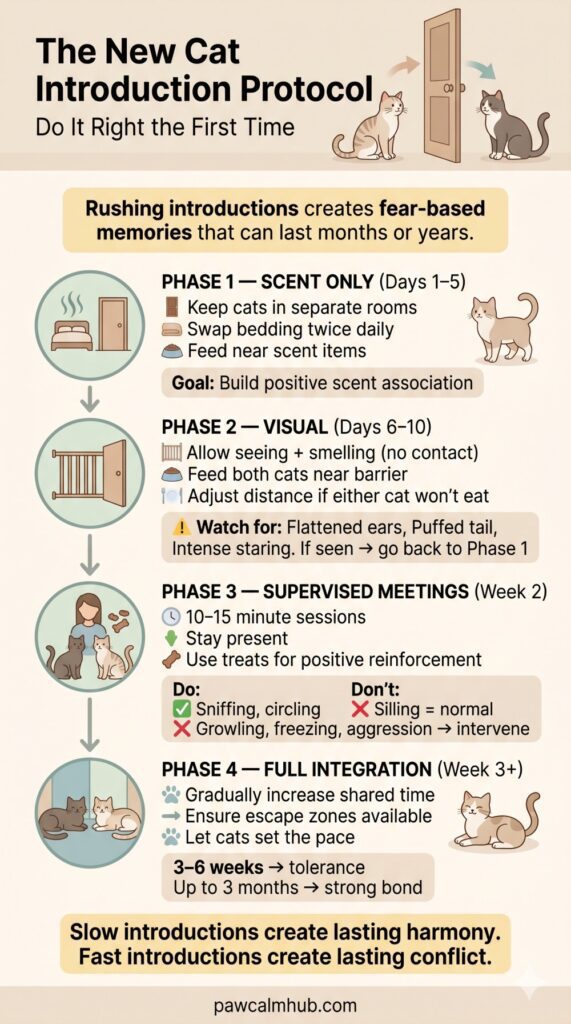
The New Cat Introduction Protocol: Doing It Right the First Time
The majority of multi-cat household dysfunction can be traced back to a botched introduction. When cats are introduced too quickly — allowed to share space before they’ve established a positive scent association — they form threat-based memories of each other that can take months or years to repair.
Here is the protocol that feline behaviour specialists consistently recommend.
Phase 1: Scent Only (Days 1–5) Keep the new cat in a completely separate room with the door closed. Swap bedding between the cats twice daily — place the new cat’s bedding near the resident cat’s feeding area, and vice versa. You are creating a scent-meal pairing: the new cat’s smell predicts good things. Feed the resident cat particularly high-value food during this phase to strengthen the association.
Phase 2: Visual Introduction Without Physical Contact (Days 6–10) Replace the closed door with a baby gate, or open the door slightly with a door stop. Cats can now see and smell each other without physical access. Feed both cats in proximity to the barrier — not so close that either stops eating (which signals too much stress) but close enough to create a shared positive experience.
Watch for: flattened ears, puffed tails, and fixed staring — signs the introduction is moving too fast. Move back to Phase 1 if these appear consistently.
Phase 3: Supervised Shared Sessions (Week 2) Allow both cats into the same space for 10–15 minutes, with you present. Have high-value treats ready. Do not intervene in normal investigative behaviour — sniffing, circling, posturing. Do intervene if either cat freezes, growls, or shows redirected aggression toward you.
Phase 4: Graduated Free Access (Week 3 onward) Gradually extend shared time, always ensuring both cats can retreat to their anchor zone. Full free-roaming integration typically takes 3–6 weeks for cats who will become tolerant cohabitants, and up to 3 months for cats who will develop genuine affiliation.
Resist the urge to rush this. A slow introduction that sticks is worth infinitely more than a fast one that creates lasting conflict.
Read more: Cat Separation Anxiety — because some cats develop anxiety not with other cats, but when separated from their bonded companion.
Pheromone Therapy: What the Research Says
Feliway Multicat (a synthetic analogue of the cat-appeasing pheromone, or CAP) is the most studied pharmacological intervention for multi-cat household stress. A 2017 double-blind placebo-controlled study published in the Journal of Feline Medicine and Surgery found that Feliway Multicat diffusers significantly reduced the frequency of inter-cat tension behaviours compared to placebo in multi-cat households.
It is not a magic solution. In homes with severe resource scarcity and no management changes, pheromone therapy provides limited benefit. But used alongside the resource-abundance and zone-based management strategies above, it meaningfully reduces baseline tension — particularly during the first 4–6 weeks of a new introduction or after a household disruption.
Position the diffuser in the room where cats most commonly interact, and replace the refill every 30 days.
For a full overview of evidence-based calming products: Best Calming Products for Cats — including pheromone therapy, interactive tools, and supplementation options.
When Multi-Cat Conflict Needs Veterinary Intervention
There are forms of multi-cat conflict that sit outside the scope of environmental management and require professional veterinary assessment.
Redirected Aggression A cat who is aroused by an external stimulus — a cat outside the window, a sudden noise — and then attacks the other household cat (or the owner) is experiencing redirected aggression. This is not dominance behaviour; it is an overflow of arousal that has no appropriate target. It is unpredictable and dangerous, and it requires veterinary behaviour consultation.
Sudden-Onset Aggression in Previously Stable Pairs If two cats who lived together harmoniously for years suddenly begin fighting, the most likely cause is pain or illness in one of the cats, not a social breakdown. Cats in pain become threat-sensitive and will respond aggressively to previously tolerated contact. A full veterinary workup — including pain assessment — should be the first step, before any behavioural intervention.
Self-Mutilation or Severe Over-Grooming A cat who has groomed to the point of open sores, or who is pulling out fur in chunks, is not just stressed — they require veterinary assessment for both the physical wounds and the underlying anxiety disorder. This level of response typically requires medication, not environmental management alone.
If your vet suspects chronic psychosocial stress as a primary driver, ask about referral to a board-certified veterinary behaviourist (DACVB). These specialists have post-doctoral training in exactly this kind of complex multi-animal household dynamic.
The Multi-Cat Household Calm-Down Toolkit: What to Have and Where to Put It
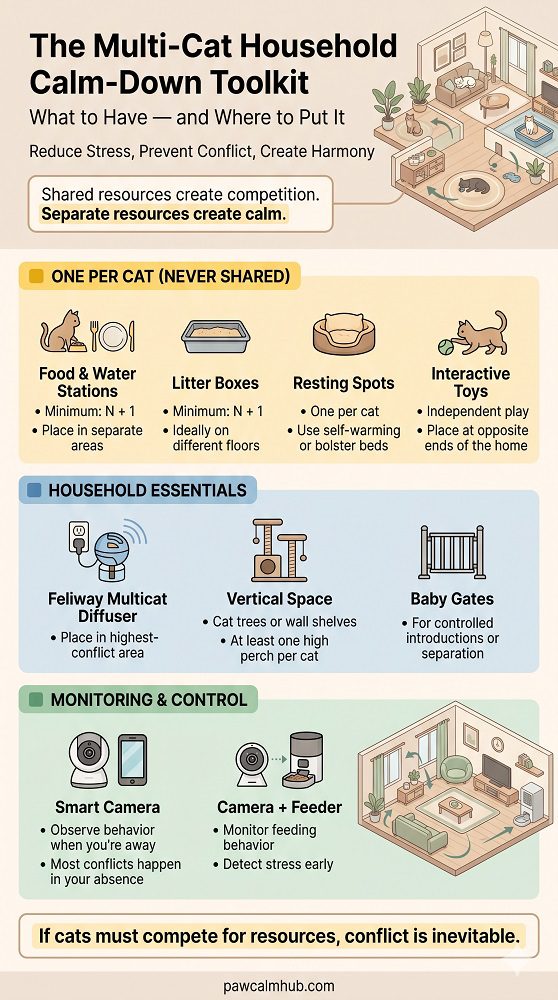
Here is a practical summary of what the evidence supports for multi-cat stress management.
One per cat (never shared):
- Food and water stations — at least N+1, spatially separated
- Litter trays — at minimum N+1, on different floors if possible
- Primary resting spots — each with a self-warming or bolster bed
- Interactive cat tumbler toy — independent play, opposite ends of the home
Household level:
- Feliway Multicat diffuser — in the highest-conflict room
- Vertical space (cat tree or wall shelves) — at least one high perch per cat
- Baby gates for phased access if reintroduction is needed
For monitoring:
- Smart camera — allows you to observe inter-cat dynamics when you’re out; most household conflict peaks during owner absence
- Video camera with pet feeder — particularly useful for monitoring feeding behaviour, a primary indicator of inter-cat stress
The One Thing That Changes Everything
If you implement nothing else from this guide, implement this:
Add one more litter tray, in a different room, today.
The litter tray situation in most multi-cat homes is the single most common source of silent, unresolved stress. A subordinate cat who cannot safely reach the litter tray without passing through a dominant cat’s territory will either eliminate outside the tray — which owners read as a behavioural problem — or suppress the urge, which leads to feline idiopathic cystitis. Both outcomes are preventable. Both stem from a resource scarcity problem, not a training problem.
Get the tray right. Then work backward through the rest of this guide at a pace that works for your household. Multi-cat harmony is not a destination you reach — it’s a dynamic you manage, consistently, with the right framework in place.
Related reading for multi-cat owners:
- Signs of Cat Anxiety — identify whether your cat’s behaviour signals stress
- How to Calm an Anxious Cat — full calm-down protocol for cats
- Cat Separation Anxiety — when cats become anxious about each other’s absence
- Best Calming Products for Cats — evidence-ranked product guide for cat anxiety
How do I know if my cats actually like each other or are just tolerating each other?
Look for affiliative behaviours: mutual grooming (allogrooming), sleeping in physical contact by choice, greeting each other with raised tails, and synchronised resting in the same room without tension signals. Cats who merely tolerate each other will share space without conflict but won’t show these behaviours. Tolerance is a perfectly acceptable outcome — it means your management is working — but it requires maintaining resource abundance permanently. The moment resources feel scarce again, tolerating cats will revert to competition.
Can cats that have been fighting for years ever learn to get along?
Yes, though “get along” usually means reaching stable tolerance rather than affiliation. The key variable is whether the conflict is rooted in resource scarcity (fixable with management) or in a genuine incompatibility between cats whose social styles are fundamentally mismatched. The latter is rarer than owners assume — most long-term conflict is resource-driven and responds well to the zone-based approach and resource abundance strategies in this guide. Expect a minimum of 8–12 weeks of consistent management before assessing whether progress is possible
My cats were fine for two years and now suddenly hate each other. What happened?
Sudden-onset aggression in a previously stable pair almost always has a medical trigger. One cat is likely in pain — most commonly from arthritis, dental disease, or an undiagnosed illness — and is now responding aggressively to contact that was previously tolerated. The vet is the first stop, not a behaviourist. Rule out pain and illness before attempting any social reintroduction protocol
How many litter trays do I actually need for two cats?
The clinical recommendation is N+1 — so three trays for two cats, placed in genuinely separate locations (different rooms or different floors), not clustered together in the same area. If either cat is experiencing stress-related house soiling, add a fourth tray temporarily and place it near the location of the accidents. This is almost always more effective than attempting to retrain the cat toward the existing trays
One of my cats keeps sitting in doorways and blocking the other cat. Is this aggression?
This is what behaviourists call passive blocking — a form of resource control that involves no overt aggression but creates significant chronic stress for the blocked cat. The sitting cat is controlling access to territory without risking a confrontation. It is a confident dominance behaviour, not neutral. Address it by increasing vertical space (so the subordinate cat can move above and around the blocker), adding an additional exit route where possible, and ensuring the subordinate cat’s anchor zone is not accessible to the dominant cat
Do calming supplements help with multi-cat stress?
Supplements work best as a support layer on top of environmental management, not as a replacement for it. For cats, the most evidence-supported options are alpha-casozepine (found in some veterinary calming supplements), L-theanine, and pheromone therapy (Feliway Multicat). For dogs in a multi-pet household where dog anxiety is also a factor, hemp calming chews provide a complementary option. Always discuss supplementation with your vet before starting, particularly if either cat has an existing health condition.
When should I consider rehoming one of my cats?
This is a question that deserves a genuinely honest answer, not reflexive discouragement. If, after 6–12 months of consistent, well-implemented management — resource abundance, zone-based separation, veterinary assessment for medical causes, and professional behaviourist input — one cat is still experiencing severe chronic stress (ongoing house soiling, self-mutilation, complete appetite suppression, or redirected aggression causing injury), then rehoming to a single-cat household may be the kindest outcome for that cat. The welfare of both cats matters. A cat living in chronic psychological distress is not thriving, regardless of how much their owner loves them.
My cats don’t fight, so why is one over-grooming?
This is “silent stress.” Cats are semi-solitary, and low-grade competition for resources (like a blocked doorway or shared litter box) can cause chronic anxiety even without visible hissing
External References
Scientific Research: Clinical Trial on Feliway Multicat Effectiveness