
Estimated read time: 14 minutes | Last updated: 2026 | Reviewed against current veterinary and behavioural science research
⚕️ Before you begin: This guide covers how heat can amplify anxiety in dogs. It is not a heatstroke guide. Heatstroke is a life-threatening emergency, and the warning signs are listed in a dedicated section below. If you are unsure whether your dog is anxious or overheating, treat it as overheating first and call your veterinarian.
Dog Anxiety Hot Weather: Most owners know to watch for heatstroke in summer. Almost none are told that heat can also make an anxious dog’s anxiety worse.
The dog who handled the neighbour’s lawnmower in April may unravel at it in July. The dog who tolerated a short car ride in spring may pant, pace, and drool through the same trip at 90°F. Owners read this as the dog “getting worse,” or assume the anxiety is purely behavioural, when part of the explanation is that the dog’s body is already working hard before the trigger arrives.
This guide explains why that happens, how to tell heat-amplified anxiety from a heat emergency, and how to adjust your dog’s routine and environment so summer doesn’t undo the progress you’ve made the rest of the year.
Why Heat and Anxiety Compound Each Other
Both heat stress and anxiety activate the body’s stress-response system, and both involve cortisol. A dog who is anxious and hot is dealing with two stress inputs at once, which is why the same trigger can produce a bigger reaction on a hot day.
Panting is the clearest example of where the two overlap. Dogs cool themselves mainly by panting, and panting is also one of the most common anxiety signals. On a hot day, a panting dog could be cooling down, anxious, or both. That overlap is why summer anxiety is easy to misread.
Reasonable expectations from this overlap, though not guaranteed for every dog:
- A lower threshold: triggers that normally produce mild unease may produce clear distress.
- Faster escalation once a trigger appears.
- Slower recovery afterwards, because the body is also working to cool itself.
Sleep matters too. A dog who can’t get comfortable in a hot room sleeps worse, and poor sleep makes almost every anxiety problem harder to manage.
Heat-Amplified Anxiety vs. Heatstroke: Know the Difference
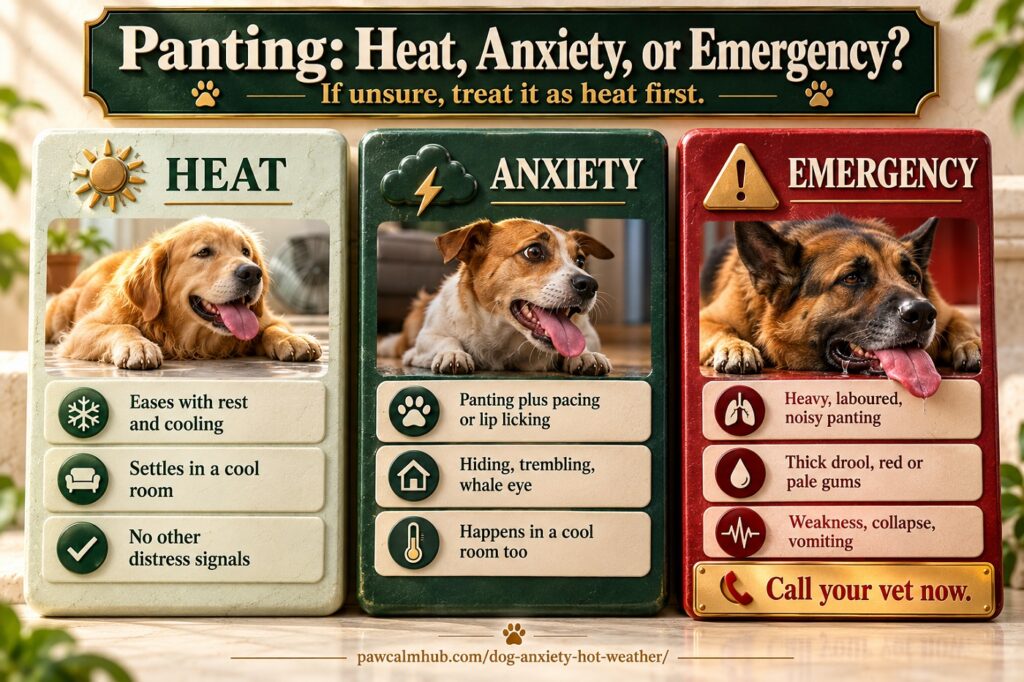
This is the most important section in the guide.
Signs consistent with heat-amplified anxiety:
- Panting plus anxiety signals (pacing, lip licking, whale eye, hiding), settling once cooled
- A lower tolerance for triggers than usual
- Restlessness during hot evenings, easing as the house cools
Signs of possible heatstroke, which is an emergency:
- Heavy, laboured, or noisy panting that does not ease with rest and cooling
- Thick drool, bright red or pale gums
- Vomiting or diarrhoea
- Weakness, stumbling, disorientation, or collapse
- Seizures
If you see any of these, move your dog to a cool, shaded area, offer small amounts of cool (not ice-cold) water, begin gentle cooling with cool water on the body, and call your veterinarian or nearest emergency clinic immediately. Do not wait to see whether it passes.
Higher-risk dogs need extra caution: flat-faced breeds such as Bulldogs, Pugs, and Frenchies, thick-coated and dark-coated dogs, seniors, puppies, overweight dogs, and dogs with heart or respiratory conditions. Heat tolerance in these dogs is lower, so the margin between “uncomfortable” and “dangerous” is narrower.
For a full veterinary overview of heat illness, see the Cornell University College of Veterinary Medicine and the AKC’s heatstroke guidance. (Verify both URLs resolve before publishing.)
Which Dogs Struggle Most in the Heat?
Heat tolerance varies widely, and the dogs least able to cool themselves are often the ones for whom heat and anxiety stack up fastest.
| Higher-Risk Group | Why Heat Is Harder | Practical Adjustment |
|---|---|---|
| Flat-faced breeds (Bulldogs, Pugs, French Bulldogs) | Shortened airways make panting, the main cooling method, less efficient | Treat any heavy panting as urgent; keep to cool indoor time on hot days |
| Thick- or dark-coated dogs | Absorb and retain more heat | Shade, early/late walks, cool resting surfaces |
| Senior dogs | Reduced heat regulation; arthritis and heart or respiratory conditions are more common | Shorter outings, close monitoring, vet check if restlessness is new |
| Puppies | Still developing temperature regulation | Short outdoor sessions, constant water access |
| Overweight dogs | Extra insulation and higher workload when moving | Gentle indoor activity on hot days |
| Dogs with heart or respiratory conditions | Less reserve to cope with added strain | Ask your vet for a personal hot-weather plan |
A dog can belong to several groups at once, and each one narrows the margin between uncomfortable and dangerous. If your dog fits two or more, assume a lower heat threshold than the thermometer suggests.

How to Tell If Heat Is Making Your Dog’s Anxiety Worse
Run a simple comparison. Note your dog’s reaction to a familiar trigger (a doorbell, a departure, a car ride) on a mild day, then on a hot day. If the hot-day reaction is noticeably stronger, quicker, or slower to settle, heat is probably adding to the load.
Keeping a short log helps. For two weeks, record:
- Outdoor temperature and indoor temperature
- Time of day
- Trigger and your dog’s reaction (1-10)
- How long recovery took
Patterns usually show up quickly, and the log is also useful to share with your veterinarian.
The Summer Management Plan
Keep the environment cool and stable
Temperature stability matters as much as the number itself.
- Keep your dog in the coolest room, usually an interior room or a basement-level space.
- Close blinds and curtains on sun-facing windows during the day.
- Use fans and air conditioning where available. Fans help dogs less than they help people, since dogs cool by panting rather than sweating, so don’t rely on a fan alone in serious heat.
- Provide fresh, cool water in several spots and refresh it often.
- Offer a cooling mat or a damp towel to lie on.
A note on hydration. Plain, cool water is the foundation. Beyond that, you can add moisture through the food your dog already eats, for example by mixing a little water into meals or offering plain frozen water ice cubes. Skip electrolyte products made for people, and don’t add salt to anything. Persistently excessive thirst, or a dog who refuses water in hot weather, is worth a call to your vet.
Rethink the bed
A bed designed to retain and reflect body heat is the right tool in winter. In summer, use it with care. A self-warming bed works by reflecting your dog’s own heat back toward them, which is the opposite of what a hot dog needs. Remove it from the safe space during peak heat and replace it with a cooling mat or a bare, cool floor surface, then bring it back when temperatures drop. Let your dog choose: if they keep moving off the bed, listen.
Move the walks
- Walk in the early morning or late evening, when pavement and air are coolest.
- Use the seven-second test: press the back of your hand to the pavement. If you can’t hold it there for seven seconds, it’s too hot for paws.
- Choose grass and shade where possible.
- Shorten walks on hot days and replace the missing activity with indoor enrichment.

Burnt or sore paws add discomfort, and discomfort lowers the anxiety threshold.
Replace lost exercise with mental work
When heat cuts the walk short, a bored, under-exercised dog is more likely to be reactive. Indoor foraging gives the brain a workout without raising body temperature:
- A snuffle mat at mealtimes
- A puzzle feeder for a slower, more challenging meal
☀️ The Summer Indoor Enrichment Stack
When heat cuts the walk short, these keep your dog’s brain busy and your house calmer, without raising body temperature.
Use cooling and calming together
A frozen lick mat does two jobs: licking is a self-soothing behaviour, and the frozen surface is cooling. Good fillings include plain unsweetened yogurt (if your dog tolerates dairy), plain canned pumpkin, wet dog food, or a low-sodium broth made without onion or garlic, both of which are toxic to dogs. Check labels for xylitol in anything you use, since it is dangerous to dogs.

Summer Triggers to Plan For
Summer brings its own anxiety triggers on top of the heat:
- Thunderstorms. Summer is peak storm season in much of the US. See How to Calm a Dog During Thunderstorms.
- Fireworks. Plan well ahead using the July 4 countdown guide.
- Car travel. Never leave a dog in a parked car, even briefly, and see Dog Car Anxiety for travel prep.
- Boarding and holidays. Summer travel peaks, so read the boarding anxiety guide before booking.
- More visitors and noise. Barbecues, parties, and open windows all raise the sensory load.
A Note on Anxiety Vests in Hot Weather
Anxiety vests apply gentle pressure, and many are made of fabrics that hold warmth. In hot weather:
- Use the vest only for the specific trigger event (a storm, a short drive), not for extended wear.
- Pick a thin, breathable fabric.
- Remove it promptly once the event ends.
- Skip it entirely if your dog is already panting heavily or seems hot.
See the full anxiety vest guide for fitting and timing.
When to Call Your Veterinarian
- Anxiety that has clearly worsened this summer and isn’t easing with cooling and routine changes
- Any suspected heat illness (see emergency signs above)
- A senior dog or a flat-faced breed showing new restlessness or heavy panting
- Sleep disruption lasting more than a couple of weeks
Persistent panting and restlessness can also point to pain, heart or respiratory disease, or other medical conditions, so rule these out before assuming the cause is behavioural.
FAQ: Dog Anxiety and Hot Weather
Can hot weather really cause anxiety in dogs?
Heat doesn’t create an anxiety disorder, but it can lower a dog’s tolerance for stress and make existing anxiety more visible. Both heat and anxiety draw on the stress response, so the effects add together.
How can I tell if my dog is panting from heat or from anxiety?
Look at the context. Panting that eases after cooling and rest points to heat. Panting alongside pacing, lip licking, hiding, or trembling in a cool room points to anxiety. If you can’t tell, cool your dog first, and call your vet if the panting is heavy or doesn’t settle.
Should I keep my anxious dog indoors all summer?
No, but adjust timing and duration. Early and late walks, shade, and water keep outdoor time safe, and indoor enrichment fills the gaps on the hottest days.
Are cooling vests a good idea for anxious dogs?
They can help with heat, but they are not a substitute for shade, water, and rest, and they don’t provide the pressure effect of an anxiety vest. If your dog is wearing any garment, monitor closely for overheating.
Is it okay to use a self-warming bed in summer?
Generally not during hot weather, since it reflects body heat. Use a cooling mat or a cool floor surface instead and bring the bed back when temperatures drop.
Why is my dog more reactive to noises in summer?
Several factors stack up in summer: heat, more thunderstorms and fireworks, more outdoor noise through open windows, and often more disrupted routines. The combined load lowers the reaction threshold.
Related reading: