
Estimated read time: 16 minutes | Last updated: 2026 | Reviewed against current veterinary and behavioural science research
A note on this guide: This article references peer-reviewed research on kennelled dog stress and cortisol response. It is written to help owners prepare an anxious dog for a boarding stay, and to give an honest, independent assessment — not written by or for a boarding facility. If your dog has a documented history of severe separation anxiety or resource-related aggression, please consult your veterinarian before booking any boarding stay.
Dog Boarding and Kennel Anxiety: Most information about dog boarding comes from one place: the facility trying to book your reservation.
That is not a criticism of boarding facilities — many are genuinely excellent, run by people who care deeply about the animals in their care. But it does mean that almost everything an owner reads before a stay is designed, understandably, to reassure rather than to prepare. “Your dog will have a great time” is a sales message. It is not the same as an honest account of what a boarding stay actually asks of an anxious dog’s nervous system, and what you can do about it.
This guide is independent of any facility. It covers what boarding genuinely involves from the dog’s sensory and psychological perspective, how to assess whether a specific dog is a good boarding candidate at all, how to choose a facility if boarding is the right call, and the preparation and recovery protocol that makes the actual stay as manageable as possible.
Why Kennels and Boarding Facilities Are Anxiety-Intensive Environments
Understanding this honestly is not meant to alarm you out of ever boarding your dog. It is meant to explain why preparation matters as much as it does.
A boarding facility asks an anxious dog to tolerate, simultaneously: the vocalisation of dozens of other dogs, many of whom are themselves stressed — a sustained, unpredictable acoustic environment unlike almost anything in normal home life; unfamiliar human handlers, however kind, who have not built the trust relationship the dog has with their owner; unfamiliar food, feeding schedule, and water source; the complete absence of the primary attachment figure for the full duration; an unfamiliar sleeping environment with unfamiliar scent; and the accumulated stress pheromones of the other boarding dogs — a chemical signal of collective distress that a dog’s far more sensitive olfactory system registers continuously.
None of this means boarding is inherently harmful. Dogs are adaptable, and many settle into a boarding routine within a day or two, particularly at well-run facilities. But it does mean the preparation an owner does beforehand has a genuinely measurable effect on how the stay unfolds — this is not a situation where “they’ll be fine” is a safe default assumption for every dog.
Is Your Dog a Boarding Candidate? An Honest Assessment
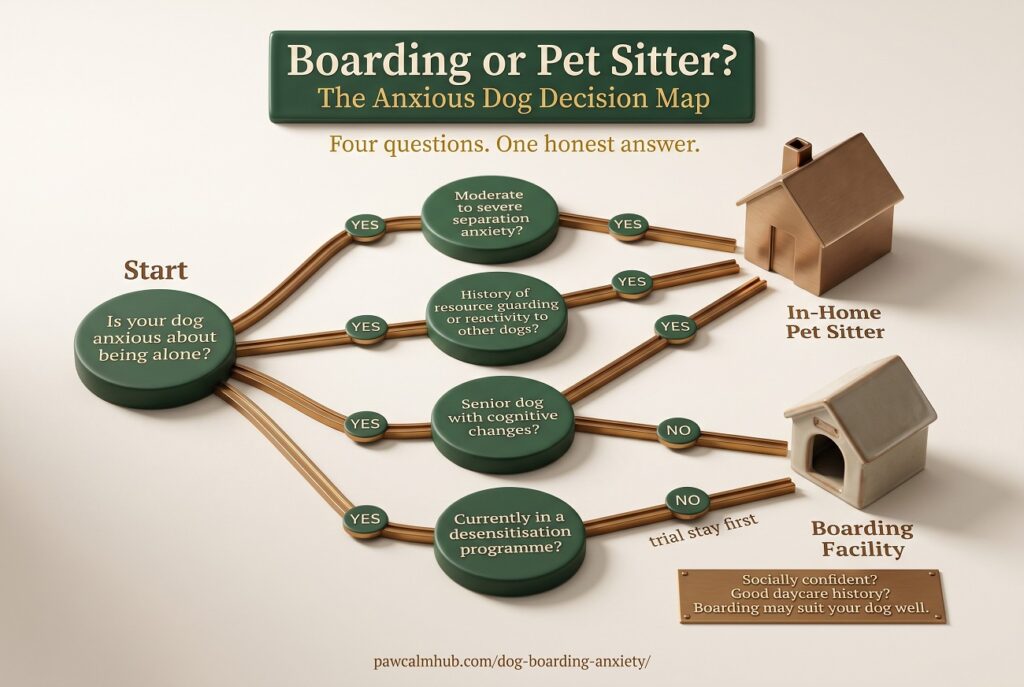
Before choosing a facility, it’s worth honestly assessing whether boarding — any boarding, at any facility — is the right fit for this specific dog, or whether an in-home alternative would serve them better.
Dogs who typically do well at boarding: socially confident dogs who enjoy the company of other dogs in normal daily life; dogs with a history of successful daycare attendance; dogs without a documented history of resource guarding or fear-based aggression; dogs whose separation anxiety, if present, is mild and well-managed.
Dogs for whom an in-home pet sitter or trusted family member is usually the better choice: dogs with moderate to severe separation anxiety, since a boarding facility adds environmental novelty on top of the separation itself rather than isolating just the separation variable; dogs with a history of resource guarding or reactivity around unfamiliar dogs, since group or semi-group housing structures common at many facilities put this directly at risk.
Senior dogs with cognitive dysfunction, for whom the disorientation of an unfamiliar environment can be considerably more distressing than it would be for a younger dog; and dogs currently in an active desensitisation programme for any anxiety type, since a boarding stay can meaningfully set back weeks of careful conditioning work.
This is not a judgement on the dog. It’s a genuine welfare assessment that most facility-published content, for understandable commercial reasons, rarely states this plainly.
| Factor | Boarding Facility | In-Home Pet Sitter |
|---|---|---|
| Environment | New, with many other dogs | Dog’s own familiar home |
| Stress load | Higher: novelty plus separation | Lower: separation only |
| Typical US cost (approximate) | $40-80 per night | $50-100+ per night |
| Best for | Social, confident dogs with daycare history | Separation anxiety, resource guarding, seniors, dogs in active training |
| Supervision | Staff on site, often around the clock | Depends on the arrangement; overnight stays offer the most |
| Main risk | Environmental overload | Sitter reliability and vetting |
Costs vary considerably by region and season, especially around holidays. Call two or three local providers for current rates before budgeting.
How to Choose a Boarding Facility for an Anxious Dog
If boarding is the right choice, the facility itself matters considerably. Questions worth asking directly, and what the answers should tell you:
“What is your staff-to-dog ratio?” A facility that can answer this specifically and confidently is more likely to be genuinely attentive to individual dogs’ stress signals than one that gives a vague answer.
“Do you offer individual housing, or is it group-based?” For an anxious dog — particularly one with any social uncertainty around unfamiliar dogs — individual housing with supervised, optional group time is generally the lower-risk structure compared to full-time group housing.
“How do you manage background noise?” Facilities that have actively thought about acoustic environment — sound-dampening in kennel areas, separating high-arousal dogs from anxious ones — are demonstrating a level of attentiveness to canine stress that correlates with better overall care standards.
“Are any of your staff Fear Free certified?” As referenced throughout this library, Fear Free certification indicates specific training in low-stress animal handling. It is becoming increasingly common in boarding and daycare settings, not just veterinary clinics.
“Can we do a trial visit or half-day trial stay before booking a full stay?” A facility willing to offer this is giving you and your dog a genuinely useful data point before committing to a multi-day stay — and a facility unwilling to offer any trial option at all is worth treating as a caution flag.

The 2-Week Pre-Boarding Preparation Protocol
Two weeks before: If the facility allows a trial half-day or overnight visit, schedule it now. This single step does more to reduce first-stay anxiety than almost anything else in this protocol, because it removes the facility itself from the list of unknowns the dog encounters on the actual boarding dates.
One week before: Begin transitioning any dietary changes gradually if the facility’s provided food differs from your dog’s usual diet — sudden diet changes compound the stress of an unfamiliar environment with digestive upset, which is avoidable with a week’s notice. Confirm the facility has your dog’s complete medical records, vaccination status, and any medication instructions in writing, not just verbally.
Three days before: Begin daily administration of hemp calming chews if you plan to use them during the stay, so the endocannabinoid system support has a baseline established before the higher-stress period begins, rather than starting cold on drop-off day.
The day before: Pack the bag — see the section below. Confirm drop-off time and any facility-specific arrival procedure. Keep the day itself calm and close to your dog’s normal routine; this is not the day to introduce anything new.
If Your Dog Needs More Than Environmental Support
Some dogs, particularly those with a history of significant distress in unfamiliar settings, need more than preparation and familiar-scent items to get through a boarding stay comfortably. Veterinarians can prescribe short-term situational medication for exactly this purpose, and asking about it is a legitimate welfare decision, not an overreaction.
Raise it early. Book a veterinary conversation at least two to three weeks before the stay, not the week of. Your vet will need to assess your dog’s health status, confirm whether a situational anti-anxiety medication is appropriate, and decide on dosing. Never give a dog a human anti-anxiety or sedative medication, since dosing and toxicity differ significantly.
Trial any new medication before the stay. If a medication is prescribed, give it once at home on a calm day so you know how your dog responds. The first dose should not be on drop-off morning, when an unexpected reaction would happen while your dog is in someone else’s care.
Tell the facility in writing. Provide the medication name, dose, and timing so staff can support it, and confirm they will administer or accommodate it.
Check supplement interactions. If your dog is on any prescription medication, confirm with your veterinarian before adding hemp-based supplements. CBD can affect liver enzyme pathways that also process certain drugs. Environmental tools such as familiar-scent items, a lick mat, and a calm drop-off have no drug interaction risk and can be combined with anything.
| Support Layer | Examples | Vet Involvement |
|---|---|---|
| Environmental | Worn clothing, unwashed bedding, trial visit, calm drop-off | None needed |
| Supplemental | Hemp calming chews, started 3 days before | Confirm first if dog is on any medication |
| Situational medication | Vet-prescribed, dosed for your dog | Required, arranged 2-3 weeks ahead |
What to Pack for Your Anxious Dog at the Kennel
The items that matter most are the ones that carry olfactory security — a variable most packing-list content underweights entirely.
A worn, unwashed piece of your clothing. Not a fresh item from the wardrobe — something actually worn for a day or two beforehand, carrying your genuine scent signature. This is one of the single highest-value items you can send, and costs nothing.
Your dog’s own bedding, unwashed. The same principle — familiar scent in an unfamiliar environment is a documented calming signal, and washing the bedding immediately before drop-off strips exactly the thing that makes it useful.
Your dog’s own food, in the correct quantities, clearly labelled with feeding instructions. Even facilities that provide food will generally accommodate a dog’s own diet on request, and a sudden diet change is an avoidable additional stressor during an already novel period.
Your dog’s own bowl. A small detail, but one more familiar object in an environment made up almost entirely of unfamiliar ones.
A lick mat, if the facility allows food-based enrichment items. Ask in advance — many do, and it gives staff a genuinely useful tool for settling your dog during the higher-stress first hours.
Most facilities allow all of the above. A facility that does not allow any familiar-scent items is worth reconsidering for a dog with any meaningful anxiety history — this is a low-cost accommodation that reflects the facility’s general orientation toward individual dog welfare.
The Drop-Off Protocol — The Most Critical 5 Minutes
This is the moment most owners get wrong, and the mechanism is the same one that runs through every other article in this library: cortisol synchrony. Your dog reads your physiological state — through scent, through the pitch and pacing of your voice, through the tension in your movements — more reliably than they read almost anything you say.
Keep your own energy calm and businesslike, deliberately. An owner who is visibly upset at drop-off — however understandable that feeling is — communicates to the dog that this situation warrants that level of distress. A calm, brief, unremarkable goodbye communicates the opposite: this is routine, and it resolves.
Avoid a prolonged, emotional goodbye. This is genuinely difficult advice to follow when you are the one feeling anxious about leaving your dog somewhere new, but a short goodbye is measurably easier on the dog than an extended one — the extended version simply extends the window in which the dog is absorbing your own anxiety signal.
Hand off calmly and leave without lingering nearby. Watching from a car in the parking lot, or returning to peek through a window, generally does not help — it extends your own stress response, which the dog may pick up on even without direct visual contact, and it delays both of you beginning the actual adjustment period.
Post-Boarding Recovery — The 48 Hours After You Collect Them
Most owners are prepared for the drop-off but genuinely unprepared for what collection and the days after can look like.
Some dogs show shutdown — quieter, more subdued, wanting to sleep more than usual, less immediately enthusiastic than the joyful reunion owners often expect. This is a normal decompression response to several days of sustained sensory and social load, not evidence that something went wrong.
Some dogs show the opposite — hyperactivity and heightened attention-seeking, following you closely, seemingly unable to settle, as though needing to re-confirm your presence repeatedly. Also normal, and generally resolves within a day or two of consistent routine.
Digestive disruption is common and usually resolves within 24–48 hours — a change in food, water source, and stress level together are enough to produce this in many otherwise healthy dogs, and it is rarely cause for concern unless it persists or is accompanied by other symptoms.
Give the first 48 hours as a genuine decompression window. Normal routine, no immediate demands, no rushing straight into a big social outing or a strenuous hike. A quiet return to the established rhythm is what helps the nervous system recalibrate fastest.
If distress or digestive symptoms persist beyond 48–72 hours, this is a reasonable point to contact your veterinarian — most boarding-related adjustment resolves within this window, and persistence beyond it is a legitimate signal rather than something to wait out indefinitely.
Products That Bridge the Gap
Packed for the stay: the self-warming dog bed, if the facility allows outside bedding, provides both the thermoregulation benefit covered throughout this library and a strong olfactory anchor once it has absorbed a few days of your dog’s own scent at home beforehand.
Pre-drop-off calming: a lick mat used in the car or immediately before handoff gives the final minutes before separation a parasympathetic-supporting activity rather than an anxious wait.
Throughout the stay: hemp calming chews, started three days before as covered above and continued through the boarding period if the facility permits owner-provided supplements — confirm this specifically when booking, since policies vary.
Read more: Do Calming Chews Work for Dogs?
🧳 The Boarding Support Stack
Three tools that map directly to this guide’s protocol: baseline support before the stay, a calming activity at handoff, and a familiar-scent anchor while your dog is away.
FAQ: Dog Boarding and Kennel Anxiety
How long does it typically take a dog to adjust to a boarding stay?
Most dogs show their highest stress in the first 24 hours, with meaningful settling by day two or three at a well-run facility — which is part of why very short one-night stays can sometimes be proportionally harder on a dog than a slightly longer stay that gives them time to actually adjust. For stays under two nights, the preparation protocol in this guide matters even more, since there is limited time for natural adjustment within the stay itself.
Should I visit or call during my dog’s boarding stay?
Generally, no, unless the facility specifically encourages it or you have a specific welfare concern. A phone call to check in is reasonable and most facilities welcome this. A physical visit partway through a stay, however, risks re-triggering a fresh separation event just as your dog may be settling into the facility’s routine — the departure you create by leaving again after a mid-stay visit can be harder on the dog than the original drop-off.
My dog has never been boarded before. Should I start with a short trial stay?
Yes, strongly recommended wherever the facility offers it. A one-night trial stay, ideally scheduled well before a longer stay you actually need to travel for, gives you real information about how your specific dog responds to this specific facility — information no amount of research or reviews can substitute for.
Is a home pet-sitting service always better than boarding for an anxious dog?
Not always — it depends on the specific dog. A trusted in-home sitter keeps the dog in their own familiar environment, which removes the environmental novelty variable entirely and is often the better choice for dogs with separation anxiety or resource-guarding concerns. But some dogs, particularly highly social ones who enjoy company, do better with the structure and stimulation of a good boarding facility than they would alone in an empty house with only periodic sitter visits. The honest assessment in this guide’s second section is the right starting point for this decision.
What if my dog comes home and seems fine, but I later hear the facility said they were distressed the whole time?
Trust the professional observation over the dog’s demeanour at pickup — many dogs mask distress effectively right up until reunion with their owner, then show a delayed decompression response over the following day or two rather than an immediate one. This is a useful data point for future boarding decisions: a facility that reports honestly on your dog’s actual experience, rather than simply reassuring you at pickup, is one worth valuing for that honesty.
Related reading: