
📊 Evidence-Based Content Rating
⭐⭐⭐ Clinical evidence: Peer-reviewed veterinary studies
⭐⭐ Moderate evidence: Some studies + strong professional consensus
⭐ Emerging evidence: Theoretical or early-stage research
This article uses this rating system throughout for full transparency.
Reviewed for alignment with AKC and Fear Free veterinary guidelines.
Written by The PawCalmHub Team. Reviewed for alignment with current veterinary behavioral guidelines. Information cross-referenced with ASPCA and Fear Free veterinary resources. Last updated 2025.
⚠️ Sudden changes in your cat’s behavior always warrant a veterinary visit to rule out underlying medical conditions before assuming anxiety as the cause.
Cats are not small dogs. Their anxiety looks different, communicates differently, and responds to different interventions.
The dog who panics openly — panting, barking, pacing — is easy to identify as anxious. The cat who retreats silently to the back of a closet, stops eating, begins methodically over-grooming a patch of fur, or starts eliminating outside the litter box is communicating distress just as loudly. The difference is that most people miss it — or mistake it for attitude.
This guide is for the cat whose distress has been missed, minimized, or misunderstood. Here is what anxiety actually looks like in cats, what drives it, and — most importantly — exactly what to do about it.
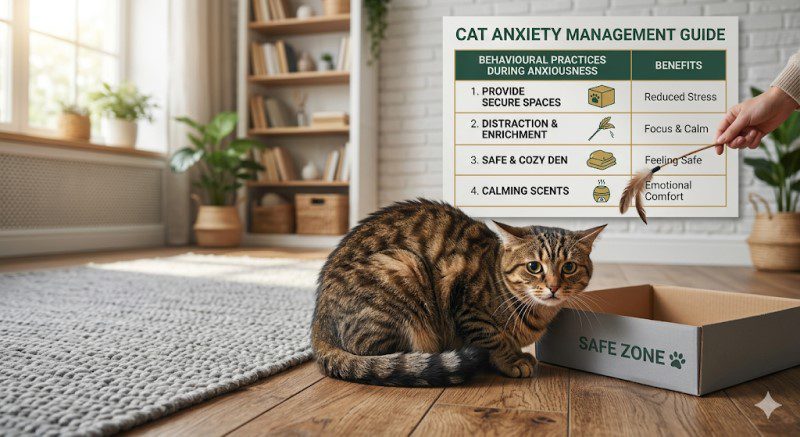
Why Cat Anxiety Is Different from Dog Anxiety
Understanding the feline-specific nature of anxiety changes how you approach it.
Cats are prey animals as well as predators. Unlike dogs, who evolved as social pack hunters, cats evolved as solitary predators who were simultaneously prey for larger animals. This dual status created a nervous system that is hypervigilant by default — one that treats novelty as a potential threat until proven otherwise, rather than as an opportunity to investigate.
Cats mask illness and distress. In the wild, showing weakness invites predation. Cats have evolved to suppress visible signs of distress as a survival mechanism. This means that by the time cat anxiety is obvious to an owner, it has often been present and building for weeks or months.
Cats are intensely territory-dependent. A dog’s sense of safety travels with their pack (you). A cat’s sense of safety is bound to their territory — their home, their established scent marks, their familiar routes and elevated positions. Any disruption to the territory is experienced as a security threat.
Cats have a smaller social threshold. Most dogs experience social interaction as inherently enriching. Many cats experience social interaction — particularly forced or unpredictable social interaction — as a stressor. This fundamentally changes how you should approach helping an anxious cat.
The 8 Most Common Cat Anxiety Triggers
Knowing your cat’s specific trigger is the most important step toward effective intervention.
1. Household changes: New furniture, renovation, repainting, new scents from cleaning products, changed furniture arrangement. Cats map their territory chemically — changing the chemical landscape of their home is genuinely disorienting.
2. New animals or people: The introduction of a new pet, a new partner, a new baby, or frequent visitors challenges a cat’s territorial security and social predictability.
3. Veterinary visits and handling: The carrier, the car, the clinic smells, the strange hands — vet-related anxiety is among the most common and most treatable forms of cat anxiety.
4. Schedule disruption: Changed feeding times, altered owner routines, new work schedules. Cats track human routine with extraordinary precision.
5. Noise and sound events: Thunderstorms, fireworks, construction, household appliances (vacuum cleaners, hair dryers, blenders).
6. Outdoor cat stressors: For indoor-outdoor cats, territorial disputes with neighboring cats, new animals in the yard, construction near the home.
7. Separation from a bonded companion: Either human or animal. Cat separation anxiety is real and increasingly recognized by veterinary behaviorists.
8. Medical conditions: Hyperthyroidism, pain, cognitive dysfunction in senior cats, and several other medical conditions directly cause behavioral changes that can appear identical to primary anxiety.
Reading Your Cat’s Anxiety Signals
Most people miss early cat anxiety signals because they are subtle. By the time the obvious signs appear, the anxiety has been escalating for weeks.
Early signals (often missed):
- Slight increase in hiding or time in elevated positions
- Subtle changes in tail position during normal activities
- Mild reduction in grooming or appetite
- Increased blinking or eye wideness
- Slight ear rotation toward perceived threats
Mid-level signals:
- Decreased food intake or refusal to eat in certain locations
- Increased hiding or withdrawal from family interaction
- Over-grooming beginning in one location (often belly, inner thighs, base of tail)
- Litter box avoidance or elimination outside the box
- Increased vocalization, particularly at night
Clear anxiety signals:
- Overt aggression — hissing, swatting, biting that is out of character
- Complete refusal to eat
- Visible trembling or freezing
- Full withdrawal from all social interaction
- Compulsive grooming leading to bald patches or skin sores
10 Evidence-Based Strategies to Calm an Anxious Cat
1. Create a Secure, Elevated Safe Space
Cats feel safest when they are elevated, enclosed, and undisturbed. Before any other intervention, provide your cat with at least one location that satisfies all three criteria — a cat tree with an enclosed top platform, a shelf with a covered bed, or a cardboard box at height in a low-traffic room.
This safe space must be completely yours-to-disturb-free — children, other pets, and visitors should never access it. A cat who knows they have a guaranteed retreat point can tolerate environmental stressors more effectively.
2. Respect the Warning Signals
One of the most powerful things you can do for an anxious cat is consistently respect their communication. When they move away, let them go. When their tail lashes, stop petting. When they hide, do not retrieve them.
Every time you override your cat’s avoidance signal — with the best of intentions — you teach them that avoidance does not work. This escalates the response from avoidance to aggression. Consistently respecting the early signals teaches your cat that communication works — which reduces the need for escalated responses.
3. Maintain a Predictable Routine
Feed at the same time every day. Play at the same time every day. Maintain consistent sleep and wake times. For an anxious cat whose security is based on territorial predictability, schedule consistency is one of the most impactful and completely free interventions available.
4. Use Feline Pheromone Therapy
Synthetic feline facial pheromones (Feliway is the best-known brand) mimic the pheromone cats deposit when they rub their face against familiar objects — a signal of safety and territory comfort. Plug diffusers into rooms your cat uses most. Spray onto bedding, carriers, and new furniture.
Evidence: multiple peer-reviewed studies support Feliway effectiveness for environmental change anxiety, multi-cat household stress, and vet visit anxiety. Less consistent evidence for severe phobias.
5. Calming Supplements with Feline-Appropriate Formulations
Natural calming supplements work in cats through the same neurochemical mechanisms as in dogs — but require cat-specific formulations at appropriate doses. The key active ingredients with evidence in cats are:
L-theanine: well-supported for feline anxiety. Promotes calm without sedation. Available in cat-specific supplement forms.
Zylkene (hydrolyzed milk protein): specifically researched in cats. Contains alpha-casozepine — a bioactive peptide that binds to GABA receptors and produces mild anxiolytic effects.
Tryptophan: an amino acid precursor to serotonin. Several studies support supplemental tryptophan for reducing anxiety and aggression in cats.
Note on CBD for cats: The evidence base for hemp extract in cats is significantly less developed than for dogs. CBD appears to be metabolized differently in cats, and dosing guidance is less established. Consult your veterinarian before using hemp extract for your cat.
6. The Lick Mat for Cats
A lick mat used with wet cat food, plain meat baby food (no garlic or onion), or tuna in water provides the same endorphin-releasing licking mechanism that makes it effective for dogs. It is particularly useful during acute stress events — vet visits, carrier trips, grooming sessions.
For cats who are unfamiliar with lick mats, introduce it initially in a completely stress-free context so that the positive association is established before you deploy it during a stressful situation.
7. Grooming as Calm-Building
Regular gentle grooming with a silicone grooming glove activates the oxytocin system and reduces cortisol in cats — but only when the cat is genuinely comfortable with the process. Forced grooming of an anxious cat is counterproductive.
Start by leaving the glove near your cat’s feeding location for several days. Progress to touching the glove briefly during a positive moment. Progress to a few strokes during a calm moment. Build duration only as your cat clearly tolerates each stage.
8. Play Therapy
Interactive play — 15–20 minutes of active predatory play with a wand toy — is one of the most effective anxiety interventions for cats because it simultaneously depletes stress hormones through physical exertion and fulfills the predatory drive that, when unfulfilled, contributes to redirected anxiety behaviors.
Play in the early evening before the primary anxious period. Let the cat make a “kill” (catch the toy) at the end of each session — unresolved hunts (play that ends with the prey escaping) can actually increase frustration and anxiety.
9. Multi-Cat Household Management
In households with multiple cats, inter-cat conflict is one of the most common and most disruptive anxiety drivers. Signs of inter-cat tension are often subtle — one cat blocking another’s access to food, water, or the litter box; subtle stalking; one cat consistently elevated while another stays low.
Management: provide resources (litter boxes, food stations, water sources) at a ratio of n+1 (one more than the number of cats). Ensure that at least some resources are separated by visual barriers so a dominant cat cannot block access. Vertical space (cat trees, shelves) is essential — it allows a lower-status cat to increase their distance from a dominant cat without leaving the territory.
10. Professional Help and Medication for Severe Cases
For cats with severe anxiety — self-mutilation through over-grooming, complete inability to eat or use the litter box, persistent aggression — behavioral interventions and natural supplements are unlikely to be sufficient alone.
Veterinary-prescribed medications including fluoxetine (Prozac), buspirone, and gabapentin have strong evidence for feline anxiety and can be genuinely life-changing when appropriate. A referral to a veterinary behaviorist is the gold standard for severe or complex feline anxiety.
Catification — Environmental Design for the Anxious Cat
“Catification” — a term coined by cat behaviorist Jackson Galaxy — refers to the practice of designing your home environment to meet a cat’s specific behavioral and psychological needs. For anxious cats, catification is one of the most powerful and completely underutilised interventions available.
The core principle: An anxious cat who cannot control their environment becomes more anxious. A cat who has multiple elevated positions, multiple escape routes, multiple safe retreats, and clear territorial boundaries becomes calmer because their environment communicates safety.
How to build a vertical retreat (DIY): This is the single most impactful catification modification for anxious cats.
Materials needed: One wall-mounted shelf (IKEA LACK or similar, 19 inches minimum depth), wall anchors appropriate for your wall type, a non-slip mat cut to size, and a small ramp or additional lower shelf as a step.
Placement: Choose a room your cat uses regularly. Mount 5 to 6 feet from the floor — high enough to be genuinely elevated but accessible via a lower step or climbing path. Position near a window if possible — elevated window access is among the highest-value environmental enrichment features for indoor cats.
Why it works: An anxious cat in an elevated position is a cat who can survey their territory from safety. The parasympathetic nervous system shift that occurs when a cat reaches an elevated safe position is measurable — heart rate decreases, scanning behavior reduces, and the cat is able to observe without the heightened alertness of ground-level vulnerability.
Other high-impact catification modifications:
- Hiding box at height: A cardboard box or enclosed bed on top of a wardrobe provides both elevation and enclosure simultaneously — the highest-value anxiety retreat combination
- Window bird feeder: Installed outside a window your cat can access — provides hours of engagement without requiring human interaction
- Multiple water sources in different locations: Anxious cats often avoid water bowls near food (predatory instinct) or in high-traffic areas. Multiple water points in quiet locations reduces resource-access anxiety
- Dedicated scratching surfaces at multiple territory points: Scratching is territorial communication — ensuring adequate scratching surfaces throughout the home reduces the territorial insecurity that drives anxiety
How do I know if my cat is anxious or just independent?
Independence looks like confident relaxation — a cat who is comfortable being alone, who seeks interaction on their own terms, and who eats and grooms normally. Anxiety looks like withdrawal, behavioral changes, or over-grooming. The key distinction: anxiety represents a change from your cat’s normal behavior.
Why is my cat suddenly anxious?
Sudden onset anxiety in a cat who was previously calm almost always has a specific trigger. Common sudden triggers include a new animal or person in the home, a neighbor’s new pet in the yard (visible through a window), a recent vet visit, illness, or pain.
Can cats take dog calming supplements?
No — never give dog supplements to cats without veterinary guidance. Cats metabolize many compounds differently from dogs, and some ingredients safe for dogs are toxic to cats. Always use cat-specific formulations.
Does Feliway actually work for cats?
Yes, for many cats — particularly for anxiety related to environmental changes, multi-cat tensions, and vet visit preparation. It is most effective as part of a comprehensive approach rather than as a standalone solution. Not all cats respond to pheromone therapy.
Is it okay to ignore an anxious cat?
Respectfully leaving an anxious cat alone when they seek space is appropriate. Ignoring clear distress signals over a prolonged period without seeking help is not. The goal is respecting your cat’s avoidance signals while actively working to address the underlying anxiety.
Non-slip base · Machine washable · Free US shipping
REFERENCES https://www.akc.org/expert-advice/lifestyle/how-to-help-an-anxious-cat ASPCA REFERENCE: https://www.aspca.org/pet-care/cat-care/cat-behavior-problems/anxiety
About the Author
The PawCalmHub Team
At PawCalmHub, we are a passionate team of pet lovers dedicated to helping anxious pets live calmer, happier lives. Every article we publish is thoroughly researched against current veterinary behavioral guidelines, peer-reviewed studies, and trusted sources including the American Kennel Club and the Fear Free organization. References in this article link directly to the sources cited.
Questions? Email us at hello@pawcalmhub.com — we respond within 24 hours.
Explore our full range of grooming and wellness tools at PawCalmHub.com