
Estimated read time: 16 minutes | Last updated: 2026 | Reviewed against current veterinary and behavioural science research
⚕️ Before You Begin
This guide references peer-reviewed research on canine attachment and is written for dogs experiencing typical adjustment distress. If your dog shows self-harm, destructive behavior causing injury, or complete inability to function during any absence, contact your veterinarian before implementing this protocol independently.
Apartment dog anxiety: Almost every piece of dog anxiety advice you will ever read assumes the same thing: a house, a yard, a fence, a quiet street. Let the dog out back. Give them space to decompress. Install a dog door.
This is the dog who has never — not once, not for a single ordinary workday — experienced their owner leaving for eight consecutive hours. Bureau of Labor Statistics data on the sustained multi-year shift toward hybrid and remote work, combined with the well-documented pandemic-era surge in pet acquisition, means a substantial share of dogs currently in US households have spent most or all of their lives without a conventional daily departure-return pattern.
(Source this against the actual BLS American Time Use Survey figures before publishing — insert the specific percentage once confirmed, rather than leaving it at “substantial share.”)
None of that applies to the roughly one in three US renters living in a multi-unit building — and to the millions more who own condos, co-ops, and apartments in cities where a private yard is simply not part of the housing stock.
If you live in a 650-square-foot one-bedroom on the fourth floor, “let them decompress in the yard” is not advice. It is a reminder of a resource you don’t have.
This guide starts from a different assumption: no yard, thin walls, an elevator, a hallway full of strangers, and neighbours who can hear everything. Every recommendation here is built around those specific constraints — because apartment living does not just make general dog anxiety advice slightly less convenient. It creates a distinct set of anxiety triggers that suburban and rural dog owners rarely encounter at all.
Why Apartments Create a Genuinely Different Anxiety Profile
Population density. Research on environmental stress in urban dogs points to a straightforward mechanism: every trip outside an apartment building involves passing through shared space with a higher concentration of unfamiliar people, dogs, sounds, and smells than a suburban dog encounters in an entire week. A suburban dog’s daily walk might pass two or three other dogs. An apartment dog’s daily elevator ride, lobby crossing, and sidewalk walk might involve a dozen unplanned close-proximity encounters before breakfast.
No decompression buffer. In a house with a yard, toileting is a private, low-stimulation event. In an apartment, every toileting trip is also a social exposure event — the dog cannot relieve themselves without first navigating a hallway, an elevator, a lobby, and a street, each with its own trigger potential.
Structural noise transmission. Apartment buildings transmit sound in ways single-family homes do not — footsteps overhead, plumbing through shared walls, a neighbour’s door closing, the mechanical hum of elevators and HVAC systems. For a noise-sensitive dog, an apartment can be a more acoustically unpredictable environment than a suburban house during a thunderstorm, except it happens daily rather than seasonally.
The welfare stakes of vocalisation. A suburban dog who barks during separation anxiety disturbs a distant neighbour, if anyone at all. An apartment dog who barks during separation anxiety is heard through a shared wall by someone who may complain to a landlord — adding a layer of consequence (noise complaints, lease violations, eviction risk in severe cases) that gives apartment separation anxiety a genuinely higher stakes profile than the same condition in a house.
The 5 Apartment-Specific Anxiety Types
1. Elevator anxiety. A confined, moving, mechanically unpredictable box that the dog cannot exit until it decides to open its doors. For a species whose ancestral threat response depends heavily on the ability to flee, an elevator removes that option entirely for the duration of the ride.
2. Hallway reactivity. Narrow shared corridors put dogs into close proximity with unfamiliar people and animals with no buffer space to retreat into — the single biggest structural difference from suburban dog-walking, where a wide street or yard allows distance-based de-escalation that a hallway simply does not permit.
3. Vocalisation anxiety during owner absence. Distinct from separation anxiety itself, this is the anxiety-driven barking or howling that produces a secondary consequence unique to apartment living: the noise complaint. Many apartment dogs develop what behaviourists sometimes describe as anticipatory vocalisation anxiety — distress not just about the owner’s absence, but about the sound they are making and its consequences, compounding the original anxiety.
4. Exit anticipation anxiety. In a small apartment, every departure cue — keys, shoes, coat, the specific sound of a particular door — is compressed into a tight physical space the dog cannot avoid. There is no separate mudroom or entryway to buffer the ritual; the departure sequence often happens within a few feet of the dog’s resting area, concentrating the anticipatory trigger sequence into a smaller, more intense window.
5. Socialisation deficit anxiety. Without a yard, every outdoor exposure is a managed, scheduled event rather than the casual, repeated, low-stakes exposure a suburban dog gets simply by existing in a yard throughout the day. Apartment dogs — particularly puppies raised in high-rise buildings — can accumulate a socialisation deficit simply because there are fewer low-stakes opportunities to build environmental confidence.
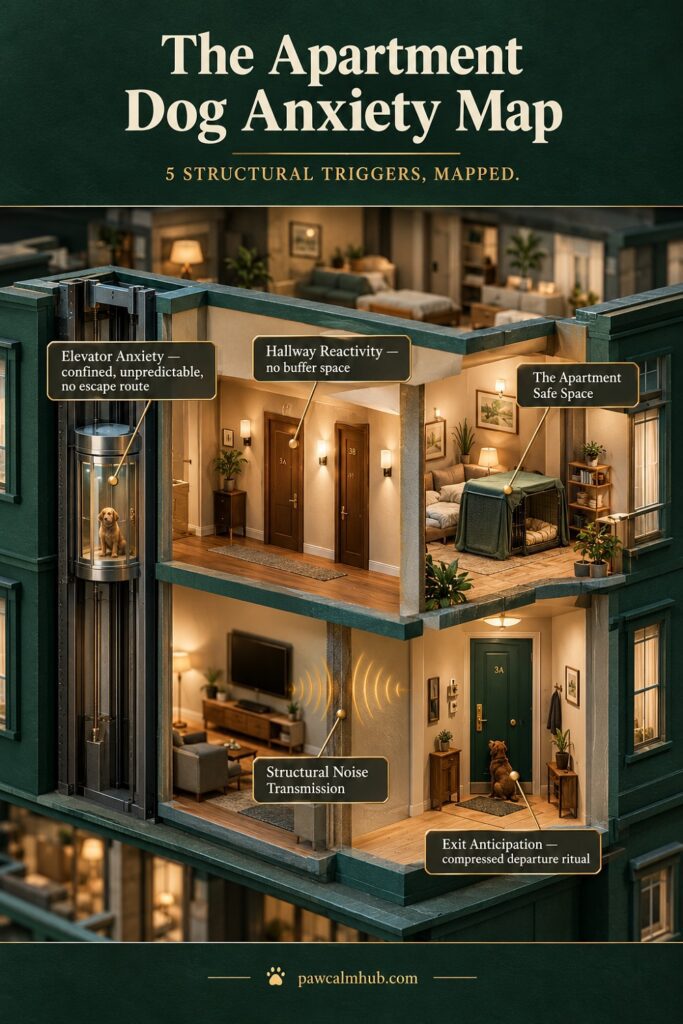
The Apartment Safe Space — What Changes When You Have No Room to Spare
The full safe room protocol assumes a dedicated interior room. In a studio or one-bedroom apartment, that assumption often doesn’t hold. Here is how to adapt it.
In a studio apartment: Designate a specific corner rather than a full room — ideally the corner farthest from the front door and any shared walls with a neighbour’s living area. A covered crate functions as a self-contained safe room within a room: cover three sides with a thick blanket, leave the front open, and place it in the identified low-traffic corner. This creates the enclosed, low-stimulus environment the safe room protocol calls for, at a fraction of the footprint.
In a one-bedroom apartment: The bedroom, when the dog is not sleeping there overnight, often makes the best safe room candidate — it typically has the fewest shared walls, is farthest from the entry sequence, and can have a door closed during high-stimulus building events (a fire alarm test, a loud neighbour, a delivery at an unusual hour).
Sound masking in thin-walled buildings: A standard white noise machine is often insufficient in buildings with poor acoustic insulation. Brown noise — a lower-frequency variant — is generally more effective at masking the specific frequency range of footsteps, plumbing, and voices through shared walls. Position the sound source between the dog’s resting area and the shared wall that transmits the most noise, rather than simply near the dog.
Crate placement strategy: In small apartments, resist the instinct to place the crate against the most convenient wall. Test multiple corners over a few days, observing which location produces the calmest resting behaviour — proximity to a shared wall with a noisy neighbour can undermine an otherwise well-designed safe space regardless of what’s inside it.
The Elevator Desensitisation Programme
For dogs showing any elevator anxiety — hesitation at the doors, trembling during the ride, refusal to enter — this structured protocol, run over approximately three weeks, produces meaningfully different outcomes than simply “getting used to it” through repeated forced exposure.
Week 1 — Lobby and door observation. Spend time in the building lobby with your dog during quiet periods, rewarding calm behaviour near the elevator doors without requiring entry. Let the dog watch the doors open and close from a comfortable distance several times daily, pairing each open-close cycle with a high-value treat.
Week 2 — Threshold and stationary car. Progress to standing just inside the elevator with the doors held open (many buildings allow this briefly), then to a very short ride of one floor with the doors opening again almost immediately. Reward heavily at each stage. If your dog shows any escalation in stress signals, hold at the current stage for additional sessions before progressing.
Week 3 — Full rides. Extend to full-floor rides during quiet periods (avoiding rush hour, when the elevator is more likely to stop repeatedly and admit strangers). A lick mat loaded with a thin layer of food and used during the ride itself provides oral motor engagement that supports parasympathetic activation exactly when it’s needed most.
Throughout the programme, timing matters as much as repetition: schedule elevator sessions during low-traffic building hours whenever possible, since an unpredictable stop that admits a stranger and their dog mid-ride can undo several sessions of careful progress in one encounter.
Managing Separation Anxiety When Your Neighbour Can Hear Everything
The core separation anxiety management principles covered in our dedicated separation anxiety guide apply fully here — but apartment living adds a monitoring and prevention layer that suburban owners can often skip.
Get accurate data before you assume the worst — or dismiss a real problem. Many apartment owners either catastrophise their dog’s alone-time behaviour without evidence, or underestimate genuine distress because they’ve never actually seen it. A smart camera with two-way audio resolves both problems at once — showing you exactly how much vocalisation is actually occurring, and allowing brief remote reassurance without an early return that reinforces the anxiety-then-owner-appears pattern.
| Option | Typical US Cost | Best For |
|---|---|---|
| Smart camera only | $50–70 one-time | Mild adjustment, monitoring without intervention |
| Midday dog walker (3x/week) | $180–300/month | Moderate distress, breaking up long absences |
| Daycare (2–3 days/week) | $400–700/month | Severe distress, high-predisposition breeds, social dogs |
Build a genuine sound buffer before you need noise complaints resolved. A white or brown noise machine running continuously during owner absence — not just during known triggers — reduces the audible transmission of the dog’s own vocalisation while also masking the hallway and building sounds that often trigger it in the first place. This double benefit is specific to apartment living: the same tool that calms your dog also protects your lease.
Sound masking during absence. As with the acoustic strategy covered in our apartment anxiety guide, brown noise — a lower-frequency variant of white noise — is generally more effective at masking the specific sounds most likely to trigger anxious vigilance during your absence: footsteps, doors, street noise, and voices through shared walls. A continuous brown noise source running throughout the workday, rather than only during known trigger windows, gives the dog a consistent acoustic baseline that makes sudden household or building sounds less jarring by comparison.
Talk to your immediate neighbours before there’s a problem, not after a complaint. A brief, friendly conversation — “I have a dog who’s working through some separation anxiety, please let me know directly if it’s ever an issue” — converts a potential formal complaint into a informal heads-up conversation in the majority of cases, and buys meaningfully more patience during the weeks a graduated departure programme takes to show results.
Does Your Dog’s Breed Make This Harder?
Some of the breeds most commonly acquired during 2020–2022 — French Bulldogs, Labrador Retrievers, and mixed-breed rescues — carry varying degrees of separation anxiety predisposition. Breeds bred for intense owner-bonding, including Vizslas, Weimaraners, and Bichon Frises, are statistically more likely to show a pronounced response to this specific transition — not because they are more fragile, but because their attachment intensity was already higher before the pandemic-era proximity pattern compounded it further.
Read the full breed breakdown: Which Dog Breeds Are Most Prone to Anxiety?
The Best Dogs for Apartments — And the Breeds That Struggle Most
For prospective apartment dog owners: exercise needs, size, and coat type are the factors most commonly discussed, but anxiety predisposition deserves equal weight given everything above.
Breeds with lower baseline noise sensitivity and lower separation anxiety predisposition — drawn from current breed anxiety research — tend to adapt more readily to apartment constraints: Basset Hounds, Greyhounds (surprisingly well suited to apartment life given their low indoor energy), and French Bulldogs among smaller breeds.
Breeds with high separation anxiety predisposition or high noise sensitivity — Vizslas, Weimaraners, Bichon Frises — present a genuinely harder apartment-living case, not because they can’t adapt, but because the structural features of apartment living (thin walls, no yard, elevator confinement) compound exactly the vulnerabilities these breeds already carry. This doesn’t mean don’t get one — it means budget more deliberately for the desensitisation and management work this guide describes.
The Urban Dog Anxiety Toolkit
Indoor foraging replaces yard exploration. A snuffle mat at mealtimes gives an apartment dog the olfactory enrichment a yard would otherwise provide passively throughout the day — arguably more important for apartment dogs than any other single tool, since it’s compensating for an entire missing category of environmental stimulation.
Cognitive engagement without square footage. A puzzle feeder produces genuine mental fatigue in a footprint of about a square foot — a critical consideration when floor space itself is limited.
Pre-departure calm engagement. A lick mat loaded and frozen ahead of time works equally well as an elevator-ride companion and a departure-moment anchor — one tool serving two apartment-specific functions.
Autonomous engagement during long owner absences. A treat dispenser toy gives an apartment dog something rewarding to do independently, without requiring the physical space a fetch session or yard exploration would need.
Talking to Your Employer About a Graduated Return
If your workplace allows any flexibility in how the return-to-office transition is scheduled, a graduated start — even two or three weeks of reduced days before the full schedule begins — gives the 8-week protocol above meaningfully more room to work before the hardest version of the transition arrives.
A short, direct request to HR or your manager is often more effective than expected. A simple version:
“I’m returning to office starting [date]. I have a dog who has never experienced a full workday alone and I’m running a structured adjustment plan to prevent separation anxiety. Would it be possible to phase in over two to three weeks — starting with two or three office days per week before moving to the full schedule? Happy to discuss how this fits with team needs.”
Many employers who introduced hybrid policies during the pandemic have already built some flexibility into RTO rollouts specifically because this exact scenario — pets, and in many households children’s schooling adjustments — was a widely anticipated friction point. Asking directly costs nothing and, where flexibility exists, can meaningfully ease both the human and canine sides of this transition.
FAQ: Apartment Dog Anxiety
Is it unfair to keep an anxious dog in an apartment?
Not inherently — but it does require more deliberate management than the same dog would need in a house with a yard. The determining factor is rarely the apartment itself; it’s whether the owner is implementing the structural adaptations this guide describes (sound masking, elevator desensitisation, indoor enrichment replacing yard access) or simply expecting the dog to cope with a mismatched environment unassisted.
My dog is fine in the apartment but panics in the elevator. Is that separate from their general anxiety?
Often, yes. Elevator anxiety is frequently a discrete situational fear rather than a symptom of generalised anxiety — many dogs who are calm at home and on regular walks show a specific, isolated fear response to the elevator’s confinement and unpredictability. Treat it with the dedicated desensitisation protocol above rather than assuming it requires the same management as broader anxiety.
My neighbours have already complained about barking. What do I do right now?
Address the immediate acoustic issue first — a sound machine running during every absence, even brief ones — while beginning the graduated departure protocol from our separation anxiety guide in parallel. A direct, non-defensive conversation with the complaining neighbour, explaining that you’re actively working on it, often buys meaningfully more patience than silence does. If the complaint has come through building management formally, ask for a reasonable timeline and update them on your progress.
Can a large dog really do well in a small apartment?
Size is a far weaker predictor of apartment suitability than energy level and anxiety predisposition. A calm, low-drive large breed frequently adapts to apartment living better than a small, high-anxiety, high-energy breed. Evaluate the dog’s actual behavioural profile rather than defaulting to size as the primary criterion.
Related reading:
- How to Build the Perfect Dog Safe Room for Anxiety
- Dog Separation Anxiety Solutions
- Which Dog Breeds Are Most Prone to Anxiety?
- Best Interactive Dog Toys for Anxious Dogs