
Estimated read time: 18 minutes | Last updated: 2025
A note on this guide: The information here references peer-reviewed veterinary and behavioural science research and is designed to help you understand and manage your pet’s anxiety. It is not a substitute for professional veterinary advice. If your pet’s anxiety is severe, sudden in onset, or accompanied by physical symptoms, please consult your veterinarian before making changes to their care.
Here is a number that should change the way you think about your pet.
72.5%.
That is the proportion of dogs — nearly three in four — who show at least one clinically significant anxiety-related behaviour, according to a landmark study of 13,700 dogs published in Scientific Reports in 2020. It is one of the largest investigations into canine behaviour ever conducted, and its finding was stark: anxiety is not an edge case in dogs. It is the norm.
Cats are not far behind — though the data is harder to collect, because cats are extraordinary at hiding distress. Feline anxiety is chronically underdiagnosed, under-treated, and almost always misread as personality rather than pathology.
Which means there is a very good chance that right now, as you read this, your pet is carrying more anxiety than you realise.
This guide exists to change that. Not with a list of five quick tips. Not with a product recommendation disguised as advice. With a genuine, thorough, science-referenced resource that walks you through everything — what anxiety actually is in dogs and cats, why it happens, how to recognise it in all its forms, and how to build a real management plan that addresses the cause, not just the symptoms.
There is a lot here. That is intentional. Pet anxiety is not simple, and you deserve a resource that treats it seriously.
What Is Pet Anxiety? The Definition That Actually Helps
The clinical definition of anxiety in animals is a state of apprehension or fear produced by anticipation of a real or imagined threat. That last part — imagined threat — is important. It explains why a dog can be terrified of a thunderstorm that causes no physical harm, or why a cat can spend three months hiding from a piece of furniture that was moved two feet to the left. The threat is neurologically real to them, even when objectively nothing is wrong.
Anxiety in pets involves the activation of the hypothalamic-pituitary-adrenal (HPA) axis — the biological stress-response system that releases cortisol, elevates heart rate, and prepares the body for fight, flight, or freeze. In short, acute bursts, this system is healthy and protective. The problem comes when it becomes chronic — when the HPA axis is running elevated day after day, week after week, because the perceived threat never fully resolves.
Chronic anxiety has measurable physical consequences: suppressed immune function, elevated blood pressure, gut dysregulation, and accelerated cellular ageing. An anxious pet is not just an unhappy pet. They are a physically compromised one.
It is also worth distinguishing three terms that are often used interchangeably but mean different things:
Fear is an immediate response to a specific, present stimulus. Your dog hears a firework and bolts under the bed. That is fear — acute, triggered, and time-limited.
Anxiety is anticipatory. It is dread of something that has not happened yet, or generalised unease with no identifiable trigger. A dog who begins pacing an hour before their owner typically leaves for work is not responding to the departure — they are anxious about it.
Phobia is an extreme, disproportionate fear response to a specific stimulus. Thunderstorm phobia is the most documented example in dogs — a response so severe it can include self-injury, house destruction, and cortisol levels that spike over 200% above baseline during a storm event.
Understanding which of these your pet is experiencing matters enormously for choosing the right management approach.
The 7 Types of Pet Anxiety — Which One Does Your Pet Have?
Pet anxiety is not monolithic. There are distinct types, each with different triggers, different presentations, and different optimal management strategies. Most pets with anxiety disorders experience more than one type simultaneously — which is one reason why single-product solutions so rarely work.
1. Separation Anxiety The most prevalent form. Affects an estimated 17–29% of dogs and a significant proportion of cats, though feline separation anxiety is dramatically underdiagnosed because cats express it differently from dogs. Dogs with separation anxiety typically exhibit destructive behaviour, vocalisation, and house soiling exclusively in the owner’s absence. Cats may over-groom, refuse food, or simply become withdrawn in ways owners attribute to independence rather than distress.
Read more: Dog Separation Anxiety Solutions and Cat Separation Anxiety
2. Noise Phobia Research indicates that noise sensitivity affects approximately 32% of dogs, with fireworks being the most common trigger, followed by thunderstorms. The response to thunder is complicated by the fact that dogs may be reacting not just to sound but to changes in barometric pressure, static electricity in the air, and the electromagnetic charge of the environment — factors that are impossible to mask with sound-blocking alone.
Read more: How to Help a Dog With Fireworks Anxiety and How to Calm a Dog During Thunderstorms
3. Situational Anxiety Fear and anxiety triggered by specific contexts: vet visits, car travel, grooming, boarding, or being left in an unfamiliar environment. Situational anxiety is often missed because pets are calm in all other contexts — owners conclude their pet is “basically fine” except for these specific situations, when in fact those situations represent significant psychological distress events.
Read more: Dog Car Anxiety and How to Reduce Cat Stress at the Vet
4. Social Anxiety Studies indicate that around 17% of dogs show fear of unfamiliar dogs, and approximately 15% show fear of strangers. Social anxiety is particularly common in dogs who missed the critical socialisation window (3–14 weeks), in rescue animals with trauma histories, and in certain breeds with genetic predispositions toward fearfulness.
5. Generalised Anxiety Disorder Some pets are anxious without any identifiable trigger. They exist in a state of chronic apprehension — scanning the environment, unable to fully rest, reactive to minor stimuli that wouldn’t register in a neurotypical pet. Generalised anxiety disorder typically requires a multi-modal management approach including veterinary assessment for medication, because environmental management alone is rarely sufficient.
6. Illness and Pain-Induced Anxiety One of the most commonly missed forms. Pain is a primary anxiety driver — a pet who is hurting is a pet who is frightened and physiologically stressed. New-onset anxiety in a previously calm animal, or sudden worsening of existing anxiety, should always prompt a veterinary examination to rule out an underlying medical cause before any behavioural intervention begins.
Read more: Senior Dog Anxiety — senior pets are particularly prone to pain-driven anxiety from arthritis and cognitive changes.
7. Age-Related Anxiety (Cognitive Dysfunction Syndrome) Dogs and cats can develop a condition comparable to dementia in humans — Canine or Feline Cognitive Dysfunction Syndrome — characterised by disorientation, disrupted sleep-wake cycles, and a new onset of anxiety behaviours in old age. Recognising this as a medical condition, not a behavioural problem, is essential. It is treatable.
Read more: Why Is My Dog Anxious at Night? — night-time anxiety is a hallmark early sign of cognitive dysfunction in senior pets.
Free US shipping · 30-day guarantee
Signs Your Dog Is Anxious — The Full Symptom Spectrum
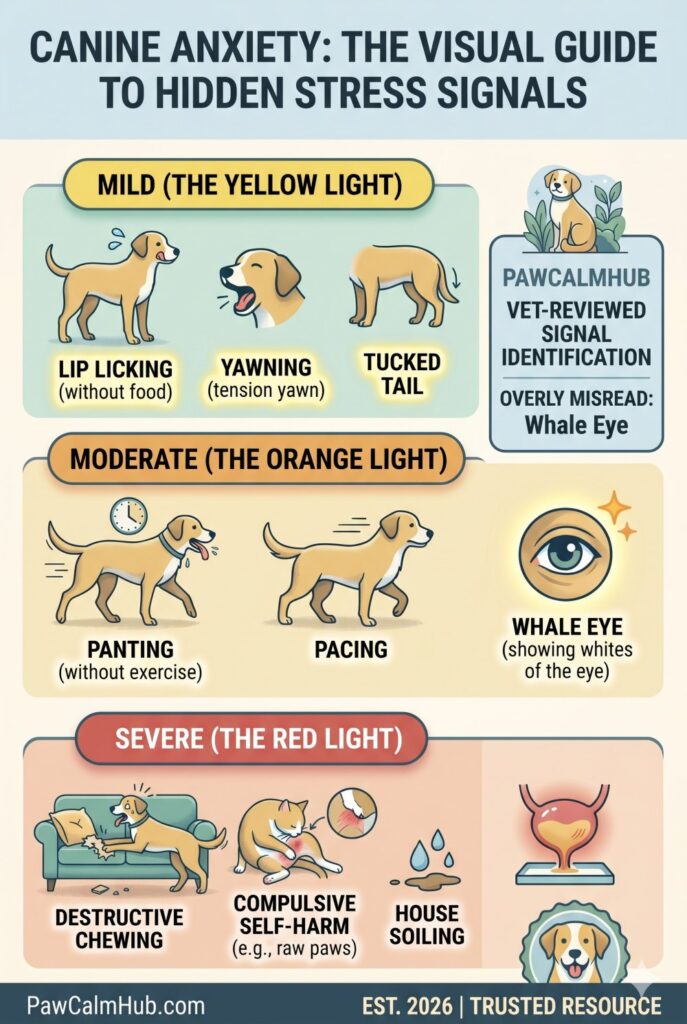
Because dogs cannot communicate verbally, they communicate anxiety through body language and behaviour. The problem is that many of the signals are subtle, easily misread, or mistakenly attributed to disobedience, stubbornness, or “bad behaviour.”
The following is a tiered breakdown from mild to severe. It is worth reading the entire spectrum, because chronic mild anxiety is often more damaging over time than acute severe anxiety — it simply accumulates beneath the owner’s awareness.
Mild Anxiety Signals — Easy to Miss
- Yawning in contexts where the dog is not tired
- Lip licking or nose licking without food present
- Turning the head away from a stimulus
- Blinking slowly or squinting
- Lowered body posture, weight shifted backward
- Tail tucked or carried low — not wagging
- Ears pinned back or flattened
- Panting at room temperature with no recent exercise
- Sudden “scratch” when asked to do something — displacement behaviour
Moderate Anxiety Signals — Noticeable but Often Rationalised
- Pacing or restlessness — unable to settle in one place
- Whining, whimpering, or low-level vocalisation
- Excessive attention-seeking — following owner from room to room
- Refusal to eat in contexts that previously caused no issue
- Trembling or shivering without cold temperature
- Increased startle response to minor stimuli
- Destructive behaviour, specifically chewing — often around exit points (doors, windows)
- House soiling in a housetrained animal
Severe Anxiety Signals — Requires Veterinary Attention
- Escape attempts — breaking through barriers, destroying crates
- Self-harm — excessive licking to the point of open sores, hair loss
- Redirected aggression — snapping at owners during an anxiety event
- Complete food refusal lasting more than 24 hours
- Inability to be left alone for even minutes without a full anxiety response
- Vomiting or diarrhoea consistently linked to anxiety triggers
One sign worth highlighting specifically because it is so often missed: “whale eye.” This is when a dog turns their head away from a stimulus but keeps their eyes on it, exposing the whites of the eye in a wide, crescent shape. It is one of the clearest signals of fear and discomfort in dogs, and the vast majority of owners have no idea it exists.
Read more: Puppy Anxiety Guide — anxiety signals in puppies have some important differences from adult dogs and deserve separate attention.
Signs Your Cat Is Anxious — What Most Owners Miss
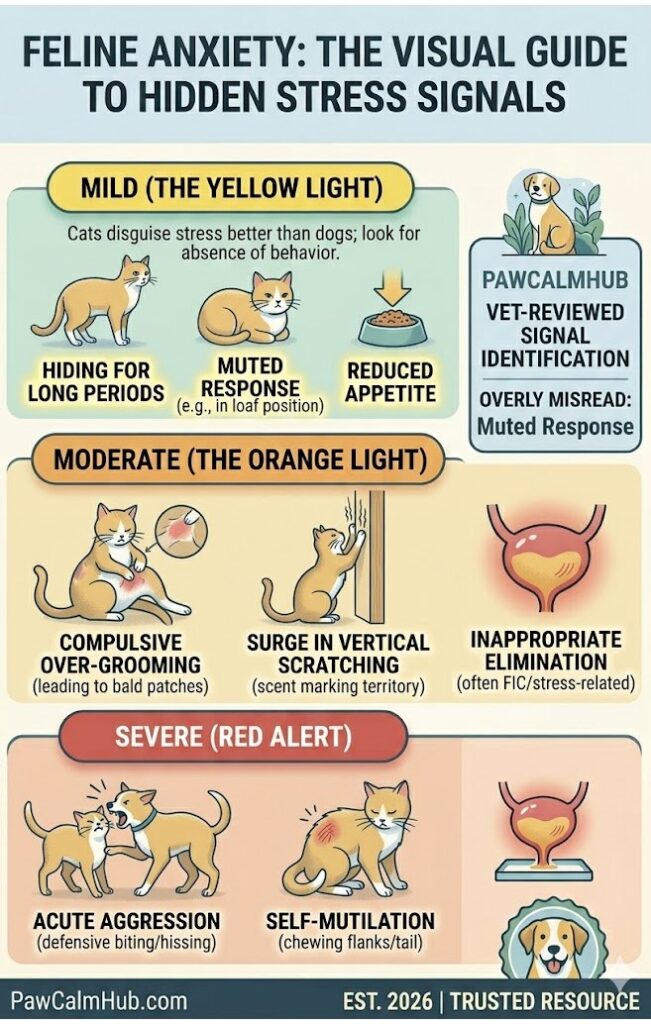
Cats are masters of behavioural concealment. Showing vulnerability is a survival risk for a small predator who is also prey — so cats have evolved to mask distress with extraordinary efficiency. By the time most cat owners recognise that something is wrong, the anxiety has typically been present for weeks or months.
The Signs Owners Commonly Miss:
Hiding more than usual. A cat who has started spending the majority of their time under the bed, in a wardrobe, or in any space that minimises their visibility is communicating that the environment feels unsafe. This is not introversion. It is active threat-avoidance.
Over-grooming. Compulsive licking — particularly on the flanks, belly, and inner thighs — is one of the most common physical manifestations of feline anxiety. The repetitive motor behaviour provides a self-soothing function, but it causes hair loss and, eventually, open sores. Many owners attribute bald patches to allergies and treat the symptom for months without addressing the cause.
Inappropriate elimination. A cat who begins urinating outside the litter tray after years of perfect use is almost certainly communicating distress, not defiance. Feline idiopathic cystitis — stress-triggered bladder inflammation — is directly linked to chronic psychosocial anxiety and produces painful, urgent urination that cats often associate with the litter tray itself, leading them to avoid it.
Reduced appetite or altered eating patterns. Anxiety suppresses appetite in cats. A cat eating less, eating more rapidly than usual, or showing sudden food pickiness deserves attention.
Increased vocalisation — especially at night. Excessive meowing, yowling, or crying — particularly after dark — can indicate anxiety, pain, or the early stages of cognitive dysfunction.
Changes in interaction. Both increased clinginess AND increased withdrawal can signal anxiety. A cat who has become unusually demanding of contact may be seeking reassurance. A cat who has stopped seeking contact from a previously affectionate baseline has retreated into protective self-containment.
Read more: Signs of Cat Anxiety — the comprehensive guide to feline anxiety symptoms, including the ones most commonly misattributed to personality.
Read more: How to Calm an Anxious Cat — practical calming strategies for cats across all anxiety types.
Root Causes of Pet Anxiety — The Science Behind the Fear
Understanding why your pet is anxious is not just intellectually useful — it is practically essential, because the most effective interventions target the cause rather than the symptom.
Genetics and Breed Predisposition
Anxiety is significantly heritable in both dogs and cats. The Finnish genome study that produced the 72.5% anxiety prevalence figure also found that specific anxiety traits cluster in specific breeds. Noise sensitivity was most prevalent in Lagotto Romagnolos, wheaten terriers, and mixed-breed dogs. Fearfulness was highest in Spanish water dogs and Shetland sheepdogs. Generalised anxiety was notably elevated in herding breeds, whose selective breeding for environmental sensitivity and responsiveness appears to have simultaneously selected for heightened emotional reactivity.
This genetic component does not mean that breed-predisposed dogs are destined for anxiety — it means they have a lower threshold, and that management needs to be proportionally more proactive.
The Critical Socialisation Window
In dogs, the window between approximately 3 and 14 weeks of age is a neurologically sensitive period during which the brain is primed to form associations about what is safe and what is threatening. Puppies who receive inadequate positive exposure to the full range of people, animals, environments, sounds, surfaces, and handling during this window are significantly more likely to develop anxiety disorders as adults.
This is why dogs from puppy mills, dogs born during lockdowns, and dogs who spent extended time in kennels during early puppyhood are disproportionately represented in anxiety disorder populations.
Trauma and Rehoming
Rescue and rehomed animals carry the neurological imprint of previous experiences — abandonment, abuse, neglect, extended kennel stays. These experiences are not simply forgotten when a loving home is provided. They reshape the nervous system’s baseline threat sensitivity in ways that require patient, consistent management over months and sometimes years.
Read more: Natural Remedies for Dog Anxiety — particularly relevant for rescue animals where owner preference is to support the nervous system without pharmaceutical intervention.
Household Changes and Disruption
Pets are exquisitely sensitive to changes in their routine and environment. Moving house, the arrival of a new baby, a change in the owner’s work schedule, the loss of a companion animal, a new pet joining the household — all of these can trigger or worsen anxiety in animals who were previously well-adjusted. The disruption does not need to be dramatic. Even moving furniture can temporarily destabilise a cat’s sense of territorial security.
Medical Causes
Any condition that causes pain, hormonal disruption, or neurological change can produce anxiety symptoms. Hyperthyroidism in cats is a classic example — it produces restlessness, vocalisation, and hyperreactivity that are often attributed to anxiety before the thyroid condition is diagnosed. Arthritis, dental disease, undiagnosed gastrointestinal conditions, and cognitive dysfunction all produce secondary anxiety. This is why a veterinary examination should always precede behavioural intervention.
The Gut-Brain Connection
Emerging research — particularly in canine gastroenterology and microbiome science — is revealing that the gut microbiome plays a significant role in mood and anxiety regulation in dogs. Approximately 90% of serotonin is produced in the gastrointestinal tract, not the brain. Chronic gut dysregulation — from poor diet, antibiotics, stress itself — may directly contribute to anxiety symptoms through disrupted neurotransmitter production. This is an area to watch, and one that points toward diet and gut health as meaningful components of a comprehensive anxiety management plan.
Subscribe & save 15% · Free US shipping
The 5-Tier Treatment Ladder for Pet Anxiety
There is no single solution for pet anxiety. What works depends entirely on the type of anxiety, its severity, the individual animal, and the owner’s capacity for consistent implementation. The following framework moves from least to most intensive intervention — most pets with mild to moderate anxiety can be effectively managed within the first three tiers.
Tier 1: Environmental Management
The foundation of any anxiety management plan. Before any product or supplement, the environment needs to support calm rather than undermining it.
Routine and predictability are among the most powerful calming forces available to a pet owner. Dogs and cats with anxiety thrive on knowing what will happen and when. Feed at the same time. Walk at the same time. Maintain consistent wake and sleep schedules. Routine reduces the cognitive load of anticipatory anxiety — the pet who knows what is coming next has less to dread.
A safe space — a room, a crate, a covered bed in a low-traffic corner — gives an anxious pet somewhere to retreat that belongs to them, where they are never approached against their will and where positive associations are consistently built. This is not indulging anxiety. It is providing the neurological equivalent of a pressure valve.
Sound management for noise-sensitive pets: white or brown noise machines to mask unpredictable sounds, blackout curtains to remove lightning flashes, and strategic placement away from external-facing walls during storm season.
Tier 2: Behavioural and Enrichment Tools
Mental and physical stimulation are not optional additions for anxious pets — they are core management tools. An under-stimulated anxious animal has no outlet for their arousal. A well-stimulated one has a nervous system that is regularly brought back to calm through productive engagement.
Nose work and foraging are the highest-ROI anxiety interventions available without a prescription. Olfactory engagement activates the seeking system of the brain — a neurological state that is fundamentally incompatible with the anxiety response. A dog working a snuffle mat is not an anxious dog in that moment.
The snuffle mat for anxious dogs turns every meal into a foraging session, producing the mental fatigue that physical exercise alone cannot replicate.
Slow feeding and licking activate the parasympathetic nervous system through oral motor activity. Licking specifically produces a measurable reduction in cortisol — it is self-soothing at a biological level. A lick mat for dog anxiety loaded with peanut butter, wet food, or yoghurt can transform a high-anxiety context — the vet waiting room, the car journey, the grooming session — into a manageable one.
Cognitive challenge through puzzle feeding addresses the boredom-anxiety loop that affects high-drive dogs in under-stimulating environments. The dog puzzle feeder for anxious dogs turns feeding into problem-solving, producing satisfaction rather than restlessness.
Physical exercise remains, despite everything, the single most effective free anxiety intervention available. A dog who has had adequate physical exercise has a measurably lower cortisol baseline than a dog who has not. For owners who find high-intensity play difficult to maintain, an automatic dog ball launcher — or a larger version for bigger breeds — allows the dog to self-exercise without requiring constant owner engagement.
For cats, predatory play serves the same function. The cat tumbler toy ball supports independent predatory play — critical for indoor cats whose anxiety is partly driven by frustrated hunting instinct.
Tier 3: Calming Products
Physical and supplemental tools that target the anxiety response directly, without requiring veterinary prescription.
Anxiety pressure vests apply gentle, constant pressure to the dog’s torso, activating the parasympathetic nervous system through deep-touch pressure stimulation — the same mechanism behind weighted blankets in humans. A 2013 open-label trial found that 89% of owners reported at least partial effectiveness for thunderstorm anxiety after five uses of an anxiety wrap.
The critical word is before. Anxiety vests work by preventing physiological escalation, not reversing it. Apply the dog anxiety vest 15–20 minutes before a known trigger — not during the panic.
Self-warming beds support thermoregulation, which directly affects the autonomic nervous system. Cold activates the sympathetic (stress) system. Warmth activates the parasympathetic (calm) system. A self-warming dog anxiety bed provides passive parasympathetic support around the clock — it is calming infrastructure rather than a calming intervention.
Remote monitoring allows owners to observe and respond to anxiety without physically intruding. A video camera with pet feeder lets you check on your pet during separations and use two-way audio to offer reassurance — without the return home that accidentally trains a dog that anxiety produces the owner’s reappearance.
Grooming as a calming tool is underutilised by most owners. Tactile stimulation releases oxytocin in both pet and owner. For anxious animals resistant to traditional grooming, the grooming glove for anxious dogs provides a gentler, less threatening point of entry — and the quiet dog nail grinder for anxious dogs eliminates the sharp clip sound that makes nail care so distressing for sound-sensitive animals.
Read more: How to Groom an Anxious Dog at Home — a step-by-step desensitisation protocol for grooming-resistant dogs.
Tier 4: Supplements and Calming Chews
A growing body of research supports the use of specific supplements for canine and feline anxiety. The most evidence-supported options:
Hemp-derived CBD interacts with the endocannabinoid system — a regulatory network present in both dogs and cats — and has shown promise in several preliminary studies for reducing anxiety scores in dogs. Quality, dosing, and sourcing matter significantly. The hemp calming chews for dogs should be given 30–45 minutes before a known trigger for situational anxiety, or daily for generalised anxiety management.
Read more: Do Calming Chews Work for Dogs? — an honest, evidence-referenced look at what the research actually shows.
L-theanine (an amino acid found in green tea) has shown anxiolytic effects in both human and animal studies. Alpha-casozepine (derived from milk protein) has a growing evidence base in cats and dogs. Valerian root is commonly included in calming formulations with moderate supporting evidence.
A consistent finding across supplement research: multi-ingredient formulations that combine several active compounds tend to outperform single-ingredient products, likely because they act on multiple anxiety pathways simultaneously.
Always discuss supplementation with your veterinarian, particularly if your pet takes any other medication.
Tier 5: Veterinary Intervention
For pets with moderate to severe anxiety disorders — particularly generalised anxiety, severe separation anxiety, or anxiety that has not responded to consistent tier 1–4 management — veterinary intervention offers options that are not available through environmental management alone.
SSRIs and tricyclic antidepressants (fluoxetine, clomipramine) are FDA-approved for use in dogs with separation anxiety and are used off-label for other anxiety disorders. They work by increasing serotonin availability in the brain over 4–8 weeks and are most effective when combined with a behavioural management programme.
Situational medications (trazodone, gabapentin, alprazolam) are prescribed for specific high-anxiety events: vet visits, thunderstorms, fireworks, travel. These must be administered before the event — typically 1–2 hours prior — to be effective.
Veterinary behaviourists — specialists with post-doctoral training in animal behaviour and psychopharmacology — are the highest level of clinical resource available for complex anxiety cases. Finding one may involve a referral from your primary vet and a waiting list, but for severe cases the outcome difference is significant.
When to See a Vet — The Non-Negotiable Signs
While much of what is described in this guide can be implemented at home, there are situations where veterinary assessment is not optional — it is the first step, not the last resort.
Contact your veterinarian if:
- Anxiety is new in onset, particularly in a pet over 7 years old
- Anxiety is accompanied by physical symptoms — vomiting, diarrhoea, weight loss, excessive thirst or urination
- Your pet is injuring themselves — open sores from licking, broken nails from scratching, injuries from escape attempts
- Anxiety is producing aggression that poses a safety risk to people or other animals
- Your pet has not eaten for 48 hours or more
- A previously well-managed anxiety disorder is suddenly and significantly worsening
- Your pet shows signs of extreme fear that do not resolve after the triggering stimulus is gone
None of these are situations for patient observation. They require professional assessment, and in most cases, the sooner the better.
Your 30-Day Calm-Down Plan — A Pet Anxiety Action Framework
Reading about anxiety management is useful. Having a structured plan to implement it is what actually changes things. Here is a four-week framework you can begin immediately.
Week 1: Identify and Document
Before changing anything, spend the first week observing and recording. What are your pet’s specific anxiety triggers? What time of day is anxiety worst? Which signals do you see first — the earliest warning before escalation? Rate anxiety on a 1–10 scale each day. This baseline becomes your comparison point for weeks 3 and 4.
Simultaneously, book a veterinary appointment if you haven’t had one in the last 6 months, or if anxiety is new or worsening. Rule out medical causes before attributing everything to behaviour.
Week 2: Build the Foundation
Implement the tier 1 interventions this week. Lock in a consistent daily routine. Set up a dedicated safe space. Introduce a snuffle mat at mealtimes and a lick mat during one previously high-anxiety context. If your pet is noise-sensitive, begin using a white noise machine. If separation anxiety is present, begin very short departures — 30 seconds — and return before anxiety escalates. The goal this week is infrastructure, not results.
Week 3: Add Tools
Layer in tier 2 and 3 interventions. Introduce the anxiety vest during a low-stakes positive context before attempting it during a trigger event. Begin calming chews if using them. Add the puzzle feeder for one daily meal. For dogs with separation anxiety, extend departure times very gradually — 30 seconds, then 2 minutes, then 5. Never push past the point where anxiety escalates. Progress is measured in weeks, not days.
Week 4: Assess and Adjust
Return to your week 1 baseline ratings. What has improved? What hasn’t moved? The interventions that haven’t produced any change after consistent implementation for two weeks are candidates for replacement. The interventions showing even modest improvement should be continued and built upon. If you are still rating anxiety at 7 or above consistently after four weeks of genuine implementation, this is the moment to pursue tier 4 or 5 support — not a reason to give up, but a signal that the nervous system needs more than environmental management.
The Full PawCalmHub Resource Library
This guide is the entry point. Everything below goes deeper into specific aspects of pet anxiety — each article is built around the same commitment to evidence, owner-experience, and genuine practical usefulness.
Dog Anxiety — By Type
- Dog Separation Anxiety Solutions
- How to Help a Dog With Fireworks Anxiety
- How to Calm a Dog During Thunderstorms
- Dog Car Anxiety
- Why Is My Dog Anxious at Night?
Dog Anxiety — By Life Stage and Situation
- Puppy Anxiety Guide
- Senior Dog Anxiety
- Natural Remedies for Dog Anxiety
- Do Calming Chews Work for Dogs?
Dog Grooming and Wellness
Cat Anxiety
- Signs of Cat Anxiety
- How to Calm an Anxious Cat
- Cat Separation Anxiety
- Best Calming Products for Cats
- How to Reduce Cat Stress at the Vet
Your pet cannot tell you they are struggling. But if you have read this far, they do not need to — because you are already paying the kind of attention that makes the difference.
Start with week one. Observe. Document. Build from there. Anxiety in pets is rarely cured overnight, but it is almost always improved with consistent, informed management. And that is exactly what this library is here to support.
How do I know if my pet’s anxiety is a medical emergency?
You should see a veterinarian immediately if your pet shows signs of self-harm (chewing their own tail or paws until they bleed), sudden and unexplained aggression, or extreme weight loss. In cats, refusing to eat for more than 24 hours is a critical emergency, as it can lead to fatal liver failure (Hepatic Lipidosis).
Can my pet’s anxiety go away on its own?
Generally, no. Anxiety in dogs and cats is a physiological condition involving the chronic activation of the stress response. Without environmental changes, enrichment, or behavioral modification, the “fear pathways” in the brain actually become stronger over time.
What are the most common side effects of pet anxiety medication?
While medications like SSRIs or Benzos can be life-changing, they may cause temporary lethargy, reduced appetite, or mild stomach upset during the first two weeks. Always consult your vet if you notice extreme sedation or a “zombie-like” state, as the dosage may need adjustment
Is there a difference between “fear” and “anxiety” in pets?
Yes. Fear is a reaction to an immediate, present threat (like a loud thunderclap). Anxiety is the anticipation of a threat. An anxious dog might start trembling the moment the sky turns gray, even before the first bolt of lightning appears.
Are natural calming chews as effective as prescription medication?
Natural supplements (containing Hemp, L-Theanine, or Valerian) are excellent for mild to moderate situational stress, such as car rides or grooming. However, for severe separation anxiety or generalized anxiety disorder, they are often used as a supportive tool alongside clinical treatment.
Is my anxiety making my pet’s anxiety worse?
Almost certainly, to some degree — and this is one of the most important and least-discussed aspects of pet anxiety management. Dogs in particular read human physiological states with extraordinary precision. They detect changes in cortisol levels through smell, read heart rate variability through proximity, and interpret the subtle shifts in your movement speed, voice pitch, and breathing pattern that you are not consciously aware of producing. Research has documented cortisol synchrony between owners and their dogs — meaning owner and dog stress hormones rise and fall together over time. Managing your own anxiety around your pet’s triggers is not a soft suggestion. It is a clinical recommendation.
Are certain breeds naturally calmer and less prone to anxiety?
Yes, with the caveat that individual variation is significant within every breed. Breeds consistently associated with lower anxiety predisposition include the Basset Hound, Greyhound, Bernese Mountain Dog, and Maltese — all bred for characteristics that favour emotional steadiness. That said, any dog regardless of breed can develop anxiety given the right combination of genetics, early experience, and environment. Breed predisposition sets the threshold — it does not determine the outcome.
My dog is only anxious when I leave. Is that really separation anxiety or just a habit?
If the behaviour occurs exclusively or primarily in your absence — vocalisation, destruction, house soiling, or distress signals captured on a camera — and stops when you return, that is separation anxiety by definition, not a habit. The distinction matters because habits can be managed with training alone; separation anxiety requires a structured desensitisation protocol and, in moderate to severe cases, veterinary support. A camera is the single most useful diagnostic tool here — most owners are shocked by what their dog does the moment the door closes. Read more: Dog Separation Anxiety Solutions
Can a dog or cat have anxiety without showing obvious signs?
Yes — and this is one of the most important things to understand about feline anxiety in particular. Cats have evolved to conceal vulnerability so effectively that owners frequently miss months of significant distress. The only behavioural change may be slightly reduced appetite, marginally more time spent in one resting spot, or a subtle shift in interaction frequency — none of which registers as anxiety to most owners. For dogs, the subtle end of the anxiety spectrum — the yawning, the lip-licking, the weight shift backward — is consistently missed until anxiety escalates to more dramatic symptoms. If you suspect your pet might be anxious but aren’t sure, a veterinary behavioural consultation is the most reliable way to assess what you might be missing. Read more: Signs of Cat Anxiety
How long does it take for calming chews or supplements to work?
This depends entirely on the supplement and the type of anxiety. Situational supplements — given 30–60 minutes before a specific trigger — work acutely or not at all; you will know within the first few uses whether they are producing a measurable effect. Daily supplements targeting generalised anxiety or baseline cortisol — including many hemp-based formulations — typically require 3–6 weeks of consistent use before behavioural changes are reliably observable. If you are not seeing any effect after 8 weeks of daily use at the recommended dose, discuss alternatives with your vet.
Read more:= Do Calming Chews Work for Dogs?
My cat and dog both have anxiety. Should I manage them together or separately?
Separately, with one important overlap. Each species has a different anxiety profile, different trigger sensitivities, and different optimal interventions — what calms a dog (vigorous exercise, pressure vests, lick mats) does not translate directly to cats. Manage each animal’s anxiety on its own terms with species-appropriate tools and strategies. The overlap is environmental: a calm, predictable, low-stimulation home environment benefits both species simultaneously, and is the single intervention that serves the entire household at once
.