
Estimated read time: 18 minutes | Last updated: 2025
A note on this guide: This article references peer-reviewed veterinary gerontology, feline cognitive dysfunction research, and pain science to address the specific anxiety challenges of ageing cats. It is written with the understanding that new-onset anxiety in a cat over 8 years old is a medical signal until proven otherwise. Everything in this guide assumes that a veterinary examination has been, or will promptly be, conducted for any cat whose anxiety is new or worsening. Please do not delay veterinary assessment based on any information in this guide.
There is a particular kind of heartbreak that comes with watching a cat you have known for fifteen years become, gradually and then suddenly, a stranger to themselves.
The cat who used to sleep in confident, sprawled comfort on the sunniest windowsill now presses into the corner of the wardrobe. The cat who greeted you every morning with the same territorial assurance now wanders the hallway at 3am crying at a wall. The cat who navigated every surface of your home with the fluent athleticism of a creature who owned all of it now stands at the base of the sofa, looking up at where they used to leap, doing the calculation and finding it no longer adds up.
This is not “getting old.” This is anxiety — specific, real, physiologically driven, and in the overwhelming majority of cases, addressable.
The problem is that senior cat anxiety is one of the most under-diagnosed conditions in small animal veterinary medicine. Not because veterinarians don’t care — they do — but because the signs are subtle, the progression is slow, the owners have adapted to changes that happened too gradually to notice, and because cats, even at fifteen, are still performing the evolutionary subroutine that tells them: do not show weakness. Do not show pain. Do not show fear.
This guide is about seeing through that performance. It is about understanding what is actually happening — biologically, neurologically, and emotionally — as a cat ages, and what owners can do at each stage to reduce the anxiety that ageing produces.
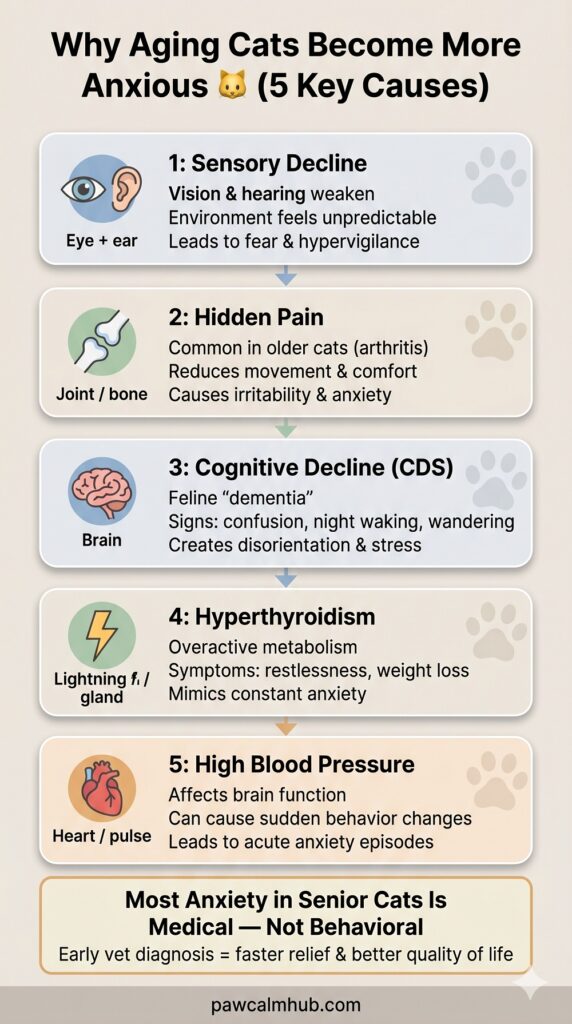
Why Ageing Cats Become More Anxious — The 5 Biological Drivers
Every form of senior cat anxiety has a biological root. Understanding the root determines the management. The following five drivers account for the overwhelming majority of late-onset anxiety in cats — and critically, most of them are addressable once correctly identified.
Driver 1: Sensory Decline — The World Becomes Less Legible
Research on age-related sensory change in cats published in the Journal of Veterinary Internal Medicine documents progressive deterioration in both visual and auditory acuity beginning in middle age (around 7–10 years) and accelerating from 12 years onward. This deterioration has direct anxiety consequences.
A cat whose vision has deteriorated no longer has reliable spatial information. Surfaces, distances, and spatial relationships that were previously navigated with automatic precision now require conscious processing — and sometimes produce miscalculation. A cat who misjudges a jump does not conclude that their vision has changed. They conclude that the surface is unpredictable and that the environment cannot be trusted. The anxiety of spatial unreliability is a real and consistent feature of visually declining cats.
Auditory decline produces a parallel anxiety through a different mechanism: the cat who cannot hear clearly cannot monitor the environment for threats. A cat who relied on hearing to detect approaching animals, visitors, and household changes now faces an environment that produces sudden, unheralded stimuli — because their early warning system has been progressively deactivated. The resulting hypervigilance — compensating for reduced auditory input with elevated scanning and threat-vigilance — produces chronic anxiety.
Driver 2: Pain — The Most Overlooked Anxiety Driver of All
Research published in the Journal of Feline Medicine and Surgery documents that osteoarthritis affects more than 90% of cats over 12 years of age — and that it is identified at routine veterinary consultation in fewer than 30% of affected cats. The gap between prevalence and diagnosis reflects how effectively cats mask pain — and how consistently owners and veterinarians miss it.
Pain-driven anxiety is not the same as pain-expression. A cat in chronic arthritic pain does not typically yelp, limp dramatically, or show the obvious discomfort signals that dogs exhibit. They show:
- Reluctance to use previously favourite elevated resting spots
- Changes in grooming patterns — either reduced (hard to reach areas) or increased (licking at painful joints)
- Altered litter tray use — entering less frequently, posturing differently inside, or avoiding entirely if entry requires a step or jump
- New interpersonal grumpiness — less tolerance for handling, less interest in social interaction, occasional hissing at previously accepted contact
Every one of these signs is commonly attributed to “getting old” or “becoming grumpy” rather than to its actual cause: an animal in constant pain who has no way of telling you and has simply stopped attempting to access things that hurt to access.
Pain-driven anxiety is the most important diagnosis to make in a senior cat showing new anxiety behaviours — because it is the one with the most immediate, direct, and life-quality-changing treatment available. A cat whose chronic pain is adequately managed by veterinary anti-inflammatory medication will show anxiety improvement within days that months of environmental management cannot produce.
Driver 3: Feline Cognitive Dysfunction Syndrome (CDS) — The Dementia No One Talks About
Feline Cognitive Dysfunction Syndrome is the cat equivalent of Alzheimer’s disease — a progressive neurodegenerative condition characterised by the accumulation of amyloid plaques and tau protein tangles in feline brain tissue, producing measurable cognitive decline.
Research published in the Journal of Veterinary Internal Medicine documents that CDS affects approximately 28% of cats aged 11–14 years and more than 50% of cats over 15 years. Despite this prevalence, it remains dramatically under-diagnosed in general practice — with many owners and veterinarians attributing the signs to normal ageing.
The DISHA framework, used by veterinary behaviourists to assess CDS, covers five domains:
Disorientation: getting stuck in corners, appearing lost in familiar rooms, staring at walls or into space
altered Interactions: reduced social interest, or conversely, increased clinginess and social demand in a previously independent cat
Sleep-wake cycle disruption: sleeping more during the day, waking and vocalising repeatedly through the night
House soiling: inappropriate elimination in previously reliably litter-trained cats
Activity changes: decreased exploration and play, increased aimless wandering
CDS is a medical diagnosis that requires veterinary assessment — and it is partially treatable. Selegiline (Anipryl) — a monoamine oxidase inhibitor used in human Alzheimer’s management — is licensed for use in cats in some jurisdictions and has shown documented benefit in reducing CDS symptoms. Environmental management (consistent routine, nightlights, ramps) significantly improves quality of life for CDS-affected cats.
Driver 4: Hyperthyroidism — The Anxiety Masquerading as Personality
Hyperthyroidism is the most common endocrine disorder in cats over 10 years — affecting approximately 10% of senior cats — and produces a clinical picture that is almost indistinguishable from anxiety disorder: restlessness, vocalisation, hyperactivity, weight loss despite increased appetite, and an overall demeanour of agitated urgency.
Many hyperthyroid cats are managed behaviourally for months before the thyroid diagnosis is made — because their anxiety-like presentation is so convincing and because the physiological cause is not considered without a blood test. Any senior cat presenting with new anxiety behaviours — particularly if accompanied by weight loss and increased appetite — should have thyroid function tested as a first-line investigation.
Hyperthyroidism is highly treatable. Medical management with methimazole or carbimazole, radioiodine therapy, or surgical thyroidectomy produces rapid and sustained anxiety resolution in the majority of cases — because the anxiety was never behavioural in origin.
Driver 5: Hypertension — When Blood Pressure Reaches the Brain
Systemic hypertension — high blood pressure — is common in senior cats, frequently secondary to chronic kidney disease or hyperthyroidism. Research from the International Society of Feline Medicine documents that hypertension affects approximately 65% of cats with chronic kidney disease and 87% of hyperthyroid cats.
Hypertension produces neurological effects — including sudden changes in behaviour, anxiety, and in severe cases, seizures — through its effects on cerebral blood flow. A hypertensive crisis can produce sudden-onset dramatic anxiety, apparent confusion, and what looks like a psychiatric episode in a previously stable cat. Regular blood pressure monitoring — increasingly recommended as a routine part of senior cat wellness checks from age 9 onward — is the only way to detect and treat this driver before it produces crisis.
The Age-by-Age Anxiety Guide
Age 7–10: The Early Senior Years — Building the Foundation
The International Cat Care guidelines classify cats as “mature” from age 7 and “senior” from age 11. The 7–10 year window is when the biological changes that drive late-life anxiety begin their gradual, often imperceptible, progression — and when intervention has the greatest return on investment.
What changes in this window:
Lens opacity begins in the eye, reducing visual acuity in low-light conditions first. Hearing at the high-frequency end of the range begins to decline. Joint cartilage begins showing the early changes of osteoarthritis, particularly in the spine, hips, and elbows. Sleep patterns shift — more frequent, shorter rest periods replace the long deep-sleep sessions of youth.
What anxiety looks like in this window:
Subtle. Easily missed. The cat who seems slightly less adventurous than they used to be. The cat who has stopped jumping to the top of the cat tree (early arthritic discomfort). The cat who startles more easily at sounds (early auditory hypersensitivity as the early warning system begins to degrade). The cat who seems slightly grumpier during handling than they were at five.
Environmental management priorities:
Add ramps or steps to elevated resting spots — even at age seven, the early arthritic changes in the spine can make jumping increasingly uncomfortable. The cat who stops using their favourite spot has not lost interest — they have done a pain calculation and found the current access route no longer worthwhile.
Increase environmental predictability: consistent routine, consistent furniture arrangement, consistent litter tray location. The cat whose world is becoming slightly less legible needs environmental constancy to compensate.
Begin regular veterinary wellness checks every 6 months rather than annually — this is the period when thyroid and kidney function monitoring begins to pay dividends.
Age 11–13: The Active Senior Years — Pain as the Primary Variable
This is the window in which pain becomes the dominant driver of anxiety in the majority of senior cats — and the window in which the most important clinical intervention is not behavioural management but adequate pain assessment and management.
The Pain Checklist for Senior Cats (Ages 11–13)
Use this checklist monthly. Any item showing change from the previous assessment warrants veterinary discussion.
Senior Cat Monthly Pain Assessment
A proactive tool for identifying silent discomfort
Grooming assistance — the underutilised intervention:
A cat who can no longer groom their full body is a cat in discomfort — and unmaintained coat condition produces secondary skin discomfort that compounds the arthritic pain driving the grooming decline. A grooming glove for anxious dogs — applied gently along the cat’s back, rump, and flanks — assists with the areas the arthritic cat can no longer self-groom, removes loose coat that would otherwise cause matting, and provides the oxytocin-releasing tactile stimulation that supports both cat and owner wellbeing during this phase.
Note: always work away from inflamed joints. If the cat shows any resistance to touch in a specific area, that area is likely painful — reduce pressure, and flag it for veterinary assessment.
Thermal management — the anxiety intervention that looks like comfort:
Cats with arthritis lose heat rapidly from inflamed joints. A self-warming bed — positioned at ground level or with ramp access — provides continuous passive warmth that reduces arthritic joint inflammation, lowers pain-driven anxiety, and supports the parasympathetic nervous system through the thermoregulation pathway.
For a cat who has spent their life sleeping elevated, the transition to ground-level sleeping requires a ramp — not an expectation that they will change their preferred height because it is now more comfortable. Research on feline resting height preferences documents that cats strongly prefer elevated resting spots for security reasons — a preference that does not diminish with age, even as the physical capability to achieve elevation changes. Ramps that maintain access to preferred elevated spots address the mobility problem without removing the security that elevation provides.
Shop: Self-Warming Dog Anxiety Bed — the same self-warming technology that benefits anxious dogs provides equivalent thermoregulation and passive parasympathetic support for senior cats with arthritic pain.
Litter tray accessibility — the anxiety source hiding in plain sight:
This is the recommendation that this guide makes with the most clinical conviction: if you have a cat aged 11 or older and they are not using a low-entry litter tray, change this immediately.
Arthritic cats who cannot step comfortably over a standard litter tray rim develop what behaviourists informally call litter tray anxiety — an anticipatory dread of the tray that produces avoidance, inappropriate elimination, and the associated owner frustration that further stresses the cat. The cause is not behavioural. It is physical. The tray hurts to use.
Research from the Ohio State University Indoor Cat Initiative documents that litter tray design is one of the most significant variables in inappropriate elimination behaviour in cats — and that senior cats have specific requirements that standard trays do not meet.
The recommended low-entry litter tray specification for senior cats:
- Entry height: maximum 3–4cm from floor to tray base. This is approximately the height of a thin book — achievable for even severely arthritic cats.
- Tray size: at least 1.5 times the cat’s body length — senior cats with stiff spines need to stretch to posture correctly, and a tray that is too small prevents comfortable posturing.
- Litter depth: 5–7cm — adequate for covering behaviour without requiring the sustained digging that arthritic paws find painful.
- Tray location: ground floor only for multi-storey homes. Never require stair navigation to reach the litter tray.
- Tray number: N+1 rule maintained — a single tray for a single-cat household is insufficient if the tray is not in every room the arthritic cat regularly uses.
Place the low-entry tray next to the existing tray initially — allowing the cat to choose rather than imposing a sudden change. Most arthritic cats switch to the low-entry tray within 24–48 hours without any training.
Water accessibility — the hydration-anxiety connection:
Research on feline urinary tract health documents that chronic mild dehydration is endemic in cats fed primarily dry food — and that dehydration significantly worsens the discomfort of arthritic inflammation and the cognitive symptoms of CDS. A dehydrated senior cat is an uncomfortable, cognitively impaired cat — producing anxiety through the same pathways as pain.
Increase water accessibility by:
- Placing water bowls in every room the cat frequents — not just near the food bowl (cats prefer to drink away from their food source)
- Using wide, shallow bowls — cats are whisker-sensitive and dislike narrow bowls that cause whisker contact during drinking
- Considering a water fountain — the movement of water is strongly preferred by many cats and dramatically increases voluntary water intake
- Warming food slightly (body temperature) and adding warm water to wet food — both of which increase the palatability and moisture content of every meal
For cats with CDS, placing water in multiple highly visible, easily accessible locations throughout the home prevents the dehydration that occurs when the cognitively declining cat forgets where the single water bowl is located.
Age 14+: The Geriatric Years — CDS, Quality of Life, and the Nighttime Crisis
This is the age range for which the least owner guidance exists and for which it is most urgently needed. A 15-year-old cat with CDS who is crying through the night is not suffering from a behavioural problem. They are suffering from a neurodegenerative disease that produces fear, disorientation, and the kind of existential distress that the DISHA framework captures but no framework can fully convey.
Managing the nighttime vocalisation:
The night-time crying of a geriatric cat with CDS is among the most distressing experiences for cat owners — and one of the most common triggers for end-of-life decision-making before other management options have been exhausted.
Before concluding that night-time vocalisation is intractable, ensure the following have been addressed:
Pain management: adequate veterinary pain management for arthritis produces dramatic reductions in night-time vocalisation in many cases — the cat who cries at night because they cannot find a comfortable sleeping position stops crying when comfort is achieved.
Bladder urgency: CDS affects bladder control in some cats, producing urgent, painful urges that wake the cat and produce distress vocalisation. Veterinary assessment for bladder function is appropriate.
Nightlights: a geriatric cat with deteriorating vision and CDS navigating a dark home at night is genuinely disoriented — and disorientation in a cat with CDS produces fear, not curiosity. A series of low-level nightlights along the routes from sleeping areas to litter trays and water bowls dramatically reduces nocturnal distress in visually impaired geriatric cats.
Sleeping proximity to owner: for geriatric cats with significant CDS, sleeping in close proximity to their primary attachment figure provides a cortisol-regulation benefit that no environmental management tool can replicate. If the cat has not previously slept in the bedroom, allowing access at this life stage — with a warm, low-entry ramp to accessible sleeping surfaces — is a welfare decision, not an indulgence.
CDS medication — asking the right questions:
If your cat has been assessed and diagnosed with CDS, ask your veterinarian specifically about:
- Selegiline (if available in your jurisdiction for cats)
- Dietary support — omega-3 fatty acid supplementation and antioxidant-enriched senior diets have documented modest benefit in CDS management
- S-adenosyl methionine (SAMe) — a supplement with evidence for hepatic support and modest cognitive benefit in senior cats
- Environmental enrichment appropriate to the cat’s current cognitive and physical capacity
Quality of life assessment — the honest conversation:
For geriatric cats with severe CDS, significant unmanageable pain, or multiple concurrent conditions, quality of life assessment becomes the most important clinical and ethical priority. The Ohio State University’s quality of life assessment framework for cats and the HHHHHMM Scale developed by Dr. Alice Villalobos provide structured frameworks for this assessment that can be completed at home and discussed with a veterinarian.
Anxiety in a geriatric cat that cannot be adequately managed — because the underlying causes are beyond current treatment options — is a welfare consideration that deserves honest veterinary discussion. The goal of every recommendation in this guide is quality of life. When that goal cannot be met, the most humane decision is the one made with full information and without guilt.
Read more: Signs of Cat Anxiety
Read more: How to Calm an Anxious Cat
Read more: How to Reduce Cat Stress at the Vet
Interactive Play — Adapted for Every Senior Life Stage
Play is one of the most powerful anxiety interventions available for cats of all ages — including senior cats, for whom its neurological benefit is often underestimated.
The cat tumbler toy ball provides independent predatory play that does not require jumping, sustained sprinting, or the physical demands of wand-toy play. The tumbling, unpredictable movement of the ball activates the predatory sequence — stalk, pounce, capture — at a physical intensity the cat can self-regulate. Senior cats who can no longer sustain the arousal of high-intensity play benefit from the cognitive engagement of predatory stalking even when the physical execution is slower than it used to be.
Play sessions should be timed for the cat’s highest-energy period — for most senior cats, this is in the morning and early evening. Session duration should be cat-led: end the session when the cat disengages, not at a fixed time. And the surface on which the toy is used should be non-slip — arthritic cats cannot safely pursue a toy across slippery hardwood or tile.
Shop: Cat Tumbler Toy Ball
FAQ: Senior Cat Anxiety
My 12-year-old cat started crying at night last month. What’s causing it?
New-onset night-time vocalisation in a cat aged 12 is a veterinary signal, not a behavioural problem to manage at home without assessment. The three most likely causes — in rough order of frequency — are: pain (particularly arthritic pain that becomes more apparent at night when the cat tries to settle), hyperthyroidism (which produces a restless, vocalising presentation that intensifies at night), and the early stages of CDS producing nocturnal disorientation. All three require veterinary diagnosis. All three are treatable to varying degrees. Contact your veterinarian this week rather than waiting to see if it resolves — night-time vocalisation in senior cats almost never self-resolves, and the underlying cause becomes harder to manage the longer it runs untreated.
My senior cat has stopped using the litter tray she’s used for 10 years. Why?
In a senior cat, inappropriate elimination almost always has a physical cause: the tray is now painful to enter (high entry step requiring arthritic joints to flex), the litter is painful to dig in (declawed cats find litter digging aversive), the tray requires too much travel from the cat’s primary resting areas (arthritis makes the journey prohibitive), or a urinary tract condition (FIC, kidney disease, urinary crystals) is producing urgency that the cat cannot manage to the tray in time. Implement the low-entry tray protocol described in this guide immediately. Schedule a veterinary appointment within the week. Do not assume this is a behavioural regression — it is almost always a communication about physical difficulty or discomfort
Can senior cats get depression as well as anxiety?
The scientific debate about whether cats experience depression in the way humans do is ongoing, but what is not debated is that cats show depressive-spectrum behavioural presentations — characterised by withdrawal, reduced interaction, decreased play, and flattened affect — that share physiological correlates with mammalian depression. In senior cats, this presentation is most commonly associated with chronic pain, cognitive decline, social loss (the death of a bonded companion or family member), and the accumulated effect of undertreated anxiety. Whether the label is depression or not, the welfare concern is real and the management — pain treatment, cognitive support, social engagement, and environmental enrichment adapted to the cat’s current capacity — is the same.
My senior cat has started hiding under the bed all day. Should I leave them or try to engage them?
Assess first, then act. A senior cat who has suddenly started hiding under the bed when they did not previously is communicating something. Run the pain checklist in this guide. Monitor for eating, drinking, and litter tray use. If eating, drinking, and toileting are normal, the hiding may reflect a temporary stressor (household change, visitor, noise disruption) from which the cat is self-managing. Sit near the bed and be quietly present without attempting to retrieve the cat — allow them to emerge on their own terms. If eating or drinking is absent, or if the hiding persists beyond 48 hours without any emergence, contact your veterinarian.
Is it too late to improve my 15-year-old cat’s quality of life?
No. This is perhaps the most important answer in this guide. A 15-year-old cat with inadequately managed arthritis who receives appropriate veterinary pain management will show quality of life improvement within days — not weeks, not months, but days. A 15-year-old cat whose water accessibility is improved will drink more and feel better within a week. A 15-year-old cat whose litter tray has been replaced with a low-entry tray may begin using it normally within 24 hours. The brevity of the remaining life does not reduce the value of improving its quality. Every intervention described in this guide is as relevant at 15 as it is at 11 — and the return on that investment, measured in a cat’s comfort and peace, is not diminished by how much time remains.
How do I know if my cat’s night-time anxiety is CDS or pain?
This is the question your veterinarian should answer through clinical assessment — but there are clinical indicators that help distinguish them. Pain-driven night-time vocalisation tends to occur when the cat attempts to move or reposition — the cry is triggered by movement. CDS-driven night-time vocalisation tends to be more sustained, disoriented, and apparently purposeless — the cat is crying at nothing, appearing lost, and not consoled by physical comfort. In practice, many geriatric cats have both simultaneously — which is why comprehensive geriatric assessment (including pain evaluation, neurological assessment, and thyroid and kidney function blood tests) is more useful than trying to distinguish them at home.