
Estimated read time: 19 minutes | Last updated: 2025
A note on this guide: This article draws on peer-reviewed research in feline territorial behaviour, veterinary ethology, and applied animal behaviour science. It is written for cat owners who have recently moved or are preparing to move, and for whom the standard advice of “keep them in one room” has either failed or felt insufficient. If your cat has not eaten or drunk water for 48 hours after moving, this is a veterinary emergency — please contact your vet immediately rather than continuing to read.
To understand what a house move means to a cat, you need to understand what a home means to a cat.
Not what it means to you. What it means to them.
To a human, a home is a legal address, a financial asset, a location of memories and relationships. To a cat, a home is something more fundamental and more biological: it is a olfactory territory map — a three-dimensional scent landscape built over months and years of systematic marking through cheek rubbing, head rubbing, paw scratching, and the passive deposition of individual chemical signatures on every surface the cat has contacted.
This map is not decorative. It is the cat’s primary source of psychological safety. Every surface that carries the cat’s own scent communicates, at a neurological level, the same message: this is mine, this is known, this is safe. Every surface that does not carry that scent communicates the opposite.
A house move does not just change where the cat lives. It destroys the entire scent map they have spent years constructing — and replaces it, in a single afternoon, with an environment where every surface communicates: unknown, unmapped, potentially dangerous.
The room-by-room reintroduction plan in this guide is not a management technique. It is a scent map reconstruction protocol — a systematic process for helping the cat rebuild the olfactory architecture of safety in a new environment, at a pace the feline nervous system can process without being overwhelmed.
The Science of Feline Territorial Identity
Before the protocol, the science — because understanding why cats behave as they do after a move is what makes every recommendation in this guide make sense rather than feel arbitrary.
Scent Marking and Territorial Ownership
Research on feline territorial behaviour published in Animal Behaviour documents that domestic cats maintain individual home ranges through a systematic and multi-modal scent-marking system. Bunting — the rubbing of the cheek glands against surfaces — deposits a complex mixture of proteins, fatty acids, and volatile compounds that communicate individual identity and territorial ownership. Head rubbing, body rubbing, and scratching serve the same territorial function through slightly different mechanisms.
The critical insight from this research: cats do not simply live in territory — they actively produce it through continuous chemical deposition. The territory is not a fixed location. It is an ongoing process. When the environment stops receiving the cat’s scent markers — because the cat has moved — the territory ceases to exist from the cat’s neurological perspective. They are not in unfamiliar territory. They are in no-territory: a space that carries none of the chemical signatures that constitute safety.
The Novelty-Threat Default
Research on feline neophobia published in the Journal of Feline Medicine and Surgery documents that domestic cats have a strong neophobic response — a default categorisation of novel stimuli as potentially threatening until they are investigated and found safe. This evolutionary adaptation makes sense for a small predator who is also prey: the unknown deserves caution.
In a new home, every smell, every sound, every surface, and every sight is novel. The cat’s neophobic response is therefore running at maximum intensity — a state of sustained threat-vigilance that is physiologically exhausting and psychologically devastating if allowed to persist without management.
The Range of Individual Response
Research by Buffington and Chew at the Ohio State University College of Veterinary Medicine — among the most extensive bodies of work on feline stress and environmental medicine available — consistently documents that individual cats vary dramatically in their resilience to environmental disruption. Some cats — particularly those with rich early socialisation histories and secure attachment styles — recover from a move within days. Others — particularly indoor-only cats with limited prior exposure to environmental change — may need three months to genuinely stabilise. Neither timeline is abnormal. Both reflect the cat’s individual neurological baseline interacting with a genuinely significant environmental stressor.
The 4 Anxiety Phases After a Move — What to Expect
Understanding what is developmentally normal at each stage prevents the misreading that causes owners to either panic unnecessarily or miss genuinely concerning signs.
Phase 1: The Hide (Days 1–3)
Complete concealment. The cat presses into the smallest, darkest, most enclosed space available and does not emerge for food, social contact, or investigation. Eating and toileting may be completely suspended.
This is not cause for alarm in the first 48 hours. It is the appropriate feline response to overwhelming environmental novelty — the neophobic system running at maximum intensity. The cat needs time to process the olfactory environment from the safety of a concealed position before they are neurologically ready to engage with it.
What causes harm at this stage: forcing the cat out of hiding, following them into their hiding spot, extended handling, loud household activity near the hiding location, and the introduction of unfamiliar people or animals.
What helps: silence, owner scent near (not in) the hiding spot, food and water placed close enough to be accessible without the cat needing to expose themselves.
Phase 2: The Cautious Explore (Days 4–10)
The cat begins to emerge — almost always at night when the household is quiet and visual stimuli are reduced. You may find evidence of exploration (moved objects, displaced water, a food dish that has been eaten from) without ever seeing the cat move. The cat is mapping the new environment under conditions of maximum safety: darkness, quiet, owner absence or sleep.
This is progress. Do not interrupt it. Do not leave lights on all night to “check on them.” The darkness is the point.
Phase 3: The Claim (Weeks 2–4)
Active scent marking resumes. You will observe the cat bunting furniture edges, corners, and doorframes — systematically depositing their scent signature on the new environment. Appetite returns to normal or near-normal. The cat begins appearing during daylight hours, though still primarily in lower-traffic periods.
This is the phase where the room-by-room protocol becomes active. The cat is neurologically ready to begin expanding their territory — and the protocol guides that expansion at a pace that produces confidence rather than anxiety.
Phase 4: Integration (Month 2 Onward)
Most cats reach something approximating their pre-move behavioural baseline within 6–8 weeks. Some reach it in 3–4. Some need 3 months. The integrated cat uses the full home, maintains normal appetite and toileting patterns, and shows normal social interaction with family members.
The tell-tale sign of genuine integration is not just the absence of hiding — it is the resumption of play behaviour and the return of voluntary, relaxed social approach toward the owner.
The Room-by-Room Reintroduction Protocol
This is the framework that separates this guide from every “keep them in one room and then let them out” article currently ranking for this keyword. The room-by-room protocol is not about containment. It is about sequenced scent map construction — helping the cat build their territorial olfactory architecture one room at a time, in a sequence that maximises confidence and minimises anxiety at each stage.
Step 1: The Anchor Room — Building the Foundation (Days 1–5)
Before the cat arrives at the new home — ideally, before any furniture is moved in — designate and set up the anchor room. This is the room from which all subsequent territory will be expanded.
Anchor room criteria:
- Quiet location — away from the front door, away from the room where most household activity occurs
- Small enough to feel manageable — a bedroom or study rather than an open-plan living space
- Containing all resources: food, water, litter tray, sleeping spot, and hiding option
What goes in the anchor room before the cat arrives:
- The cat’s own bedding — unwashed, carrying their familiar scent
- A litter tray — the same tray from the previous home if possible, with some of the used litter transferred (the familiar scent of their own waste is a genuine olfactory marker of territorial security)
- Food and water in familiar bowls
- The cat’s carrier, left open as a hiding option — familiar enclosed space with carrier-scent
- A worn owner garment, unwashed
The first 48–72 hours: The cat stays in the anchor room. The door is closed. The household continues normal activity elsewhere. The cat has one small, fully controllable environment to begin mapping rather than an entire unfamiliar home to be overwhelmed by.
Sit in the anchor room for 20–30 minutes twice daily — reading, working on your phone, being quietly present without directing attention at the cat. You are providing olfactory owner-presence and proximity without social demand.
Step 2: The Scent Transfer Protocol — Pre-Seeding New Rooms
This is the technique that most articles describe in a single sentence — “introduce scents gradually” — without ever explaining how to actually do it. Here is the specific method.
The sock technique:
Take a clean cotton sock and rub it vigorously along your own hands, neck, and arms. Then rub the sock along the skirting boards, door frames, and furniture legs of the room you are preparing to open next — at cat nose height (5–20cm from the floor).
You are pre-seeding the next room with owner scent before the cat enters it. When the cat investigates the new room for the first time, their olfactory system encounters familiar, safe owner-scent markers rather than a completely blank and unknown environment. The threat assessment of the new room begins from a different baseline.
The bedding rotation technique:
Take a piece of the cat’s used bedding — carrying their own scent — and place it just inside the doorway of the next room to be opened, 24 hours before you open access. The cat can smell their own scent in the adjacent space through the closed door. By the time the door opens, their individual scent signature is already present in the new territory. The first investigation is of a space that already smells, partially, like them.
The facial pheromone collection technique:
For cats who are willing to be handled: use a clean cloth to gently rub the cat’s cheek region — the primary bunting gland location — and then rub this cloth along surfaces in the room to be opened next. You are transferring the cat’s own facial pheromone to the new environment before they enter it. This is the most direct scent pre-seeding possible.
Step 3: Room-by-Room Expansion — The Sequencing Logic
Open one new room every 3–5 days, but only once the cat is showing the following indicators in the current space:
- Eating and drinking normally
- Using the litter tray without hesitation
- Moving freely through the room rather than pressing against walls or hiding
- Showing at least one episode of voluntary bunting or head rubbing on surfaces
The sequencing recommendation:
Open rooms in order of decreasing human activity, from lowest to highest. The quietest rooms first — spare bedrooms, bathrooms, a study — before the kitchen, living room, and entry hall. The cat builds territorial confidence in the easy rooms before encountering the more socially complex, higher-traffic spaces.
Each room opening:
- Perform the sock scent transfer and bedding rotation 24 hours before opening
- Open the door and allow the cat to approach and enter entirely on their own terms
- Do not carry the cat into the new room
- Place a small trail of high-value treats leading from the anchor room into the new room — scatter feeding at the threshold creates a food-pairing for the new room’s initial scent impression
- Spend quiet owner-presence time in the new room in the first 24 hours
Step 4: Resource Redistribution — Following the Cat
As each room is opened and the cat begins using it, add resources to it gradually:
- A second water station in the second opened room
- An additional resting spot in the third opened room
- A second litter tray in a different location by week three
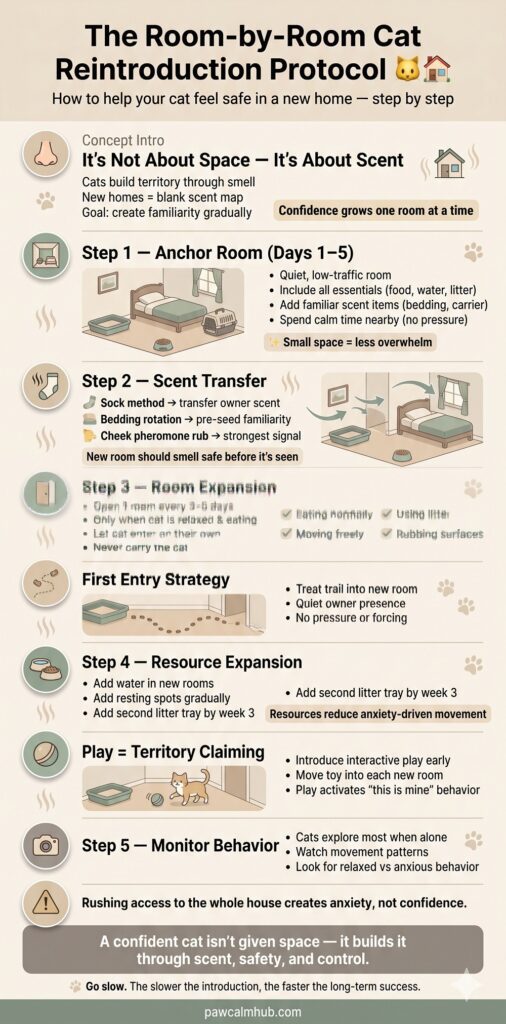
The resource redistribution serves two functions: it ensures the cat can always access basic needs without having to travel back through potentially anxiety-provoking territory, and it gives each new room a positive functional association from the moment of opening.
Using interactive play to accelerate territorial claiming:
Once the cat is eating normally and moving freely through the anchor room — typically around day five — introduce the cat tumbler toy ball in the anchor room. Interactive predatory play in a space activates the territorial claiming behaviour — a cat who has “hunted” in a space begins associating it as their own hunting ground, which accelerates the scent-marking behaviour that constitutes territorial ownership.
As each new room is opened, bring the tumbler toy into it for the first play session. The predatory play accelerates the claiming process by biologically activating the territorial instinct.
Shop: Cat Tumbler Toy Ball
Step 5: Remote Monitoring During Alone Time
Most cats make their most significant territorial exploration during owner absence — particularly working hours. A video camera with pet feeder positioned to monitor shared areas gives you accurate data on where the cat is going, how they are moving (relaxed exploration vs. anxious wall-pressing), and whether they are using the resources placed in newly opened rooms.
The two-way audio allows you to speak to the cat during periods of apparent anxiety without being physically present — a useful intermediate reassurance option that does not require you to return home and interrupt the autonomous exploration that the cat needs to do.
Securing the Garden: The Outdoor Cat’s Greatest Challenge
Scent Familiarisation
Before physical access, apply the “sock scent technique” to fence bases and furniture. Place the cat’s bedding near the back door for 24 hours so they can process the garden’s smells from a position of olfactory safety.
Supervised Short Sessions
Limit first visits to 15–20 minutes during quiet times (mid-morning). Avoid dawn and dusk—peak times for territorial neighborhood cats. Act as a calm, familiar anchor without restricting their investigation.
Physical Containment Options
- Roller-Top Fencing: Rotating battens that prevent climbing out.
- Catios: Fully enclosed structures for controlled neurological stimulation.
- Garden Netting: Cost-effective mesh for walled perimeters.
Neighborhood Intel
Observe neighboring cat activity for one week. Identify the “territorial regulars” and use commercial deterrents or citrus peels at the perimeter to reduce pressure while your cat establishes their own confidence.
Progressive Expansion
Build confidence cumulatively over 2–4 weeks. Short, anxiety-free sessions are significantly better than one long, unsupervised outing that risks a territorial confrontation and anxiety regression.
When Moving Anxiety Becomes a Medical Emergency
Two specific post-move presentations require immediate veterinary contact rather than continued management at home.
Hepatic lipidosis — the 48-hour food refusal rule:
Cats who do not eat for 48 hours or more are at risk of developing hepatic lipidosis — a form of liver disease caused by the liver attempting to process fat stores when caloric intake is insufficient. Hepatic lipidosis can develop rapidly in cats who stop eating due to stress and is potentially fatal without veterinary intervention. The Cornell University College of Veterinary Medicine documents that hepatic lipidosis is the most common severe liver disease in cats — and that stress-induced anorexia is a primary trigger.
The 48-hour rule: if your cat has not voluntarily eaten anything in 48 hours after moving, this is a veterinary emergency regardless of other behaviour. Do not wait to see if appetite returns.
Urinary obstruction from stress-induced feline idiopathic cystitis:
Chronic stress triggers feline idiopathic cystitis — inflammation of the bladder with no infectious cause — in susceptible cats, particularly male cats. FIC can progress to urinary obstruction, which is life-threatening within 24–48 hours. Signs: repeated visits to the litter tray with little or no urine produced, vocalising while attempting to urinate, blood-tinged urine, and restless pacing. Any of these signs in the context of post-move stress require same-day veterinary attention.
Read more: Signs of Cat Anxiety — the complete guide to anxiety symptom recognition in cats, including the subtle signs most commonly missed.
Read more: How to Calm an Anxious Cat
Pheromone Therapy — The Evidence Base for Moving Anxiety
Feliway Classic — a synthetic analogue of the feline facial pheromone produced during bunting — has the most extensive evidence base of any pheromone product for feline stress management. Its mechanism is directly relevant to moving anxiety: it supplements the facial pheromone markers that the cat’s own bunting produces, accelerating the process of olfactory territorial establishment in a new environment.
A double-blind placebo-controlled trial published in the Journal of Feline Medicine and Surgery found that Feliway Classic significantly reduced stress-related behaviours in cats during environmental change compared to placebo. Critically, the greatest benefit was observed in the first two weeks of use — the period when the cat’s own territorial marking is least established and the pheromone supplementation provides the greatest incremental value.
Practical use for moving anxiety:
Plug a Feliway Classic diffuser into the anchor room before the cat arrives. Move it to each new room as it is opened in the protocol, 24 hours before the cat has access. Replace the refill every 30 days. Use it for a minimum of 6 weeks — the timeline needed for the cat’s own facial pheromone deposition to establish at a density where the synthetic supplement provides diminishing returns.
Read more: Best Calming Products for Cats
My cat has been in the anchor room for a week and still won’t eat. What should I do?
If it has been 48 hours or more without any voluntary food intake, contact your veterinarian today — not tomorrow. For cats who are eating minimally but not normally at the one-week mark, try the following: warm the food slightly (body temperature amplifies olfactory appeal), offer it from your hand rather than a bowl (reduces the novelty of the feeding context), try a different texture than their usual food (pâté versus chunks, or vice versa), and place the food in the hiding spot rather than requiring the cat to expose themselves to eat. If appetite has not returned to at least 50% of normal by day 10, a veterinary check is appropriate even without the 48-hour rule being triggered.
My cat found a hiding spot inside a wall cavity/under the floor. How do I get them out?
Do not attempt to force them out. A cat in an inaccessible hiding location is safe — they found it, they can leave it. Place food, water, and a litter tray as close to the access point as possible. Sit near the opening and read quietly. Give them up to 24–36 hours. If you can smell that they have urinated or defecated in the space (indicating they are not coming out even for basic functions), contact your veterinarian for guidance on safe retrieval — this indicates a level of shutdown that warrants professional assessment.
How long should I keep my previous outdoor cat indoors after a move?
The minimum recommendation from feline behaviour specialists is 4 weeks of full indoor stabilisation before any outdoor access — and this applies to cats who were outdoor all day in their previous home. The risk of a cat who has not formed a spatial attachment to the new home running in an unfamiliar neighbourhood is that they orient toward their previous territory and are found miles away attempting to return to the old address. This is not theoretical — it is a well-documented phenomenon. Six weeks is a safer minimum for cats who were very outdoor-oriented in their previous home.
My cat has started spraying inside the new house. Is this normal?
Urine spraying — as distinct from normal toileting — is a territorial marking behaviour that increases dramatically in cats under social or environmental stress. In the context of a move, spraying is a stress response to the absence of territorial scent markers: the cat is supplementing their facial pheromone marking with urine marking because the threat-assessment of the new environment is high enough to require the more potent olfactory signal. It is normal in the sense of being a predictable response to this specific stressor. It typically resolves as the cat’s territorial confidence builds over the first 4–8 weeks. Feliway Classic diffusion significantly reduces spraying behaviour in this context. If spraying is heavy, sustained, and combined with other signs of severe anxiety, veterinary assessment is appropriate — some cats benefit from short-term anti-anxiety medication during the moving transition.
My two cats always got along but are now fighting in the new house. Why?
Moving disrupts the established social order and territorial familiarity between bonded cats in the same way it disrupts individual territorial security. Both cats are now in a space without established territorial markers — and the negotiation of shared territory in a new environment can temporarily produce inter-cat conflict between cats who were previously stable. Manage this by implementing the room-by-room protocol for both cats simultaneously in separate anchor rooms, reuniting them only once both are showing Phase 3 claiming behaviour in their respective spaces. The inter-cat tension typically resolves within 4–6 weeks as shared territorial familiarity re-establishes.
Read more: Multi-Cat Household Stress
Should I move the furniture arrangement from the old house into the new house?
Yes — to the extent possible. Familiar furniture carries the cat’s scent signature from years of contact. Moving familiar pieces into the new home provides olfactory territorial anchors that dramatically reduce the blank-slate problem of the new environment. A sofa that smells of the cat, positioned in the new living room before the cat enters it, seeds that room with a significant volume of familiar scent that accelerates the territorial claiming process. If a complete furniture recreation is not possible, prioritise the pieces the cat used most frequently — their primary sleeping furniture, their scratching post, and any upholstered furniture they regularly bunted.